

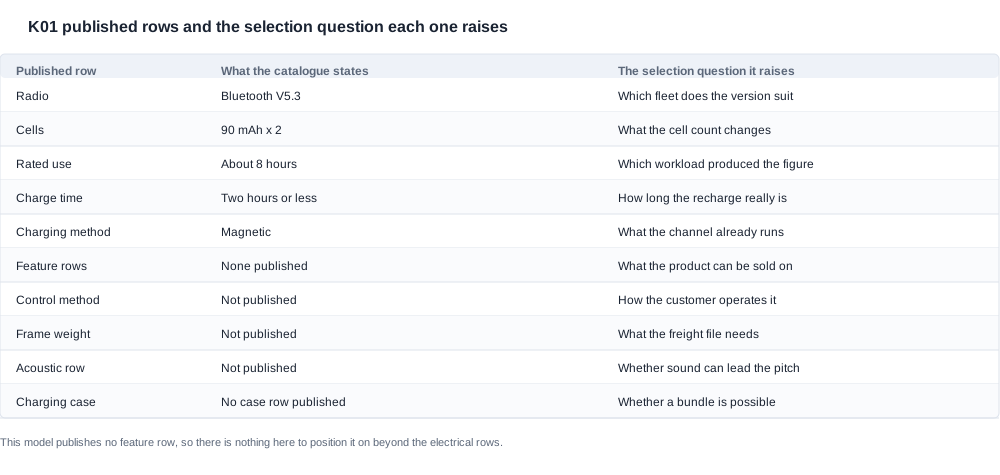
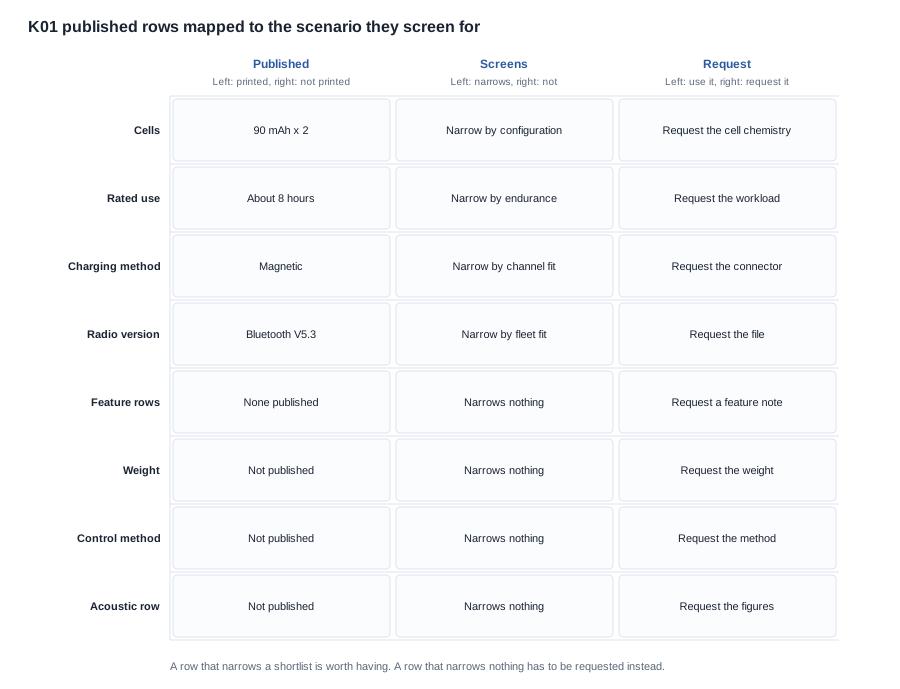
Our answer to k01 smart glasses best for is a set of conditions rather than a name, and the reason is in the published specification. Five rows and no feature rows at all is what this model has: a radio version of 5.3, a two-cell 90 mAh arrangement, a magnetic charge method, a two-hour ceiling and an eight-hour rating. On the two rows that carry the most weight in a selection, the K01 leads its group and ties with one sibling — the eight-hour figure is the highest published in the audio range, and the cell configuration is the largest published there — while on every row that would make it distinctive, the catalogue is silent. So the useful answer is not "best for X". It is: this configuration is a candidate for a shortlist whose criteria are stated in advance, and the criteria it can be judged against are the published rows plus a short list of written answers the supplier has to give.
K01 smart glasses best for: turning the question into a selection problem
A "best for" question is really a scenario question, and a scenario is made of constraints rather than of preferences. The buyer who says "what is this model best for" is usually holding a deployment in mind — a working day that has to be covered, a channel that already stocks a particular charging interface, a market that needs a radio version in the technical file — and the model that answers it is the one whose published rows survive every constraint without a footnote. That is the whole method, and it is worth saying plainly what it is not: it is not a ranking, and it does not produce a verdict, because the rows that would decide a verdict are not the rows our catalogue prints.
There is a second thing a selection method has to handle, which is the point at which this model becomes unusually delicate. The K01 and the K02 publish the same five rows. Not approximately the same — the same. Bluetooth V5.3, a two-cell 90 mAh arrangement, a two-hour charge ceiling, an eight-hour rating, magnetic charging, and not one feature row on either of the two pages. A selection built on published rows therefore cannot separate them, and a buyer who picks one of the two on the strength of the cell row has not made a selection at all; they have made a coin toss and written a justification for it. The only place a real decision can be made is in the rows neither model publishes, which is why the request list at the end of this page is the operative part of the article rather than an appendix.
We should also be clear about what a selection method cannot do in this category. We do not publish prices, so no price tier appears here and none of the groupings below is a price bracket. We do not publish a ranking, and the criteria in this article are arranged so that a reader can reach a different conclusion from the same published rows and reach it defensibly. What we do publish is the structure of the range and the conditions under which this model moves to the front of a shortlist, and the questions that have to be answered before it can move there.
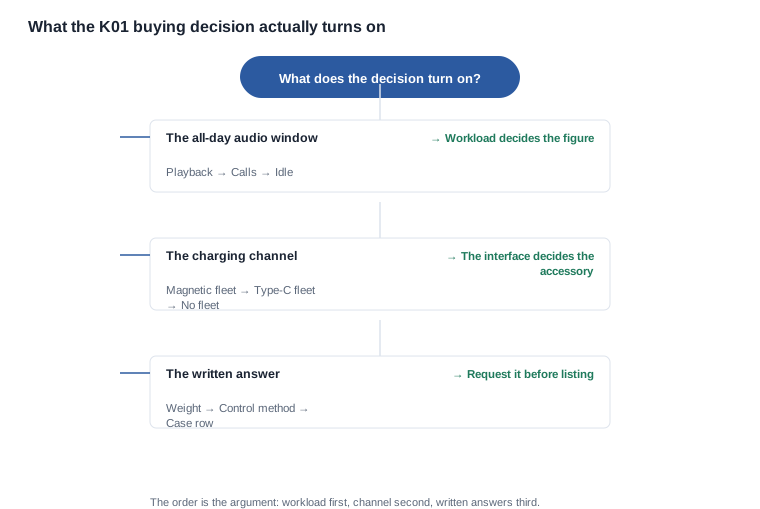
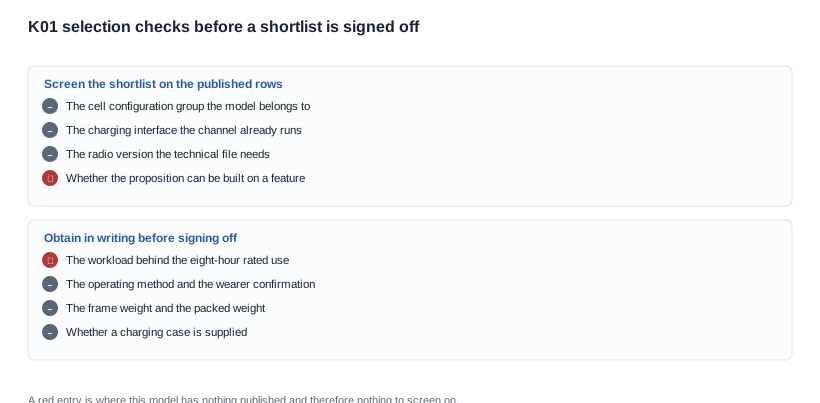
The decision structure above puts those questions in sequence, and the sequence is what the argument rests on. The workload comes first because it decides the endurance figure, and the endurance figure is the row that puts this model ahead of its group. The charging channel comes second because it decides the accessory programme, which is an operating cost rather than a specification. The written answers come third because they are the ones that decide whether the model is usable in the customer's hands at all, and they are also the ones a supplier can answer in a single reply.
The published row set, and the product that shares it
Five rows and nothing else is an unusual catalogue page, and it is worth reading carefully because the absence is itself a selection criterion. Five rows carry the specification of this model: a radio version, a cell arrangement, a charge ceiling, a rated use and a charging method. The feature section of the page is empty. There is no structural descriptor, no acoustic descriptor, no control note, no weight, no ingress marking, no colour list and no charging-case row.
The empty feature section does two things, and a buyer should hold both of them. The first is that there is nothing to position the product on. A model with a published feature row — a surround-sound note, a slim-temple note, a detachable-temple note, a long-endurance note — gives a channel a line of positioning that a model without one cannot use. For this model the positioning has to be built from the electrical rows, which is a narrower and more technical proposition than the rest of the range offers. The second is that the absence of a feature row removes the possibility of a claim that does not exist. A listing cannot say this model has a particular function, because the catalogue does not publish one, and any capability a buyer wants to claim — a control method, an additional function, a construction detail — is a question for the supplier rather than a fact in our material.
That is also where the correction to an older version of this page belongs. The K01 does not publish a touch row, a capacitive control note, or any additional function line, and our catalogue publishes no touch row for any model. Anything of that kind has to be obtained in writing before it appears in a listing, and until it is obtained, a claim built on it is a claim with no published basis. Getting this wrong is not a small error: it is the difference between a product page that a quality team can sign off and one that a channel's own auditor will fail.
Structurally, the audio range in our catalogue contains eight models. Two publish a 90 mAh × 2 configuration, two publish a 55 mAh × 2 configuration, two more publish 55 mAh × 2 with a lower rated use, and two publish a single 100 mAh cell with a Type-C interface. That is a grouping by published configuration, which is a legitimate way to narrow a range; it is not a price grouping and it is not a recommendation. The full set of published rows is in the full published row set for this model, the items this model does not publish are collected in K01 smart glasses limitations, and the pre-order checks are in the pre-order check list for this model.

The procurement scenarios this configuration can serve
The scenarios below are written as filters rather than as recommendations, because a filter can be applied to a shortlist that includes other models and a recommendation cannot. Each one names the published row that puts this model into contention, the way it should be read, and the condition that has to be attached to it before it is used in a business case.
The first scenario is a deployment where the audio window has to cover most of a working day. The published row that puts this model in contention is the rated use of approximately eight hours, which is the highest figure published in the audio range. It should be read as a manufacturer rating rather than a guarantee, and the condition to attach is the workload behind it, because the catalogue publishes none. A buyer who schedules against the bottom of the rating and who has obtained the workload in writing can use this model in a working-day business case. A buyer who schedules against eight hours as though it were a measurement of their own customer's use is building a case on a number the catalogue never made.
The second scenario is a channel whose existing accessory logistics are already magnetic. The published row is the charging method, and the range context is that seventeen of the twenty-eight models in our catalogue charge magnetically, seven over Type-C, and four publish no charging method at all. The condition to attach is the interface geometry and the box contents, because the catalogue publishes the method and not the connector. For a channel already running magnetically charged stock, this model introduces no new accessory line and no new training, and that is a genuine operating saving. For a channel already standardised on Type-C, the same model introduces a proprietary part into the aftersales kit, and the same row that helps one channel hurts the other. This is the clearest example on this page of why a published row can move in both directions depending on the buyer.
The third scenario is a technical file that needs a radio version on paper. The published row here is Bluetooth V5.3, and it is the easiest row on the page to use: the version is stated, so the radio section of the file can be started without a request, and a Bluetooth qualification is confirmed by the buyer in the member database as an independent step rather than a claim taken from a catalogue. The condition to attach is the conformity documentation itself, since the catalogue carries no per-model certification row for any model.
The fourth scenario is a volume programme where consistency matters more than differentiation. A model with a five-row specification and no feature rows is a model whose file is short, and a short file is a file that can be written once and applied across a production run. The condition to attach is the sample order, because a model with no feature rows still has behaviour, and the behaviour is what the acceptance conditions exist to capture.
What links the four scenarios is that each of them is anchored on a published row. That is the discipline the whole method depends on: a scenario qualifies on what the catalogue prints, and everything else is a request. A scenario that can only be justified by an unpublished capability is not a scenario this model can be selected for, however attractive the idea is.
The scenarios it cannot serve without a written answer
There is a second list, and a buyer building a shortlist needs it as much as the first. These are the scenarios where the published rows do not reach, and where the model either qualifies or does not depending entirely on a document that has not been seen.
A deployment where the customer will operate the frame by touch is the first, and it is the most common one. Our catalogue publishes no touch row for any model, and this model publishes no control method, so a business case that depends on a customer finding and pressing a control cannot be written from our material. A business case that depends on a customer being handed a working product and getting on with their day is a different matter entirely, because that only needs the product to work. The distinction is worth drawing explicitly, because a procurement team that treats "hands-free" as a product characteristic rather than as a customer behaviour is designing a product nobody has specified.
A channel whose differentiation is sound is the second. This model publishes no acoustic descriptor of any kind, so it cannot be positioned on sound quality in a listing, and a channel whose whole proposition is the audio experience will find that this model gives it nothing to write. The rows this model does lead on are electrical, and there are channels for which that is exactly the right proposition and channels for which it is not.
A scenario that needs a weight figure, a shipped and packed weight, is the third. No weight is published for this model, and the freight and customs file needs one, so any business case that computes a per-unit landed cost has a hole in it until the supplier supplies the figure. A scenario that needs a charging case, because the deployment is a retail bundle or a gift-set proposition rather than a professional deployment, is the fourth: the catalogue publishes no case row for this model, so the case has to be established before it can be planned.
A scenario that needs a distinctive feature to justify the price a customer will be asked to pay is the fifth, and it is the one that bites hardest. With no feature row published, the only positioning available is the specification itself, which is a proposition that works in a professional or fleet channel and works poorly in a consumer channel where the comparison is against a product with a feature list.
And a scenario that needs a per-model certification line is the sixth, because the catalogue does not carry one anywhere. A buyer who has to answer a customer's compliance questionnaire from the catalogue alone cannot do it; a buyer who has the technical file can.
The total cost of a model in this category is not only the unit price, and it is worth putting the non-price terms into the comparison explicitly. The accessory line, the charging-point cost per team, the documentation effort for the acceptance file, the sample-order cost, and the returns exposure created by an unstated control method are all costs, and they differ between the models in the range. That is the comparison a buyer can actually make, and it is the one we would want to see in a total-cost assessment.
The K01 shortlist: a decision you can defend to a customer
Building the shortlist on the same criteria for every candidate
The reason a selection on this model is hard is that its closest rival is indistinguishable on published data, and the way through is to make the comparison honest rather than to look for a tie-breaker the catalogue does not contain. The method has three steps. First, narrow the range by published configuration: the eight audio models separate into the 90 mAh × 2 group, the 55 mAh × 2 group and the single-cell 100 mAh group, and within each group the models are separated by the charging method and the radio version. That narrows a range of eight to a handful without a single unpublished assumption. Second, put the same written request to every supplier on the shortlist, in the same form, so the answers are comparable rather than curated. Third, apply the same criteria to the answers and record the result.
The trade-offs that come out of that method are the real ones, and they are the opposite of the ones a feature comparison would surface. There is a trade-off between the published endurance figure and the published cell configuration, because two models with half the cells publish the same figure, so the cell row does not explain the rating. There is a trade-off between the charging method and the channel, because a magnetic interface is nearly free to a channel that already runs one and expensive to a channel that does not. There is a trade-off between the published radio version and a mixed fleet, because a version stated on the page is convenient for a file and a question mark for someone managing several generations. And there is a trade-off between the size of the specification file and the size of the positioning, which is the one that decides this model in practice: a five-row model is easy to qualify and hard to sell.
The request that has to travel with the shortlist
- The workload behind the eight-hour rating — volume, connection state and ambient conditions — stated in writing.
- The start state and the end criterion used in that measurement.
- The operating method for the frame, and the confirmation the wearer receives, since no control note is published.
- The cell chemistry, the expected cycle life and the position of both cells in the frame.
- The transport documentation for both 90 mAh cells, including a test summary that names them.
- How the charging interface is built, whether the magnetic connector ends in a standard plug, and what the box contains.
- Whether a charging case is supplied, given that the catalogue publishes no case row.
- The frame weight as shipped and the packed weight, for the freight and customs file.
- The construction description and the type-examination record for the model, which for a page with no feature rows is the only published-form description of what the product is.
- The radio version confirmation, plus the conformity documentation that covers the configuration actually shipped.
On the ninth and tenth items, the shape of the file follows from what this page does and does not publish. With no feature row and no structural descriptor, the construction description inside the technical file is the only description of the product that exists, and a buyer who has not read it cannot describe the product beyond its electrical specification. Our published pages attach no CE, FCC or RoHS certification to this model, and none to any other product in the catalogue; the export-certification page carries pictures rather than readable text, so the paperwork has to be assembled by the supplier, and a buyer who needs the construction description and the conformity declaration has to ask for both in writing. A radio placed on the European market is covered by the Radio Equipment Directive (EU) 2014/53/EU, and a Bluetooth qualification is confirmed by the buyer in the member database.
What we publish, and what we will tell you
We publish the five specification rows this model carries and none of them is turned here into a runtime test method, a cell chemistry, a cell position, a control method, a feature, a charging-case capacity, a frame weight or a certification claim. We do not publish a price, so nothing on this page is a price tier and no grouping here should be read as one. And we do not name a best model for a scenario, because the rows that would decide it are the ones our catalogue does not print, and a verdict built on the rows that are printed would be a verdict about paperwork rather than about the product.
What we can do is tell you when this model moves to the front of a shortlist. It moves up when the deployment needs the longest published audio window in the range, when the channel already runs magnetic charging, and when the technical file needs a stated radio version. It moves down when the channel's proposition depends on sound, on a feature the customer can see, or on a published weight, and it stops being a candidate the moment a customer is expected to operate it by touch and nobody can describe how.
If the K01 is on your shortlist, send us the deployment, the channel, the hours the product has to cover, and the listing copy you intend to publish. We will take the copy apart for you, marking the parts a published row already carries, the parts that need a supplier document or a measurement, and the parts we would leave out. Send the questions first, and the selection you arrive at will be one you can defend to a customer, which is the only kind of selection worth having.


