

K01 smart glasses sit in the audio range as one of just two platforms that publish Bluetooth V5.3, and that single row does more work in a procurement file than its size suggests. It tells a channel buyer that the product is not on the newest version the range offers, it tells a compliance reviewer which radio framework question to ask, and it tells a sourcing team that the platform is shared with exactly one sibling. Everything else this platform publishes is a battery, a charging time, a runtime and a charging method — five rows in total, with no feature note attached.
That thin published base is the subject of this article. Not because it is a problem to be solved, but because it changes the order of work: on a platform with a long specification, a buyer can draft the listing and verify afterwards, while on a platform with five rows the brief itself has to be written as a question set, because every line that cannot be answered from the page has to be closed in writing before money goes into artwork, samples or a first order.
K01 smart glasses customisation: what the V5.3 row does and does not carry
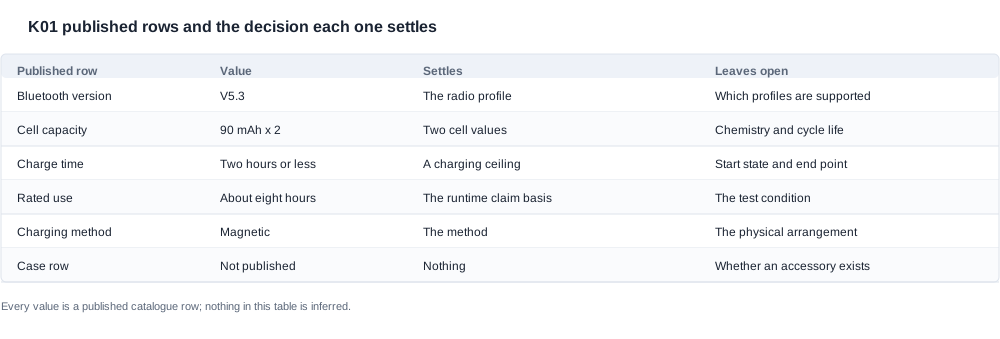
The published set for this model runs to five entries: a Bluetooth version of V5.3, two cells of 90 mAh each, charging by magnet, a charge time of two hours or less, and a rated use of roughly eight hours. Nothing else is published for it — no feature row on the catalogue page, no colour row, no acoustic descriptor and no certification line.
The version row is a constraint in a range that moved on
Eight audio models make up the range, and their published Bluetooth versions split cleanly: two platforms publish V5.3 and six publish V5.4. This model is on the older side of that split, alongside the K02.
That has three commercial consequences that a buyer should settle before writing a listing.
First, a listing cannot describe this platform as carrying the latest Bluetooth version in the range, because six of the eight audio models publish a later version. Whether that matters depends on the devices in the channel, and the honest way to answer that question is to obtain a list of the phones and laptops the channel actually sells against, then ask for confirmation of the profiles each one supports.
Second, the version row interacts with the radio regulatory question. The framework a buyer should raise for a Bluetooth product in the European Union is the Radio Equipment Directive, (EU) 2014/53/EU. Regulatory scope for this platform cannot be read off a catalogue page at all: the export certification page carries images rather than extractable text, and CE, FCC and RoHS appear nowhere in the catalogue text. What remains is a document request — which documents, at which versions, for which market — and each of those has to arrive in writing before the order is released.
Third, the version row is the only published row that distinguishes this platform from the sibling whose catalogue page reads identically, which makes the document controls described later in this article more than good hygiene on this model.
The absence of a feature row is not the absence of a feature
When a catalogue page carries no descriptive row, three readings are possible: the capability is absent, the capability is present but unstated, or the capability is present only at a level nobody has committed to in writing. Those readings have very different commercial consequences, and the page cannot distinguish them.
That is the reason the unanswered items on this model have to be treated as open questions with commercial weight rather than as gaps nobody noticed. A question left open until inspection has no leverage. A question answered in writing before the order becomes a line in the inspection plan and a term in the purchase order.
The items worth raising, in the order a buyer usually meets them, are the physical charging arrangement behind the magnetic method, the acoustic characteristics behind an audio product, the control scheme on the temple, the colour and material options, and the certification document scope.
The audio range has a documented acoustic minority, and this model is not in it
Four of the eight audio models publish a descriptive acoustic row: the D11 publishes a surround-sound row and a long-runtime row, and the YK12 publishes a surround-sound row and a slim-temple row. The remaining audio models publish no descriptive row at all, and this platform is one of them.
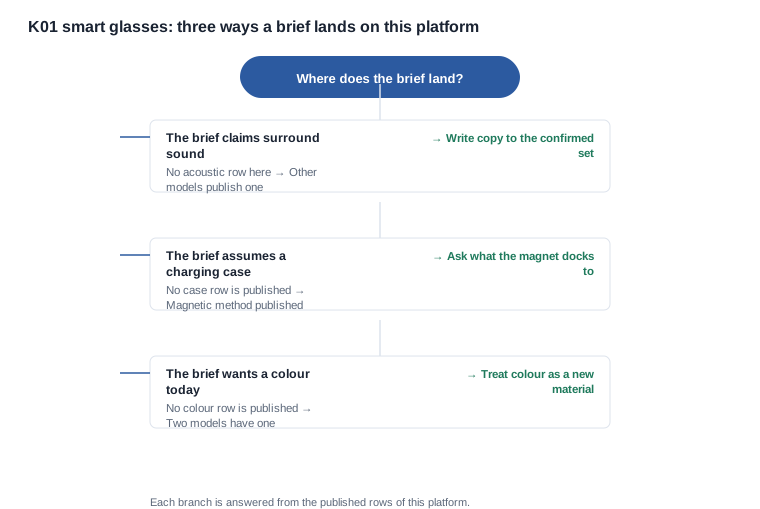
That is a fact about the documents, and it produces a clear rule for listing copy: on this platform, a surround-sound claim cannot be sourced from the catalogue, because no acoustic descriptor has been published for it. If a channel listing for this product needs an audio claim, the claim has to be written against a supplier confirmation and a sample, not against the range's more descriptive models. The comparison of this platform against the D11 sets out how the two differ in published terms, and the certification status article covers what a buyer should request in writing.

The dual-cell platform: 90 mAh × 2 and a charging arrangement to confirm
Two rows of this platform's published set matter most in a sourcing file: the cell capacity of 90 mAh × 2, and magnetic charging. Together they describe an architecture with two physical power elements and a contact-based charging method, and both raise questions that a single-battery platform would not.
Two published cells is not one published capacity
The catalogue prints a cell value and a cell count, published together as 90 mAh × 2. Any total of 180 mAh is arithmetic performed by the reader rather than a figure printed by the manufacturer, and the distinction is worth preserving in both directions. In a specification sheet that a customer or an inspector may compare against the catalogue, the cell form is the one that matches the source. In a costing model or an internal analysis, the total is useful provided it is marked as derived.
The published form also carries information the total destroys. Two cells means two power elements, which means a charging arrangement that has to bring both to state, which is the reason a contact-based magnetic method appears on this platform at all. A single figure of 180 mAh tells a sourcing team nothing about the hardware inside.
There is a second consequence of the dual-cell arrangement that is worth raising with the supplier, because it affects what happens to a unit in service. With two cells, the two elements do not necessarily age at the same rate, and the behaviour of a unit whose cells are unevenly charged is a field-service question rather than a brochure question. Ask how the platform reports charge level when the two cells differ, and what a user should do when that report disagrees with the expectation the listing created.
The battery tier in context
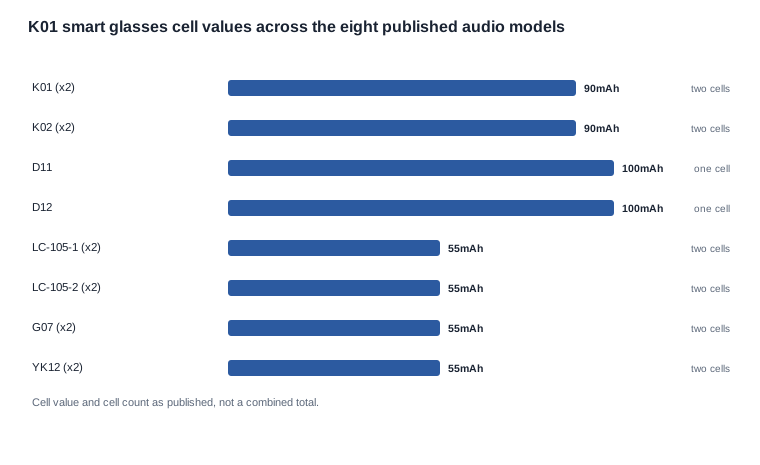
Across the eight audio models, the published cell values are 90 mAh × 2 on this platform and the K02, 100 mAh on the D11 and the D12, and 55 mAh × 2 on the LC-105-2 and the YK12, and the LC-105-1 and the G07. The published runtimes are about eight hours on the dual-cell 90 mAh models, about seven hours on the 100 mAh models, about eight hours on the LC-105 pair and about six hours on the G07 and the YK12.
The pairing of a cell count with a runtime figure is worth holding on to, because the figure that moves is the one that is published. The G07 and the YK12 sit in the smallest cell tier and publish the shortest runtime in the audio range, and the G07's page also carries a detachable-temple row, which suggests that form factor decisions and the cell tier travel together on the platforms where they are published at all.
Magnetic charging, and what it does not tell you
Magnetic charging is published for this model, and no charging-case row appears on its catalogue page. That combination is common on the audio range, and it produces a specific question that the page cannot answer: what, physically, does the magnet dock to?
Three practical arrangements are possible and each has a different consequence for a programme. A dock in the carton is a small moulded part that has to be packed, protected, and described in the listing. A charging case is a second large object with its own approval cycle. A contact on a desk pad is a different product experience altogether, and it carries a different replacement argument to the customer.
Because no case row is published for this platform, the safe formulation for a procurement file is that the catalogue publishes the charging method and does not publish a case for this model, and that the arrangement behind the method has to be confirmed in writing. The absence of a row is an absence of information; it is not a statement that no case exists, and a buyer who treats it as one will either over-order or under-order.
What to request, in the order that costs the least to obtain
- The physical arrangement the magnetic charging method refers to, named against the model designation.
- Whether a charging accessory is included in the carton, and if so what it is called.
- Whether the unit can be charged without any accessory, and through what.
- The behaviour of a unit whose two cells are at different charge levels.
- The accessory's colour and material options at the volume being discussed.
- The charge behaviour of the unit when it is connected to the accessory.
Each of these asks for something that exists in a production file, and each answer becomes a line that can be checked later rather than argued about later.
How to evaluate the platform, and what the trade-offs actually are
The five published rows do not narrow the choice between this platform and the K02, and they do not narrow it between this platform and any other dual-cell audio model either. What narrows it is the set of rows that are silent. So the evaluation is not a comparison of published values; it is a comparison of how many unanswered questions each platform leaves in the file, and what each of those questions costs to close.
The trade-offs on this platform are specific, and they are all about what the catalogue does not say. The acoustic characteristics are unstated, so a buyer who needs a sound claim has no published basis and must obtain one in writing. The charging arrangement is named by method but not by what it physically is, so the accessory that has to be ordered alongside the unit is unstated. The case position is unstated, so the carton contents are unstated. The control surfaces are unstated, so any input method in the listing is unstated. The per-model certification position is unstated, so the document list for a given market is unstated. Every one of these is a cost that surfaces only once — at the point where somebody has to decide what to write on the page or into the file.
That makes the criteria for choosing this platform narrow and checkable. A buyer who wants the simplest possible documentation has a sound reason to prefer it, because fewer published rows mean fewer written confirmations to hold and fewer places for a listing to overstate what the catalogue supports. A buyer who needs an acoustic claim, a colour range or a named control method should put the platform on a shortlist only if the supplier answers those specific questions before the purchase order is released, and not after it.
Three red flags are worth naming, because each is easy to miss on a page this short. The first is a colour row appearing in a specification that quotes only this platform's five published rows. The second is a touch or translation claim attached to a model designation whose catalogue page carries neither. The third is a certification number cited without a document reference, which is the same problem as a number with no source: it cannot be checked at the sample stage, so it does not survive one.
The total cost of the platform is not the unit price, and the two are worth setting side by side before you commit. The unit price appears nowhere in this catalogue, so it comes from the quotation. The documentation cost is measurable and entirely yours: it is the number of written confirmations held, the length of the acceptance plan, and the share of the listing copy that has to be written against a confirmed value rather than a published one. A platform publishing five rows and a platform publishing eight rows differ in that cost by the difference in the specification, not by anything in the unit price.
What to ask, in the order that closes the file fastest, is the same list as above with a different owner and a different deadline: each item is assigned to the person who can answer it, and each answer is required before the order is released rather than before the first shipment. The criterion for accepting an answer is the one already used in the specification sheet — the supplier's position, its exclusions and its evidence, in writing, against the model designation.
The questions to ask about this platform are therefore not open-ended. They are the five silent rows, each one expressed as an outcome with a date attached, and each one attached to a document that will exist at the moment of inspection rather than at the moment of ordering.
Building a written specification for the rows that are silent
The instrument that works on a five-row platform is a two-column sheet, and the format matters more than the content. Column one is your requirement, written as an outcome. Column two is either the published basis for it — the row and the value, cited — or the words Not published followed by the exact question that has to be answered in writing.
A requirement that carries a published basis is a decision you can take now. A requirement marked Not published is a question, and it belongs in the part of the sheet that nobody signs until an answer arrives. That separation also produces the inspection plan later, because the same two columns become the acceptance criteria: a published basis becomes a pass-or-fail check with a citation, and an unstated item becomes a check that can only be made against a value the supplier committed to in advance.
Turning a question into a specification
The difference between a question that gets answered usefully and one that gets answered vaguely is entirely in its wording, and it is worth rewriting the obvious ones.
- Instead of asking what the charging method is, ask which physical arrangement the magnetic method refers to, whether an accessory is included, and whether the unit charges without one.
- Instead of asking about the sound, ask which acoustic characteristics the supplier will confirm in writing for this designation, and which it will not state at all, so that the listing can be written to the confirmed set.
- Instead of asking whether there is a touch surface, ask what control surfaces the platform has and how each one behaves, given that no touch row appears anywhere in the catalogue.
- Instead of asking about certification, ask which documents the supplier will provide for this designation, at which versions, and by when.
- Instead of asking about colours, ask which colour and material options exist in production for this platform today, and what a new colour would require.
The pattern in all five is the same: a question that can be answered yes or no will be answered yes or no, and a question that asks for the supplier's position, its exclusions and its evidence produces an answer you can build a specification from.
The identity question that the identical rows create
The published rows on this platform and on the K02 are the same five rows, and they appear in the same order on both pages: a Bluetooth version of V5.3, a pair of 90 mAh cells, a charge time of two hours or less, a rated use of roughly eight hours, and magnetic charging. Neither page carries a feature row. Placed side by side, the two entries are indistinguishable from the document alone.
For a shopper that is an inconvenience. For a procurement team it is an identity risk that runs through every document in the file. A purchase order, a packing list, an inspection plan and a barcode mapping all describe the product in words, and on this platform those words have to carry the model designation explicitly, because the descriptive words — dual-cell, V5.3, magnetic — do not separate the two models.
Four document controls close that gap, and none of them costs anything.
- Carry the model designation on the purchase order line and on the packing list. Not the product name, which a supplier may shorten, and not a marketing description.
- Bind the barcode to a designation in writing, so a receiving team can detect a substitution at the point where a substitution is cheapest to detect.
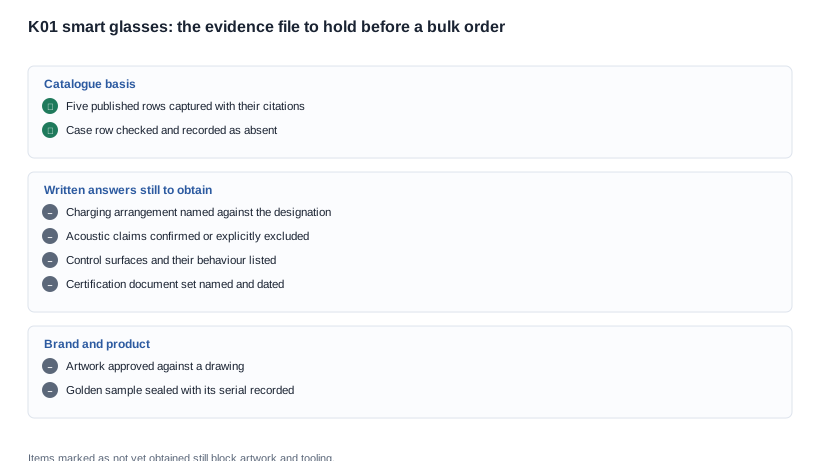
- Confirm in writing which unit a sample is. A pre-production sample carries no label, so the designation has to be recorded against its serial number.
- Tie the golden sample to the approved artwork, so that a later dispute about a mark, a manual language or a paired-device name has an agreed physical reference.

Audio claims, colour and certification: the three lines buyers get wrong
These three come up in almost every enquiry about an audio platform, and each of them has a specific failure mode that a procurement team can close.
Audio claims
No acoustic figures are published for this platform: driver size, frequency response, leakage, sensitivity and impedance are all absent. The catalogue also publishes no surround-sound row for this model, even though other models in the audio range do publish one.
The practical consequence is a constraint on copy rather than on the product. Any statement about the sound of this platform has to originate somewhere other than the catalogue page — a written supplier confirmation and a sample evaluation — and the listing should be written only to the set that is confirmed. A claim about the sound quality of a whole range, written on a page that describes a model with no acoustic descriptor, is the most common way an audio listing becomes indefensible.
Colour and material
No colour row is published for this platform. The catalogue lists colour options for only two models across the whole range, and this is not one of them. Colour therefore cannot be treated as a pick from an existing run; it is a new-material question that carries a sample, a consistency standard across a batch, and a photography task that happens after the material is settled.
The sequencing rule that avoids most of the pain is simple: settle the colour before artwork sign-off, because a colour change after artwork approval reopens the photography, the packaging and the carton insert.
Certification and regulatory scope
No per-model certification row exists for this platform, and the one certification page the catalogue carries is a set of images rather than text, so nothing about CE, FCC or RoHS can be read off the model page and the file has to be requested by designation. There is no per-model certification row anywhere in the range, and no per-model record of a pending certification either. So the certification scope for this platform is created by agreement: named documents, at named versions, with a delivery date, attached to the purchase order.
What a good request contains is specific. The applicable radio framework in the European Union, the Radio Equipment Directive (EU) 2014/53/EU. The electromagnetic compatibility framework, which is a different instrument and a different number, 2014/32/EU. The battery transport document that any lithium-containing product needs to move by sea or air, UN 38.3. And, for a children's or general-retail channel, the market access documents for the destination market, requested by name rather than by category.
None of these can be read from this model's page, which is precisely why they belong in the request list rather than in a spreadsheet of "known items".

A customisation sequence for a channel launch
The order of work on this platform is not complicated, but it is sensitive to sequencing, and the two items that are hardest to obtain come first.
- Mark every line of the brief as surface or platform. Surface lines are changeable; platform lines are fixed and belong in a model-selection question.
- Send the platform lines back as questions, in the wording set out earlier, so that the answers are usable as specification lines.
- Obtain written answers with the model designation attached, since a confirmation that names the platform leaves the file ambiguous.
- Settle the colour, the accessory and the packaging contents, because all three are physical decisions that cost money once committed.
- Lock the barcode, the paired-device name and the manual language, since all three appear on packaging that is about to be printed.
- Approve artwork against a drawing rather than a render, and check the mark against the assembly that carries it.
- Seal one golden sample and record its serial, attached to the artwork approval sheet and to the written answers.
- Run a pilot and inspect against your own criteria, not against the supplier's description of them.
The sample evaluation guide covers the last two steps, the packaging design article covers the sequencing that keeps freight and artwork costs from crossing over, and the best-fit article sets out how this platform is usually matched to a channel.

What the purchase order should carry
Five terms belong in the document rather than in the email thread, and each of them is open for discussion before signature, which is a different thing from being left until after the first shipment.
- The designation and its published basis. Name the model and the five rows the order refers to. An order describing a dual-cell V5.3 magnetic-charging frame is an order with an ambiguity inside it.
- The confirmed surface items, itemised, each with its method and position, so that a moulded mark on one unit and a printed sticker on another are not both compliant.
- The charging arrangement as a written term, including what is in the carton, because the accessory is what a customer uses and the cable is what they lose.
- The acceptance conditions, with the measurement conditions attached, so that the published runtime and charge figures become criteria you can withhold a lot against rather than marketing copy.
- The certification document set and the payment milestones, with the milestones tied to the first shipment, because on a private-label programme the first shipment is the one that proves the branding.
K01 smart glasses: the boundary of our published position
We will state the published rows for this platform and nothing beyond them: a Bluetooth version of V5.3, a pair of 90 mAh cells, a charge time of two hours or less, a rated use of roughly eight hours, and magnetic charging. We will tell you that the same five rows appear on the K02 page, that no charging-case row is published for this model, and that no capacitive-touch row, no translation row and no certification row of its own appears anywhere in the catalogue. We will also tell you plainly that no CE, FCC or RoHS reference appears in the catalogue text, and that the export certification page is images rather than extractable text.
We will not publish a driver size, a frequency response, a leakage figure, a weight, a colour list or a charge-cycle count for this platform, because none of those exist in the document we work from. We will not describe the sound of the product, and we will not attribute a surround-sound claim to a model whose page carries no acoustic descriptor. We will not convert the runtime figure into a guarantee for your channel, and we will not turn the two-hours-or-less ceiling into a claim about a part-charged unit. The usual line for the category holds as well: no claim about vision, eye health or any medical benefit.
For a platform with five published rows, the most useful first conversation is not about artwork. It is about which of your requirements survive contact with a catalogue page this short, and in what order the rest have to be closed.
Related reading
- The buyer question this platform is usually matched against — where it fits
- The interface difference against the D11, written out row by row — K01 against the D11
- Which market-access documents to ask for, and who holds them — K01 certification scope
- What a pre-production sample has to settle — sample evaluation
- How the carton and insert structure should be laid out for a private label — OEM packaging structure
- The full audio range this platform sits inside — the Bluetooth audio glasses range
Send the target market, quantity and required configuration and we will come back with what is available and what is not.


