
The K01 smart glasses certification status cannot be read out of the catalogue, because the catalogue publishes no per-model certification row for this model. What it does publish is a single export certification sheet at company level, and what it shows is a set of images rather than of text; ten certificates appear on it — two utility-model patents and eight appearance-design patents. Nowhere in the catalogue text does CE, FCC or RoHS appear. That combination is the starting point for every compliance question raised about this model, and it is why the evidence has to be requested from the supplier rather than looked up.
This page is written for the compliance reviewer and the procurement manager who will have to sign for the market access of a product they are about to buy. It sets out what exists, what does not, how the European framework divides into parts that are routinely confused with one another, and what a request for evidence should actually ask for.
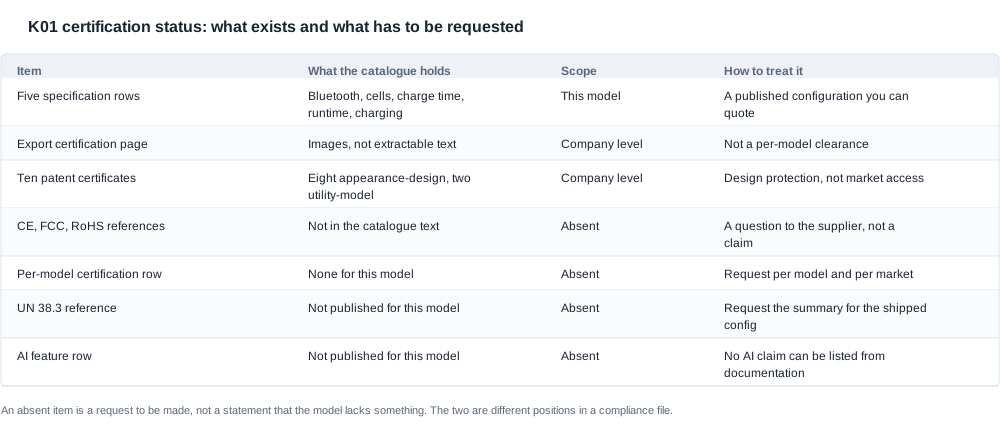
K01 certification status: what the catalogue does and does not say
The five published rows, and the certification row that is not among them
The catalogue publishes five specification rows for this model, and it is worth reading them as a complete statement of what the documentation contains:
- Bluetooth version — V5.3
- Cell configuration — 90 mAh per cell, two cells
- Charge time — two hours or less, published as a ceiling
- Rated runtime — about eight hours, a rated figure
- Charging method — magnetic
That is the whole of the published text for the K01. There is no feature row, no acoustic descriptor, no ingress rating, no weight, and no certification reference. A reader who goes looking for a certification line on this model's page will not find one, and the correct conclusion is not that the model lacks the paperwork — it is that the catalogue does not record the paperwork, which is a documentation gap with a defined remedy.
The company-level export page, read for what it is
The catalogue's front section carries an export certification page that is company-level in scope. Its content is images rather than extractable text, and the images are ten patent certificates — two utility-model patents and eight appearance-design patents. A patent is a different legal instrument from a conformity assessment: it establishes rights over an invention or a design, and it says nothing about whether a product may be placed on a market.
The useful way to hold that page is as evidence of what the company has done at the level of design protection, and as nothing at all at the level of market access. It is genuinely useful for one question in particular — whether a supplier is inventing a design or working from an established one — and it is useless for the question a compliance reviewer is actually asking, which is whether this configuration may be sold into this destination market.
What the catalogue text does not contain
It is worth being exact about this, because a buyer who assumes the absence means something different will draw a different conclusion. The catalogue text contains no reference to CE, to FCC, to RoHS, to REACH, to UKCA, or to any numbered conformity, test or certificate reference. It contains no per-model certification row, and it contains no record of a certification that is pending confirmation. Those two absences are different from each other: the first says the documentation does not carry the item, and the second would have said the item exists but is not yet confirmed.
A catalogue that lists a mark, a standard number, a test laboratory or a certificate identifier is making a claim that can be checked. This one makes none. What follows from that is a request, not a lookup.
The structural fact that makes the request a request
Across the range the catalogue covers twenty-eight models, of which seventeen charge magnetically, seven use Type-C, and four have no published charging method at all. Eight of the twenty-eight are audio models, and this is one of them. Eleven are camera models, whose published content includes a resolution class.
The reason this structure matters to a compliance reviewer is that the range is documented unevenly, and the unevenness is not concentrated in one product line. A per-model certification position therefore has to be established model by model and market by market, and the catalogue cannot shortcut that for any of them.

Why a company-level export page cannot carry a per-model clearance
Company capability and product conformity are different tests
A company-level page answers a question about the supplier: what has this company registered, protected or arranged. A per-model clearance answers a question about a product: may this configuration, with this radio, this cell configuration and this firmware, be placed on this market.
The two questions are frequently collapsed into one, and the collapse usually happens at the point where a buyer is being reassured. The reassuring sentence sounds like "we are a certified manufacturer, so the product is covered", and the gap in that sentence is exactly the whole of the compliance work. Manufacturer approval, factory assessment, and product conformity are three separate instruments, and in most regimes the first two do not substitute for the third.
Why a buyer cannot infer a model clearance from a company page
Inferring a product clearance from a supplier's company page fails for three separate reasons, and it is worth separating them because each fails differently.
The first is scope. A certificate attached to a company describes a legal entity and a set of activities. Even where the activity is closely related — say, radio module testing for the same product family — the document has to be checked for the specific model identifier, the specific variant and the specific firmware. A document that names a different model is not evidence for this one.
The second is timing. A company page describes the supplier at the moment the catalogue was produced. Model clearance is a property of a product as it is built today. A supplier can be audited, accredited and compliant while a specific production run, a specific cell batch or a specific firmware branch carries a difference that pushes it outside the tested configuration.
The third is the simplest. Nothing on the company page mentions this model at all, so there is no textual chain to follow even if the first two problems were absent.
The scope question a request has to settle
Every request for certification evidence should specify the configuration it applies to, and for this model that specification is already written. It is 90 mAh per cell across two cells, magnetic charging, Bluetooth V5.3. If the evidence names a different cell configuration, a different charging method or a different radio version, then it is evidence about a neighbouring product rather than about the K01, and the file needs to say so before anyone relies on it.
Reading the EU framework: RED, EMC and the general product safety regulation
Radio equipment and electromagnetic compatibility are separate frameworks
A Bluetooth device sold into the European Union falls into more than one framework, and the most common error in a compliance file is treating them as one instrument with two names.
The radio side is the Radio Equipment Directive (EU) 2014/53/EU, commonly written RED. It governs the radio equipment itself — the radio transmission, the radio spectrum use, and the radio-related safety, EMC and privacy requirements. It is the framework under which a Bluetooth product is assessed for radio behaviour.
The electromagnetic compatibility side is Directive 2014/32/EU, the EMC Directive. It governs the product's electromagnetic emissions and immunity as a general requirement across the EU market. A device can sit under the EMC Directive rather than under the radio provisions of RED for part of its assessment, and in practice a Bluetooth product is commonly assessed under the radio requirements of RED with EMC standards drawn in as the supporting method.
The point for the buyer is narrow and practical: a document titled around RED does not, on its own, discharge the EMC obligation, and a document titled around EMC does not, on its own, discharge the radio obligation. If the file you receive contains only one of them, that is a gap to raise rather than a clearance to rely on.
The general product safety regulation and what it adds
The General Product Safety Regulation (EU) 2023/988 replaced the previous general product safety directive and is the framework that applies to consumer products made available on the European market where no specific sectoral regime fully applies. It introduces a general safety obligation, requirements on responsible economic operators, traceability and online-sales information, and a recall framework.
For a product like this one, its practical significance for a buyer is that it adds obligations which sit on top of the technical conformity assessment rather than inside it. Traceability of the product and its economic operator, the information a consumer must be given, and the ability to withdraw a product in the field are the items a channel operator has to be able to evidence, and none of them are answered by a radio test report.

Other markets, named as questions rather than claims
The same structure applies outside the European Union, with different instruments, and the catalogue publishes nothing for any of them. For the United Kingdom, the conformity route and its marking are distinct from the European route. For the United States, the radio equipment authorisations and the separate requirements that apply to lithium batteries in transport are both relevant. For every other destination, the applicable regime has to be identified before evidence is requested, because "CE" is not a global answer and a supplier who offers it as one is telling you they have not done the market mapping.
The question to put to the supplier is therefore not "are you certified" but "for which destination markets, for which model identifier, against which instruments, with which test reports, and in whose name is the responsible economic operator recorded".
The AI claim is a compliance question before it is a marketing question
The catalogue carries an AI feature entry on twenty of its twenty-eight models. This model is not among them — it has no AI feature row, and no touch-control row, for that entry appears anywhere in the range.
That matters here because an AI capability claim is not merely a copy question. Where a product page describes an AI function, a reviewer will ask whether processing is on the device or in the cloud, whether a subscription is involved, whether the function works without connectivity, and where data is retained. Those are questions with commercial answers, and until they are answered the claim cannot be published. The evidence question here is the same shape as the certification question: a capability asserted in copy, and an unstated position in the documentation, is a liability sitting in a product listing.

Harmonised standards, and why a standard number is not a certificate
What EN 301 489 and EN 300 328 are
EN 301 489 is the series of European harmonised standards covering electromagnetic compatibility for radio equipment and radio communication equipment. EN 300 328 is the European harmonised standard covering Bluetooth radio equipment. Both are standards: they describe the test methods, the measurement procedures and the performance levels that a conformity assessment is conducted against.
A standard is not a certificate. A certificate is the record that a named product was assessed against a named standard, by a named body, on a named date, and passed. The distinction matters in a file because a standard number tells you what was supposed to be tested, and a certificate tells you what actually was.
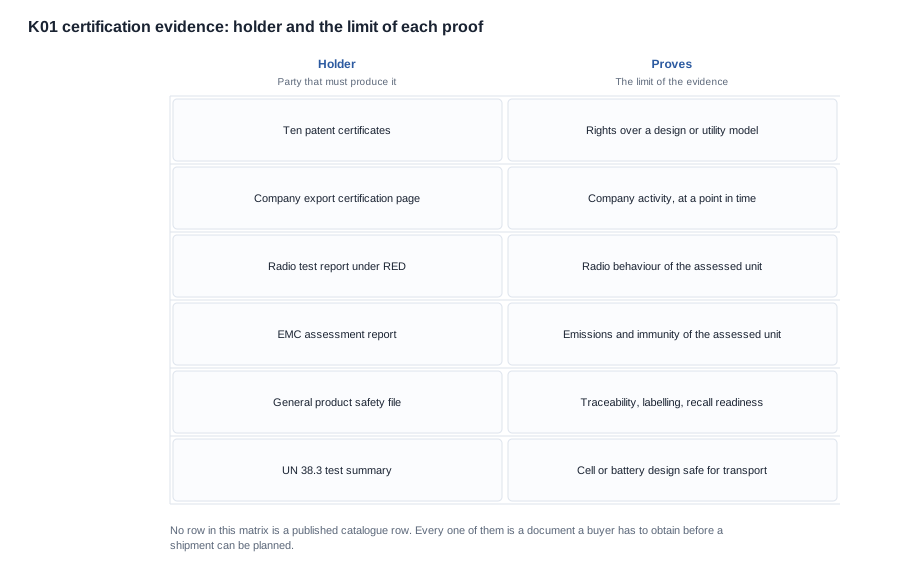
The four things that have to be true before the claim is defensible
A test report that supports a compliance claim has to satisfy four conditions, and a file should be checked against all four before a shipment is planned against it.
The scope. The report must name the model under assessment, or state the model family and the variants covered, and the K01's own configuration — two cells at 90 mAh each, magnetic charging, V5.3 — must fall inside what was assessed.
The version. Standards are revised, and a report against an earlier version is not automatically a report against the current one. The version and the date of the standard matter, and so does the date of the assessment relative to any regulatory change in force.
The body. The report has to come from a body recognised to carry out that assessment for the destination market, and the laboratory's accreditation scope has to include the standard in question.
The instrument. There are two kinds of conformity evidence and they are not interchangeable. A test report records what was measured. A declaration of conformity is the document the manufacturer or its authorised representative makes, and it is supported by a technical file that is not released to the market but is held and must be producible on request.
The technical file is the real deliverable
Buyers often chase the certificate and find it thin. The document that actually answers questions is the technical file, because it contains the design description, the component list, the test reports, the instructions, the labelling and the assessment of foreseeable risk. If a supplier cannot produce a technical file for a given model and market, that is a more serious signal than a missing certificate, and it is worth establishing early.
Four criteria, and the reply that fails the second one
The request itself is straightforward; the assessment of the reply is where buying projects lose time. Four criteria separate a usable file from a decorative one, and a buyer who applies them can evaluate a supplier's answer in a single pass rather than over several rounds of email.
Does the document name the product, or only the category? A report that describes "the Bluetooth audio glasses" without a model identifier has not been assessed for the thing you are buying. The identifier has to be on the document.
Is the configuration inside the assessed scope? Check the cell configuration, the charging method and the radio version against the five published rows for this model. If the report covers a single cell where the K01 ships two, or a wired interface where this model uses magnetic charging, the report is about a different product.
Can the scope be extended without a new test? This is the criterion that decides whether a supplier is a partner for a second shipment or a supplier for one. If the answer is that any change to the cell, the charging interface or the firmware requires fresh testing, then the product's configuration is effectively frozen, and the buying plan has to accept that. If the supplier can tell you which changes are administrative and which trigger a new assessment, the plan can move faster.
Is the answer traceable to a named person and a dated document? A verbal assurance has no expiry date and no scope. The same assurance in a dated document, issued by a named body, has both, and it can be re-checked at the next order.
A short evaluation checklist is worth keeping in the buying file: document named, configuration in scope, change impact understood, evidence dated and attributable. A reply that fails the second item is the one that matters, because it means the product you have been quoted is not the product that was assessed.

UN 38.3 and the transport question behind every battery order
What the catalogue publishes for this model
The transport position starts from the same five rows: 90 mAh per cell, two cells, magnetic charging, a two-hour ceiling on charge time, and a rated runtime of about eight hours. There is no transport test row among them, and no UN 38.3 reference appears in the catalogue text for this model or for any other.
Why a two-cell configuration makes the transport question sharper
UN 38.3 is the United Nations manual of tests and criteria used to assess the safety of lithium cells and batteries for transport. The assessment is carried out on the cell and battery design, not on the finished product, and a design that passes for one cell is not automatically the same design as a pair of cells assembled into one product.
Two consequences follow for this model. The first is that the evidence has to cover the two-cell configuration as an assembly, because that is the configuration that ships. The second is that the charging method is part of the question rather than a detail: a magnetic dock arrangement is a charging interface with its own assembly and its own failure modes, and the charging assembly is part of what the transport assessment looks at.
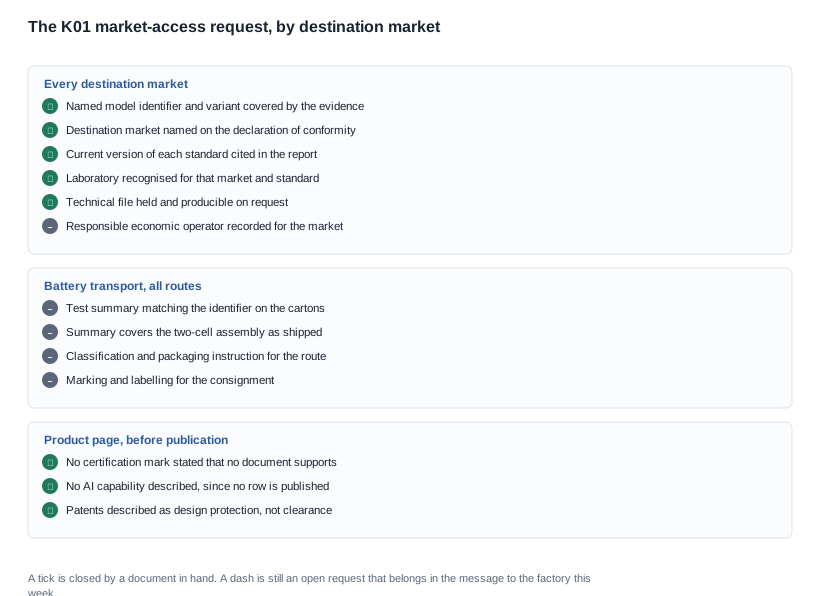
The questions to ask, in the order they bite
Ask for the test summary for the cell or battery as supplied in this configuration, and check that the model or type identifier on the summary matches what appears on the cartons and the documentation. A summary for a different identifier is the most common form of this problem.
Ask whether the summary covers the two-cell assembly or only the cell, and ask for the assembly report if the latter.
Ask for the transport documentation set for the route and the carrier — the classification, the packaging instruction, the marking and labelling requirements that follow from it. These are determined by the cell design, the energy content and the quantity in the consignment, not by the product's brand.
Ask who prepares that set and at what point in the order. It is a document that travels with the cargo, and a document that has not been drafted when the goods are ready to move cannot be produced in time.
Where CYNRIN stands on K01 certification evidence
On this model, our position is that the certification position is a set of documents to be requested, model by model and market by market, and that presenting a company-level page as though it discharged a product obligation would be a misrepresentation we are not prepared to make.
We will not state that the K01 is CE-certified, FCC-certified or RoHS-compliant, because the catalogue publishes no such reference for it, and a claim of that kind would be a claim about a document we cannot produce. We will not read a patent certificate as a market-access clearance, because the export certification page carries ten patent certificates instead of conformity documents — eight of them for appearance designs, two for utility models, which is a different legal thing entirely.
What we can do is narrower and more useful. We can state the published configuration of the K01 precisely, so that a request for evidence is specific enough to be answered: 90 mAh per cell across two cells, magnetic charging, Bluetooth V5.3, with no per-model certification row, no UN 38.3 reference and no AI feature row in the catalogue. We can tell you which questions in a request are the ones that decide the outcome, and we can tell you which of them we can answer from the documentation and which we cannot.
Tell us the destination market, the quantity and the configuration, and we will come back with the evidence position for the K01 in those terms, plus the questions that remain open and need to go to the factory.


