

A form factor comparison between these two models has almost nothing to work with. No frame dimensions, no temple length, no bridge or nose pad specification and no frame weight are published for either model. What the G07 does publish is a detachable, ultra-slim temple, and that is the single row in this comparison that bears on physical form at all. This page is written for the buyer who has to choose between them, and it sets out what exists, what does not, and what a sample has to do instead.
The one thing worth understanding before anything else is that this is not a gap in the supplier's diligence. It is how the catalogue is built. Across all 28 model designations, exactly one frame weight is published — the MT6 at 158 grams, which is a camera model's eyewear body and cannot stand in for an audio frame. No dimensions of any kind are published for any model. So a question about size, shape or how the frame sits cannot be answered from documentation for any pairing in this category, and the honest response is to say so and move on to measurement.
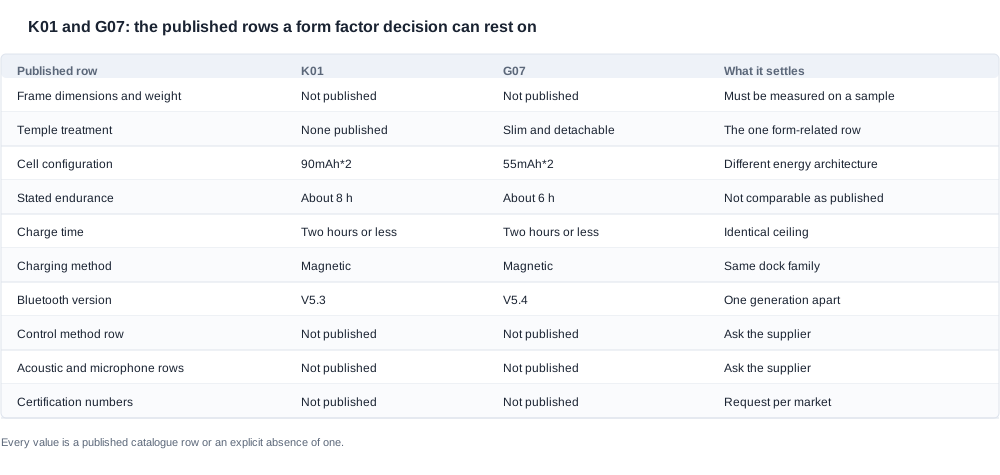
The rows that exist against the rows that do not
What is published for each model
| Published row | K01 | G07 | What it settles |
|---|---|---|---|
| Frame dimensions, temple length, bridge and nose pad specification | Not published | Not published | The fit rows that decide the return rate — and neither model has one |
| Frame weight | Not published | Not published | Neither model can be quoted on weight |
| Temple treatment | None published | Slim and detachable | The one form-related row, and it bears on after-sales rather than on comfort |
| Cell configuration | 90mAh*2 | 55mAh*2 | Different energy architecture, not a size difference |
| Stated endurance | About 8 h | About 6 h | Not comparable as published, and it should not decide the comparison |
| Charge time | Two hours or less | Two hours or less | Identical, so it cannot separate them |
| Charging method | Magnetic | Magnetic | Identical accessory approach |
| Charging case | No row published | No row published | Neither parcel cost can be planned from the catalogue |
| Control method row | Not published | Not published | Has to come from the supplier for both |
| Acoustic and microphone rows | Not published | Not published | Has to come from the supplier for both |
| Certification numbers | Not published | Not published | Has to be requested per market for both |
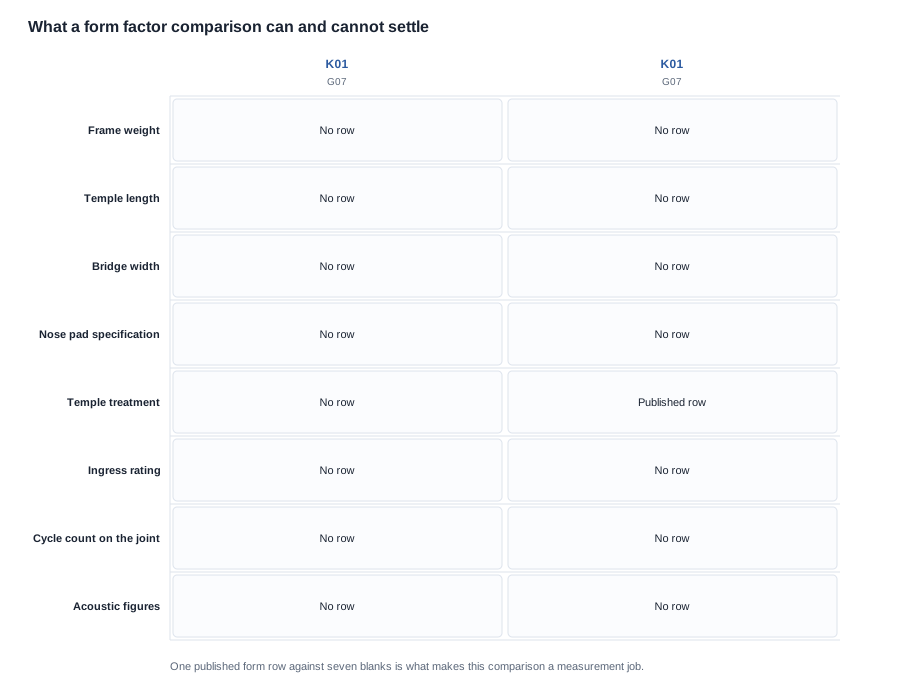
That table is the honest shape of this comparison: one published form-related row against a column of blanks. A buyer who has been told otherwise — usually by a supplier who inferred dimensions from a photograph or quoted a competitor's listing — has been given a number that no document in our catalogue supports.
The one form-related row that exists
The G07 publishes an ultra-slim temple and a detachable temple. The K01 publishes neither. That distinction matters for a specific and narrow reason: a detachable temple means a broken arm is not necessarily a written-off product. For a channel shipping into markets where returns travel a long way and repair economics are tight, that changes the after-sales calculation more than any battery figure would.
Two caveats travel with the row, and both need answers rather than assumptions. The joint existing does not mean spare temples ship in the box or are stocked — that is a separate question with a separate commercial answer. And a detachable temple is a mechanical claim, not a durability claim: no ingress rating and no cycle count are published for the G07, so nothing supports a statement about how long the joint lasts.
An ultra-slim temple also does not imply a light frame. No weight is published for either model, so that inference is unsupported — and it is precisely the inference this comparison should not encourage, because it is the one a listing is most likely to make by accident.
The rows that do separate them, and what they actually mean
Cell configuration. The K01 publishes 90mAh2 and the G07 publishes 55mAh2. That is a difference in energy architecture, and it is worth being precise about what it does and does not imply. It means the K01 carries more energy in the frame. It does not mean the K01 runs longer by a proportional amount, because the endurance figures attached to these two models do not behave that way.
Stated endurance. About 8 hours on the K01 against about 6 on the G07 is the intuitive reading, and the catalogue contradicts it. The LC-105 pair uses the same 55mAh*2 configuration as the G07 and publishes about 8 hours. Identical cells, a two-hour spread. That comparison is the reason the endurance row cannot carry a decision, and the smart glasses battery life treatment sets out why the condition behind these figures is missing across the range.
The two models also sit one Bluetooth generation apart — the K01 publishes V5.3 and the G07 publishes V5.4. That is rarely decisive on its own and becomes decisive only when a customer's platform is known and the question turns into a compatibility check rather than a product check. The bluetooth connectivity piece covers what to establish before a radio version is quoted as a feature.
Why form factor comparisons attract invented numbers
A comparison with mostly blank rows has an unusual property: it invites filling. A supplier who has read a competitor's listing and can see a lens width on a product page, a distributor who has handled the hardware once and has a ruler somewhere, a buyer who has seen the frame in a photograph — each of them can produce a number that sounds right. Each of those numbers then enters a specification sheet, and once it is on a sheet it acquires the authority of a published figure whether or not anybody can produce the document behind it.
The discipline is not to refuse the number, but to mark its source. A dimension inferred from a photograph is an estimate and has to be labelled as one. A measurement taken on a sample is a measurement, and it has to be labelled with the sample it came from. A value supplied in writing by the supplier is a supplied value, and it is only as good as the document that carries it. Three labels, three different weights in a procurement file, and conflating them is how a range ends up with a specification nobody can defend.
This matters more in this category than in most, because the blanks are structural rather than accidental. Our catalogue publishes five standard rows per model — the cell, the endurance, the charge time, the charging method and, where it exists, the radio version — and a set of feature lines on some pages. There is no row for dimensions, no row for weight on any audio model, and no row for a control method on any model at all. A comparison that quietly fills those blanks is not describing our products more completely; it is describing products that no one in the chain has actually inspected.
How to choose between them on the rows that do exist
When the form rows are unusable, the choice has to be made on the three rows that are published, and the criteria for making it are worth stating plainly so that the decision can be reviewed later by someone who was not in the room.
The service criterion. If your channel's proposition includes field repairability — if a broken arm should not become a written-off unit — then the G07's detachable temple is the row that answers it, and the K01 publishes nothing comparable. This criterion has a cost attached to it, because it requires a spares route that has to be established, stocked and priced, and it is worth checking whether that route exists before the criterion is allowed to decide anything.
The energy criterion. If your proposition is built on published energy in the frame, the K01's 90mAh*2 configuration is the row that answers it, and it is the larger of the two. It supports a claim about energy. It does not support a claim about hours, because the endurance figure behind it has no test condition and cannot be compared with the G07's — or with the LC-105 pair, which publishes about eight hours on the G07's own cell configuration.
The platform criterion. The K01 publishes V5.3 and the G07 publishes V5.4. The K01 and the K02 are the only two models in the whole catalogue on V5.3; every other audio model publishes V5.4. That is a real fact, and whether it matters depends entirely on whether the customer's platform is known. If it is not known, this criterion cannot be applied at all, and pretending otherwise is how a market-access problem appears at the shipping stage.
Which model does the criterion set point to? If more than one criterion applies, the tie is broken by asking which claim the channel will make on the product page, because that is the claim the buyer has to support for the life of the listing. And if the honest answer is that the page will carry no differentiating claim at all — a channel that sells on price, on a promotion, or on a distribution relationship — then the fit data becomes the deciding factor, and the fit data has to be measured. The Bluetooth audio glasses which model to pick piece covers the range-level version of the same decision.
The point of setting criteria before the samples arrive is that it stops the sample from being rationalised afterwards. A buyer who has already decided on weight and then weighs the frame will find what they expected to find.
The three questions to ask before you order
Every comparison between these two models comes down to the same short list, and asking it in one message is faster than asking it in three.
- What is the endurance test condition for each model, in identical wording? Include whether the Bluetooth link was active during the measurement, what volume was set, and whether the measured sample was the production configuration. This single answer determines whether the eight-hour and six-hour figures can appear on any page.
- How is each model controlled, and how does that control behave when it is not meant to be triggered? The catalogue publishes no control-method row for any model, so the surface, the behaviour and the failure mode all have to come from the supplier. A control that can be triggered by a face resting against the frame is a support cost before it is a feature, and the two models may behave very differently here.
- What is the G07's replacement route for a damaged temple, and what does it cost? Cycle count, connector design, whether spare temples ship separately, at what price and with what lead time. If the answer is that arms come only with a serviced unit, the serviceability argument for the G07 is much thinner than the published row suggests, and that is worth knowing before the copy is written rather than after.
Add a fourth item to the same message: the certification position for each model in each destination market. It is the request with the longest lead time, and it is the one that has no answer in our catalogue — no per-model certification row exists for either model, and the catalogue text contains no reference to CE, FCC or RoHS. The conformity framework a buyer works within for radio equipment is the Radio Equipment Directive (EU) 2014/53/EU, with EMC governed separately under 2014/32/EU, but the framework is the buyer's obligation to satisfy and the documents that demonstrate it have to be requested.
Send those four together. Splitting them across two exchanges is how a buyer ends up with a condition for one model and none for the other, which is the same defect as comparing figures that were never measured the same way.

Closing a form factor decision with a sample rather than a spec sheet

What a buyer has to establish in writing
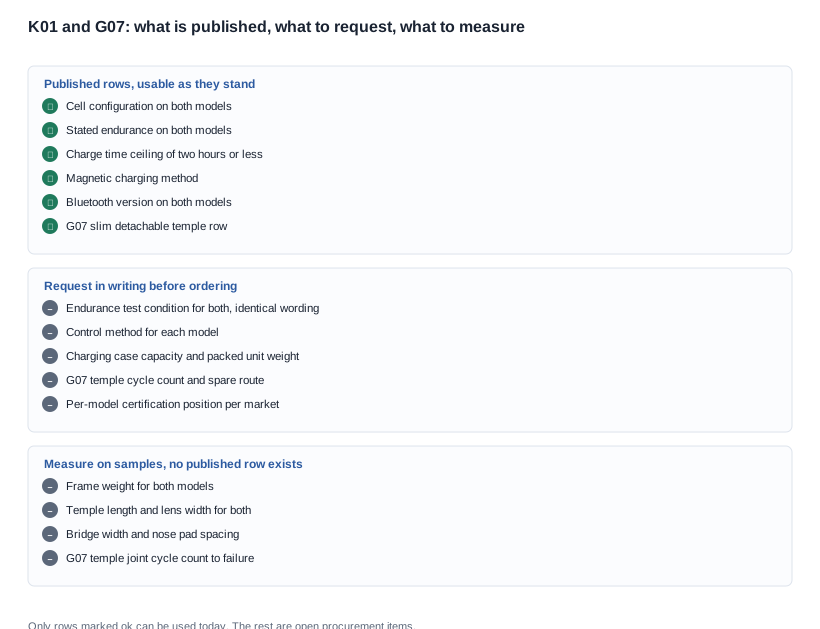
The endurance test condition for both models, asked in identical words. One request, one reply each, and the runtime row either becomes usable or is formally retired from the comparison. Without it, the eight-hour and six-hour figures sit side by side in every comparison table and nobody can act on either.
How each model is controlled. The catalogue publishes no control-method row for any model, including these two, so the control surface, the behaviour and the failure mode all have to come from the supplier. A buyer who lists a control method without that answer is asserting something our documentation does not contain, and the risk is not only that the page is wrong — it is that a control activated by contact with a face produces a support cost rather than a feature.
The G07's three spare-temple questions. Cycle count, connector design, and whether spare temples are stocked and at what price. A detachable temple without a replacement route is a design feature with a service problem attached, and the two are worth different amounts.
The charging case and packed unit weight for both. Neither model publishes a charging-case row, so the parcel cannot be modelled from the catalogue, and a magnetically charged frame implies a dock in every carton.
The certification position per model per market. Our catalogue carries a company-level export certification page whose content is images rather than text, and the catalogue text contains no reference to CE, FCC or RoHS. There is no per-model certification row for either model, so this is a document request with a lead time — and it should be the first request out, not the last.
What a buyer has to measure
Weigh and measure a sample of each model. Frame weight, temple length, lens width, bridge width, nose pad spacing. This is the row that predicts the return rate, it is missing on both sides, and it is closed in an afternoon with a scale and calipers. It is also the only measurement that lets a buyer write anything specific about fit, because no other source exists.
Cycle the G07's temple joint to a stated count and record where it fails. If it survives, the service claim holds. If it does not, the claim has to be dropped before the copy is written rather than after a customer reports it.
Compare the two frames side by side rather than in isolation. A buyer who measures each against an office ruler learns two numbers. A buyer who holds them against each other learns the thing that matters — whether the G07's slimmer temple is visibly different at the viewing distance a customer sees them from, which is the difference between a shelf differentiator and a manufacturing detail.
The five failure modes this comparison produces
A dimension was inferred from a photograph or from a competitor's listing. Symptom: the purchase order is placed on a shape that does not arrive. Root cause: an inference was made where a measurement was needed. Prevention: weigh and measure, and treat any inferred dimension as unsupported.
The ultra-slim temple was read as a light frame. Symptom: a listing implies lightness, comfort complaints arrive, and the channel carries the correction. Root cause: a design word was read as a weight claim. Prevention: quote your own measurement or quote nothing.
The runtime row decided the comparison. Symptom: the K01 was chosen for a longer day and the field result does not match the table. Root cause: a figure with no condition was read as a product property. Prevention: set the row aside until the conditions are documented for both.
The detachable temple was sold as a repairability promise. Symptom: a broken arm cannot be replaced and the channel absorbs the cost. Root cause: the cycle count, the connector and the replacement route were never established. Prevention: ask the three questions and price the answer.
V5.3 was discovered as a problem at the market-access stage. Symptom: a market conversation that cannot be closed on the documentation. Root cause: the radio version was never checked against the customer's platform. Prevention: check it in the first round of questions, alongside the certification request.

What this comparison is worth commercially
The choice is between a service proposition and an energy proposition, and the unit price gap is usually the smallest of the three variables. A channel selling on repairability gets a lower write-off rate and a spare-parts line from the G07, if the temple is user-replaceable and stocked. A channel selling on published energy in the frame gets the K01, whose 90mAh*2 configuration is the larger of the two. Price is the third variable, and it should be scored last.
The terms worth spending negotiation time on are unit price and volume tiers, the accessory set and its own minimum order quantities, the spare-temple route and its pricing, packaging specification, delivery splitting, payment nodes tied to inspection, the warranty period with a stated response, and the terms of a pilot order. The spares route is the one that changes the after-sales cost rather than the purchase cost, and it is the one most often left undefined.
Two cost lines behave differently from the rest. Certification cost and its timeline follow the process and the testing body, and tooling is frequently amortised across a first order while certification sits per product family — so ask which of the two is being quoted, because the two are often bundled into one line that hides which carries the volume.
What the agreement should carry
The published rows for the configuration ordered; the endurance figure with its condition once established; the temple treatment and the spares route with its cycle count and replacement price; the control method and its operating conditions; the frame weight and dimensions as measured and agreed; the certification position per market; and the warranty period with a stated response.
What must be left out is any weight, dimension, acoustic figure, control method or runtime claim that is neither published nor measured for the specific configuration being ordered.
The three clauses that decide which model a buyer ends up with
Most of the agreement language in this category is boilerplate that neither buyer nor supplier reads closely. Three items are worth writing carefully, because each one changes which model a channel can honestly sell.
The temple clause, where the G07 is in scope. Write the arrangement rather than the adjective: whether the temple detaches by hand or with a tool, the cycle count the joint is rated to, the connector or interface used, whether a replacement temple can be ordered separately, and at what price. A clause that says the frame has a detachable temple establishes a feature. A clause that says what happens after the twentieth break establishes a service. The second one is what a distributor's returns department will actually rely on, and it is the clause that gets left out.
The measured-specification clause, for both models. Write the frame weight, the temple length, the lens width and the bridge width as measured on an agreed sample, and state that the figures apply to the configuration ordered. This clause exists because no weight or dimension is published for either model. Without it, the delivered unit's dimensions are whatever the production run produced, and there is nothing to inspect against.
The endurance clause, which can be written two ways. Either the agreed test condition is stated alongside the figure and the figure becomes usable, or the clause records explicitly that no condition has been agreed and the figure will not be used to differentiate. The second version is less satisfying and considerably safer, and it is the version that survives when a customer compares the K01's eight hours against a competitor's product quoting the same number for a different reason.
A buyer who writes those three clauses before the artwork is commissioned has also written the decision criteria, because each clause names the evidence the listing will depend on.

Where CYNRIN stands on the K01 and G07 form factor question
This comparison is mostly empty by construction, and saying so is more useful to a buyer than filling it with plausible dimensions. The rows that exist are a detachable temple, a cell configuration difference and a radio version difference, and those are enough to choose between two products. We will not fill a weight or a dimension with an estimate, we will not publish a control method the catalogue does not record, and we will not describe an AI capability as a documented specification when no model in this pair publishes one.
What we will do is narrow the decision to the two claims that are actually available and name the evidence still outstanding for each. Tell us whether repairability or energy drives your proposition and we will take it to one model. The K01 specifications and features page is the published baseline for the K01, the G07 limitations page sets out the G07's gap set, and the range as a whole is on the Bluetooth audio glasses range page.
Five things to do next
- Weigh and measure a sample of each model, and record the fit data.
- Ask the three spare-temple questions for the G07.
- Ask the runtime condition for both, in identical words, in the same message.
- Ask how each model is controlled, before any control method is listed.
- Set the listing boundary before the copy exists, and put the pass lines in the agreement.
Related reading
- The published baseline for the K01 — K01 smart glasses specifications and features
- The gap set on the other model — G07 smart glasses limitations
- The measurement work itself — materials and ergonomics
- Choosing across the wider range — Bluetooth audio glasses which model to pick
Give us the target market, the quantity and the required configuration, and we will reply with what is available and what is not.


