

Five rows are published for the K02: Bluetooth 5.3, two 90 mAh cells, a charge time of up to two hours, roughly eight hours of rated use, and magnetic charging. That is genuinely all of it. It is enough to decide whether the product is in the right ballpark, and nowhere near enough to sign a purchase order against. The gap between those two statements is what this article is about — the specific set of things to check before ordering, and the order in which asking them saves the most time.
That combination makes it easy to buy quickly and hard to buy well, and the difference shows up four to eight weeks after shipment rather than at the quotation stage. By then the specification has already been printed on your listing, the packaging has already been tooled, and the channel has already been trained on claims nobody checked. The twelve questions below exist to move that discovery forward to the stage where it is still cheap.
The K02 is a straightforward hardware product with a thin published file. That combination makes it easy to buy quickly and hard to buy well, and the difference shows up four to eight weeks after shipment rather than at the quotation stage.
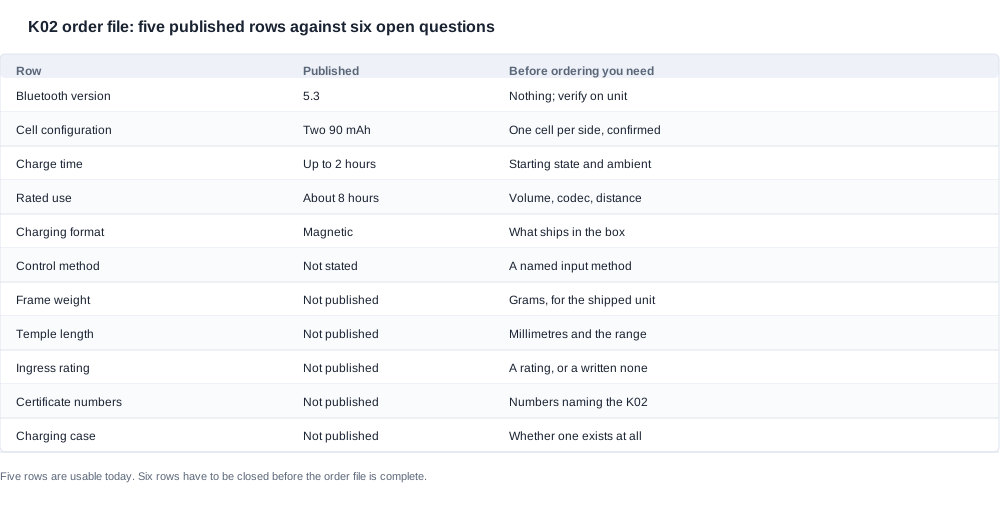
K02 published rows: five lines, and how far each one carries you
Bluetooth 5.3. Correct and current enough for an audio accessory. Do not let a supplier present the version number as a differentiator; in this category it is rarely one, and negotiating on it wastes a conversation you will need later.
Two 90 mAh cells. A real capacity figure and one of the larger ones published in this range. The cell count is stated as two, which implies a cell per side — an architecture detail worth confirming, because a single-cell design behaves very differently when one side fails, and because a per-side failure on a two-cell design may be repairable in a way that changes your service cost entirely.
Charge time of up to two hours. Reasonable and unremarkable. The published figure does not say whether that is from empty, from a flat battery, or under a stated ambient condition, so time it yourself before it appears in a specification table on your site.
Roughly eight hours of rated use. The most useful row and the most slippery. No volume, codec, distance or duty cycle is stated. Treat it as a ceiling rather than an expectation, and do not place it beside a competitor's figure that was measured under a different condition, because the comparison will not survive a buyer who asks how both numbers were obtained.
Magnetic charging. That is the format, not the experience. What ships in the box beside it is not published, and a magnetic pad with no cable and no case is a support contact rather than a product.
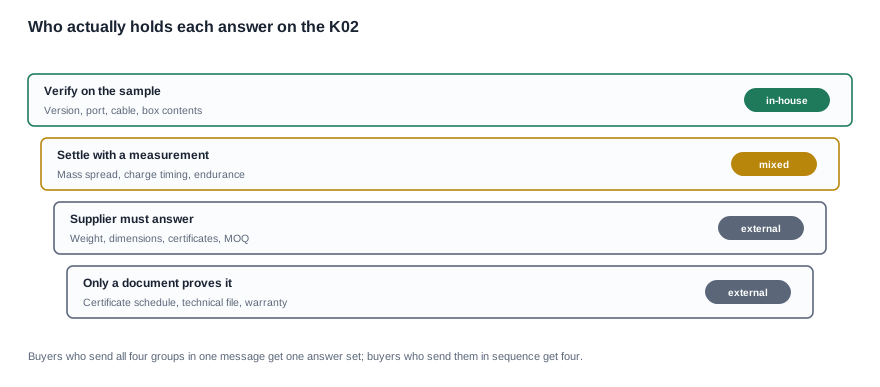
One practical consequence follows from that. When a supplier's published file is short, the temptation is to treat the missing rows as unimportant, because a short list leaves nothing obviously absent. The opposite is true: every row you cannot see is a row where the supplier may hold a figure and simply has not published it, or may genuinely not have one. You cannot tell which from outside, and the two cases lead to completely different decisions. A row that exists but is unpublished is a documentation request. A row that does not exist is a product limitation, and you cannot create it by asking.
The pattern across all five rows is the same, and it is worth naming because buyers routinely misread it: a published row tells you the product exists in that configuration, not that the figure is a measured specification. The distinction is what separates a five-line file you can order from with confidence and a five-line file you can order from with a request attached.

Four places the money is lost after shipment rather than before it
A purchase order for a frame is not a purchase order for a box of cables. There are four areas where money is lost after the goods have shipped rather than before, and all four are invisible in the published data.
Sizing and returns. Frame weight and temple length are not published for this model. A frame that does not suit returns, and returns on a product at this price point are expensive because the reverse logistics cost a meaningful share of the unit value. Ask for both figures, for the specific unit you will ship, rather than for a platform average.
The compliance match. Our catalogue publishes no CE, FCC or RoHS text and no per-model certification row. The certificate numbers, the issuing body and the list of models each certificate covers are not published. A certificate for a sibling model is not a certificate for the K02, and this is the single most common document failure in the category: everything looks complete until somebody checks the schedule and finds the model designation missing.
The box contents. Whether a charging case is included, whether it is a separate line item, and what happens when a customer returns the unit without it. All three are commercial decisions with reverse-logistics consequences, and all three are invisible until a return arrives.
Ask for the spare-part price list, not just for confirmation that parts exist. A part that is described but unpriced is not a service option; it is a warranty queue. The same applies to the warranty: ask what the period is, what it excludes, who receives the claim in each market you sell into, and what evidence the claimant has to supply. Where the answer is a general policy rather than a model-specific term, write it into the purchase order anyway, because a general policy changes without notice and a written term does not.
The service path. Replacement tips, replacement temples, spare charging cables and the warranty terms are all unpublished. At this price point the service path is what determines whether your channel can carry the product at all, because a channel that cannot service a product cannot sell it confidently and will discount it to compensate.
Returns are the item most often underestimated, so it is worth being concrete about the arithmetic. A unit that comes back costs the reverse shipment, the handling, the inspection and the re-listing, and in many channels it never re-sells because the packaging has been opened. That means a modest return rate on a low-value product consumes a large share of the margin, which is why an unpublished frame weight is not a missing curiosity but a missing input to a number you already care about. Where the weight cannot be obtained, the mitigation is to state sizing guidance conservatively in your own documentation rather than to leave it to the customer.
Each of these four has a matching question below. What connects them is that none can be answered from the published data, and all four can be closed in a single written exchange if you send them together.
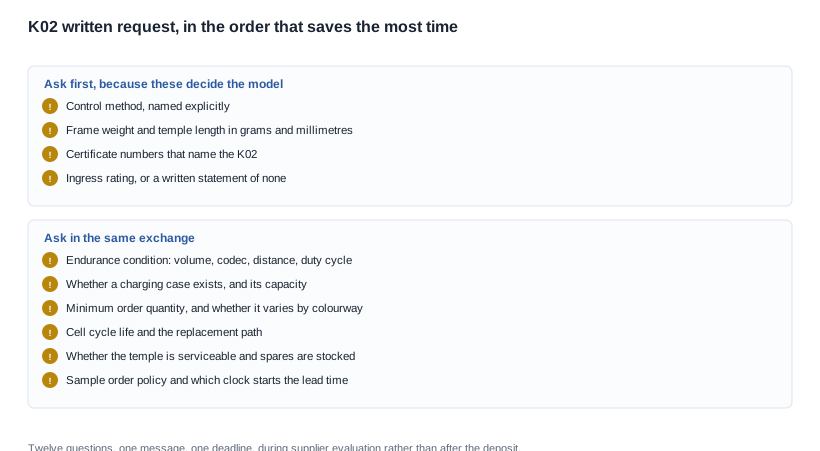
The twelve questions, and the order that saves you the most time
- What are the frame weight and the temple length in millimetres? Both, for the specific unit you will ship, including the adjustment range if the temples move.
- Is a charging case included at my order quantity, and is it a separate line item?
- What test condition produced the eight-hour figure? Volume, codec, distance from the phone, and whether anything else on the device was active during the measurement.
- Do the certificates name the K02 specifically? Ask for the certificate and its schedule, not for a statement that the product is certified.
- What is the ingress protection rating, if any? Not published. If your channel is outdoor, this is a blocker rather than a detail.
- What is the control method? Not stated for this model, which is the awkward part of the two-model comparison discussed below.
- What is the published minimum order quantity, and does it differ by colourway or packaging?
- What is the rated cycle life of the cells, and what is the replacement path when one fails?
- Is the temple serviceable, and are spare temples stocked as parts?
- What is the sample order policy — units, cost, dispatch time, and whether the cost is credited against a first bulk order?
- Which clock starts the lead time, and does it hold at my volume and my colour count?
- What is the warranty period, what does it cover, and what is the claim route after delivery?
Evaluate the answers by shape as well as by content. A number with a stated method and an attached document is usable. A number without a method is a starting point for negotiation. A confident adjective is nothing at all, and it should be recorded as absent rather than as answered. Score the replies across suppliers in a single three-column sheet — question, answer type, evidence attached — because a structured comparison takes about ten minutes per supplier and it converts an opinion into a record that you can defend to your own management later.
Send them as one message with a deadline, during supplier evaluation rather than after the deposit. There is a specific reason for the deadline beyond urgency: a supplier who answers a twelve-point structured request in one response has demonstrated that they hold per-model records, which is the property you will need most if a shipment later arrives short of the file. A supplier who answers three and offers to look into the rest has demonstrated something else, and it is cheaper to learn now.

Why two models with identical rows are not interchangeable
The K02 shares its battery platform with another model in the same range: Bluetooth 5.3, two 90 mAh cells, roughly eight hours, magnetic charging. The two are distinguished in our own documentation by a translation feature listed against one of them, and by a capacitive touch control published against one of them while the other states no control method at all. The translation feature is a company self-description we have not independently verified and are not asserting here.
That comparison is worth stating plainly: two models with identical published electrical rows are not interchangeable on paper alone.

If you are choosing between them, the honest basis is that the electrical platform is the same and the decision rests on the feature claims, which you should verify before building a listing on either. Ask what the actual difference is, in writing, before picking one on price. A price difference between two models whose published rows are identical is usually being paid for a feature that one of them documents and the other does not — which is a defensible reason, but only if you know which one you are buying.
Ask the question in a form that produces an answer you can put in a contract rather than an answer you can put in a conversation. "What is the difference?" reliably returns a feature description. "What is the difference, expressed as a specification row, a document reference or a price difference?" reliably returns something you can negotiate against. Suppliers are not being evasive in the first case; they are answering the question that was asked, and the first question does not have a checkable answer.
The same logic applies within your own catalogue. Two products listed on adjacent pages of your site, sharing a specification table, differing only in a feature nobody has evidenced, is a comparison that a technically literate customer will resolve against you rather than for you.

Terms to settle before the purchase order rather than after it
Several of the twelve questions are commercial rather than technical, and those are the ones most often left until the quotation has already been accepted.
Price tiers and minimum order quantity. Not published. Ask for the tier structure at your volume and ask whether it differs by colourway or by packaging, because the second question is where the real cost hides on a product with several variants. A price tier that assumes a single colourway is not a price tier.
Lead time. Not published. Ask which clock starts the period — deposit, artwork approval or confirmed purchase order — because the three readings differ by weeks. Ask whether it holds at your volume and your colour count, and what happens to it if a component is substituted late in production.
Sample order policy. Units, cost, dispatch time, and whether the cost is credited against the first bulk order. A sample that is neither credited nor discounted is a real cost on a product at this value, and it is the kind of term that is easy to agree in principle and never revisited.
Payment terms. Deposit percentage and the balance trigger. Ask what the balance trigger is attached to: a shipping date, a passed inspection, or a bill of lading. Each is a different transfer of risk, and only one of them gives you evidence before you pay.
Warranty and defect allowance. The period, what it covers, who receives the claim, and the allowance applied on a failed pre-shipment inspection. Write the allowance and its remedy side by side, because an allowance without a remedy becomes a negotiation that starts once the container has sailed. Where a supplier resists, record the resistance against the supplier rather than against the model.
The quality control arrangements belong there too. Agree the pre-shipment sample size, the defect classes that count against the allowance, and who pays when the inspection fails. Draw the sample from packed cartons rather than from a finished-goods pile, because packed units are the units that reach your customer. Where a supplier resists a named sample size, that is worth recording against the supplier rather than against the model, because it tells you what an inspection dispute will look like when you have one.
Incoterms belong in the same conversation, because the named term and the place together decide who carries the risk for the part of the journey that usually goes wrong. Leave either one vague and the argument at the port is between two parties who both believed they were covered.
Who the K02 fits, and when a different model is the better buy
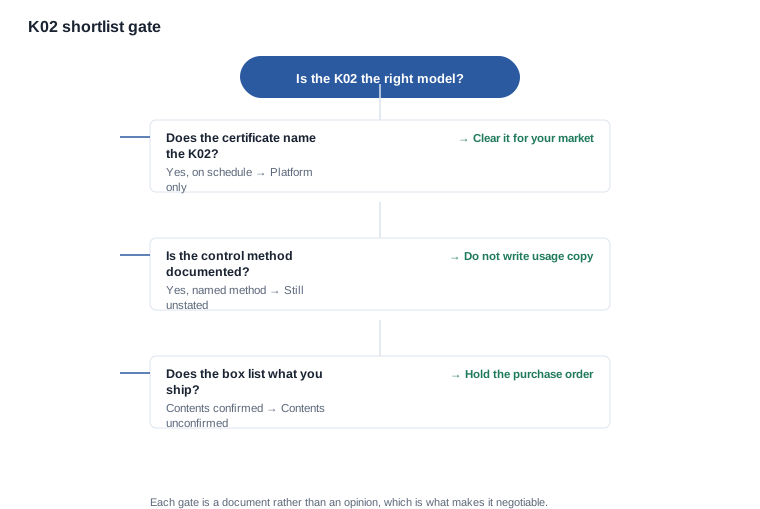
Name the cases, because a shortlist containing only the model you can supply is not a shortlist. If your channel is call-led, the K02 has no published microphone specification and no published pickup condition, and a model that publishes either will convert better at the same price. If your channel is outdoor or industrial, no ingress rating is a blocker rather than a gap. If your listing depends on a documented user experience, no published control method means nobody on your side can write the instruction, and a buyer who cannot find the control will conclude the product has none.
If you want to move quickly, the short version is question one, question four and question five: weight and temple length, certificates that name the model, and the ingress position. Those three answers are enough to decide whether the K02 belongs on your shortlist at all, and they are the three rows where a blocker is most likely to appear late. The remaining questions matter once you have decided to proceed, and none of them changes that first decision.
Where the K02 is a reasonable pick: general retail, promotional volume, and channels where the frame is sold on weight and price rather than on features. The electrical specification is generous for the category, the interface is current, and the absences are absences of documentation rather than evidence of a problem.
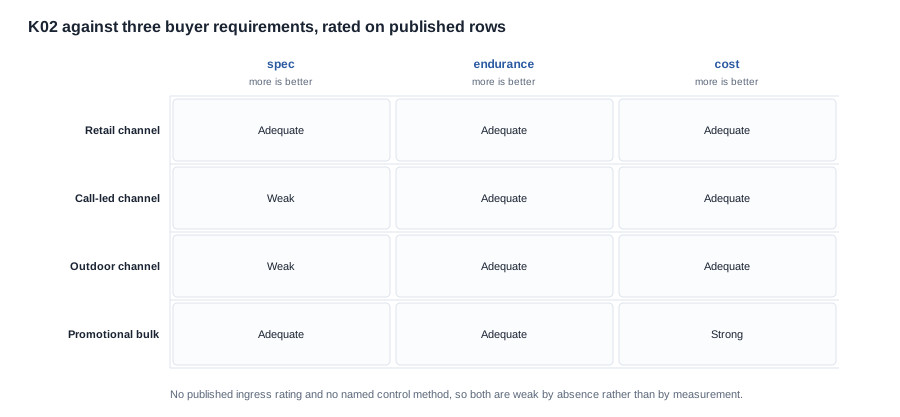
Buyers should also know what they are not buying. No published frame weight, no published temple length, no published ingress rating, no named control method, no certificate numbers and no charging case capacity. If any one of those is central to your proposition, settle it before you commit rather than after the first quarter of channel feedback.
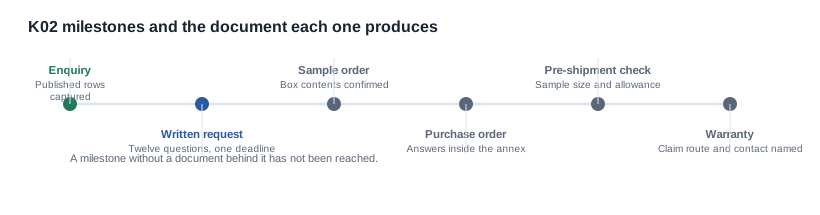
Run the evaluation as a single exchange rather than as a sequence of stages, and record the outcome in one place. The practical sequence that works is: capture the five published rows, send the twelve questions with a deadline, score the replies by shape, order a sample once the three blocking rows are answered, and issue the purchase order with the surviving answers inside the annex. Buyers who follow that sequence usually sign inside a month. Buyers who follow the specification first and the commercial terms afterwards usually sign inside a month as well, having renegotiated twice on the way.
We can give you the published rows for the K02, and we can tell you item by item which of the twelve questions we can answer from the material we hold. We will not estimate frame weight from comparable models, we will not quote a market price, and we will not claim a certification status we cannot evidence with a certificate number.
If you send us your target market, the retail price you need to hit and the quantity, we will come back with the K02's realistic position in that brief — including telling you when the answer is that a different model in the range fits better.
Related reading
- How this model is placed — which Bluetooth audio glasses model to pick
- Reading the runtime figure honestly — battery comparison for Bluetooth audio glasses
- Checking a certificate rather than a claim — Bluetooth SIG certification checklist
- What an unpublished weight does to freight — weight comparison across the range
Send the market, the price and the quantity, and we will tell you what is realistic for the K02.


