

Not one model in this range publishes a frame weight. A comparison built on published figures is therefore impossible, and the useful version of this article is a comparison of what the configurations imply — which is an inference, clearly marked, and which points to the one place a real number can be obtained.
Bluetooth audio glasses weight comparison: the numbers do not exist
The comparison is missing a definition, not a data set
A buyer who wants to compare weights across this family hits a wall at the first step, and the wall is usually described as missing data. It is not. The wall is that a weight figure without a scope definition is not a fact about a product; it is a fact about a measurement, and two measurements with different scopes are not comparable no matter how precise they are.
The scope questions are the same in every category and they are almost never asked: does the figure include the charging case, or the frame alone; are the cells fitted; are the accessories and the cable inside the figure or outside it; is it a single unit or a mean across a sample; was it measured on a sample unit or on a production unit; and what is the resolution and the tolerance of the scale. Two suppliers answering all six the same way produce a comparison. Two suppliers answering three of them produce a table that reads like a comparison and is not one.
This is the whole method for a weight comparison in a category with no published weights: define the scope first, then collect, then compare. The definition is the part that costs nothing and the part that is almost always skipped.
What the published rows do support, and what they do not
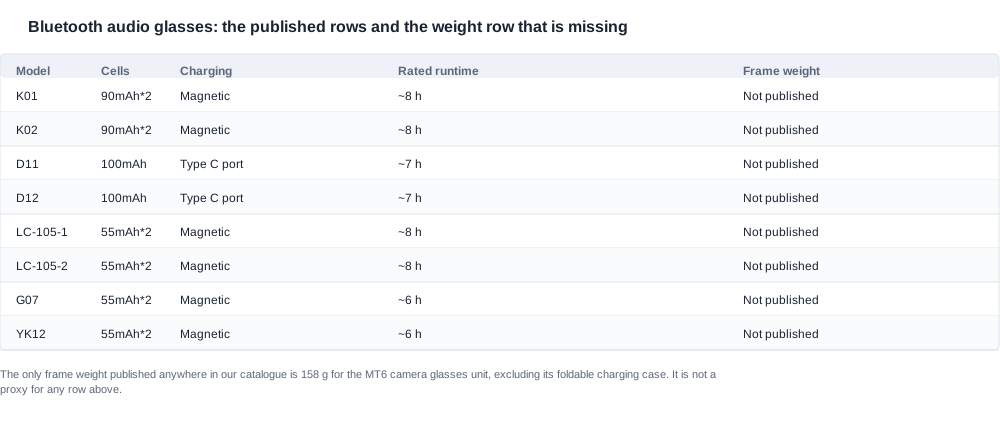
The table above is the entire published record for the eight audio models, and the last column is empty for all of them. The Bluetooth version, the cell configuration, the charge time, the rated runtime and the charging method are published; the weight is not.
What the published rows do support is a structural grouping. It is a grouping by configuration, and it is worth being explicit that it is not a price tier: we do not publish prices, minimum order quantities or lead times, and the group below carries no commercial ranking of any kind. It exists to tell a buyer which rows to weigh first when they weigh samples, and to establish that some questions about a model are already closed before the sample arrives.
What the published rows do not support is any statement of the form "this model is lighter than that model". That statement requires a number, and no number exists for either side of the comparison.
The one published weight in the catalogue, and what it can do
Exactly one frame weight is published anywhere in our catalogue: 158 g for the MT6 AI camera glasses unit, explicitly stated as the glasses unit including its battery and camera and excluding its foldable charging case, whose capacity is published separately at 1200 mAh.
It is worth being precise about what that figure can and cannot be used for, because it is the number most likely to be misapplied.
It can be used to establish the order of magnitude of a device of this class, which is a real and useful anchor when a buyer is deciding whether a quoted figure is plausible or whether the supplier is describing a different product class.
It cannot be used as a proxy for any of the eight audio models. The MT6 is a camera platform with a different battery, a different electronics load and a different temple construction, and the 158 g explicitly excludes a foldable charging case that none of the eight audio models is documented as shipping. Treating it as a proxy produces a number that reads like evidence and is not.
What the published rows imply, and how far that inference can be pushed
Reading the configuration columns
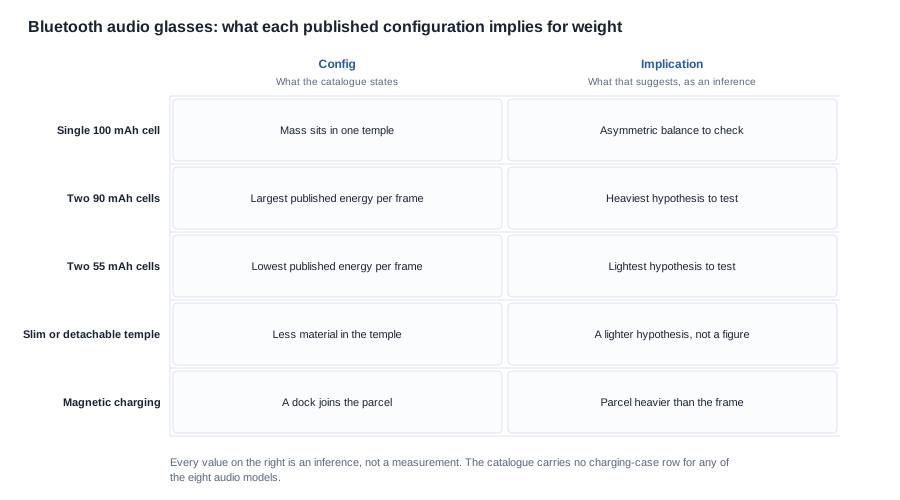
The matrix above is a hypothesis, and it is labelled as one in every cell. It exists to order the work — which samples to weigh first — and not to produce a ranking.
The single-cell group. The D11 and the D12 publish a single 100 mAh cell. A single cell sits in one temple, so the mass is asymmetric by construction, and the balance of the frame is a different question for these two models than for the rest of the family. That is a reason to weigh them and to record the balance, not a statement that they are heavier or lighter than anything else.
The 90mAh*2 group. The K01 and the K02 publish the largest energy configuration in the family, 90mAh*2. On the reasoning that more energy means more cell mass and more electronics, this is the heaviest hypothesis in the range and the first place a buyer should put a scale.
The 55mAh*2 group. The G07 and the LC-105-1, and the LC-105-2 and the YK12 publish the smallest energy configuration, 55mAh*2, and this is the lightest hypothesis. It is also the group where the two published feature rows sit: the G07 publishes an ultra-slim detachable temple, and the YK12 publishes a surround sound claim together with a slim temple.
On the temple rows. A slimmer temple is usually a lighter temple, and the detachable temple on the G07 changes the construction rather than merely the profile. Both of those are reasonable inferences from the published feature rows, and neither is a measurement. The G07 is also the model where the weight question is most likely to decide a shortlist, because a detachable temple is a service and sizing story as well as a weight story, and the two questions arrive together.
On the interface row. Six of the eight charge magnetically and two charge over Type-C. That splits the accessory chains, and a magnetic chain implies a dock, and a dock is a second cell in the parcel. Note the careful wording: the catalogue publishes no charging-case row at all for any of the eight audio models, so the presence of a case remains an open question for every one of them, including the two that charge over Type-C. It is the packaging question, not the weight question, that decides this, and the shipping weight analysis sets out the six elements of a shipped parcel.
The runtime tiers, and why they are the closest published proxy
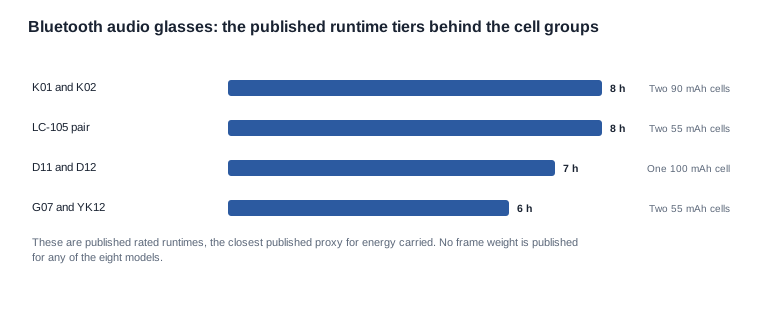
Where the published rows are forced to do indirect work, the runtime figures are the best proxy available, because a rated runtime is a statement about how much energy the cell configuration carries and how efficiently it is used.
The tiers are: approximately eight hours on the K01, the K02 and the LC-105 pair; approximately seven hours on the D11 and the D12; approximately six hours on the G07 and the YK12. Note that the two 55mAh*2 models at the lower end of the range publish the higher runtime, which is a reminder that runtime is not a function of cell capacity alone — the load, the radio and the power management are in it too, and no test condition is published for any of them.
That last point is the warning label on the whole exercise. A runtime figure is a rated figure, produced under conditions nobody publishes, and it is the same class of number as a weight figure. It is useful for grouping and it is useless as a specification.

Making two suppliers' weight figures comparable
The five scope questions, and why they are the method
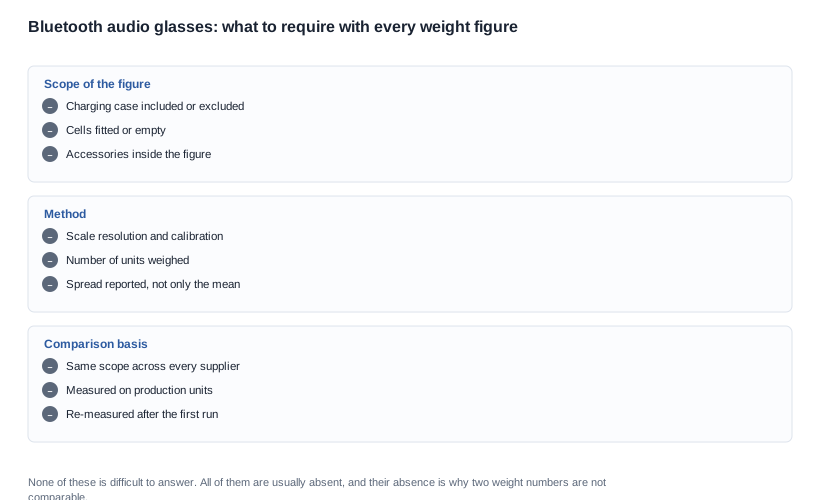
The checklist above is the collection protocol. It is short, and every line of it is a question to put to every supplier in the same form, so that the answers are comparable by construction rather than by assumption.
The scope questions establish what the number covers. A frame weight that excludes the case, a packed unit weight that includes it, and a parcel weight that includes the carton are three different quantities, and a comparison that mixes them is meaningless.
The method questions establish how much the number is worth. A single unit on a consumer scale is a different kind of evidence from a sample of ten production units on a calibrated scale, and a supplier who reports the mean without the spread has given you a number that can move by an amount you cannot see.
The comparison basis questions establish whether the figure survives contact with production. Packaging and tooling change between the sample and the first production run, and a weight taken from a sample unit is a statement about the sample.
The normalisation rule, stated once
Write the scope into the request, not into the spreadsheet afterwards. If a supplier's figure is "the frame with the cells fitted, excluding the case and the packaging", ask every other supplier for the same scope and mark any answer that does not match as out of scope rather than converting it. Converting a figure requires assumptions, and the assumptions are the whole problem.
This is the part of the exercise that reads like pedantry and is not. A comparison assembled from mismatched scopes does not fail visibly; it produces a confident ordering, and the ordering is wrong in a direction that depends on which supplier answered the question most loosely.
A worked normalisation, with two quotations
Two quotations arrive for the same configuration. One states the weight of the frame with the cells fitted. The other states the weight of the frame, the cells and the retail box, both without the charging case, and both taken from a sample of three.
Neither figure is wrong. They are not comparable, and the difference between them is the difference between the device and the parcel.
The normalisation has three steps. First, identify the scope of each figure and mark the parts that are not shared: the box is inside one and outside the other, and the sample sizes differ. Second, decide which scope the comparison needs. For a product-page claim the answer is the frame with the cells fitted, because that is the object the customer holds. For a freight model the answer is the packed retail unit, and for a channel margin model it is the carton weight divided by the units in it. Those are three different questions and each one needs its own figure. Third, request the missing scope from each supplier, in the same words, and hold the comparison open until both answers arrive.
The red flag to watch for is a figure that arrives with no scope stated at all. It is more common than the mismatched figure, because it is easier to produce, and it is the reason a comparison assembled from a mixed set of quotations has to be rebuilt rather than adjusted.
Claims the category can support, and the ones it cannot
The two words that need a number
"Lightest" and "heaviest" are the two words a competitor's product page uses, and they are the two words that require a number behind them. A range where no model publishes a weight cannot support either one, and a brand that writes "lightest in the range" without a figure is making a statement it cannot evidence.
The competitor landscape piece covers who is making which claim in this category, and the premium options analysis sets out which arguments the category can actually support today.
The claims that can be made without a number
A brand can say things about a model that describe its configuration rather than its mass: the cell architecture, the charging interface, the rated runtime, the temple description, the published feature rows. It can say that a model publishes a detachable temple. It cannot say that it is lighter than the alternatives, and it cannot say that it is the lightest in the range, without a measured figure and a stated scope.
That is a narrower position than a marketing team would like, and it is the one that survives a claim, a competitor's comparison and a marketplace review.
What to write instead
A product page that cannot state a weight does not have to be silent about the physical side of the product. It can describe what is published: the charging interface, the cell configuration, the rated runtime, the temple description, the detachable temple where the model publishes one. It can describe what a buyer can verify — that the frame was weighed on production units, on a stated scope, with the spread recorded.
What it cannot do is rank. The two words that rank are the two words that need a figure on both sides of the comparison, and in this family there is no figure on either side. A listing that describes configuration is accurate; a listing that ranks is a claim, and the claim sits with the brand for as long as the listing is live.
Why the gap matters more than it appears
Balance. The frame's mass distribution is a function of the cell architecture, and the D11 and the D12 put their single cell in one temple. A balance problem appears in the field as a physical complaint rather than as a defect, so it never appears in a defect rate.
The parcel. The frame is the largest single component of the shipped weight, and the shipped weight is the freight rate.
Returns. A physical complaint does not come back with a fault; it comes back as a return, and it is attributed to the product rather than to the geometry. The physical-side analysis of this family covers the mechanism behind that link.
Channel expectations. A category where the weight is not published is a category where the listing copy drifts towards adjectives, because there is no number to write instead.
A hypothetical shortlist, and the five numbers to close before you order
A hypothetical shortlist, worked through
Treat this as an illustrative case rather than a client project; the purpose is to show the decision sequence rather than to report what happened.
Assume a channel buyer who has narrowed the family to four models on published rows alone and now needs a weight basis to choose between them.
The first step is the grouping, and it is structural rather than commercial. The four candidates fall into two 55mAh2 models with a published temple feature, one 90mAh2 model and one single-cell model. That grouping tells the buyer which published rows to read and which questions to ask; it does not tell them which model to sell, and it is not a price tier.
The second step is the scale plan. The buyer weighs the 90mAh2 model first, because it is the heaviest hypothesis, and the two 55mAh2 models last, because they are the lightest. Three scale readings, plus the single-cell model, characterise the shortlist. Each reading is recorded against a stated scope: frame only, cells fitted, production unit, sample of ten, spread reported.
The third step is the accessory question, asked per model rather than assumed across the range, because the catalogue publishes no case row for any of the eight. A model that ships with a dock and a model that does not cannot be compared on packed weight, and the comparison has to be made on the frame or the comparison has to be made twice.
The fourth step is the claim. The buyer writes the listing without "lightest" and without a weight figure, because at this point there is a measured number but no comparative statement, and a comparative statement needs the same scope across every model in the comparison, including the ones the buyer did not weigh.
The fifth step is the re-measurement after the first production run, with the same scope, so that the number in the file is the number the factory is producing.
The outcome is a defensible number and a narrower claim. Both are worth more than a figure that cannot be reproduced.
What we publish, and what we will not do
No weight figure in this range can be quoted because none of them is published, and the configuration-based ordering above is an inference we have labelled as one rather than a comparison we would put on a page.
We will not publish a frame weight, a packed unit weight or a certificate number that the documentation does not contain, and we will not describe any model in this range as the lightest or the heaviest. We will not fill an unpublished row with a typical value, and we will not carry a figure across from one model to another. What we will do is tell you exactly which rows differ between which models, and which questions we can close for you on request.
The who needs the G07 analysis covers the model where the weight question is most likely to decide the order, and the family is on our Bluetooth audio glasses range page.
Five items to establish for a weight comparison
- The frame weight per model, measured on production units with the cells fitted, with the spread reported.
- The frame dimensions, measured on the same units.
- The case weight, where a case exists — and the answer to whether one exists at all, which the catalogue does not publish for these eight models.
- The packed unit weight, per configuration, on a stated scope.
- The re-measurement after the first production run, on the same scope, so the two numbers can be compared.
Related reading
- Why the physical side decides the outcome — the physical-side analysis
- Establishing the parcel figure — bluetooth audio glasses shipping weight
- Which claims this category can support — bluetooth audio glasses premium options
Send us the models you are shortlisting and the volume, and we will tell you which samples to weigh first and what a real figure would let you claim.


