

Kids eye protection glasses technology: the growth window
A children's product is bought against a period, not against a fitting. The A05, the A06 and the A07 all publish the same rough-use figure of around twenty hours, and not one of them publishes a frame dimension, a temple length or a unit weight, so the only compatibility question with real money behind it is the one the catalogue cannot answer: how long does the product still fit once the child has grown into it. Kids eye protection glasses technology smart glasses compatibility is read here as four separate compatibility questions — growth, routine, household and configuration — and only the first of them decides whether a buyer gets a reorder from a satisfied household or a return at month three.
The short answer is that you should not commit to a children's line until you have measured the fit across the age range you intend to serve, and you should not write an age range on a listing until that measurement exists. A size guide on a product page is an assertion, and an assertion that a retailer discovers was wrong is a restocking decision they make without telling you.
The growth window, stated in three sentences
Choose on the growth window rather than on the published cell capacity, because the published capacity in this tier is 40 mAh on the A05 and the A06 and 70 mAh on the A07, and none of those three numbers tells you how long the frame stays wearable. If your channel sells a two-year-old's glasses to an eight-year-old's parent, the fit programme is the line item that decides your return rate, and it is the one line most often omitted from the first quotation. If the fit is not your problem — an optical channel, or a gift market where the child is nine and stays nine for two years — then the compatibility question shrinks to configuration and household, and you can decide this tier in a fortnight rather than a quarter.
What the buyer is holding when the growth-window question arrives
The buyer working through compatibility is usually a brand owner or a channel buyer who has already decided the product category and is now deciding whether a children's line is viable, and they are holding samples, a customer profile, a size range in their head rather than in a document, a target price and a market list. What they are not holding is a sizing system, and in this category a sizing system usually comes from the design team's intent rather than from a measurement of real children.
The commercially expensive part of that gap is the handover. The person who signs the purchase order is rarely the person who decides whether the product keeps being worn in week nine. A parent approves a device for their child on documentation, on the claim wording and on the photos; the child decides on comfort and on whether it nags, and the second decision is the one that ends the reorder. Every part of a compatibility programme that only addresses the first decision is a programme that answers the wrong question.
Four compatibility questions a buyer's spreadsheet hides from itself
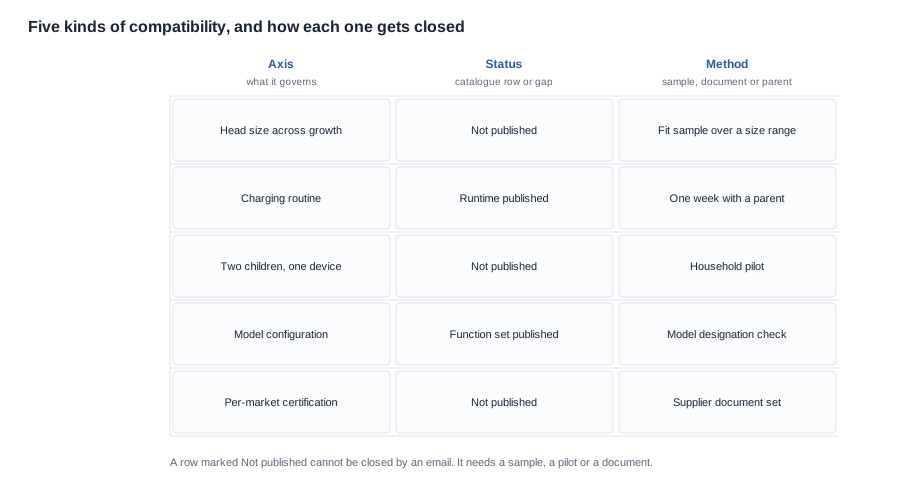
Compatibility in this category is four questions wearing one word, and a spreadsheet that has one column headed "compatibility" will quietly collapse all four into whichever one the supplier answered most confidently. That is why the same A05 unit can pass a review with a buying manager and still generate returns from an optician. How to choose a shortlist on four axes rather than one is a commercial decision that belongs before the sample order, not after it.
The first question is growth compatibility: whether the temple length and the frame width still work on a head that has grown since the fitting. This is the only one of the four that decides the product's commercial life, because a child who outgrows the product at eleven is a customer who will replace it at eleven, and a child who outgrows it at nine has already cost you a year of reorder.
The second is routine compatibility: whether the charging routine works in the household that bought it. A magnetic charger that lives on a hallway table is a different product from one that lives in a child's bag, and the published twenty-hour rated use says nothing about which one you have. The A05 and the A06 publish magnetic charging and a charge time of two hours or less; the A07 publishes the same. Where the charger is kept, who puts it back, and whether a sibling can use the device at the same time are all commercial questions that never appear in a datasheet.
The third is household compatibility, and it is the one most often missed. Two children in one family, a device shared with a sibling, a parent phone that is the only one able to configure it, an app that needs an account in a language the parent does not read. None of this is engineering, and all of it is returns.
The fourth is configuration compatibility: whether the model you are buying is the model the documentation names, and whether the functions on the label are the functions on that particular unit. The A05 and the A06 publish identical rows, and the A07 publishes neither of their two functions, so a range built from all three models can easily carry a function across a model boundary that does not support it.
The measurements that make a fit comparable, and the ones that do not
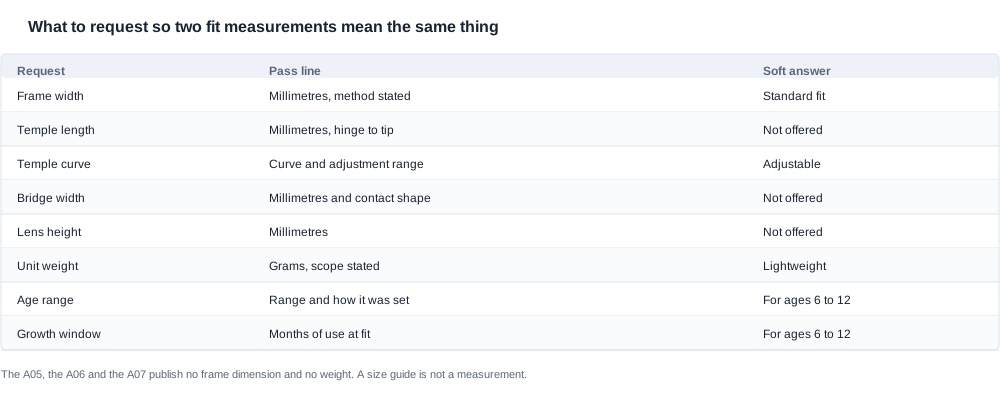
The trade-offs in this section are not between cheap and expensive suppliers; they are between a fit you can defend and a fit you can only assert. Fit is one of the few areas in this category where the buyer's problem is not that the supplier gave a soft answer but that two soft answers look identical on paper. "Standard fit" from one supplier and "standard fit" from another are the same phrase and they may describe frames that differ by four millimetres. The request below is written to force the measurement out of the phrase, and the right-hand column is the part that tells you whether the supplier has measured anything at all.
The request list, and the pass line for each row
| What to ask the supplier for | The pass line | What a soft answer sounds like |
|---|---|---|
| Frame width, at a stated method | A figure in millimetres, inside or outside the front as stated | "Standard fit" |
| Temple length, hinge to tip | A figure in millimetres, with the measurement point named | Not offered |
| Temple curve and the adjustment range | A description of the curve and a range | "Adjustable" |
| Bridge width and nose contact shape | A figure and a description of the contact area | Not offered |
| Lens height | A figure in millimetres | Not offered |
| Unit weight | A figure in grams, with the scope of the figure stated | "Lightweight" |
| The age range and how it was established | A range and the method used to establish it | "For ages 6 to 12" |
| The growth window in months | A number of months the product is expected to fit | "For ages 6 to 12" |
| The household routine | Charging location, who configures it, the sibling case | Not offered |
| Model designation | A published designation for the exact configuration | A series name only |
Two of these rows are worth more than the rest. The measurement method is worth more than the measurement, because a figure without a method cannot be compared against another figure, and a frame width measured across the outside of the front and one measured across the inside differ by the wall thickness of the rim — a millimetre or two, which is the distance between a fit and a near miss on a child's head. And the growth window is worth more than the age range, because an age range is a claim about a market while a growth window is a claim about a product, and only the second one can be tested.
The fit thresholds in plain language
The published position on this tier is unambiguous and it is the reason this section exists. The A05, the A06 and the A07 publish no frame dimension and no unit weight. The only weight figure published anywhere in the catalogue is 158 g, and it belongs to the MT6 — an AI camera model with a 1200 mAh foldable charging case, not a children's product, and a whole-product figure rather than a frame weight. It is routinely borrowed for this tier in channel conversations, and it should not be, because it is a different product in a different class.
The first threshold is therefore method, not size. Before any number is comparable, agree what is being measured: frame width across the outside of the front, temple length from hinge to tip, weight of the complete unit as shipped. Write the method into the purchase order rather than into an email, so that it survives the moment somebody asks the question again in year two.
The second threshold is spread. A single adult head is not a size range, and a sample frame is not a child's head. Two units of the same model tell you the manufacturing variation, and that variation is what a customer's unit will actually sit inside. A buyer who measures two units of each candidate model and finds a spread of more than a millimetre on temple length has learned something more useful than any catalogue figure: the model's own tolerance consumes a meaningful part of the fit.
The third threshold is the day-six record. Fit, setup, reminder fatigue and the charging routine are all settled in a week of ordinary use, and none of them is settled in a demonstration. A child who keeps the glasses on at day six has given you a usable fit number; a child who takes them off after the first reminder has given you a threshold problem, which is a different problem with a different supplier question.
The fourth threshold is the range you publish. The range you measured, not the range you hoped for. A retailer who can advise a parent against a genuinely wide fit range will recommend the product; a retailer with an optimistic range generates returns and then quietly stops restocking, and the restocking decision is invisible until the order volume drops.

Getting from a supplier's answer to a fit you can defend
Verification in this category has an unusual property: the person who has to be convinced is often not the person who signed the purchase order. A school procurement officer, a district compliance team, a marketplace reviewer or an optician's practice manager will ask for the file, and the file has to exist in a form that survives that review. A fit claim is the easiest part of a children's product to assert and the easiest to attack, because any adult can put a child's head in a frame and say it does not fit.
Six steps that produce a number rather than an opinion
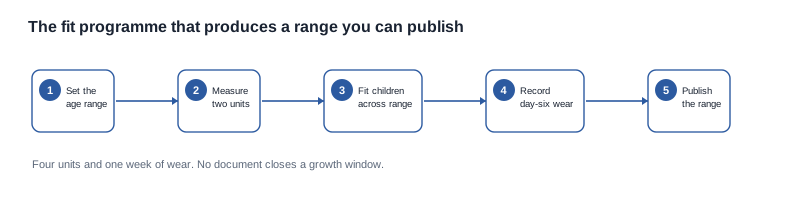
- Fix the age range and the head-size method before anything is ordered. Write the range you intend to serve and the measurement method in the same document. A buyer who changes the target range after the samples arrive pays for the fit programme twice.
- Measure two units of each candidate model yourself. Use the agreed method, record every figure against the unit serial rather than against the model name, and keep the record. This step costs a day and it is the only step that gives you the manufacturer's real tolerance rather than the catalogue's.
- Fit children across the range in the room the product will be used in. Not an office and not a demonstration: a classroom desk and a table height change both a child's head position and the distance at which a distance-detection function would trigger.
- Run the full day and record where the charge ends up. Both cell configurations behave differently on paper — 40 mAh on the A05 and the A06, 70 mAh on the A07 — and a day that ends in a flat device is a routine failure, not a battery failure.
- Record day six, not day one. Write down whether the child is still wearing it, how many reminders were ignored, and where the charger lives. The three answers are your acceptance criteria and they belong in the purchase order.
- Publish the range you measured and the conditions you measured it under. A range without conditions is an assertion, and an assertion on a children's listing is a liability the moment a parent compares it with their own child.
The five documents to ask for alongside the fit programme
The fit programme answers the growth question, and four other questions in this category have to be answered at the same time because they share the same lead time. The checklist below is the minimum, and it is the part a buyer's due diligence usually skips. The frame dimensions, temple length, curve, bridge and lens height, each with the measurement method attached. The unit weight with its scope. The age range and the method used to establish it. The certification file references with standard names, edition numbers and model designations, per market — because the frameworks that apply to a children's product in Europe, including EN 71, and the United States frameworks including ASTM F963 and the CPSC rules, are separate from CE marking and separate from radio approval, and none of them is inherited from an adult model. And the battery transport documentation for the fitted cell, which is a lead-time item as well as a compliance one.

Where a growth-window programme loses money
Five failures that appear in the first two quarters
The recurring pitfalls in a growth-window programme are worth naming as a list, because each of them has the same shape: an assertion where a measurement was required, and a return where a restock was expected. The product is returned in month three because the child has outgrown it. The symptom is a return with a description that reads like a quality complaint rather than a fit complaint. The root cause is that the growth range was never established, so the product was specified for a moment rather than a period. The prevention is the fit programme, and the acceptance criterion belongs in the order.
A retailer stops restocking because the fit advice keeps failing at the counter. The symptom is not a return; it is an order that simply stops, which is far more expensive because there is no signal. The root cause is an asserted age range on the listing. The prevention is to publish the measured range and to update the listing when the range changes, which is a maintenance obligation on you rather than on the factory.
Two children in one household cannot both use the product. The symptom is a return citing a configuration problem. The root cause is that the sibling case was never asked about, because the datasheet has no field for it. The prevention is the household question, asked of a parent, before the listing goes live.
The certification question arrives a month after the product is specified. The symptom is a launch held while a laboratory queue is booked. The root cause is that the regulatory question was scheduled after the product work. The prevention is to ask the regulatory questions at the same time as the fit questions, because both have lead times longer than a sample, and the laboratory's is the longer of the two.
A weight is quoted from a catalogue figure for a different model. The symptom is a specification sheet that names a 158 g figure for a children's frame, which happens because the MT6 is the only published weight in the catalogue and it is easy to misattribute. The root cause is borrowing. The prevention is to leave the field empty until it is measured on the model being ordered, and to say so in writing when a supplier asks you to fill it in.
The commercial lines you can move, and the ones you cannot
The moveable lines in this category are mostly about scope rather than price. Minimum order quantity is negotiable, and a children's line is often a brand's first order in a new category, which is exactly where a factory has the most incentive to be flexible on quantity. Packaging and insert design — the size guidance card, the market labels, the required warnings — is a low-cost negotiation that carries no tooling implication, and in this tier the size guidance card is where a measured range should live rather than a marketing range. Delivery splitting against a fit-approval milestone is often granted more easily than a price concession, because it moves the approval risk onto the schedule where it belongs. Payment dates are standard ground: a deposit on the first build, a balance on the passing inspection ahead of the shipment, and a retention on the file protects you against the failure that costs most here, which is a product that arrives with paperwork that does not cover it.
The lines that do not move are the ones that belong to other people's timetables. Certification cost and certification time are not commercial levers, because the fee is per market and per model and the elapsed time is set by the test laboratory and its review queue. A tooling cost is normally a one-off item amortised across the first order, so the questions worth asking are over what volume it is amortised and what happens to it if the programme is discontinued. The frame geometry itself is not a commercial variable: a supplier who will not change the temple length, the bridge or the curve is telling you the growth window is fixed, and with it the return rate.
Four clauses are worth writing into the purchase order, and none of them is about price. The measured fit rows, with the measurement method, attached to the order. The acceptance criteria from the day-six record. A clause requiring notice before any change of frame material, temple geometry or the supplier of a safety-relevant component. And a clause on who bears the cost when a lot fails the acceptance criteria, because without it the argument happens after the goods have landed.
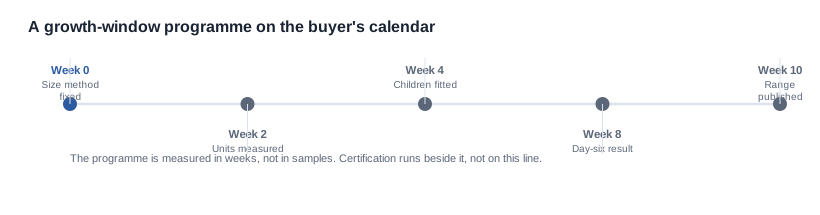
A worked case: a school-channel trial across three age bands
This is a hypothetical case rather than a client project, and it is here to show the sequence.
Assume a regional distributor is asked to trial a children's line with a small group of schools, and the trial brief gives them a target price, a modest first quantity and no age guidance. The first thing the distributor refuses to do is borrow an age range from a competitor's listing, and the reason is commercial rather than ethical: if the published range turns out to be wrong, the restocking decision that follows is theirs.
The first measurement is the cheapest and it happens before any sample is fitted. The distributor asks the supplier for the measurement method behind each of the eight geometry rows, and for the manufacturing tolerance between two units of the same model. A supplier who answers both has a fit programme, because tolerance is a production question and a supplier without one has never compared two of its own units.
The second measurement is the spread. The distributor orders two units of each of the A05 and the A07 and measures them against the agreed method. The A05 and the A06 are not in the trial, because their published rows are identical and a third model would add a per-model testing line without adding a function. The tolerance figure that comes back is what sets the size bands for the trial, and it is a number from a measurement rather than an intention from a design team.
The third step is the fit itself, and it is where the trial's structure was decided before the trial started. Three age bands are set from the measured head sizes, and each band is fitted in a classroom rather than an office, because a table height changes the angle at which a child's head sits and a distance-detection function is judged against a distance in centimetres.
The fourth step is the day-six record, and the distributor writes down three things: whether the child is still wearing the device, how many reminders were ignored, and where the charger lives at the end of the day. The third answer is the one that changes the programme, because a charger that lives in the school office produces a device that is flat by the afternoon and a complaint that looks like a battery fault.
The outcome is a trial with a published fit range covering three measured bands, a size card that carries those bands rather than a general age slogan, and an acceptance criterion in the purchase order. The decisive decisions were the method request, the two-unit tolerance check and the day-six record, and the fit programme cost more than the first order did.
What a fit claim is worth, and what we will not write for you
The boundary of what we publish on fit
Concretely, we publish the rows we hold and mark the rest as open, because a buyer's specification sheet is only as good as the weakest number in it. What we publish for the A05 and the A06: a 40 mAh cell, a charge time of two hours or less, roughly twenty hours of rated use, magnetic charging, posture and viewing-distance detection, and a lens-type electronic fogging function, which our catalogue describes as a lens-type electronic atomiser. What we publish for the A07: a 70 mAh cell, the same charge time, the same rated use, magnetic charging, and Bluetooth V5.4. What we do not publish, and will not estimate: the frame dimensions, the temple length, the temple curve, the bridge width, the lens height, the unit weight, the detection thresholds, the delays, the false-positive rate, the ingress marking, the size range and the certification position for any of the three models.
We are also direct about the 158 g figure, because it is the number most often misapplied to this tier. It is the complete-unit weight of the MT6, an AI camera model with a foldable charging case. It is not a children's model, it is not a frame weight, and it cannot be used as a proxy for the A05, the A06 or the A07. We would rather the field stayed empty than carried a number no test in your programme produced.
And we make no eye-protection, vision or health efficacy claim for any of our products, in any market. The category name is a description of what the product is sold against, not evidence of what it does. If your channel's proposition is an eyesight concern, this is the wrong category, and we would rather say that before the first order than after the packaging is printed.
What to send us about the fit
Send the measurement method, not a size. Ask the supplier to state the method for each of the eight geometry rows, and accept a figure only when the method travels with it. That single request tells you more about a supplier's fit programme than a sample ever does, and it is the first item on any pre-order checklist for this tier.
Order two units of each candidate model and measure them against the agreed method. Two units reveal the manufacturing tolerance, which is the part of the fit that a single sample hides and that your customer will experience.
Book the household pilot before you book the artwork. The pilot needs a real school week and a real charging routine, and it is the only thing that will tell you whether the reminder survives day six.
Send us the two candidate models, the target age range and the market list, and we will tell you which rows our documentation answers, which have to come from a supplier, and which need a week in a household. The range is at kids smart glasses and the background is under kids eye care technology. The sizing side is in how do I find my size and the adjacent question is in do you need it.
Where the compatibility read comes from
Send us the two units and the age range and we will take the fit measurements with you.


