

Kids eye protection glasses technology: three problems solved
The honest answer to "do we need this" depends on whether the problem is a behaviour problem or a vision problem, and only one of those two is what this product does. Kids eye protection glasses technology smart glasses do you need it is a decision tree that separates them, names the three situations where the product is genuinely the right tool, and names the three where it is not — before a specification exists, because a children's line built around the wrong problem generates complaints that look like defects.
The published data explains what the product actually is. The A05 and the A06 publish a 40 mAh cell, charging in two hours or less, roughly twenty hours of rated use, magnetic charging, posture and viewing-distance detection, and a lens-type electronic fogging function that our catalogue describes as a lens-type electronic atomiser. The A07 publishes Bluetooth V5.4 with a 70 mAh cell on the same charge and runtime figures, and publishes neither of the two functions. Nothing in that set addresses eyesight, and nothing in that set is a spectacle.
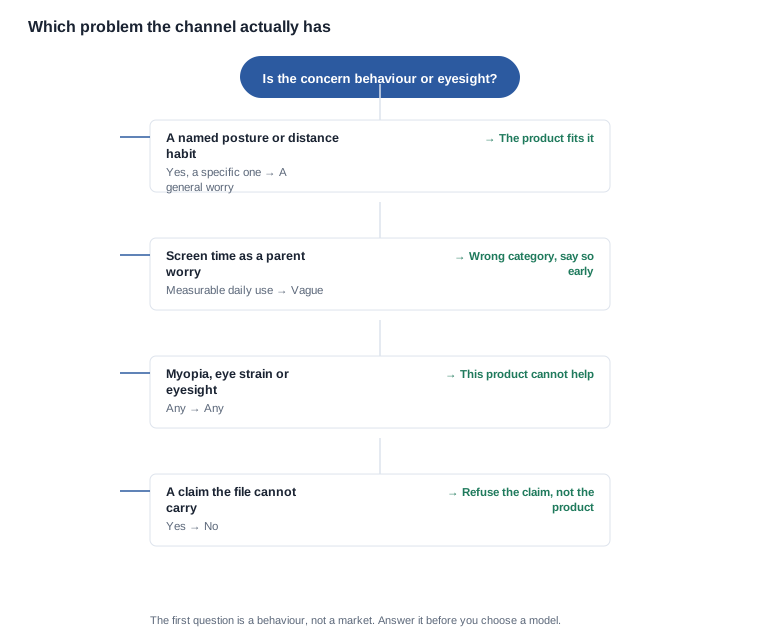
The need, answered in three sentences
The question is answered by one question: is there a specific, named behaviour you want to change? If the answer is a general worry about screen time, the product is a lottery ticket, because "reduce screen time" is not a behaviour you can instrument and therefore not a behaviour you can verify. If the answer is "she never breaks her posture when reading", the product has a job, and the job is measurable. And if the underlying worry is myopia, eye strain or eyesight, this is the wrong category — not a weaker fit, the wrong category — because a product that appears to address a concern it cannot address produces returns that are indistinguishable from quality failures.
What the buyer is holding when the need question arrives
A buyer asking this question is usually deciding whether to open a children's line at all, and they are holding a customer profile, a market list, a target price and a set of competitor pages. What they are not holding is a view of the customer's actual problem, because the category name has already framed it as a vision problem and the product is not one. The category name is the single most expensive document in a children's programme, because every downstream decision — the listing, the packaging, the channel choice, the claim wording — inherits its framing.
The commercially important consequence is that a children's smart glasses product competes for the same budget as other screen-time interventions, and the comparison that decides the purchase is behavioural rather than technical. A buyer who has not established which problem the customer has will build a product, and then a listing, around the wrong one, and the discovery will arrive as a return rate rather than as a decision.
Naming the behaviour before naming the model
The productive form of this question is a sentence, not a noun. "The child slouches when reading" can be instrumented, tested, tuned and written into an acceptance criterion. "The child spends too much time on screens" cannot, because there is no threshold, no trigger and no pass condition. A behaviour that cannot be named precisely cannot be verified, and an unverifiable behaviour cannot be the basis of a product decision.
The second part of the question is who changes. A posture or distance reminder is delivered to the child, and a child who has been told off repeatedly for the same thing stops responding to the reminder. The feature does not decay through wear or battery; it decays through repetition, and it decays fastest in exactly the households that bought the product. This is the single most important thing to understand about a reminder product in this category, and it is why the false-positive rate is the parameter to negotiate on and why the pilot has to run longer than a demonstration.
The third part is what the parent gets. If the parent's expectation is visibility — knowing the child was wearing the device through the school day and for how long — then the runtime is not a spec-sheet curiosity but the product. A roughly twenty-hour rated figure is consistent with a device designed to be picked up once and worn all day; a device that is flat at lunchtime produces incomplete data and a support query. The published data does not describe the parent-facing component for any of these models: no app, no delivery mechanism and no data handling are documented, and none of them should be written into a specification until they are confirmed.
The three situations where the product is the right tool
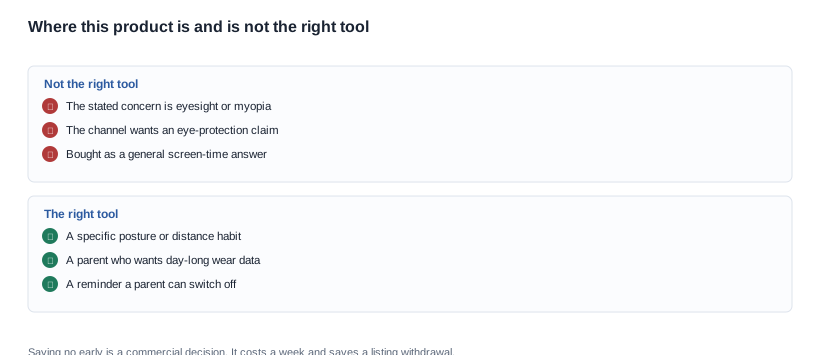
A specific, named posture or viewing-distance habit in one age band. The A05 and the A06 publish posture and viewing-distance detection, which is exactly the function set this situation needs. What makes it workable rather than theoretical is that a habit can be measured, tuned and given a pass condition.
A parent who wants day-long wear data rather than a session. The roughly twenty-hour rated use is the longest published runtime in the catalogue, and the camera and audio models in the same catalogue publish figures between roughly five and eight hours. A product that has to be picked up once and worn through the school day is a different commercial proposition from one that is charged at lunch.
A reminder a parent can switch off. A parent who cannot silence an alerting function will stop the child wearing it, and a parent who can silence it will use it. The published entries do not state the parent-disable position for the reminder or for the fogging function, so this has to be established in writing — and it is the difference between an asset and a return driver.
The three situations where it is not
The stated concern is eyesight. Myopia, eye strain, the fear of myopia: none of these is addressed by a device that detects a position or a distance and reminds. We make no efficacy claim covering eye protection, vision or health for any of our products in any market, and we advise any buyer building a listing in this category to do the same.
The channel wants an eye-protection benefit claim. The claim boundary is a regulatory position, not a marketing preference, and a listing that promises a benefit the file cannot support is the fastest route to a withdrawal.
The product is bought as a general screen-time answer. A general worry produces a general product, and a general product produces a return rate that nobody can diagnose.
The parameters that decide whether a reminder gets kept or switched off
The presence of a detection function is published for the A05 and the A06. The parameters of that function are not published for either of them, and the parameters are the product. A threshold expressed as a number with a unit can be tested on a sample, compared across suppliers and written into an acceptance criterion. A threshold expressed as a quality — "adjustable sensitivity" — cannot be tested at all, and the difference between the two is the difference between a feature and a specification.
The request list and the pass line for each row
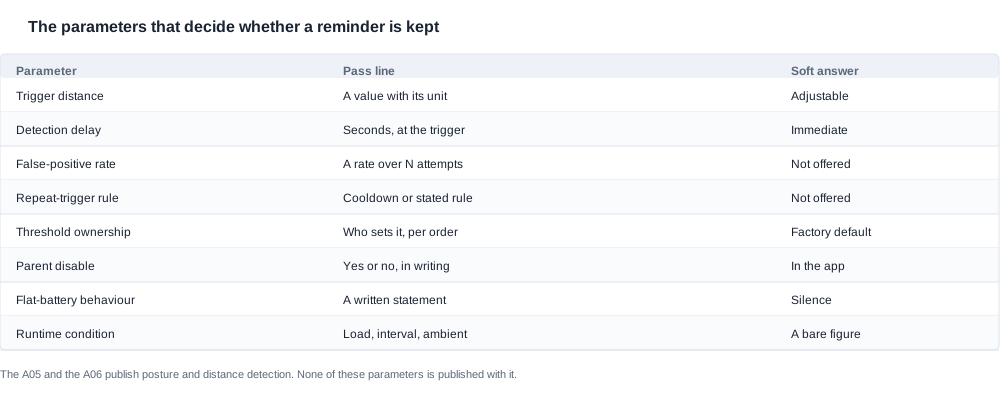
| What to ask the supplier for | The pass line | What a soft answer sounds like |
|---|---|---|
| Detection thresholds and delays | A measurable value with its unit, and whether the threshold is adjustable | "Adjustable sensitivity" |
| The false-positive rate | A rate over a stated number of attempts | Not offered |
| The behaviour on a repeated trigger | A cooldown, or a stated rule for repeat suppression | Not offered |
| Who sets the threshold | Per order, per channel, or factory-fixed | "The factory sets it" |
| The parent-disable position | Yes or no, in writing, per alerting function | "In the app" |
| The runtime measurement condition | The load, the interval and the ambient condition | A bare figure |
| The behaviour at a flat battery | A written statement, and how the parent knows | Silence on the subject |
| The parent-facing component | What it shows, where the data is stored, who operates it | "An app" |
| The certification position, per model and per market | Standards, editions, laboratory and document references | "Fully certified" |
| Model designation | A published designation for the exact configuration | A series name only |
The row that matters most is the false-positive rate, and the reason is commercial rather than technical. A reminder that fires when nothing has changed teaches the child that the device is noise, and a device that is noise gets taken off and never put back on. The rate has to be measured over a stated number of attempts, in the room the product will be used in, with children who are not performing for a demonstration. A rate quoted from a lab bench with a stand-in head is not the rate that will be seen in a classroom.
The second row that matters most is the runtime condition. Two twenty-hour figures from two suppliers are two different measurements unless the load behind them is stated, and the published twenty-hour figure for the A05 and the A06 comes with no condition at all. Compare it against the camera and audio models in the same catalogue, which publish between roughly five and eight hours, and the gap looks like a different class of product until you ask what each figure was measured under.
Running the household test that a demonstration cannot replace
A demonstration proves that a device can do something. It does not prove that a child will keep doing it, that a parent will not switch it off, or that the charging routine survives a Tuesday. The only test that answers those three questions is a household pilot with the actual children over a real school week, and it costs a fortnight. That fortnight is the cheapest line in the whole programme, because every other line in a children's line is spent against a problem the pilot would have identified for free.
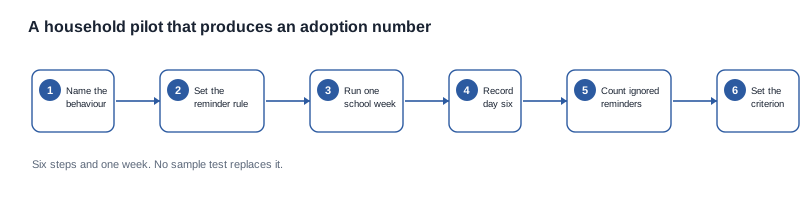
Six steps that produce an adoption number
- Name the behaviour in one sentence and write it down. If the sentence cannot be checked by an observer, stop here and re-write it.
- Set the threshold and the repeat-suppression rule before the pilot, not after. A pilot that starts with the factory default produces a false-positive rate that tells you about the factory default.
- Run one real school week in a real household. Not an office, not an adult wearing the device, and not a single evening.
- Record day six, not day one. Every metric that matters in this category has already moved by day six, and a result taken on day one is the most flattering and least useful number available.
- Count the reminders that were ignored. This is the adoption number, and it is more predictive of reorder behaviour than any other figure in the trial.
- Set the acceptance criterion from the result and write it into the order. A criterion that lives in an email is not binding, and in a category where supplier documentation is often thin, your own standard is the enforceable one.
Where a reminder device loses the household
Three things will end the product's use in a household, and only one of them is about electronics. The first is the ignored-reminder count, which is a tuning problem with a known owner. The second is the flat battery at the wrong moment, which is a routine problem: if the device is flat when the child puts it on at the end of the school day, the routine breaks and does not recover on its own. The third is the parent's inability to intervene, which is a product question and a contractual one at the same time.
What happens to the commercial case when the product solves the wrong problem
Five ways an unestablished need goes wrong
The listing is pulled for a health claim and the product is relisted. The symptom is a takedown or a complaint citing eyesight. The root cause is that the copy was written from the category description rather than from the device's function. The prevention is to narrow the claim to detect and remind, and to have the copy reviewed before the artwork is approved rather than after it is printed.
The product is bought for a vision concern and the customer returns it. The symptom is a return that reads like a defect. The root cause is that the problem was a vision problem and the product is a behaviour tool. The prevention is to establish the problem category before the specification, and to say plainly when the answer is that this is the wrong product.
The reminder is switched off in week one. The symptom is a product that stops being worn and a return with no stated reason. The root cause is that the false-positive rate was never measured, so the default was too aggressive for a real household. The prevention is to measure it with real children in a real room, and to set the acceptance criterion from the result.
The product runs flat by the afternoon. The symptom is a complaint about battery life against a published twenty-hour figure. The root cause is that the published figure is a duty-cycle number and the household ran a heavier one. The prevention is to run a full day at the reminder setting you intend to ship, on both the 40 mAh and the 70 mAh configurations, and to publish the condition with the figure.
The parent cannot tell that the device is flat. The symptom is a support query that reads as a defect. The root cause is that the behaviour at a flat battery was never asked about, and the parent-facing component does not surface it. The prevention is to ask it in writing and to confirm it in the pilot.
What can move in this decision, and what cannot
Minimum order quantity is negotiable, and a children's line is often a brand's first order in a new category, which is where a factory has the most incentive to be flexible. Packaging and insert design — the size guidance, the market labels, the required warnings — is a low-cost negotiation with no tooling implication, and the insert is where the measured age range belongs rather than a marketing range. Delivery splitting against a pilot-approval milestone is often granted more easily than a price concession, because it moves the risk of the pilot onto the schedule where it belongs. The way a payment falls due is standard ground: a deposit placed when the order is confirmed, a balance on the inspection before the goods move, and a retention released with the file protects you against the failure that costs most in this category, which is a product that arrives with paperwork that does not cover it.
Certification cost and certification time are not a commercial lever, because the fee is per market and per model and the elapsed time belongs to the test laboratory and its review queue. A one-off tooling charge is usually amortised across the first order, and the questions worth asking are over what volume it is amortised and what happens to it if the programme is discontinued. The maintenance obligation behind the parent-facing component is a term rather than a price, and the claim boundary is a legal position rather than a commercial one.
The documents to request before the deposit are the certification file references with standard names, edition numbers and model designations per market; the detection parameters with units, including the false-positive rate; the runtime measurement condition; the written statement of the behaviour at a flat battery; the parent-facing component description; the frame dimensions, temple length and weight with the measurement method; and the certificate numbers with the issuing body and validity dates. The clauses to write into the contract are the exact model designations covered by the certification file attached to the order; the acceptance criteria from the pilot, referencing the detection observations, the day-six result and the duty-cycle run; a maintenance commitment with a defined term and scope; a clause requiring the marketing and label wording to match the file; and a clause on who bears the cost when the sample does not meet the acceptance criteria.
The answer we will give you before you order
The boundary of what we publish on need
The short answer: this tier is a low-load product, and the published rows describe it accurately, which is also how a buyer decides whether it fits the behaviour they want to change. The cells are 40 mAh on the A05 and the A06 and 70 mAh on the A07, the charge takes two hours or less, the published runtime is roughly twenty hours, charging is magnetic, Bluetooth V5.4 appears on the A07, and posture and viewing-distance detection is present on the A05 and the A06. We publish no detection threshold, no delay, no false-positive rate, no frame weight, no dimension, no ingress marking and no certification position for this tier, and we will not estimate them from typical values. A number a buyer can defend on a page is worth more than a number that makes the page look more complete, because a children's product carries a heavier burden of proof than an adult one.
We will also be direct about the boundary, because it is the most commercially useful thing we can say on this question: this is a product that detects a position or a distance and reminds. It is not a vision intervention, and a product that appears to address a vision concern it cannot address generates complaints that look like defects.
What to send us about the need
Send the customer and the problem, in one sentence each, before you send a model list. The sentence is what we will use to tell you which of the three situations you are in, and it takes less time to write than the RFQ it replaces.
Send the four supplier questions in writing. What are the detection thresholds and delays, and is the threshold adjustable? What is the false-positive rate over a stated number of attempts? What is the runtime measured under? What happens when the battery is flat, and how does the parent know?
Send us the models, the markets and the customer, and we will tell you which rows our documentation answers, which have to come from a supplier, and which need a week in a household. The background is under kids eye care technology, the scenario mapping is in kids use cases, the limits are in kids limitations and drawbacks, and the range is kids smart glasses.
Where the decision tree comes from
Send us the customer and the problem and we will tell you which of the three situations you are in.


