

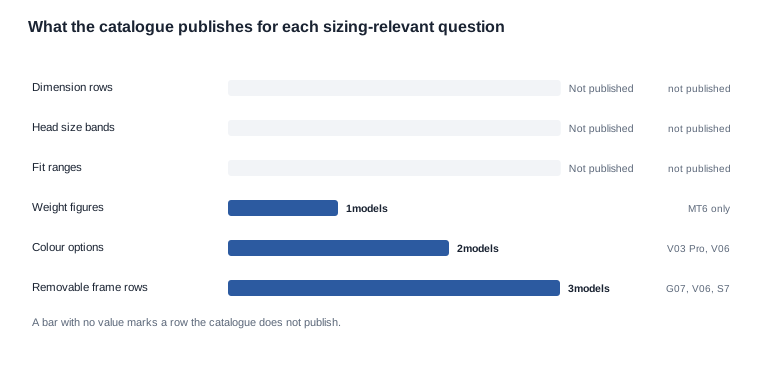
How do I find my size? For this range the honest answer begins with an admission that no catalogue enjoys: the catalogue publishes no dimensions for any of the twenty-eight entries. There is no temple length, no lens width, no bridge measurement, no head-size band, no tolerance and no sizing range anywhere in the published material. Sizing in this category is therefore not a lookup and cannot be made into one. It is a measurement programme, and the buyer's real task is to build a size matrix from physical samples and dimensioned drawings rather than to read a table that does not exist.
The three-part answer still applies. Published: the rows that bear on sizing indirectly — one weight figure in the whole range, 158 g for the MT6 glasses body including its 265 mAh battery and camera and excluding the foldable charging case; a detachable temple on the G07; a detachable inner frame on the V06 and the S7; a flexible temple on the V03 Pro; colour options on the V03 Pro and the V06; and IP54 on the V06 and the S7. Not published: every dimension, every tolerance, any head-size band, any age segmentation for the A05, the A06 or the A07, and any per-model sizing range. Ask the supplier: a dimensioned drawing per model with tolerances stated, the sizing range expressed as two limits, and a physical sample of every configuration that will be sold.
There is a structural reason this matters more here than in ordinary eyewear, and it is that the electronic parts are not distributed evenly. A pair of glasses with a front-mounted battery, a camera module and a set of electronics changes the load distribution, and a sizing approach calibrated on a conventional frame will not transfer. The published sheet cannot even warn a buyer about this, because the one weight figure it contains covers a single model and says nothing about where the mass sits.
How do I find my size: the five measurements and the one that decides the outcome
The five measurements a sizing programme needs
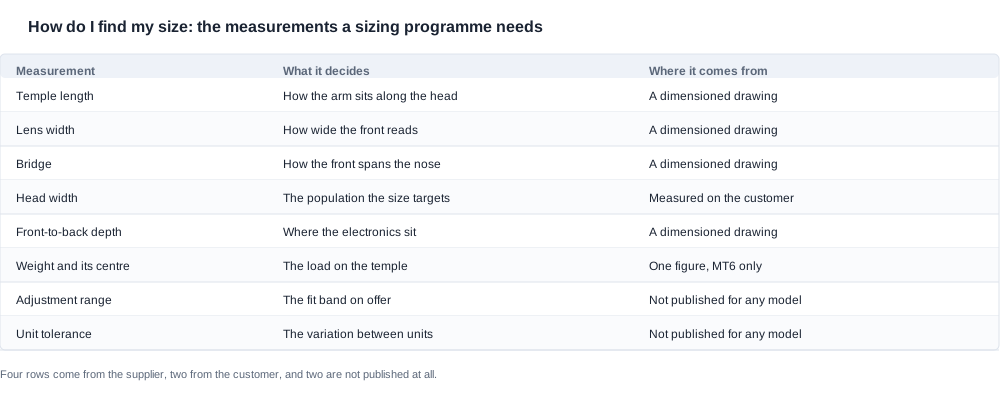
Five measurements carry the whole decision, and a buyer who has all five can build a matrix; a buyer who has two is guessing.
Temple length is the distance from the hinge to the end of the arm, and it is the measurement that determines whether the product stays in position through an afternoon. Lens width determines how wide the front reads and how the electronics sit relative to the eye. The bridge determines how the front spans the nose, which on a pair with a camera module also decides where the front sits in relation to the field of view. Head width is the population the size targets, and it is measured on the customer rather than on the product. Front-to-back depth is the distance from the front of the frame to the ear, and it is the one most often omitted from a buying conversation, because it is the parameter that interacts with the electronics.
Two further parameters complete the work but are usually supplied rather than measured. The weight and its centre determine what the temple actually carries, and the catalogue publishes one figure for one model. The adjustment range and the unit-to-unit tolerance determine how many sizes a channel really needs, and neither is published for any model.
Why the catalogue cannot supply any of them
The published sheet was assembled to describe electronics and it did not describe the frame. Every model page carries a cell capacity, a use-duration band, a charge-time ceiling, a charging method and — on the camera models — a resolution class. The frame appears only in the five feature rows listed at the top of this article, and three of those five describe removability rather than dimension.
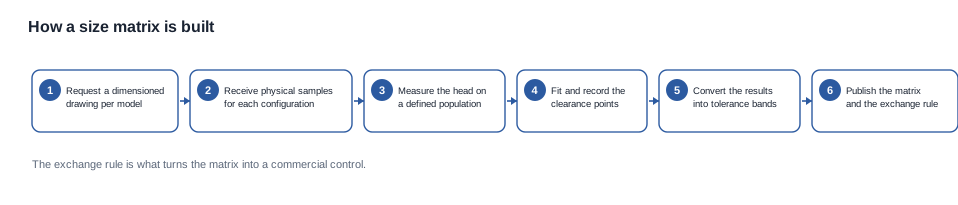
That means the buyer is not dealing with a gap that better reading would close. A dimension cannot be inferred from a resolution class, from a cell capacity or from a charging method, and a head-size band cannot be inferred from a product name. The realistic routes are exactly two: a dimensioned drawing from the supplier, and physical measurement of samples. Everything else a buyer does with sizing has to be built on those two inputs.
What the published rows can and cannot tell you about size
The pair that publishes identical rows and different hardware
The sharpest illustration in the catalogue is the G07 and the YK12. Their five standard specification rows are identical: a V5.4 radio, two 55 mAh cells, recharge within two hours, six hours of use and magnetic charging. The two are separated only by their feature rows — one of them carries an ultra-slim build with a temple that comes off, while the other carries a surround-sound line alongside a slim temple. Two products that a datasheet presents as the same object are physically different objects, and the difference between them is exactly the difference a customer feels.
A second pair makes the point in the camera tier. The V06 and the S7 publish the same two structural rows — an ergonomic design and a detachable inner frame — alongside the same IP54 marking, while their published camera rows differ, with the S7 publishing a thirteen-megapixel figure against the eight-megapixel class the V06 sits in. Two units a buyer might treat as one product in a price comparison are two size questions.
The runtime rows are not size indicators
A buyer who hopes to infer something physical from the battery rows will not get there, and the published numbers make that plain. The A05 and the A06 publish 40 mAh cells and about twenty hours of use. The L1 Pro, the L2 Utral and the CY03, and the CY05 publish 290 mAh and about seven hours. The K01 and the K02 publish 90 mAh × 2 and about eight hours. The D11 and the D12 publish 100 mAh and about seven hours. A smaller cell published with a longer runtime, a larger cell published with a shorter one — these rows describe what the catalogue records, and nothing about the geometry of the product.
The reason is structural rather than accidental. A runtime figure is a function of the cell, the electronics, the radio and the workload, and the workload in a published sheet is not stated. So the rows cannot be used as a proxy for battery volume, for front loading, or for anything else about how the product is built.
The one weight figure and the question of front loading
The MT6's 158 g is the only weight available, and it is worth noting precisely what it covers: the glasses body, the figure taking in the 265 mAh battery and the camera while leaving out the foldable charging case, whose own weight is unweighed. A buyer therefore has a total for one model and nothing at all for the other twenty-seven, which means the return-freight model, the balance test and the front-loading question are all answerable for a single product.
The front-loading question is the one that a sizing programme cannot avoid. A pair with a cell and a camera in the front has its mass forward of the ear, and that mass sits at the end of the lever that the temple has to carry. Two products of the same published weight can present a completely different balance, and the only published weight in the range belongs to a model whose construction is described in three short feature rows rather than in a dimensioned drawing. How a balance is judged is a question of its own, and the method for it adds to the sizing programme rather than taking its place.

Building a sizing method a channel can run

Measure the head, not the product
The order matters: the population is measured first and the product second. A channel that measures the product and then tries to match it to customers is doing it the wrong way round, because it produces a set of product measurements with no population attached and therefore no way to know whether the sample was typical. The head measurements a channel needs are head width, the temple-to-temple distance, the bridge span and the depth from the front of the face to the ear, taken on a defined and recorded population.
Recording the population matters as much as recording the measurement. A matrix built on ten people is not a matrix, and a buyer who asks a supplier for a "sizing range" should ask how it was derived, on how many people, and with what measurement method. A supplier that cannot answer that has a marketing number rather than a sizing range.
Record a tolerance band rather than a size
A published size is a point, and a point is wrong for most of the population. What a channel needs is the band the unit actually occupies once unit-to-unit variation is included, which means the supplier has to state a tolerance and the channel has to record the actual position of each unit it measures.
The practical method is simple and repeatable: measure the clearance at each adjustment point rather than the setting itself, record the position within the adjustment range, and note whether the unit can be adjusted to accommodate a head narrower or wider than the one it was measured on. That converts a sizing decision from an opinion into a number, and it is the number that lets a channel set an exchange rule rather than argue about one.
Test the removable configurations as separate sizes
Where parts come apart, the number of sizes multiplies. The G07 publishes a detachable temple, the V06 and the S7 publish a detachable inner frame, and the V03 Pro publishes a flexible temple. A detachable part is not a styling option; it is a second configuration that a customer can end up in, and each configuration needs its own clearance points and its own tolerance band.
This is also where the handling of the product matters to the channel. A part that is installed and removed repeatedly introduces a second failure mode and a second sizing question, and a channel that publishes a single size for both states is publishing a size that is wrong for one of them.
The kids tier needs a different bench
The A05, the A06 and the A07 publish no dimension, no tolerance and no age segmentation, so a channel cannot build a size matrix for them from published material either. The A05 and the A06 do publish a set of feature rows that a sizing programme has to reproduce: a fogging unit, prompts for correct and incorrect posture and distance, and lens clarity and lens fogging rows. Those rows describe a positional expectation rather than a dimension, and the consequence for a buyer is that the product has to be evaluated in the position it is intended to be used in, on a bench, with the prompts observable — not held for a minute in an office.
The point is worth stating without dressing it up: the catalogue lists these rows as features, and this article does not claim any health outcome from them. What it claims is narrower and is about procurement: a product with a positional expectation has to be verified in that position, and a buyer who verifies it in the wrong position has verified nothing.
The questions that produce a usable size matrix
The requests below are written so that each answer can be used to build a matrix rather than to describe an intention. The order reflects how much each answer unblocks.
- A dimensioned drawing per model. Published: no dimension row anywhere in the catalogue. Not published: temple length, lens width, bridge, front-to-back depth and the drawing itself. Ask: the drawing with the key dimensions marked, and the tolerance on the temple length.
- The sizing range as two limits. Published: no sizing range for any model. Not published: the population the size targets and the limits of the adjustment. Ask: both limits, plus the population and the measurement method used to derive them.
- The unit-to-unit tolerance. Published: nothing. Not published: the variation between units of the same model, and whether the drawing is nominal or a bound. Ask: the tolerance and whether it applies across the production run.
- The parts that come apart. Published: the G07 carries a detachable temple, the V06 and the S7 carry a detachable inner frame, and the V03 Pro carries a flexible temple. Not published: how many states each configuration has and what each state measures. Not published: how many states each of them has, and what each state measures. Ask: the states and the clearance points for each.
- The weight and its distribution. Published: one figure, the MT6 glasses body at 158 g excluding the foldable case. Not published: every other weight, the case weight, and where the mass sits on any model. Ask: the product weight and the case weight separately, plus the mass distribution if it can be given.
- The accessory clearance. Published: charging-case capacity on five camera models, a case shown on two more, and no case row on four. Not published: whether the case changes the geometry of the product in use. Ask: whether a case in use alters the temple position or the clearance points.
- The sizing method for the kids tier. Published: no dimension and no age segmentation for the A05, the A06 and the A07. Not published: the head-size range and the intended use position. Ask: the range, the measurement method, and the verification position for the published feature rows.
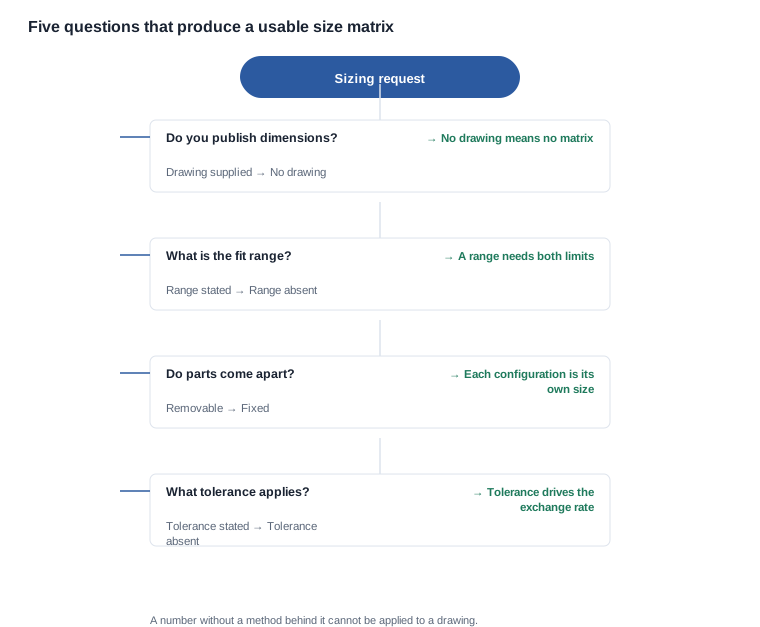
Two answers in this category should be treated as unresolved even though they arrive with numbers in them. The first is a sizing range stated without a population, which is a marketing figure rather than a fit range. The second is a tolerance stated as a percentage without a nominal dimension, which cannot be applied to a drawing that does not exist. Both are easy to detect once the buyer knows to ask what the number was measured from.
Comparing two suppliers' sizing answers
A sizing request rarely produces two comparable answers, because most suppliers answer in the units that suit them rather than the ones a channel needs. Before you commit to a supplier, assess each response against a fixed set of criteria: whether a dimensioned drawing exists, whether the sizing range is given as two limits, whether the tolerance is stated against a nominal dimension, and whether the population and the measurement method behind the range are documented. How to choose between two suppliers then becomes a scoring exercise that can be fixed before the first request goes out, so that whichever reply lands first cannot shape the scoring by itself.
The recurring red flags are easy to name once the criteria are set: a range with no population behind it, a tolerance with no nominal value, a drawing that shows one configuration while the catalogue sells another, and a sizing method for the kids tier that cannot be run on a bench. Every one of them means the evidence has to be requested again rather than left as a gap. The trade-offs between two suppliers in this category are usually trade-offs in paperwork rather than in hardware, and which model a channel ends up stocking often turns on the quality of the answer rather than on the geometry itself.
Handling the returns that sizing creates
Where sizing returns come from
Sizing returns are structural in this category rather than incidental, and the reason is the published sheet. A customer who buys on the basis of a product name and a photograph has nothing to compare against, because the catalogue publishes no dimensions and no sizing range. A channel that adds a sizing matrix therefore reduces a category of returns rather than a single product's returns, and the reduction shows up in the returns data within a season.
The two failure modes to expect are the unit that sits too far forward because the temple length was too short for the head, and the unit that sits too far back because the front-to-back depth was too shallow for the wearer's face. The first produces a front-heavy product that a buyer may perceive as a balance fault; the second produces a product that slides and that a buyer may perceive as a quality fault. Both need to be distinguishable in the returns record, which is a matter of the intake form rather than of the product.
The exchange policy is a sizing control
An exchange policy that requires a physical return before a replacement is a slow policy, and a slow policy pushes customers towards a refund. A policy built on a recorded head measurement and a published matrix can act on the recorded measurement alone, which makes an exchange fast and cheap. That is the practical argument for building the matrix even when the channel has no intention of publishing it: it converts a shipping cost into a database lookup.
The terms that matter are therefore commercial rather than technical. Whether an exchange needs the original unit back. Whether the refund is net of a restocking charge, and if so whether that charge applies to a sizing exchange as well as to a fault. Whether the channel carries the cost of a second unit when the first was mis-sized by the customer or by the published matrix, and how the two are distinguished in the record. Each of these is a term to settle before the first order, and each of them changes the cost of the sizing gap.
What the claim record tells you about the matrix
The returns record is the measurement of the matrix, and treating it as such is what closes the loop. If a configuration produces a disproportionate share of sizing returns, that is a finding about the matrix or about the tolerance, and it can be acted on by changing what the channel recommends rather than by changing the product.
This is also where a channel's own data becomes commercially useful. A channel that can state, per configuration and per size band, the rate of sizing returns and the reason codes behind them is in a materially stronger position than one that can only report a returns percentage. It is the same argument that applies to the claim record in the after-sales process, and it is worth running both as one dataset.
The geometry reference for this range is in materials and ergonomics, with the audio tier collected in bluetooth audio glasses and the construction side in how to choose smart glasses frame materials. The clearance notes for the audio models are in notes on frame geometry and clearance, the entry-level construction summary is in smart glasses frame materials for beginners, and the kids tier is in kids smart glasses sizing. The balance method that a sizing matrix depends on is in how to know if the weight is distributed well, and the structural side of the same decision is in does the temple strength matter.
Related reading
- The balance test a sizing matrix depends on — how to know if the weight is distributed well
- The structural decision behind the same geometry — does the temple strength matter
- The construction method for the frame — how to choose smart glasses frame materials
- Geometry and clearance notes for the audio tier — notes on frame geometry and clearance
- A construction summary for a new channel — smart glasses frame materials for beginners
- Sizing for the kids tier — kids smart glasses sizing
- The reference page for construction and sizing — materials and ergonomics
- The audio tier as a collection — bluetooth audio glasses
Send the models you intend to stock and the head measurements you already hold, and we will tell you which sizing rows exist to quote and which have to be built from drawings and samples.


