
Kids eye protection glasses technology: twenty structural limits
The limit that comes from a small cell and a light workload
The A05 and the A06 publish a 40 mAh cell with two-hours-or-less charging, roughly twenty hours of rated use, magnetic charging, three lens options, a lens-type electronic fogging device, and posture and viewing-distance detection. The A07 publishes a 70 mAh cell, Bluetooth V5.4, the same charging and runtime figures and magnetic charging. For none of the three do we publish the detection thresholds, the delays, the false-positive rate, the frame weight, the frame dimensions or the certification status.
These constraints are structural rather than incidental, and the reason is that this category tries to do three things at once with a small cell: sense the wearer's behaviour, run through a school day, and sit inside a compliance regime that adult products do not face. Each of those constrains the others, and the published rows show the consequence directly. The long runtime is a light-load figure, because a 40 mAh cell producing roughly twenty hours tells you the workload is small, not that the product will do that with everything active. The margin for the sensing features is thin, because a detection function that runs continuously competes with everything else on the same cell. And the charge time, at or under two hours from 40 mAh, is proportionally a better result than the same figure would be from a 290 mAh cell in a camera platform, which makes the overnight routine forgiving and conceals how little the battery is doing.
Kids eye protection glasses technology smart glasses limitations and drawbacks is therefore a list of what a buyer is accepting, and the honest way to read it is as a set of trade-offs rather than a set of defects. A better supplier does not remove these limits. A better supplier measures them and tells you which ones you have chosen to live with.
The limit that comes from the sensing parameters being absent
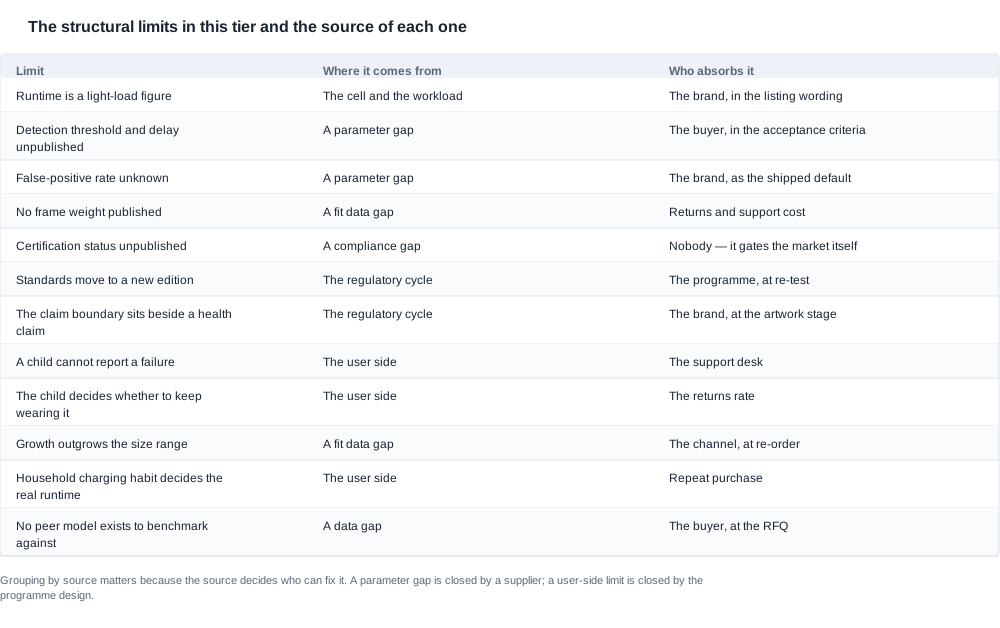
Ten separate limits live in one gap. The presence of posture and viewing-distance detection is published on the A05 and the A06; the threshold is not, the delay is not, the false-positive rate is not, the range is not, the behaviour on a repeated trigger is not, and the behaviour at a flat battery is not. Nothing about the alert format is published either — visual, audible or both is a decision that changes how a product behaves in a classroom and in a bedroom.
These are not minor omissions. A reminder that fires every few seconds is ignored inside a week, and a child who has been told off repeatedly stops responding to it, which is how a feature becomes decoration. A threshold set too tight fires constantly; set too loose, it never fires; and both outcomes are available on the same hardware with the same published specification sheet. There is also nothing to benchmark against, because one tier in our range produces one set of published rows and no peer to compare a supplier's claims with, which means a buyer's first comparison in this category is always against the specification sheet rather than against a competing product.
The limit that comes from the compliance position
The certification status is not published to us for the A05, the A06 or the A07, which makes the largest question in this category a question rather than a position. Every standard behind a children's product has a next edition: EN 71 in the European Union and ASTM F963 with the Consumer Product Safety Improvement Act in the United States can both require a product to be retested once a new edition is published, so a launch made against the current editions is a launch against a moving target, and nobody working in this category retires from standards maintenance.
Two further limits sit alongside it. A camera or a microphone on a child's device raises a different set of questions than the same hardware on an adult product, and our published position is that the AI feature details and the data location are not published for these models. And the lens-type electronic fogging device appears on the A05 and the A06, with its regulatory position not provided, so whatever it is intended to do has to be established rather than assumed.
The limit that comes from the person wearing it
The child cannot report a failure, so failures are silent and a parent's conclusion is that the product does not work. The child decides whether to keep wearing it, and the only person whose opinion determines whether the product succeeds is the one with no voice in the purchase. A product that fits at eight and not at twelve has a short commercial life, and the frame dimensions are not published for any model in our range, so the sizing is a programme risk rather than a specification. The household's charging habit decides the real runtime rather than the published figure, and the sibling and peer effect is a market variable that no specification addresses.
Which limits your programme can absorb and which it cannot
Where each limit lands once it reaches the market
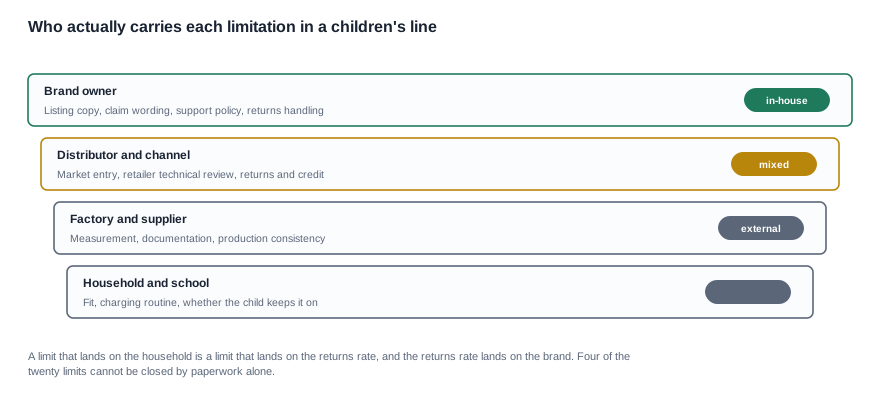
The practical question about a limit is not whether it exists but who ends up carrying it. A limit that lands on the factory can be fixed by a different supplier. A limit that lands on the household arrives as a return, and a return lands on the brand's cost of goods and on the retailer's willingness to reorder. A limit that lands on the compliance side ends the programme.
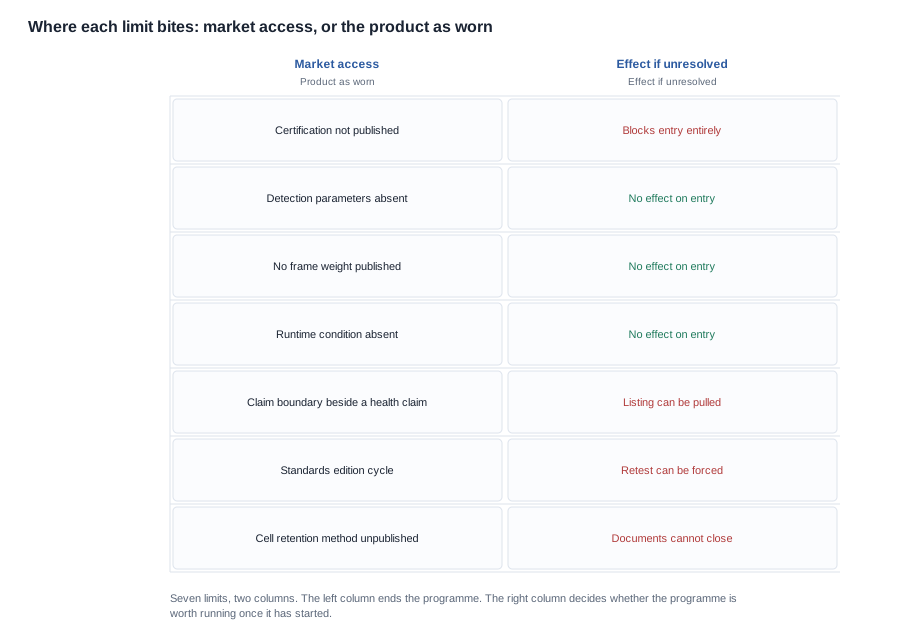
That distinction is what separates a tolerable category from an intolerable one. A programme whose limits are concentrated in the household is dealing with a returns rate, which is a pricing problem. A programme whose limits are concentrated in the compliance side is dealing with a market-access problem, which is a go or no-go problem. Most buying errors in this category come from pricing a market-access problem as though it were a pricing problem.
A limit that lands on the household becomes a return
Four of the twenty limits land on the household, and each of them has a mechanical path into the returns rate. A child removes the product within an hour because the fit was never established, because no weight or dimension is published and therefore fit was never measured. A reminder is switched off in the second week because the false-positive rate was never measured, so the shipped default was too aggressive for a real household. The product runs flat by the afternoon because the published twenty hours is a duty-cycle figure and the household ran a heavier one. And a parent cannot turn the lens-type device off, because the disablement question was never asked, so the return is filed as "it keeps beeping".
None of these four is a hardware failure. All four are failures of the buyer's own evidence gathering, and all four are closed by the same three actions: measure the false-positive rate in a real room, establish fit across a size range with real children, and ask whether a parent can disable each function. The measurement method for these is set out in how to measure kids eye protection glasses.
The five questions that decide whether a programme survives its limits
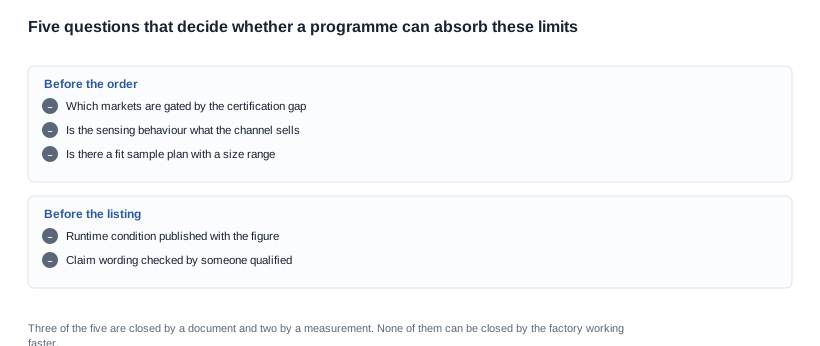
- What are the detection thresholds, the delays, and the behaviour on a repeated trigger? This is the product, and it is the only row that separates the A05 and the A06 from every other product a buyer might be comparing them with.
- Which standards, on which edition, on which model designations, and by which laboratory? A file that names a family rather than a model is not a file for your product.
- What is the runtime measured under, with the sensing load included? Without the condition, the twenty-hour figure cannot be put on a product page.
- What are the frame dimensions and the weight, and what size range do they cover? No model in our range publishes either, so the answer has to come from a measured sample.
- What is the regulatory position for the lens-type device on the two models that carry it? Whatever it is intended to do, its compliance status has to be established rather than assumed.
The go or no-go test before you commit a children's line
The test in four steps
A buyer who wants a decision rather than a description should run four steps in order, and each one has an output that is either a document or a refusal.
Step one is the market test. Name the destination markets, establish which frameworks apply to a children's product in each of them separately from the radio approval, and confirm whether the model has a model-level file. If the answer is that no file exists for the exact model, the programme does not proceed into product work; it proceeds into a testing project with a budget and a date. Buyers who skip this step discover the answer at the artwork stage, which is the most expensive place to discover it.
Step two is the product test. Establish whether the sensing function is the reason the product exists, and if it is, obtain the parameters in writing before any further design or content work. If the function is not the reason, the A07 becomes the relevant model and the sensing limits drop away, which is a legitimate and considerably cheaper programme.
Step three is the household test. Run a wearing trial across a size range with real children and record day six rather than day one, and measure the false-positive rate in a real room rather than a laboratory one. This step is cheap in money and expensive in calendar time, and it is the step most often skipped because the hardware appears to work on the bench.
Step four is the claim test. Put the draft listing beside the evidence file, line by line, and remove every adjective that does not correspond to a row. This is a two-hour exercise for someone with the file in front of them, and it is the last chance to remove a health claim before the packaging is printed.
Where the trade-offs sit
The trade-offs in this category are real and they are not symmetric. A programme can accept a longer schedule in exchange for a narrower range, and that is usually a good exchange, because each additional model carries its own compliance cost. A programme can accept a weaker evidence position in exchange for a faster launch, and that is usually a bad exchange, because the cost of a withdrawn shipment or a pulled listing is not proportional to the weeks saved.
The trade-off most worth naming is between breadth and depth. Two models with a full evidence file beat four models with a partial one, in a channel where the buyer is a retailer's technical team or a school procurement officer. That is the criterion the buying checklist for this category is built around, and it is set out in kids buying checklist.
Proving a limit is real before you accept it
What to ask a supplier to close the parameter limits
The parameter limits are closed by measurement, and the measurement has to be specified before it is run. The request for the detection parameters should ask for the threshold with its unit, the delay after a trigger, the false-positive rate expressed as a rate over a stated number of attempts, the alert format, and the behaviour when detection is not working. A supplier who can state all five has measured the product; a supplier who cannot has a feature rather than a specification.
The same request should cover the lens-type device, because that device has both a technical question and a compliance question attached to it. How it activates, how quickly, what it consumes, whether a parent can disable it, and what the regulatory position is for a device carried on a product intended for children.
For the fit limits, the request is measurement rather than description: the frame dimensions, the weight, the measurement method, and the size range they cover. None of that is published for the A05, the A06 or the A07, and the only catalogue weight in the whole range is the 158 g of the MT6 in the camera line, which is a different product in a different tier and is not a substitute for a figure on this one.
What a household week can and cannot close
A household week closes the household limits and nothing else. It closes the fit question, because a child who will not wear the frame settles it faster than any measurement. It closes the reminder-fatigue question, because a real household running a real routine reveals the false-positive rate by day four. It closes the charging-routine question. And it gives you the parent's own words, which is the most accurate description of the product that will ever exist.
A household week does not close the parameter limits, the compliance position or the difference between the A05 and the A06. Those three come from a supplier in writing, and no amount of observation at home will produce them. A buyer who runs the week and treats the result as a complete evaluation will end up with a product that works well and cannot be listed or shipped, which is the worst of both outcomes.
What the commercial conversation should be based on
The commercial terms for a children's line should be negotiated on the limits, not on the unit price. A programme that has established the fit programme, the measurement protocol and the acceptance criteria before the first order has something to attach to its purchase order, and a programme that has not has only a price. The clauses that carry the weight are the exact model designations covered by each document, the acceptance criteria from the sample, a requirement for notice before any change of firmware, detection threshold default, frame material, lens or safety-relevant component supplier, and a clause on who bears the cost when a lot fails the acceptance criteria.
On the negotiating room itself: the number of models and colours committed, the artwork round count, the per-market label scope, the fit programme scope and the market list are all negotiable numbers, and each of them is worth more than a percentage point on the unit price. The compliance cost and the elapsed time of testing are per model and per market and cannot be moved by commercial pressure. Tooling is a one-off, and the volume it is spread across is normally the opening order; the limits worth naming are that volume and where the tooling would sit if the programme stopped. And the safety-relevant design decisions, including the cell retention method and the small-parts policy, are not commercial variables at all.
A scenario: a distributor weighing the limits before accepting a line
The situation and the decision in front of it
This is a worked case rather than a live order. The order of choices is set out.
Assume an Asian distributor already stocking an audio line is offered a children's range under its own label, with a school channel alongside a consumer channel. The distributor's constraint is not the price. It is that their retailer's technical team now asks for the file before accepting delivery, and they have already had a listing suspended in another category for a documentation gap.
Walking the four steps
The market test comes first. The three destination markets are identified and the frameworks established per market, and two of them turn out to need a children's safety file that the brand's adult product does not have. The distributor now knows the size of the file, which is the number their retailer's technical team actually wanted, and the cost of that test has been one email.
The product test then settles the model. Because the sensing function is the reason the channel wants the product, the A05 and the A06 are the candidates, and the detection parameters become a prerequisite rather than a nice-to-have. The brand supplies the thresholds, the delay and the false-positive rate in writing, and the distributor treats them as the first acceptance criterion.
The household test is commissioned as a fit sample across a size range, because no weight or dimension is published. The brand supplies the units and the measurement protocol. The result is a day-six record rather than a day-one impression.
The claim test is the last one. The listing says the product detects posture and viewing distance and reminds, and says nothing about eyesight, and the retailer's technical team accepts the file because the claim and the evidence are the same width.
What the outcome was decided by
The outcome was decided by the market test and the claim test, and neither of them involved the electronics. The distributor ended up with a narrower range than they were offered, a fit programme that cost money before the first order, and a file that survived the retailer's review. A case template for this kind of programme walk-through is in kids case study template.
The limits we will state, and the questions worth sending
The published rows, and what we will not estimate
Here, we publish the children's models' electrical rows accurately, and we state plainly that the detection parameters, the certification status, the frame dimensions and the weight are not published. We will not fill a children's product file with a plausible threshold or a certification claim, because an invented figure in this category does not stay a specification. It becomes a safety statement on a product page that a parent will read as a promise.
We make no medical, health or eye-protection efficacy claim for any of our products, in any market, and we will not describe a device that detects a position or a distance and reminds as though it changed a child's eyesight, because that is a clinical claim and the product is not a clinical device. If your channel's proposition is an eyesight concern, this is the wrong category, and we would rather say so before the first order than after the packaging is printed.
We will also tell you plainly that a household pilot over a real school week is the only test that produces the data this category is missing, and that a supplier who has run one knows more than a specification sheet can carry.
The five questions to send this week
Ask for the detection thresholds, the delays and the repeated-trigger behaviour in one message, with the unit attached to each figure. Ask which standards, on which edition, for which model designations, from which laboratory, and ask whether the file names the model or the family. Ask what workload sits behind the twenty-hour figure, and ask for the frame dimensions and weight with the measurement method rather than a description of them.
Then send us the destination markets and the age range, and we will tell you which of these limits are decisive for your programme and which of them you can carry without spending money on more evidence. The background is under kids eye care technology.
Related reading
- Kids eye care technology
- Kids detection measurement method
- Kids buying checklist
- Kids case study template
Tell us the destination markets and the age range and we will tell you which of these limitations are decisive.


