
Kids eye protection glasses technology: three unstated facts
The first thing to understand about children's smart glasses is that most of the published category information describes a smaller version of an adult product, and that the parts of the product which are actually different for a child are the parts that appear least in a spec sheet. That is the orientation a first-time buyer needs, because the alternative is to compare a children's product against an adult one on the rows the adult product publishes better — battery, Bluetooth version, charge time, camera — and to draw a conclusion from the comparison.
That conclusion is always the same and always wrong. A brand that reads the A05 and the A06 as "a cheaper camera-and-audio glasses" is reading a product that has no camera, and the comparison tells them nothing about whether the thing will be worn by a nine-year-old on a Tuesday afternoon. Kids eye protection glasses technology smart glasses for beginners is therefore an orientation to the category for a buyer who has decided the product is right and now has to know what to ask, in what order, and which answers are worth a follow-up.
Our catalogue entries for this tier publish a 40 mAh battery for the two models with the lens-type electronic fogging function, charging in two hours or less, roughly twenty hours of runtime, magnetic charging, and posture and viewing-distance detection. The A07 publishes Bluetooth V5.4 with a 70 mAh cell. Certification status for these three models is not published to us.
The beginner's answer, in three sentences
Three things make this category different for a child, and none of them is a specification: the certification position, the fit across a size range, and the interaction design. Two of those three have the longest lead time in the programme, and the third decides whether the product is still being worn in week four. If you are about to make a first purchase, the order of operations matters more than the choice of model, because two of the three items cannot be compressed and the third cannot be bought.
What a first-time buyer already has in hand
A first-time buyer in this category usually holds a target retail price, a market list, an idea of the customer and a folder of competitor product pages. What they do not hold is a sizing system, a sense of which regulatory frameworks apply to a children's product rather than an adult one, and any measurement of how a child actually behaves with a device that beeps at them. All three gaps are normal at this stage, and all three are cheap to close — but only if they are closed in the right sequence, because two of them need a laboratory and one of them needs a week of household time.
It is worth saying plainly what a first order actually costs, because the order is the small part. The units are the smallest line in a children's programme; the per-market and per-model testing, the label and warning set for each destination, the battery transport documentation and the artwork are all larger, and none of them scales down with a small quantity. A first buyer who cuts the first order to the smallest workable quantity has not saved the programme cost, and the pressure to cut it again at the second order is where the discipline usually breaks.
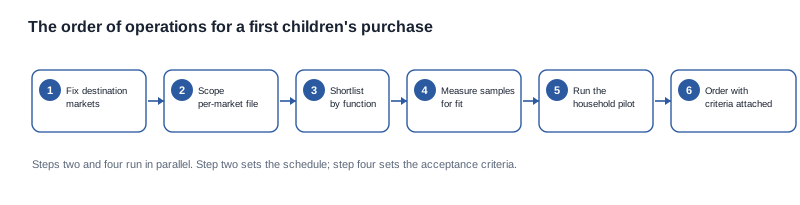
The order of operations for a first children's purchase
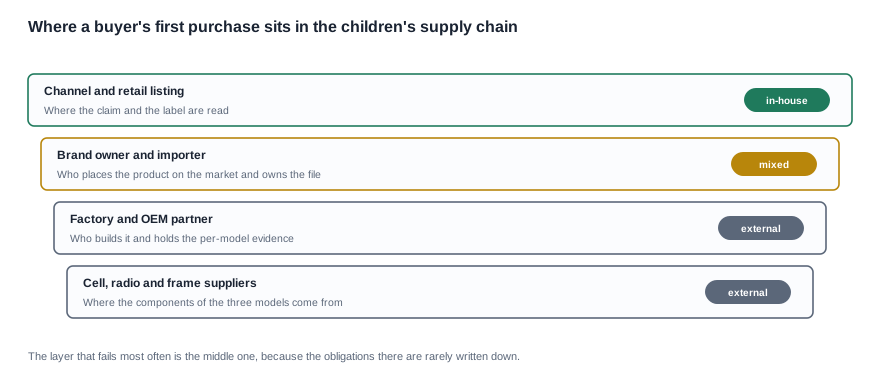
The mistake a first-time buyer makes is to treat the first purchase as a product selection with a compliance step attached. It is the other way round. The documentation determines which models you can afford to carry, the model count determines the documentation, and the household behaviour determines whether the product has a commercial life at all.
Why the file runs beside the product work rather than after it
Children's products in the European Union and the United States attract frameworks that adult products do not. The EN 71 series applies in Europe, and ASTM F963 and the Consumer Product Safety Improvement Act apply in the United States. These work on an edition cycle, where a new edition of a standard can require retesting a product that has already shipped, and none of them is inherited from an adult model with the same electronics. For the three models in our range, the certification position is not published to us, which makes it the first and largest open question in a beginner's evaluation and a project rather than a document request.
The second thing that is genuinely different is the fit. A child grows, and a product that fits at eight and not at twelve is a product with a short commercial life. The published data for this tier includes no frame dimensions and no weight for the children's models, and the only weight published anywhere in the catalogue is 158 g on the MT6 — an AI camera model with a foldable charging case, not a children's product. So the size question cannot be answered from any sheet and has to be answered with samples.
The third is the interaction design. A child cannot be assumed to read an instruction, complete a pairing flow without help, or keep using a device that beeps at them. A feature that works when demonstrated by an adult can be abandoned in a week by a child, and this is the one of the three that no document can settle either.
A worked case: a first children's order built in the right order
This is a hypothetical case rather than a client project, and it is here to show the sequence rather than the result.
Assume a brand that has never sold a children's product has a target retail price, a first order it wants to keep modest, and two candidate destination markets. The buyer's instinct is to shortlist models and request samples. The sequence below is the same budget spent in a different order, and the differences are in what was still available at the end.
The first action is not sampling. It is a written request for the certification position per market, per standard, with the edition and the laboratory named, plus the model designations those documents would cover. The buyer's model count is not yet decided, and that is deliberate: the number of models is the largest single lever on the testing cost, so deciding it before the answers arrive would be deciding it blind. The reply establishes the per-market and per-model shape of the file, and the reply also establishes that the A05 and the A06 publish identical rows, which means a range does not need both.
The second action is the model narrowing, on the published function set. The A05 and the A06 publish posture and viewing-distance detection and the lens-type electronic fogging function; the A07 publishes Bluetooth V5.4 with a larger cell and neither of the two functions. The buyer takes one model from the first pair and the A07 only if the channel needs an audio-led product, and the model count is now two rather than three, before a single document is requested.
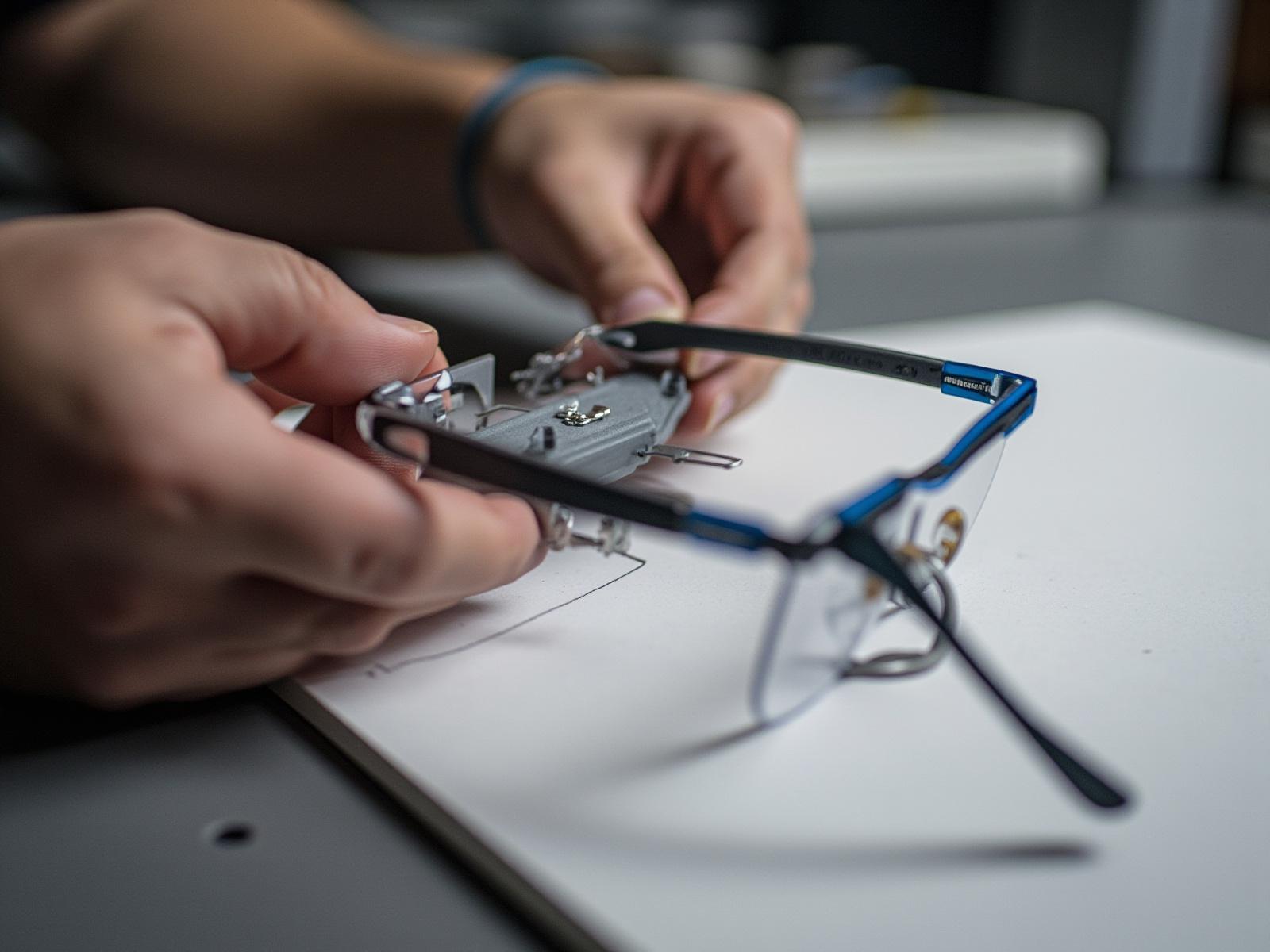
The third action is the sample order, and the order is not a sample order. It is a measurement order: two units of each shortlisted model, with a written request for the measurement method behind each geometry row and for the manufacturing tolerance between two units of the same model. The buyer measures the units against that method, which turns the fit question from an opinion into a range, and it does so while the certification file is in the laboratory.
The fourth action is the household pilot, run against the measured range and at the reminder setting the buyer intends to ship. A fortnight here determines the false-positive rate, the charging routine and whether a child is still wearing the thing on day six. It is also the point at which the parent-disable question is tested rather than asked.
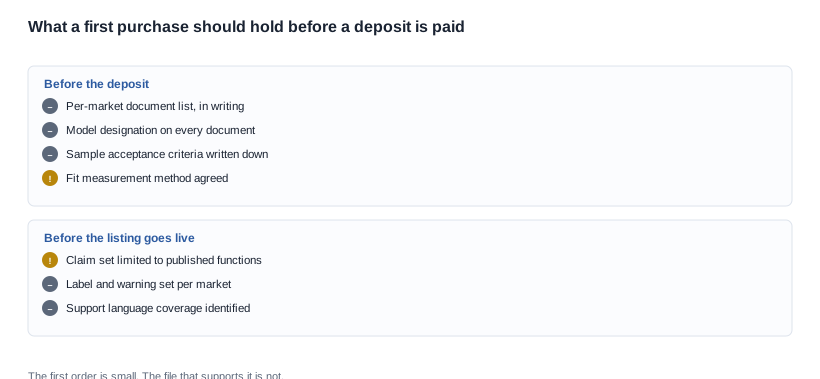
The fifth action is the purchase order, with the acceptance criteria attached: the measured fit range, the day-six result, the detection parameters with units, the certification file references naming the exact model designations, and a maintenance commitment with a term.
The outcome is a two-model launch that was specified before the sample was measured and a documentation pack that names the units that ship. The decisive decisions were the order of the first three actions, and the buyer spent the same money in a different sequence.
The six questions that decide whether you proceed
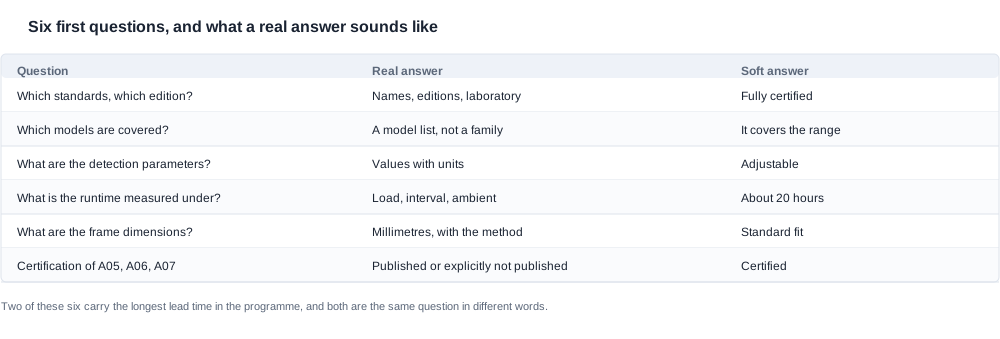
- Which standards have been applied, against which edition, on which models, and by which laboratory? This is the first question because it determines whether the product can be sold in your market at all, and because the answer sets the cost of every subsequent decision.
- What are the detection parameters? The threshold, the delay, and what happens on a repeated trigger. The presence of detection is published for the A05 and the A06; the parameters are not, and the parameters are the whole product.
- What is the runtime measured under? A twenty-hour figure with no stated condition cannot be compared with another twenty-hour figure, and the camera and audio models in the same catalogue publish between roughly five and eight hours.
- What does the product do when the battery is flat, and how does the parent know? A twenty-hour runtime is worthless if the device is flat when the child puts it on at the end of the school day.
- What are the frame dimensions and the weight, and what sizes are available? Not published in this range, and required for a retail decision. The measurement method matters as much as the figure.
- Who maintains the firmware and the parent-facing component, and for how long? This is a term, not a feature, and it decides whether a reminder that stops working in year two is a support ticket or a wave of returns.

Reading a children's datasheet without being misled by the runtime
The single most quotable number in the children's tier is the roughly twenty-hour runtime, and it is the least decisive one. It is a consequence of a small cell and a light load — 40 mAh on the A05 and the A06, 70 mAh on the A07 — and it is the longest rated runtime published anywhere in the catalogue, which makes it an excellent marketing line and a poor specification. The customer experience is determined by the detection behaviour, the fit and the charging routine, and none of the three is visible in a runtime figure.
The second trap is the adult comparison. A children's product in this range is not a cheaper version of an adult one, and the rows where an adult product publishes well — a camera, a Bluetooth version, a charging case — are either absent or irrelevant here. The A07 is the only model in the tier that publishes a Bluetooth version, and it publishes no detection function and no fogging function, so a buyer who selects on radio capability is selecting a model whose published function set is empty.
The third trap is the product page. A listing that carries a size guide carries an assertion, and in this category the assertion is the part a parent will test. "For ages 6 to 12" is a claim about measurements that no supplier has published for the A05, the A06 or the A07, and a retailer who discovers that will stop restocking rather than file a complaint.

Three first-order mistakes that are expensive to undo
Buying the runtime. The symptom is a product brief whose entire performance argument is a twenty-hour figure. The root cause is that the runtime is the only row available in three columns, so it gets quoted. The prevention is to require a condition with the figure and to fund the fit programme and the pilot instead.
Treating the adult comparison as valid. The symptom is a children's line specified on Bluetooth version and cell capacity, which are the two rows that matter least here. The root cause is that adult products publish more of what a buyer knows how to read. The prevention is to compare against the published function set of the children's models rather than against a different category's specification style.
Running the pilot with adults. The symptom is a confident go decision followed by a low reorder rate. The root cause is that a demonstration proves a device can do something, while the question is whether a child will keep it on. The prevention is a household pilot with the actual children, over a real school week, with the charging routine as it will actually be done, and a day-six record rather than a day-one one.
Discovering the certification question after the artwork is approved. The symptom is a label revision, and a label revision in a children's product is a re-approval cycle rather than a print run. The root cause is that the file was scheduled after the product work because the buyer assumed the adult product's file would cover it, and it does not — the EN 71 series and the United States frameworks including ASTM F963 and the CPSC rules are separate from CE marking and separate from radio approval. The prevention is to ask the regulatory question in the same week as the model question, which is free, rather than in the week after the artwork is signed off, which is not.
Carrying a function across a model boundary. The symptom is a listing that promises the reminder functions on a model whose published entry does not contain them. The root cause is that the range was written as one product rather than as a set of configurations, which is easy to do when two of the three models publish identical rows and the third is the odd one out. The prevention is to write each model's published function set on its own line, and to check every claim against the model designation on the purchase order rather than against the range.
The commercial terms of a first order
Minimum order quantity is the line a first order can move most easily, because a brand opening a new category is exactly where a factory has the most incentive to be flexible. Packaging and insert design, including the size guidance card, the market labels and the required warnings, is a low-cost negotiation with no tooling implication, and the insert is where a measured range should live rather than a marketing range. Delivery splitting against a pilot-approval milestone is often granted more easily than a price concession. The way a payment is arranged is standard ground — a deposit on the order value, a balance that falls due on the inspection, and a holdback on the document file, which protects the buyer against the failure that costs most here, a product that arrives with paperwork that does not cover it.
Certification cost and certification time are not a commercial lever, because the fee is per market and per model and the elapsed time is set by the test laboratory and its review queue. Tooling is a one-off cost usually amortised across the first order, and the questions worth asking are over what volume it is amortised and what happens to it if the programme is discontinued. The maintenance obligation behind the firmware is a term rather than a price.
What a first purchase from us actually looks like
The boundary of what we publish to a first buyer
It is worth being precise: the safe-to-quote list for this tier is short, and we would rather it stayed short. We publish the 40 mAh and 70 mAh cells, the two-hour-or-less charge time, the roughly twenty-hour runtime, magnetic charging, Bluetooth V5.4 on the A07, and the presence of posture and viewing-distance detection on the A05 and the A06. The detection parameters and the certification status are not published, and that is where the list stops. A number a buyer can defend on a page is worth more than a number that makes the page look more complete, because a children's product carries a heavier burden of proof than an adult one.
We will not fill a children's product file with a plausible threshold or a certification claim. In this category an invented number becomes a safety statement on a product page that a parent will rely on, and that is the one thing we will not do. Unit prices, minimum order quantities and lead times are confirmed per enquiry rather than published as fixed numbers, and we would rather give you a number that survives a purchase meeting than a number that makes the first page look complete.
What to send us as a first buyer
Send the destination markets and the age range, and we will tell you which standards are likely to apply and which parts of the file we can answer today. That single email is worth more than a model shortlist, because it tells you how many models you can afford to carry.
Send the model narrowing question in the same message: do you need the published reminder functions, the published fogging function, or an audio-led product? The A05, the A06 and the A07 publish different function sets, and the right number of models follows from that answer.
Send the fit measurement request, which is the one you can close fastest. Two units and a written method, and the size question stops being a guess.
The background is under kids eye care technology, the documentation side is in kids certification requirements, the full buying checklist is in kids buying checklist, and the range is kids smart glasses.
Where a first purchase starts
- Kids eye care technology
- Kids certification requirements
- Kids buying checklist
- Kids smart glasses range
Tell us the destination markets and the age range and we will say which standards apply and which parts of the file we can answer.


