

Kids eye protection glasses technology: two questions first
A buying checklist for a children's smart glasses product is dominated by two questions that have nothing to do with the electronics: whether the product may lawfully be sold in the destination market, and whether the detection behaviour will hold up with a real child across a real school week. Everything else — the cell, the charge time, the runtime, the radio version — is published and comparable, and almost none of it is what decides the purchase.
That is an unusual position for a hardware category and it has a practical consequence for how the checklist should be used. A buyer who works through the datasheet first will produce a comparison that is complete, accurate and useless, because it compares the four things that are already known against the three things that are not known at all. The order of the list matters more than the length of it.
Our published position makes the same point from the other side. The children's tier publishes a 40 mAh cell on the two models that carry the lens-based electronic fogging arrangement, a 70 mAh cell on the A07, charging in two hours or less, roughly twenty hours of rated use, magnetic charging, Bluetooth 5.4 on the A07, and posture and viewing-distance detection on the two 40 mAh models. The detection parameters are not published. The certification position is not published to us. The frame dimensions, the temple length and the temple curve are not published for any model in this tier, and a unit weight is published for one model in the entire catalogue — 158 g for the MT6 glasses body, which is not a children's model.
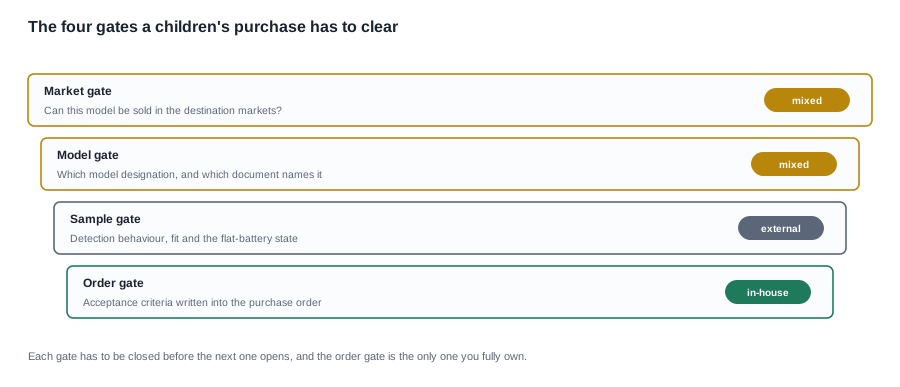
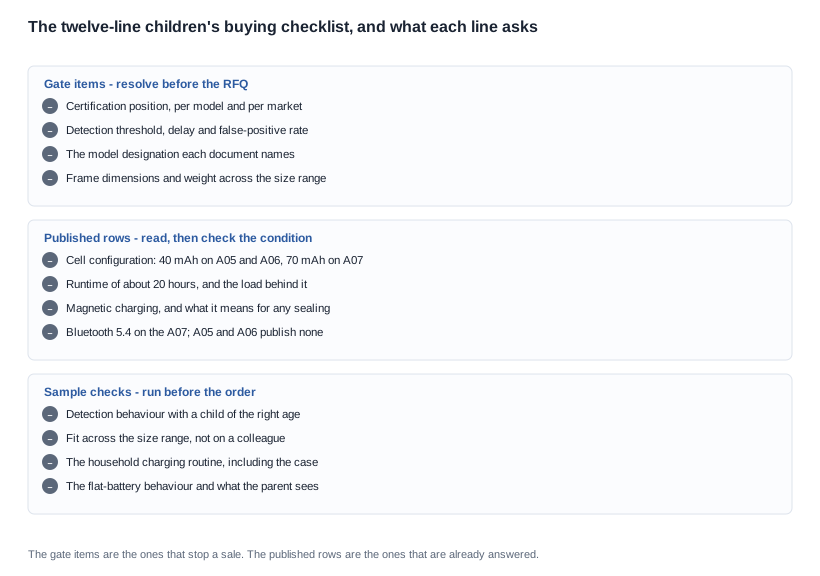
So this is a checklist for a product where the published rows describe the electronics and the decisive facts are elsewhere, and it is arranged accordingly: four items to close before the request for quotation goes out, four published rows to read with their conditions attached, four checks to run on a sample, and four comparison traps that cost buyers money in this tier.
The buyer at the point the checklist is opened
The buyer opening this list is usually a brand product manager or a channel buyer who has been asked to take on a children's line, and they are typically holding two or three supplier catalogues, a target retail price, a market list and a launch date. They are usually also holding a deadline they did not set, because a retailer or a distributor has asked for the line before a particular season.
What they are not holding is the two answers that the checklist is built around. In most programmes the certification question has not been asked at all, because it sounds like a legal matter rather than a sourcing matter, and the detection parameters have not been asked because the feature list makes them sound like a specification that is already settled. Both are asks that have to be made, and both take longer to answer than the sample does.
The other thing the buyer is usually not holding is a reference point. Children's smart glasses are not a category with a settled price band, a settled feature set or a settled compliance position, so the buyer is being asked to make a judgement without a reference. The four items below are what turn that into a comparison.
Why the electronics row is the least decision-relevant part
There is a reason the datasheet is the last thing rather than the first. In this tier the electronics are ordinary: small cells, magnetic charging, a short charge time, a quoted runtime in the region of twenty hours, and a radio version that is published on one of the three models. These are figures that are comparable across suppliers, and comparable figures answer questions that are already answered.
The figures that decide the purchase are not comparable because they are not published by anybody. The detection threshold for the two sensing models, the false-positive rate at the default reminder setting, the frame dimensions across the age range, the certification position per model per market — none of these appear on any row, and each of them is worth more than the entire electronics list.
This is also why the checklist below is grouped as four-and-four rather than as a single long list. A long list gets worked through in order, which is exactly wrong here, because the first items on a long list are usually the datasheet. A grouped list forces the buyer to finish one group before starting the next, and the grouping says which group is which.
The four items that have to close before the request for quotation
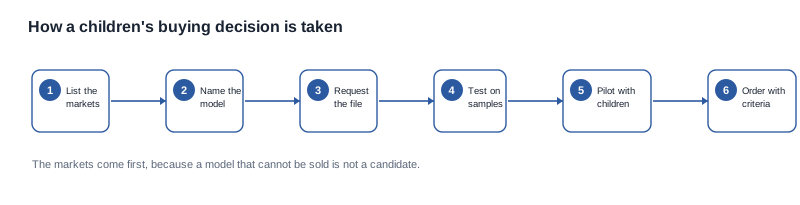
The certification position, per model and per market. The certification status for these models is not published to us, and this is a question about whether the product may lawfully be sold at all rather than a question about paperwork quality. In the European Union the frameworks that reach children's products include EN 71, and in the United States ASTM F963 and the Consumer Product Safety Improvement Act apply alongside the radio approval; all of them work on an edition cycle where a new edition can require retesting. The ask is per model and per market, and the answer has to be a document reference.
The detection parameters. The threshold, the delay, the behaviour on a repeated trigger and the false-positive rate. The presence of detection is published; the parameters are not, and the parameters are the product. A threshold expressed as a number with a unit can be tested on a sample, compared across suppliers and written into an acceptance criterion, while a threshold expressed as a quality cannot be tested at all.
The model designation and the documents that name it. A family-level document does not cover a specific model, and the model list on the file is what a retailer's compliance file is built from. This is the row that decides whether the other three are real, because it decides whether the documents describe the product that is actually being ordered.
The fit, across a size range. The dimensions and the weight are not published, and a product a child will not wear is a product that does not work however well the detection behaves. This one cannot be closed by a document at all; it is closed by a sampling programme with real children, which is why it has to be scoped before the order rather than discovered after it.
The request list behind the four items
The four items are questions; the request list is what makes the answers usable. Two of the four items can be closed in a single message if it is written as a list rather than as a paragraph, and the difference between a supplier who answers in one message and one who answers across a call is worth a week of schedule.
- Standards, with edition numbers, per model designation, per market. Named standards rather than a general statement of compliance, because "fully certified" is not a document reference and an edition number is what tells you whether a re-test is due.
- The model list printed on each document. The exact designations, as they appear on the document, not as they appear in the catalogue.
- Certificate numbers, with the issuing body and the validity dates. A number is the only part of a document that a procurement officer, a marketplace reviewer or a customs broker can check later.
- The detection parameters, with units. The threshold, the delay, the behaviour on a repeated trigger and the false-positive rate at the default setting, plus what the default setting is on a unit that ships to a household.
- The runtime condition. The reminder interval and the ambient condition behind the published figure, so the two suppliers' figures become comparable measurements rather than two bare numbers.
- The frame dimensions and the weight, with the measurement method. Not offered, measured, and stated per unit — because a single measurement on one sample is a sample, and a range needs a range.
Send the list as a list. A supplier who answers all six in one message is running a documentation habit, and the answers you get back will be specific enough to write into an acceptance criterion. A supplier who answers two is telling you something you want to know before the deposit rather than after the artwork is printed.
The model designation is the row everything else is built on
In this tier the A05 and the A06 publish identical specifications, and the difference between them is not published to us. That is a specific and unusually sharp version of the general problem, because a buyer comparing two rows that are identical cannot tell from the catalogue which one they want, and the instinct is to assume the newer designation is the better one.
The assumption is wrong often enough to be worth naming as a trap. Two models with identical published rows can differ in firmware defaults, in the enclosure, in the app, in the certification scope or in nothing at all, and the catalogue cannot distinguish those cases. The ask is a written statement of what differs, and it is worth more than any additional photograph of the sample.
The A07 is a different case again rather than a variant of the same one. It is listed as a children's audio model with a 70 mAh cell, Bluetooth 5.4, magnetic charging and the same quoted runtime, and with no sensing rows published for it at all. A buyer comparing the A07 against the A05 on the basis of cell capacity is comparing a different product category, not two variants of one.

The published rows, read with their conditions attached
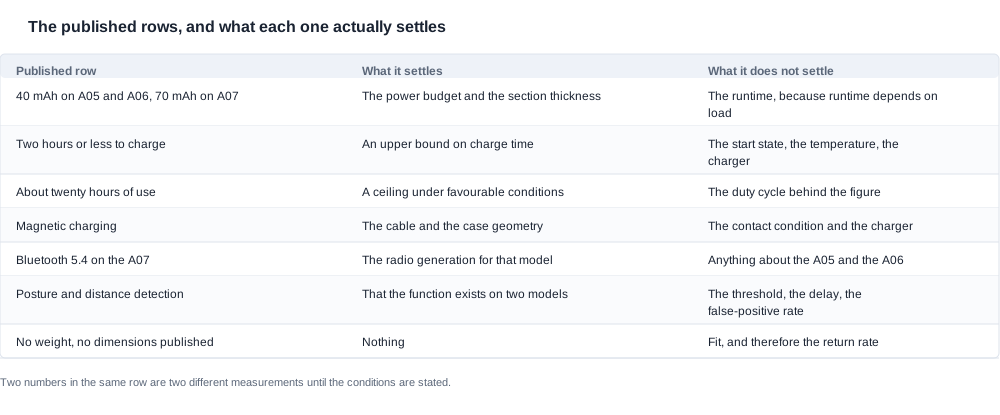
The cell configuration. 40 mAh on the two models with the fogging arrangement and 70 mAh on the A07. The cell is the input to the section thickness, and the section thickness is the input to whether the frame fits a child's head. That chain is the reason the cell row is more interesting than it looks: it is not a runtime row, it is a fit row that happens to be expressed in milliamp-hours.
The runtime, with its condition. Roughly twenty hours across the tier, and a long figure on a small cell tells you the load is light rather than that the product lasts for a school day. The published figure is a duty-cycle number, and the duty cycle is a setting the brand or the parent controls. Read it as an upper bound under favourable conditions and nothing more.
The charging method. Magnetic charging across the tier, and a magnetic contact in a temple is an opening that interacts with any ingress position. No ingress marking is published for these models, and that absence is worth stating plainly to a buyer who assumed a sealed product because the charging method is magnetic.
The radio version. Bluetooth 5.4 on the A07, and the A05 and the A06 publish identical specifications with no radio row at all. There is no third-party radio row to check for the two sensing models, which means the radio approval has to be requested by model designation rather than inferred from a sibling.
The runtime is a duty-cycle number
The identical twenty-hour figure across a 40 mAh cell and a 70 mAh cell is the most informative thing on the datasheet, and it is informative because it is slightly odd. A cell that is nearly twice the size producing the same quoted runtime implies a different load profile, and the difference has to be somewhere. The most likely place is the reminder duty cycle: the published figure describes a use pattern that is not published, and the reminder frequency is a setting the brand or the parent controls.
This is why the runtime must be treated as a duty-cycle figure rather than a continuous one, and why a household that leaves the reminder on a high setting will reach the end of the day sooner than the published figure suggests on a 40 mAh model. It is also why the acceptance criterion for the sample has to be written in terms of the reminder interval. A runtime measured at a low reminder frequency is not the same measurement as one measured at a high frequency, and until the conditions are stated, two numbers in the same row are two different measurements.
A magnetic contact in a temple is an opening
Charging is the one interface every unit in this tier shares, and it is the interface most likely to be forgotten when a buyer reads a product page. A magnetic contact is an exposed conductive surface seated inside a temple, and it is a place where a seal has to be made and then maintained. No ingress marking is published for these models, and the charging case is a second enclosure with its own position.
None of that is an argument against the design. It is an argument for a specific line in the sample check: open the interface, look at the contacts, and ask what the supplier's own position is on the interface and on the case. A supplier who has an answer is a supplier who has thought about the enclosure, and that answer is worth more to a buyer than the cell capacity.

The checks to run on a sample, and the traps to avoid
The detection behaviour, with a child of the right age, over a real school week rather than a demonstration. The failure mode is a stream of false reminders, and it only shows up with time. Write the protocol down before the first reading: the trigger distance, the delay, the number of repeated triggers, the room, and the pass condition. Those five things are what turn a session into an acceptance criterion.
The fit, across the size range, with the child and not a colleague. Measure the dimensions and the weight on the units rather than assuming them, and record which end of the age range each unit serves. The adult wearing a child's product is the most common way this check gets faked.
The charging routine, in the household's actual pattern, including the case. Where the unit is charged, how often, by whom and what the parent sees when the charge is low. This is the check that decides whether the runtime figure is relevant.
The flat-battery behaviour, and what the parent sees. A child does not report a flat battery; they stop wearing the product. If the parent's information about charge state is worse than the child's, that is a design fault and it will not appear in any specification.
Four comparison traps in this tier
Comparing on the runtime. The published twenty hours is a light-load figure and it does not describe a day with continuous detection. Two suppliers quoting twenty hours are quoting two different measurements.
Assuming the detection parameters are the same across models. The A05 and the A06 publish identical specifications and the difference between them is not published, so a comparison that assumes identical behaviour across the two is an assumption rather than a finding.
Treating a family certificate as model coverage. This is the most expensive trap in the list, because it is invisible until a customs query, a marketplace rejection or a school that will not take delivery. The model list on the file is the row that settles it.
Planning the launch around the certification rather than before it. Where the certification position is unknown, a launch date is a date for a laboratory result, and the rest of the schedule is built on top of an unknown.
The checklist you can send with the request for quotation
What our own range can and cannot answer
Three of the four items that decide this purchase are not on the published row at all, which is why this checklist opens with them rather than with the cell. Our position is that we publish the children's models' electrical rows accurately and that we state plainly that the detection parameters, the certification status, the frame dimensions and the weight are not published. We will not close an open line in a children's product file with a plausible threshold or a certification claim, because an invented number there stops being a specification and becomes a safety statement that a parent will read as a limit on their child.
Run the pilot in a household with a real child in it, and treat what comes back as a deliverable rather than as feedback, because it is the only instrument in this category that produces the numbers the catalogue does not carry. A supplier with pilot results behind them can be compared; a supplier without them is asking you to guess. The methods for running one are set out in how to compare kids eye protection glasses, and the shortcuts to avoid are in the buying mistakes in this category.
The four lines to send us
Send the destination markets, the age range and the quantity. Markets because the frameworks differ and the answer changes with them, age range because the fit question changes with it, quantity because the per-model and per-colour minimums change what a launch is worth.
Send the two models you are comparing. The A05 and the A06 publish identical rows and the difference is not published to us, so tell us which pair you are actually evaluating and we will tell you what is and is not known about that pair.
Ask us whether the channel's proposition is an eyesight concern. We will be direct about it: we make no claim tied to vision, health or eye-protection performance for any of our products in any market, and a listing in this category should describe functions and documentation. Whether the product is right for that channel is a question worth settling before the artwork rather than after it.
Ask whether the category is right for you at all. The background is under kids eye care technology, the range is on the kids smart glasses page, and the question of whether a children's line belongs in your portfolio is covered in do you need kids eye protection glasses.
Where the checklist comes from
- Kids eye care technology
- How to compare kids eye protection glasses
- Kids buying mistakes to avoid
- Kids smart glasses range
Send the markets, the age range and the quantity, and we will say what we can answer today.


