
Kids eye protection glasses technology: three claim classes
The three claim classes and what separates them
Claims in this category fall into three groups, and a buyer who sorts them correctly can remove most of the risk before a single sample is ordered. Kids eye protection glasses technology smart glasses manufacturer claims is that sort.
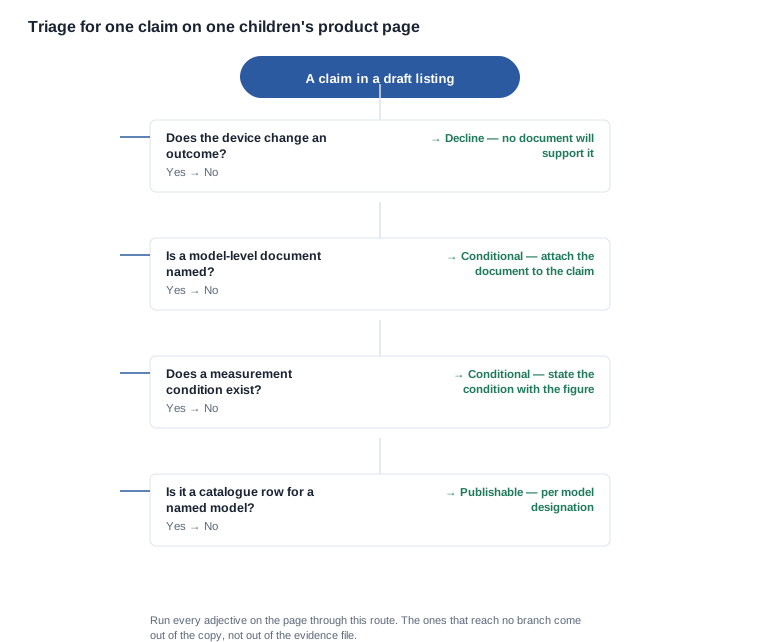
The first group is declined outright. These are claims about an outcome — that the product prevents myopia, that it protects eyesight, that it is fully certified for a range. No document supports them, and the reason no document supports them is not a gap in the buyer's evidence gathering: the device's published function is to detect a position or a distance and to remind, and a product that monitors behaviour is not a product that changes eyesight. The second group is conditional. These claims become publishable once a named document exists for the exact model, or once a measurement condition is stated alongside a number. The third group needs nothing at all, because the claim is already a published catalogue row for a named model.
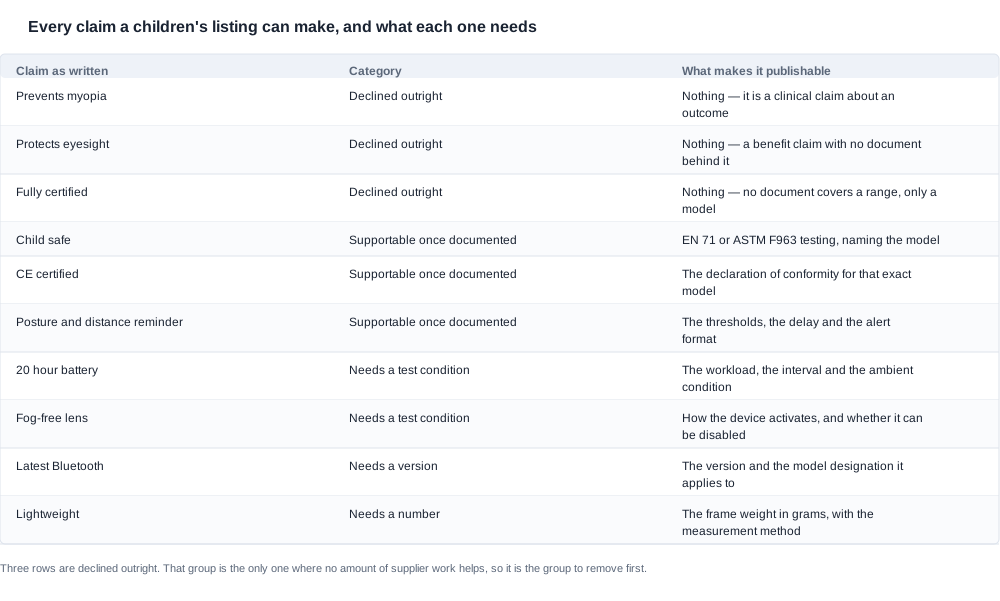
The commercially useful way to read a claim set is to sort it by what would be needed to defend it rather than by how attractive it is. Some claims need a document that already exists somewhere. Some need a measurement that has not been taken. Some need an authority the buyer does not have and cannot obtain. The third group is the one to remove first, because it is the only group where no amount of supplier work changes the answer, and removing it is much cheaper before artwork is approved than after the packaging is printed.
What a buyer is holding when the claim comparison starts
A buyer comparing supplier claims is usually holding three or four product pages, a draft listing of their own, and a set of quotations. What they are not holding is the evidence behind any of them, because product pages are written to be read rather than to be checked, and a competitor's page is not a document of record by any stretch.
The first task is therefore to establish what is actually being claimed, because the claims across four pages will not be consistent with each other and they will not be consistent with what the devices do. A supplier who writes "fog-free lens" for a lens-type electronic fogging device has described a permanent condition where the catalogue describes a device. A supplier who writes "child safe" has made a claim about testing that exists or does not exist. A supplier who writes "20 hour battery" has published a figure whose test condition is not published with it, and a figure that far outside the pattern of the rest of our range — the camera models run roughly five to eight hours and the audio models roughly six to eight — deserves a question about the load behind it.
The three claims to remove before anything else is discussed
The myopia claim. The posture and distance functions published on the A05 and the A06 are reminder functions: they alert when posture or working distance changes. Describing them as myopia prevention is a regulatory exposure rather than a marketing decision, and it arrives with a regulator attached rather than with a customer.
The "child safe" shorthand. The phrase implies a test standard has been met. In Europe the applicable frameworks for products intended for children include EN 71, and in the United States ASTM F963 and the Consumer Product Safety Improvement Act apply; those are separate from a radio approval and separate again from a declaration of conformity. If a report naming the model exists, the term can be supported. If it does not, the term cannot appear.
The blanket certification claim. "Fully certified" is the phrase that covers a range rather than a model, and no document in this category does that. A certificate or a report is issued against a model designation, and a buyer's file has to name what it covers.
Comparing three competing pages without building a spreadsheet
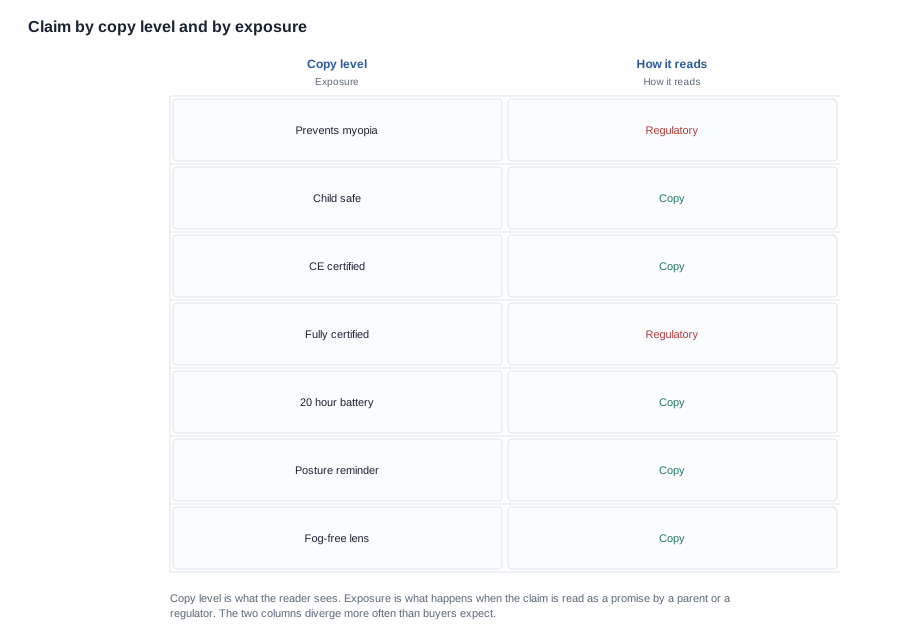
Claim sets can be compared without a scoring model, and the method that works is to rebuild each page in the buyer's own evidence file and count the differences. Take a supplier's page and list every claim it makes in three columns: the claim as written, the class it falls into, and the document that would support it. Then repeat for the other two pages and compare the three lists side by side.
What emerges from that comparison is usually not a quality ranking, it is a documentation ranking, and that is a more useful result than a quality ranking because documentation is what the buyer's own file will eventually depend on. A supplier whose page is full of conditional claims and whose file is thin is more expensive than a supplier whose page is modest and whose file is complete, even when the two products perform the same way on a bench.
The second thing that comparison reveals is the shared vocabulary problem. It is common for three suppliers to describe the same function with three different words — a reminder, a prompt, an alert — and each of those words implies a different delivery mechanism, a different level of intrusiveness and a different support expectation. When the comparison is done on the page language alone, the buyer concludes that three different products are being offered. When it is done on the evidence, the buyer often finds one product offered three ways, which changes the shortlist entirely.
The third output is the request list, and it falls out of the comparison for free. Every conditional claim that has no document behind it becomes a line in a request to whichever supplier is still in the running. Because the request is derived from the claims rather than from a generic template, it is short, specific, and answered per model by a supplier who has a documentation habit.
The document that sits behind each conditional claim
A declaration of conformity is not a children's safety approval
The CE route is a self-declaration rather than a certificate, and it says nothing about children's safety specifically. This is the single most common confusion in the category, because a declaration of conformity is a document a supplier can produce on request and it covers the product it names and the framework it addresses. The children's safety frameworks are a different document set, with a different issuing body and a different scope.
The practical consequence is that the frameworks have to be separated claim by claim. When a supplier answers the certification question with a single document, the buyer cannot tell whether the document covers the radio requirement, the children's safety requirement, or both. The request should be written so that each framework is answered by its own document reference, with the issuing body and the validity dates, against the exact model designation.
The scope of this matters more than it does in an adult line, because a children's product attracts regulatory attention that an adult product does not. A product derived from an adult platform does not inherit the adult product's file, because the requirements differ, and because the frameworks work on an edition cycle where a new edition can require retesting a product that has already shipped.
The supporting evidence for each conditional claim
| Claim as it appears | Class | The document or measurement that makes it publishable |
|---|---|---|
| "Prevents myopia" | Declined outright | Nothing — the published function is a reminder, and this is a clinical claim |
| "Protects eyesight" | Declined outright | Nothing — a benefit claim with no documentary basis |
| "Fully certified" | Declined outright | Nothing — no document covers a range rather than a model |
| "Child safe" | Conditional | EN 71 or ASTM F963 testing, with a report naming the model |
| "CE certified" | Conditional | The declaration of conformity naming the exact model designation |
| "Posture and distance reminder" | Conditional | The detection thresholds, whether they are configurable, and the alert format |
| "20 hour battery" | Conditional | The load, the interval and the ambient condition, published with the figure |
| "Fog-free lens" | Conditional | How the lens-type device activates, how quickly, and whether a parent can disable it |
| "Latest Bluetooth" | Conditional | The version and the model designation it applies to |
| "Lightweight" | Conditional | The frame weight in grams, with the measurement method |
The three claims that need a measurement rather than a document are the ones buyers most often assume are covered. A runtime figure without its condition is not a claim about a product, it is a number. A "fog-free" description of a device that can be switched off, replenished and consumed is a claim about a permanent property that the device does not have. And a Bluetooth version without the model it applies to is a claim about a family rather than a product.
Where a claim becomes an exposure rather than a risk
A risk is something you can manage. An exposure is something that has already happened and that somebody else now controls. The difference between the two in this category is usually one line of copy and the point at which it was written.
Words like protection, care, therapy and prevention in a children's product do not only create a claim problem. They attract the attention of a regulator and of a plaintiff's lawyer in a way the same words in an adult product do not, and they do it in a category where the certification file is empty. The row that turns a claim into an exposure is therefore not the claim itself but the combination of the claim with an unverified safety position: a listing that says "protects eyesight" and shows a CE mark is making two assertions at once, and only one of them is even arguable.

Auditing copy before the artwork round, not after
The copy audit in two passes
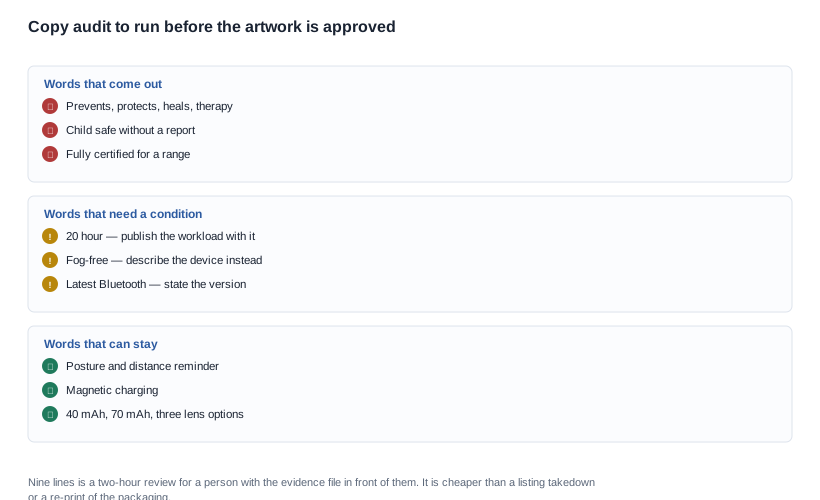
The audit works in two passes, and the order is not negotiable. The first pass removes the declined class. Every claim about an outcome, every claim about safety without a report, and every claim that covers a range rather than a model comes out. The reason to do this pass first is cost: removing a word from a draft is free, while removing a word from a printed package is a reprint, a re-plan of the artwork rounds and a stock write-off.
The second pass qualifies the conditional class. Each remaining claim gets attached to the document or measurement that supports it, and where the support is a measurement, the condition is written next to the number rather than kept in a file. A claim that says "roughly twenty hours of use" and carries the condition in a spreadsheet is a claim a retailer can still challenge; a claim that says "roughly twenty hours of use at a low reminder frequency" is a claim that can be defended.
Who signs the claim review, and when
The review needs one owner, and the owner is usually not the copywriter. In a children's line the claims touch the compliance file, and the person who can say whether a document supports a phrase is the person who holds the file. The review should happen at a fixed point in the programme — after the compliance position is known and before the first artwork round is released — and its output should be a version, not a set of comments.
The output is a claim-to-document map: one line per claim on the listing, the class it falls into, and the document reference or the measurement condition behind it. That map is what lets a buyer answer a retailer's technical team, and it is also what lets the buyer answer a marketplace reviewer without opening a fresh research project.
The two documents that have to agree
Product page copy and packaging copy are written by different workstreams in most brands, and in a children's line they carry different legal exposure: the page is marketing, the package is a regulated label. A claim set that is defensible on one and not on the other is the most common way a compliant programme produces a non-compliant package. The check is simple and takes an hour once the map exists: put the two documents side by side and compare them line by line.
What a claim boundary is worth commercially
The commercial cost of a claim that has to be withdrawn
A withdrawn listing is not a marketing loss that the next campaign repairs. It is a channel disruption, a stock that cannot be sold in the market it was printed for, a compliance enquiry, and in some channels a suspension that reaches beyond the one product page. The cost of removing an unsupported claim before artwork is measured in hours; the cost of removing it afterwards is measured in the value of the print run.
That asymmetry is what makes the claim review the highest-return hour in a children's programme. It is also why the claim boundary is not a marketing preference and why no commercial term changes it. A medical claim on a children's product is a regulatory matter, and a negotiation that treats it as a copy detail will produce a listing that has to be withdrawn.
The clauses that keep the copy and the file aligned
Four clauses do most of the work. The first requires the marketing and label wording to match the documentation, with the buyer holding the right to require that copy be amended. The second requires the exact model designations covered by each document to be attached to the purchase order. The third requires notice before any change of firmware, detection threshold default, frame material or supplier of a safety-relevant component, because each of those can change what a claim is supportable for. The fourth sets out who bears the cost when a sample does not meet the acceptance criteria.
The negotiable numbers sit elsewhere. Minimum order quantity is negotiable, and a children's line is often a brand's first order in a new category, which is exactly where a supplier has the most incentive to be flexible. Packaging and insert design, including the size guidance, the market labels, the language of the documentation pack and the required warnings, is a low-cost negotiation that carries no tooling implication. Delivery splitting against a sample-approval milestone is often granted more easily than a price concession, because it moves the approval risk onto the point where the evidence is. Payment node structure is a standard area, and a retention held against the documentation package protects the buyer on the failure that costs most in this category, which is a product that arrives with paperwork that does not cover it.
The compliance cost and the elapsed time of testing are per model and per market and are not a commercial lever. Amortised across a first order as a one-off, tooling puts two questions on the table: how much volume carries it, and what the position is on it should the programme be discontinued.
A scenario: a listing rewritten line by line
This is a worked case rather than a client project. The order of choices is set out.
Assume a distributor has drafted a listing for a children's range under their own label. The draft opens with a claim that the product protects eyesight, states "20 hour battery", describes the lens as fog-free, and marks the product as child safe and CE certified, with a Bluetooth 5.4 badge taken from the A07's row and applied across the range.
The first pass removes three things: the eyesight claim, the child-safe claim and the blanket certification claim. Nothing else in the draft changes at this stage, and the listing is now weaker but defensible.
The second pass qualifies the rest. The runtime gains its condition, published in the listing rather than held in a file. The lens is described as a lens-type electronic fogging device rather than a fog-free lens, with the activation behaviour and the disablement position added. The Bluetooth badge is removed from the range and attached to the A07 only, because that is the only model for which a version is published, and the A05 and the A06 publish none.
The fourth and fifth claims are the ones the distributor has to go and get: the model's certificate references and the detection thresholds, the delay and the alert format. Both requests go out as lists rather than paragraphs, and both are answered per model.
The result is a listing whose every adjective corresponds to a row in the file. It reads as a smaller claim than the draft, and it is the version a retailer's technical team accepts, because the claim and the evidence are the same width.
The claim review we can run on your draft
The published rows behind every publishable claim
Every claim that can be published without further work is a row we hold: the 40 mAh cell and the 70 mAh cell, the two-hour-or-less charge time, roughly twenty hours of rated use, magnetic charging, three lens options on the two protection models, the lens-type electronic fogging device, posture and viewing-distance detection, and Bluetooth V5.4 on the A07. Nothing else in the published data supports a marketing claim about a children's product, and the rows themselves are the ceiling on what the listing can say.
The framework those rows sit inside is set out in kids certification requirements, and the wider argument about why this category needs a careful position is in why it matters for kids eye protection glasses.
What we will publish, and what we refuse to write down
The working rule we apply: we publish the parameters we hold for the A05, the A06 and the A07, and state plainly that no certification status, frame material, weight, detection threshold or lens-device specification is available to us. We will not make a health, vision or protection claim for any product, in any market, and we will not publish a claim on our own pages that we would not accept on a customer's.
The reason is worth stating once, because it applies to every article in this set. A children's product carries a documentation and safety obligation, and the correct positioning is a compliant, well-made device with named functions. A claim that a parent relies on and that no document supports is not a marketing risk. It is a regulatory one, and it is the kind that arrives with a regulator attached rather than with a customer.
The draft to send for a claim review
Send the draft listing, the packaging copy if it exists, and the model list. We will return the claim set sorted into the three classes, the document or measurement each conditional claim needs, and the specific sentences we would change.
The criteria for that review are simple enough to run yourself: every adjective on the page should correspond to a row in the evidence file, and the ones that do not come out. The background is under kids eye care technology.
Where the claim screen comes from
Send us your draft listing and we will tell you which claims are supportable and which to remove.


