
Kids eye protection glasses technology: six problems, ordered
The six problems, ordered by when they surface
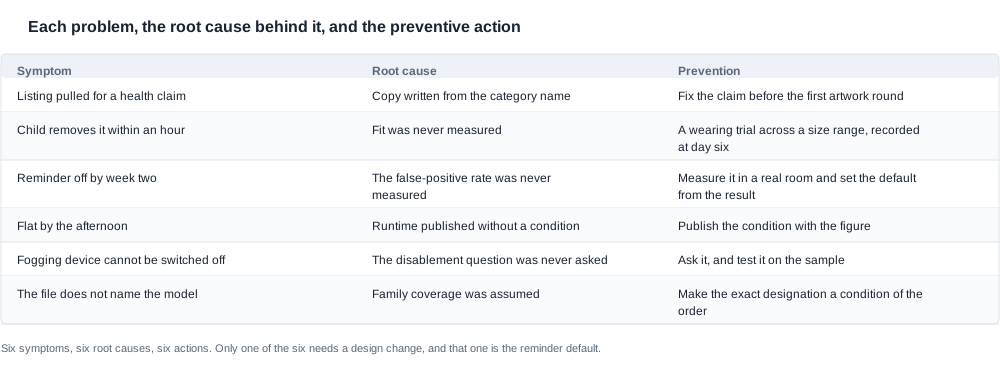
Six problems account for nearly everything that goes wrong with a children's smart glasses programme, and they arrive in a predictable order. Kids eye protection glasses technology smart glasses problems and fixes follows that order: the wrong reason for buying at week one, the detection parameters at week one, fit and the charging routine at week two, reminder fatigue at week three, and the certification question at the point of listing.
Our published data for this tier is short and exact. The A05 and the A06 publish a 40 mAh cell, charging in two hours or less, roughly twenty hours of rated use, magnetic charging, three lens options, a lens-type electronic fogging device, and posture and viewing-distance detection. The A07 publishes Bluetooth V5.4, a 70 mAh cell, the same charge and runtime figures and magnetic charging. The detection parameters and the certification status are not published.
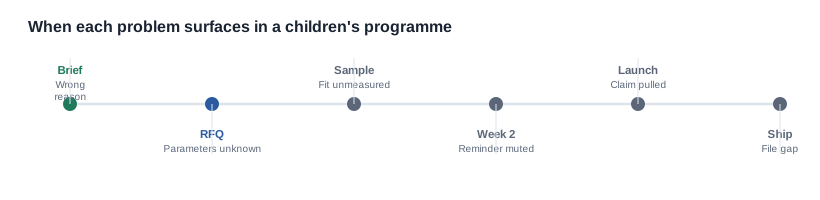
The ordering matters more than the list. A programme that knows when each problem appears can schedule its evidence gathering against the same timeline, and a programme that does not will discover all six in the same month, usually the month before it wants to ship.
The framing error that makes the other five inevitable
The most expensive problem is the first one, and it is a framing error rather than a technical fault. A buyer opening a children's line is usually a brand team, and the category name has already framed the product as a vision product. A device that detects a position or a distance and reminds is not a myopia intervention, and a programme built on the expectation that it is will discover the mismatch at the point where the claim is published — which is the worst possible time, because the artwork is approved and the packaging is ordered.
This is why the first fix in this category is a sentence rather than a test. The buyer has to name the specific, named behaviour the product is meant to change: a reminder when a child's posture changes during a study session, a prompt when the working distance falls outside a tested range, a nudge to take a break. If the answer is a general concern about screen time, the product has no job, and no specification, sample or supplier will supply one. If the answer is a named behaviour, every other problem in the list acquires a specification attached to it.
The detection parameters are the product
Posture and viewing-distance detection is published as a function on the A05 and the A06. The thresholds, the delays, the behaviour on repeated triggers and the false-positive rate are not published, and those are the rows on which two products in this tier differ most. A threshold expressed as a quality cannot be tested on a sample, compared across suppliers or written into an acceptance criterion. A threshold expressed as a number with a unit can do all three.
The alert format is in the same category. Whether a parent sees the reminder visually, hears it audibly, or gets both, and what the user sees when detection is not working, are unstated. In a classroom a visual alert and an audible alert are different products with different acceptance criteria and different support expectations.
Fit is not a specification question in this tier
The frame dimensions and the weight are not published for any model in our range, and the frame weight for the whole catalogue is available for one model only, the 158 g of the MT6 in the camera line — a different product in a different tier, which is not a substitute for a figure on this one. Fit therefore has to be established on samples across a size range with actual children, and it cannot be closed by a supplier answering a question.
That is the single largest driver of returns in any eyewear category, and in a children's line it is also the largest driver of the "it does not work" return reason, because a child removes a badly fitting frame within an hour and the removal is recorded as a product failure rather than a fit failure.
The two problems that only appear in a household
The certification question arrives last and costs the most
Of the six problems, the certification question is the one with the longest lead time and the one that most often arrives at the wrong end of the programme. In the European Union the frameworks that apply to products intended for children include EN 71, and in the United States ASTM F963 and the Consumer Product Safety Improvement Act apply; neither is satisfied by a radio approval, and both work on an edition cycle where a new edition can require retesting a product that has already shipped.
The reason it arrives late is structural rather than careless. A compliance question has no obvious owner inside a brand that is used to thinking of compliance as a finished-product concern, so it gets scheduled alongside the other finishing work rather than at the front of the programme. When it eventually surfaces, the artwork has been approved against a label set that assumed a certain classification, and the artwork has to be redone.
The fix is to treat the compliance position as a prerequisite with a duration, and to date the launch from it rather than from a factory date. It is also to narrow the model list early, because the cost is per model and per market, and every model added after the laboratory booking is added to a critical path.
The charging routine and what a long unattended charge does
A twenty-hour runtime is irrelevant if the device is not charged when the child puts it on at the end of the day, and the published figure only means something in the context of a household's charging habit. The routine is the product in that sense: it is the thing that determines whether the published endurance is ever experienced.
This is also where a safety question hides that no specification covers. A charging arrangement in a household where a child can reach the dock is a different proposition from an adult product's, and the arrangement that ships in the box — the adapter, the cable, the dock, and what happens on a long unattended charge — has to be established rather than assumed. For the A05, the A06 and the A07 the published rows state magnetic charging and roughly twenty hours of rated use, and they publish nothing at all about the charger.
Reminder fatigue and the default nobody measured
A reminder that fires every few seconds is ignored inside a week. A child who has been told off repeatedly stops responding to reminders, and the feature becomes decoration. The reason it happens is almost always the same: the false-positive rate was never measured, so the shipped default was too aggressive for a real household, and the first household to receive it switched it off.
The fix is not a softer default chosen by intuition. It is a measurement: the false-positive rate expressed as a rate over a stated number of attempts, in the room the product will actually be used in, with the shipped default set from the result. A default tuned in a laboratory produces a household that switches the feature off in week two, and the returns that follow carry no reason at all.

What each problem costs when it is found late
The four fixes that cost nothing on the purchase order
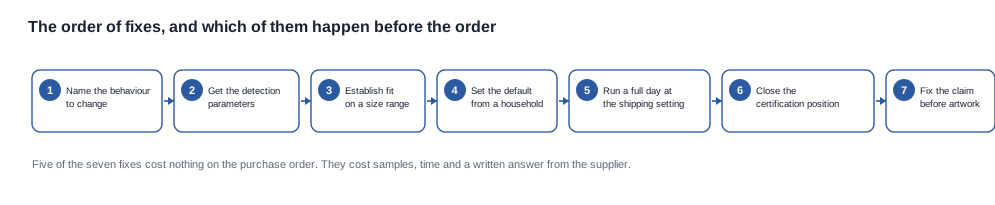
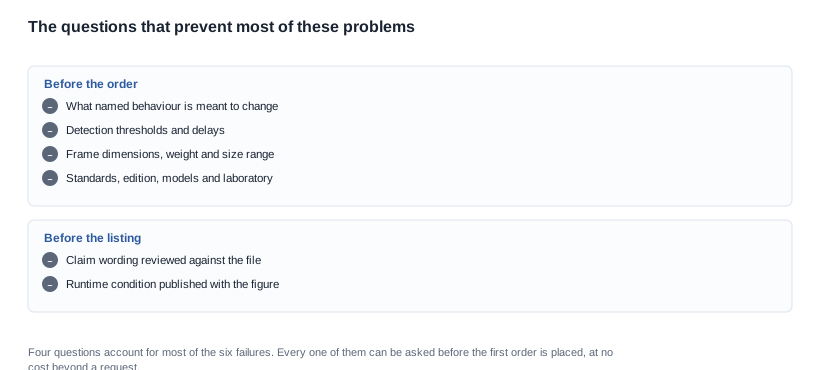
Four of the six problems are fixed before the first order is placed, and none of the four fixes requires a change to the product. They require a question, a document request or a sample.
Naming the behaviour costs one afternoon of internal work and prevents a claim problem that would otherwise be discovered after the artwork is approved. Obtaining the detection parameters costs one request to a supplier and closes the difference between a feature and a specification. Establishing fit on samples costs a small number of units and a week of calendar time, and it replaces an argument with a measurement. Running a full day at the shipping reminder setting costs one sample and one day, and it produces the margin that the runtime claim needs.
The other two problems are the certification question and the claim itself, and both of them are cheaper to fix early than late but neither is free. The certification question has the longest lead time of anything in the programme, and it is also the one that arrives last if the schedule is built from the product rather than from the compliance position. The claim is a copy exercise, and the only reason it is expensive is that artwork rounds take weeks and printed packaging cannot be un-printed.
The clauses that keep a fix from becoming a dispute
A fix-forward programme should carry four clauses that a fix-later programme will wish it had. The first sets the acceptance criteria for the sample, referencing the detection observations, the duty-cycle run and the wearing trial, so that the standard is the buyer's rather than the supplier's. The second requires the exact model designations covered by the certification file to be attached to the purchase order, so that a family-level file is never treated as coverage. The third requires notice before any change of firmware, detection threshold default, frame material, battery or supplier of a safety-relevant component, because each of those can silently invalidate a criterion the buyer has already measured against. The fourth sets out who bears the cost when a sample does not meet the acceptance criteria.
Why a fix-forward programme pays less for the same product
The four fixes look like extra work, and compared with a programme that fixes nothing they are. Compared with a programme that discovers the same four problems during the pilot, they are dramatically cheaper, and the reason is that each problem has a discovery cost that rises steeply with the point at which it is found.
A named behaviour costs one afternoon at the start of the programme and a reprint of every piece of artwork if it is found at listing. A parameter set costs one request before the order and a supplier escalation, a re-test and a renegotiated schedule if it is found during the pilot. A fit sample costs a small number of units before the order and a returns rate measured over months afterwards, which is the most expensive version because it is the only version that shows up in a channel's reorder decision. A published runtime condition costs a paragraph in the copy and a wave of support contacts if it is found after launch.
The trade-off worth naming is between speed and evidence, and the way to resolve it is to look at which of the four fixes is actually slow. Only the fit sample and the duty-cycle run take calendar time, and both take it in parallel with the rest of the programme rather than in series. The other two are requests, and a request costs nothing but attention.
Where the negotiating room actually sits
The negotiable numbers in a children's programme are the number of models and colours committed, the artwork round count, the per-market label scope, the fit programme scope and the market list. Each of them is worth more than a percentage point on the unit price, because each model and each lens combination carries its own compliance cost and its own per-SKU minimum. Minimum order quantity is negotiable, and a children's line is often the brand's first order in the category, which is where a supplier has the most incentive to be flexible. Packaging and insert design, including the size guidance, the market labels, the language of the documentation pack and the required warnings, is a low-cost negotiation with no tooling implication. Delivery splitting against a sample-approval milestone is often granted more easily than a price concession, because it moves the approval risk onto the point where the evidence is.
The compliance cost and the elapsed time of testing are per model and per market, and the elapsed time is set by the test laboratory and its review queue rather than by the buyer's urgency. A one-off charge for tooling, spread across the opening order, is the other fixed item; the questions worth putting are the volume the charge covers and whether the tool would still be needed once the programme is discontinued. The safety-relevant design decisions — the battery retention method, the small-parts policy and the frame materials — are not commercial variables, and no price moves them.

A scenario: a brand fixing four problems before it orders
The situation and the sequence
This is a worked case rather than a customer case. It exists to show the order.
Assume a brand team opens a children's line with a target market, a channel plan and a price point. The brief arrives framed as a screen-time product, which is the framing error, and the first week is spent on a detection-accuracy debate that nobody can settle because no supplier has been asked for the thresholds.
The first fix is a single afternoon of internal work: the team writes down the one named behaviour the product is meant to change, which turns out to be a break prompt during long study sessions rather than anything about eyesight. Everything downstream reorganises around that sentence, and the claim problem never reaches the artwork stage because it was never created.
The second fix is the request list. The thresholds, the delay, the repeated-trigger behaviour, the false-positive rate, the alert format and the behaviour when detection is not working go out as a numbered list. One supplier answers all six with numbers and units, which tells the team that the product has been measured rather than described.
The third fix is the fit sample. Because no weight or dimension is published, the brand commissions samples across a size range and runs a wearing trial recording day six. The result is that one of the two candidate fit profiles is dropped from the range before the order, which removes a SKU and its per-SKU compliance cost at no cost to the programme.
The fourth fix is the duty-cycle run at the reminder setting the brand intends to ship, on both the 40 mAh and the 70 mAh configurations, with the condition published alongside the figure. The copy is written from that result rather than from the catalogue, so the listing carries a condition instead of a bare number.
The certification position is requested in the same week as the model question, and the artwork is held until it is answered. The programme reaches the point of order with four problems already closed, a claim that is the width of its evidence, and a file that names the model it covers. The measurement method behind steps two and four is set out in how to measure kids eye protection glasses, and the closely related buying errors are catalogued in kids buying mistakes.
What the four fixes were actually worth
None of the four fixes changed the hardware, and all four of them changed what the buyer could prove. The programme that arrives at the order with a named behaviour, a parameter set, a fit sample and a published condition is the programme that can settle an acceptance dispute quickly, because the criteria are already written down and attached. The programme that arrives with a quotation, a unit price and a product page is the programme that will discover the same four problems during the pilot, at four times the cost and against the same launch date.
The published rows, and what we will not fill in
What we publish and what we refuse to estimate
The working rule we apply: we publish the children's models' electrical rows — the 40 mAh and 70 mAh cells, the charge time of two hours or less, the roughly twenty-hour runtime, magnetic charging, Bluetooth V5.4 on the A07, the three lens options, the lens-type electronic fogging device, and the presence of posture and distance detection — and we say plainly that the detection parameters and the certification status are not published. We publish no frame weight, no dimension and no size range for this tier, and we will not fill a fix list with plausible thresholds or a certification claim, because in this category an invented number becomes a safety statement on a product page that a parent will rely on.
We make no benefit claim about vision, health or eye protection for any of our products, in any market, and we would rather a buyer runs the copy past someone qualified than finds out afterwards that the claim is the problem.
The measurement plan to send with the RFQ
Send four things with the RFQ: the named behaviour, the parameter request list, the fit sample protocol with a size range and a day-six record, and the duty-cycle protocol with the reminder setting you intend to ship. Each of the four has a defined output, and the outputs together become the acceptance criteria attached to the purchase order.
We will also say plainly which four questions prevent most of these six problems, and that all four can be asked before the first order is placed. Send us the two products and the behaviour and we will tell you which of the six problems you are most likely to hit, and which of them are already closed by the evidence you have. The range is at kids smart glasses and the background is under kids eye care technology.
Where the fix list comes from
Send us the two products and the behaviour and we will tell you which of these six problems you are most likely to hit.


