
Kids eye protection glasses technology: children's quality control
Breakage rate is a design input, not a defect rate
Adult glasses are dropped occasionally. A pair handed to a seven-year-old is dropped, thrown, sat on and chewed on. If a quality plan assumes adult drop rates, the failure rate will surprise the buyer at the pilot stage, and the surprise will be attributed to manufacturing rather than to the fact that the test conditions did not resemble the use conditions.
The question is therefore not "what is your defect rate" but "was the model drop-tested on the specific build you are buying" — the colour, the finish, the plastic batch and the age of the material. A drop report produced on a reference sample in a laboratory tells a buyer about the reference sample. For a children's line it tells the buyer almost nothing about the unit a child will actually be handed, which is why the report has to name the build.
Skin contact and the materials that touch a child
Children wear glasses longer and closer to developing tissue than adults do, and a frame that an adult would tolerate for a decade can be a contact issue over a school year. The buyer should hold a material declaration for anything that touches the skin and a nickel-release statement from whoever performed the plating, and the buyer should hold the plating declaration as a document rather than as an assurance.
We cannot provide these for our own models because they have not been given to us, and we will not substitute a general statement about materials for a declaration. That is not caution for its own sake: the buyer who receives an assurance rather than a declaration cannot put it in a file, and a file that cannot hold a declaration cannot be shown to a retailer's technical team or to a school's procurement officer.
The six control points that carry the risk in this tier
Our catalogue's children's models are the A05, the A06 and the A07. The A05 and the A06 publish a 40 mAh cell, charging in two hours or less, roughly twenty hours of rated use, magnetic charging, three lens options, a lens-type electronic fogging device, and posture and viewing-distance detection. The A07 publishes Bluetooth V5.4, a 70 mAh cell, two hours or less of charging, roughly twenty hours of rated use and magnetic charging. The certification status for all three is not published to us, and that gap has to be resolved before product work begins.
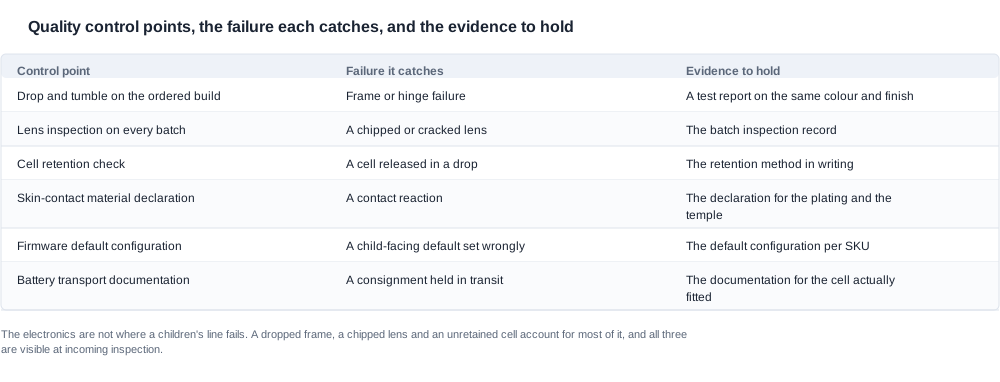
Given those rows, the risk in this tier is concentrated in six places, and none of them is the electronics.
| Control point | Failure it catches | Evidence the buyer should hold |
|---|---|---|
| Drop and tumble on the ordered build | Frame, hinge or temple failure | A test report naming the colour and finish |
| Lens inspection on every batch | A chipped or cracked lens | The batch inspection record |
| Cell retention check | A cell released in a drop | The retention method in writing |
| Skin-contact material declaration | A contact reaction over a school year | The declaration for the plating and the temple |
| Firmware default configuration | A child-facing default set wrongly | The default configuration per SKU |
| Battery transport documentation | A consignment held in transit | The documentation for the cell actually fitted |
Lens integrity is a safety issue, not a cosmetic one
A chipped or cracked lens on a child's pair is not a return, it is an exposure, and it is the one control point in this list that a buyer can perform without any laboratory at all. Batch inspection is the minimum, and the inspection standard should be written down rather than left to the operator on the line, because a standard that lives in an operator's judgement will be applied differently on a Friday afternoon than on a Monday morning.
The same applies to the temple and the hinge. These are the two parts a child uses as a lever, and they are the two parts a drop report is most likely to have been written about on a different build.
The battery compartment and what retention means
Small lithium cells in a product a child can handle require mechanical retention, and adhesive is not retention. The question a buyer asks is how the cell is held and what happens to it in a drop, and the answer is a design decision that the catalogue does not record for the A05, the A06 or the A07.
This is a control point rather than a specification point because it has to be verified on the unit rather than read from a sheet. It also carries a second question that is easy to miss: the charging arrangement that ships in the box is part of the safety argument rather than a convenience, and the published rows state magnetic charging and roughly twenty hours of rated use without publishing anything about the charger, the dock or the behaviour on a long unattended charge.

Incoming inspection: what a warehouse can catch without a laboratory
The incoming inspection sequence
The sequence matters, and the order below is deliberate. The document check comes first, because a carton that does not match the file is not worth opening, and the physical checks come after it because they are the checks that consume labour.
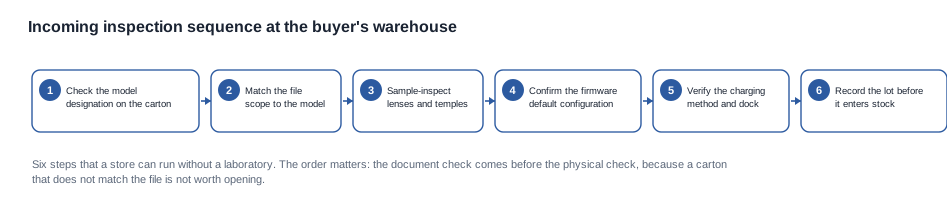
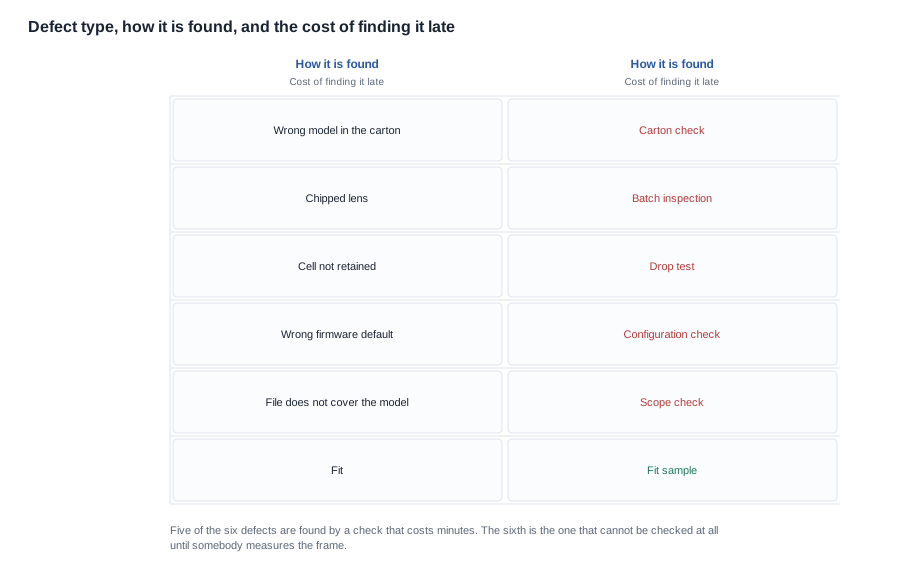
Step one checks the model designation on the carton against the purchase order. A wrong model in the carton is the most common reason a buyer's documentation does not match what arrived, and it is invisible until someone reads the box.
Step two matches the file scope to the model. The buyer asks which designations the certification file names and checks the string on the carton against that list. A family-level file is not coverage for a branded unit, and the difference between the two is a shipment held at a customs gate rather than a discovery made in a warehouse.
Step three samples the lenses and temples. The chip, the crack, the hinge and the temple are all visible under a light, and the inspection standard should be written down with the pass and fail conditions rather than described in words.
Step four confirms the firmware default configuration against the version that was approved. The defaults are the child's-facing settings, and a unit shipped with a different default is a unit whose behaviour no longer matches the acceptance criteria.
Step five verifies the charging method and the dock. A missing or substituted dock is a support cost from the first delivery rather than a quality incident, but it is found cheaply here.
Step six records the lot before it enters stock. The lot record is what makes a later claim possible at all, and it is the single piece of paperwork that a buyer's quality file is built around.
What a carton check can and cannot establish
A carton check establishes identity and it establishes that the documentation and the goods agree with each other. It does not establish anything about performance. The distinction matters because a buyer who treats the incoming inspection as a substitute for the sample acceptance test will discover the performance problems in the channel rather than in the warehouse.
The deeper point is about where the costs sit. A carton mismatch costs a return and a documentation correction. A performance mismatch costs a returns rate, a channel relationship and a reprice, and it is invisible at the dock because the unit passes every check a dock can perform.
What the factory should be checking and what you should re-check
Every quality plan divides into two layers, and the division is where most of the value is lost. The factory's layer is process control: it runs on every unit, it is the supplier's own responsibility, and its output is a record rather than a judgement. The buyer's layer is incoming inspection: it runs on a sample, it exists to catch what the supplier's layer missed or accepted, and it is the only layer that stands between a lot and a channel.
The failure mode is a buyer who writes a plan that only covers the second layer, and then argues with the supplier about the first. That argument is unresolvable because the supplier's process control is invisible and the buyer's sampling is statistically thin. The workable division is narrow: the factory checks everything it can check on every unit and documents it, and the buyer re-checks the things that would be catastrophic if wrong — identity, lens integrity, cell retention and firmware default — rather than re-checking everything.
Two consequences follow for a children's line. The first is that the buyer's sample should be small and targeted, because the items worth re-checking are few and each of them is binary. The second is that the acceptance limits have to be written into the agreement rather than left to the buyer's judgement on the day, and that a sampling plan with stated acceptance limits is part of the deliverable. A plan without acceptance limits is a plan that produces a conversation every time a lot arrives, and in a channel where deliveries are frequent, that conversation becomes the cost.
The record that has to travel with the lot
Three records should travel with every lot, and they are cheap to require and impossible to reconstruct later. The first is the lot identifier and the build identity, so that a unit found in the channel can be traced back to the colour, the finish and the material batch. The second is the batch inspection record for the lenses, with the inspection standard attached. The third is the firmware version and its default configuration, so that a behaviour question can be answered without a physical unit.
All three are worth more than a percentage point on the unit price, and all three are negotiable in the same way: they cost the supplier a small amount of process discipline and they cost the buyer almost nothing to ask for. The clause that makes them enforceable is a simple one — the documentation pack for a lot is delivered with the lot, not after it.
Configuration control as a quality-control function
Change control between the sample and the shipment
The most common way a children's programme loses its acceptance criteria is not a bad unit. It is a good unit that no longer matches the sample the criteria were written against. A firmware update that changes a default, a new frame material, a new lens source, a different cell or a different supplier for a safety-relevant component will each alter what the buyer has approved without altering what the buyer's file says.
The control is a notice obligation: the supplier tells the buyer before any of those changes, and the buyer has a defined period to re-test. Without it, the criteria in the purchase order refer to a product that no longer exists, and every dispute afterwards is a dispute about which version was approved.
There is a second configuration item that belongs in the same list, and it is the one buyers forget: the marketing and label wording. A change to the copy can make a product non-compliant without changing a single component, which is why the claim-to-document map should be version-controlled alongside the firmware.
The compliance gate that has to come before quality control
Quality control assumes there is a product that is allowed to be sold. In a children's line that assumption is not safe, because the certification status for the A05, the A06 and the A07 is not published to us, and the frameworks that apply to products intended for children — EN 71 in the European Union, ASTM F963 and the Consumer Product Safety Improvement Act in the United States — are separate from a radio approval and separate again from a general declaration of conformity.
The ordering is therefore fixed: the compliance position has to be established first, the quality plan second, and the sample acceptance criteria third. A quality plan written for a product that cannot be sold is a quality plan for a product that will not be sold.
The claim boundary is part of the same gate rather than a separate topic. The posture and distance functions published on the A05 and the A06 are reminder functions: the device alerts when a wearer's posture or working distance changes. It is not a medical device, it is not a myopia treatment, and it is not a vision protection claim, and a quality file that describes the device accurately is one where that distinction is never in question.

Agreeing the quality plan before the first order
The quality clauses worth writing into the purchase order
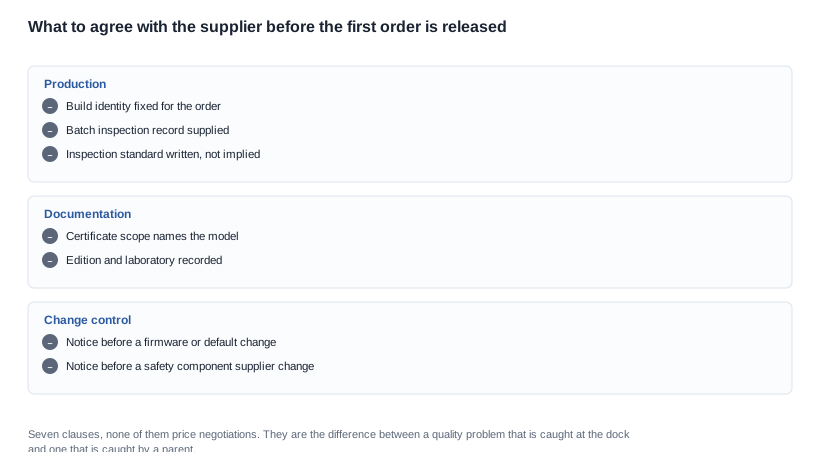
Seven clauses carry most of the weight, and none of them is a price negotiation. The build identity is fixed for the order. A batch inspection record is supplied with every lot. The inspection standard is written down rather than implied. The certificate scope names the model. The edition and the laboratory are recorded. Notice is required before a firmware or default change, and before a change of safety-relevant component supplier.
On the commercial side, the negotiable numbers are the same ones that appear in every children's programme: minimum order quantity, the number of models and colours committed, the artwork round count, the per-market label scope, the fit programme scope and the market list. Delivery splitting against a sample-approval milestone is usually granted more easily than a price concession, and a retention held against the documentation package protects the buyer on the failure that costs most, which is a lot that arrives with paperwork that does not cover it. The compliance cost and the elapsed time of testing are per model and per market and are not a commercial lever, and tooling is a one-off usually amortised across a first order, so the useful questions are over what volume it is amortised and what happens to it if the programme is discontinued.
One commercial point belongs here rather than in the general terms, because it is specific to quality: the cost of a lot that fails the acceptance criteria. A buyer who has not written that clause will discover the default position at the worst possible moment, which is when a container is already at the port and the channel date has been announced. Stating who bears the cost, and what happens to the lot while the dispute runs, turns an open-ended conflict into a procedure with a known duration.
A scenario: a quality failure found at the dock
This is a worked case rather than a client project. It exists to show the order.
Assume a distributor receives a first children's consignment and finds, during the incoming inspection, that a proportion of the cartons carry a model designation that does not appear on the file. The units are not defective. They perform as specified, they pass every physical check, and the problem is entirely one of identity between the goods and the paperwork.
Had the carton check not been the first step, the distributor would have put the units into stock and discovered the mismatch later, on a school order, with a retailer asking for the file for a model it does not name. At that point the options are a recall from stock, a shipment that cannot be delivered, or a listing that cannot be supported.
With the carton check first, the outcome is a held pallet and a written question. The question goes back to the supplier with the lot record, the file scope and the purchase order attached, and the answer either names the correct file or confirms that the lot was built against a different variant than ordered. Either answer is cheap at that point.
The second thing the scenario shows is what the lot record is for. When the same consignment was checked against a written inspection standard with the lens condition recorded, the distributor could state precisely what was received rather than what was supposed to arrive, which is the difference between a dispute and a negotiation.
The published rows behind the quality argument
What supports a quality argument in this tier is the same set of rows that supports a specification argument: the 40 mAh and 70 mAh cells, the two-hour-or-less charge time, roughly twenty hours of rated use, magnetic charging, three lens options on the two protection models, the lens-type electronic fogging device, posture and viewing-distance detection, and Bluetooth V5.4 on the A07. What we cannot supply is a weight, a dimension, a size range, an ingress marking, a certification position, a detection threshold or a false-positive rate for any of the three, and we will not estimate them for a quality plan any more than for a listing.
The quality plan to send with the RFQ
Send the six control points with the RFQ as a table, and ask which of them the supplier can evidence on the build that will be ordered rather than on a reference sample. Ask for the inspection standard in writing, for the default configuration per SKU, and for the retention method. Then ask the one question that decides how much of this is manageable: which of these six will you evidence with a document, and which will you evidence only by a test result.
That distinction — a document against a test result — is the one that matters when the plan is written, because it tells the buyer where the file will have a hole in it. The certification checklist and how a document is validated are covered in certification checklist and model coverage, the after-sales side of a lot that arrives wrong is covered in what a certificate must name, and the background is under kids eye care technology.
Related reading
- kids eye care technology and claim boundaries
- certification checklist and model coverage
- what a certificate must name
Tell us the market you are selling into and we will say what the compliance scope requires before we talk about samples.


