
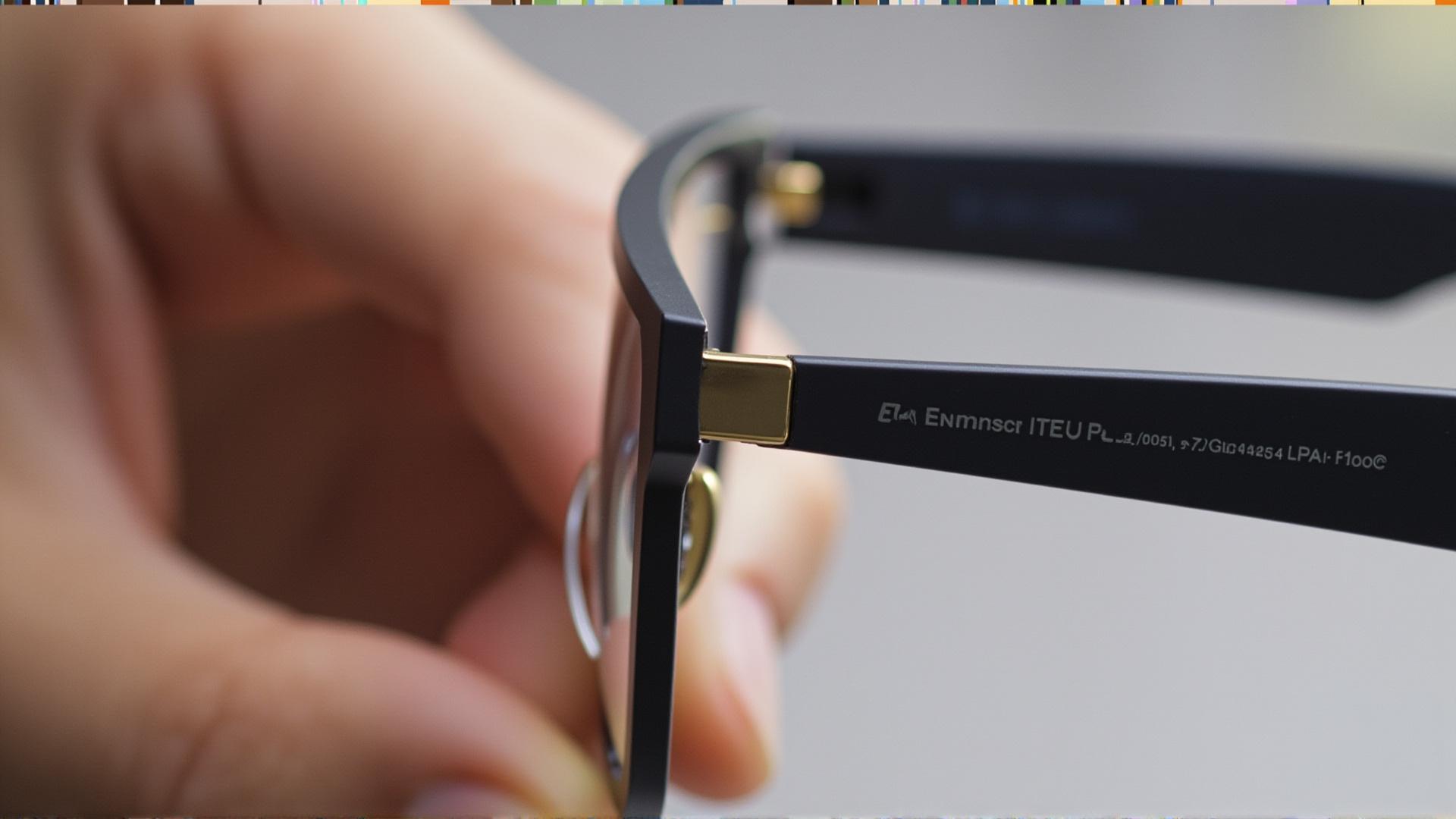
Kids eye protection glasses technology: the first questions
A product intended for children sits under a regulatory regime that is stricter than the one that applies to a general consumer product, and the strictness is not uniform across markets. That means the first decision in any children's programme is not about the product. It is about which markets the product is being placed in, because the market decides the applicable product regime, the documentation set, the age grading and the claims language, and each of those then decides what the factory has to build and what the listing may say.
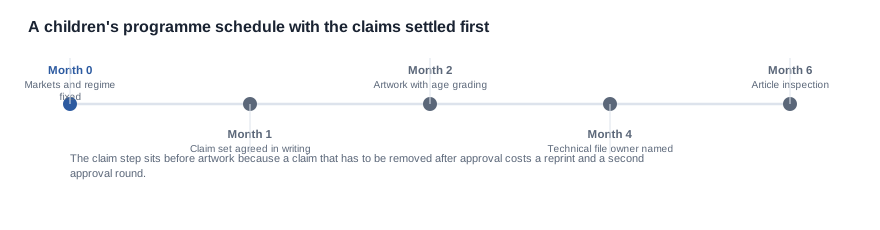
The second decision follows immediately from the first, and it is the one most often taken in the wrong order. Decide what the product may say before the artwork is produced, not after. The permitted claim set is short, it is defined by the destination market rather than by the product, and a claim that has to be removed after the packaging artwork has been approved costs a reprint, a second approval round and a schedule that no longer matches the launch date.
There is a third decision that sits underneath both, and it is the one that determines whether the programme is viable at all: which claims are available in principle. The answer is narrow. A children's smart glasses product can describe what the device does — what it detects, what its lens element does, how long it runs, how it charges and what age range it is graded for. It cannot describe what it does for a child's eyesight, for hearing, or for development. Those claims are not available under the frameworks that apply to this category, and the medical device boundary in FDA 21 CFR 800.30 is a separate regime from consumer electronics entirely. The safe answer to a marketing request for an eyesight claim is that the claim is not available, and a supplier who volunteers one is telling you something important about how the rest of the documentation will be handled.
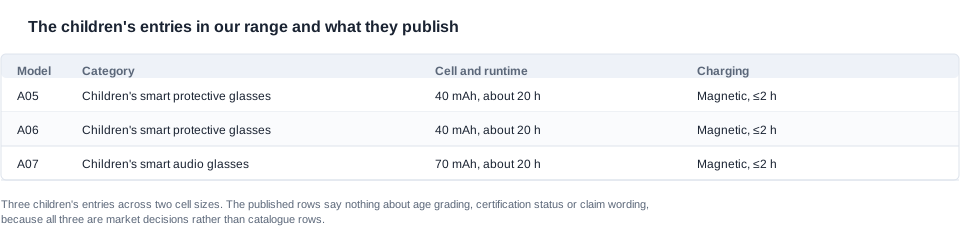
Our catalogue holds three children's entries, and they are worth reading precisely because of what they do and do not publish. The A05 and the A06 publish a 40 mAh cell, a charge time of two hours or less, a rated runtime of roughly twenty hours and magnetic charging. The A07 publishes a 70 mAh cell, the same charge time, the same runtime and magnetic charging, plus Bluetooth V5.4. The A05 and the A06 also publish the lens element type and the detection behaviour: correct posture and viewing distance versus poor posture and distance, and a lens that stays clear in the first case and fogs in the second.
What none of the three publishes is an age grading, a certification status, a detection distance, a detection threshold, a sensor part number or a frame weight. Those are the open rows, and a buyer has to close them with the supplier and with the destination market before the first order.
The four questions that decide the programme
Which markets is this product being placed in? Not where you would like to sell it, but where the regulatory position is clear enough to write the listing. The regime differs by market, and the documentation sets differ with it. A product that satisfies one market is not thereby lawful in another, and the second market is where the cost surprises arrive.
What is the permitted claim set, in writing? Ask the supplier or the compliance adviser for the exact wording that is permitted, and get it in an email before any asset is produced. A paraphrase is not sufficient, because a paraphrase is exactly what ends up on a box.
What does the category require for cells, magnets and detachable parts? These are design constraints, not paperwork. A cell arrangement, a magnet and any detachable component have their own requirements in the children's category, and a configuration designed without them in view cannot be fixed at the end of production. This is the question that turns a children's programme from a marketing exercise into an engineering one.
Who owns the technical file, and where is it held? The technical file is the document that makes the product lawful in the market it is placed in, and it is also the document a successor buyer would need. A file that lives in somebody's inbox is not an asset. Name the owner, the location and the transfer terms at the start of the relationship, not at the point where a relationship changes.


Who owns the conformity route for a product placed for children
The reader here is a brand-side buyer with a compliance responsibility attached, a channel buyer building a private-label children's range, or a product manager who has been handed a children's line because it is a growth category and nobody has said who is accountable for it. The situation is one of three: comparing quotations that differ on documentation, opening a new material number for a market with a defined regime, or taking over a programme from a previous supplier and finding the technical file incomplete.
The accountability question is the first thing to settle, because in this category the party that carries the regulatory obligation is not necessarily the party that does the work. Where the product is placed on the market under the buyer's own name, the buyer's obligations are direct rather than delegated, and the agreement should say which party prepares which part of the technical file rather than leaving it to be discovered at the first market access question. The failure mode is specific and common: the factory assembles a file, the buyer's compliance team assumes the factory's people did the work, and six months later a market access question arrives with no answer and no owner.
There is a second party in the chain that is easy to overlook, and that is the customer. In a children's category the end customer is a parent or a guardian who is buying on behalf of somebody else, and that changes what a complaint looks like and what a return looks like. A product returned because a child would not wear it, or because the parent did not understand the age grading, is not a defect, and it cannot be processed as one. That means a returns position has to be agreed with the channel explicitly rather than inherited from a general consumer policy.
This is also the category where the aftermarket and the long tail matter more than usual. The claim set is narrow and the age grading is specific, so a product that is sold with an age indication and then re-listed without one is a different product in the eyes of the regime, and the listing copy has to be version-controlled rather than edited casually. A change-control clause that covers artwork, packaging copy and the claim set is worth more here than in most categories, because in this category a change of copy is a change of compliance position.
Where a children's programme costs more than an adult equivalent
The visible difference between a children's product and an adult equivalent in a quotation is often small, and the invisible difference is where the programme budget is actually decided. Two effects drive it. The first is that the documentation set is per market, so entering three markets is three documentation sets. The second is that the aftersales profile is different in kind, not just in degree, because the customer buying for a child is buying on somebody else's behalf.
The per-market documentation cost is the item that a price comparison between two suppliers will not reveal unless the buyer asks for it. A quotation for a children's product sold into one market and a quotation for the same product sold into three will look comparable on unit price and will differ by two complete documentation sets in cost and, more importantly, in elapsed time. The route runs on a queue the factory does not control, so a market added late does not arrive late in a proportionate way. It arrives late in full.
The second effect is the aftersales position, and it belongs in the cost model rather than in a policy document. A product for a younger user is more likely to be returned for reasons that are not defects: the age grading does not match the child, the child will not accept it, the parent expected a different function from the category word. A channel that has not agreed a returns position absorbs those in its margin, and because they are not defects they are invisible in the defect rate, which means nobody fixes the cause. The defence is an explicit allowance in the cost model, agreed before the price, and a listing that explains the function honestly enough that the expectation matches the product.
The third cost is the artwork and the label. The age grading, the permitted claims, the warnings and the manufacturer's identification all live on the packaging and on the label, and each one is a separate approval. Every extra market is another artwork set, and the number of artwork rounds is negotiable while the number of approvals is not. Moving artwork earlier in the schedule, before the documentation route completes, is worth more than any negotiation on unit price, because the artwork approval is the step where all the other unresolved items surface at once.
Verifying a children's programme before the first order
Verification in this category is mostly documentary, and the order matters more than usual because each step depends on the one before it.
Step one: confirm the regime per destination market. Ask which product regime each market applies to this category, and confirm the documentation set that follows from it. Do this before asking anything about the product, because the regime decides which evidence is relevant. The industry standards overview covers the frameworks that come up, and the point for a buyer is not to memorise them but to know that they differ.
Step two: get the permitted claim set in writing, per market. Ask for the wording that is allowed, not the wording that is desirable. Then check it across every asset that will exist: the product page, the packaging, the artwork, the insert, the retailer listing and the support scripts. A claim that appears in one asset and not the others is still a claim, and the channel will find it in the asset you did not check.
Step three: confirm the design constraints against the ordered configuration. Cells, magnets and detachable parts have their own requirements in this category. Ask what the category requires, confirm that the configuration being ordered meets it, and get the answer against the specific model rather than against the family.
Step four: verify the published detection behaviour against the specification. Our catalogue publishes the behaviour of the A05 and the A06 as correct posture and viewing distance versus poor posture and distance, with the lens staying clear in the first case and fogging in the second. What is not published is the detection distance, the detection threshold and the sensor part number. Ask the supplier for those three rows and write them into the specification, because "detects poor posture" is a behaviour that a customer will notice and a threshold is a behaviour a buyer can test.
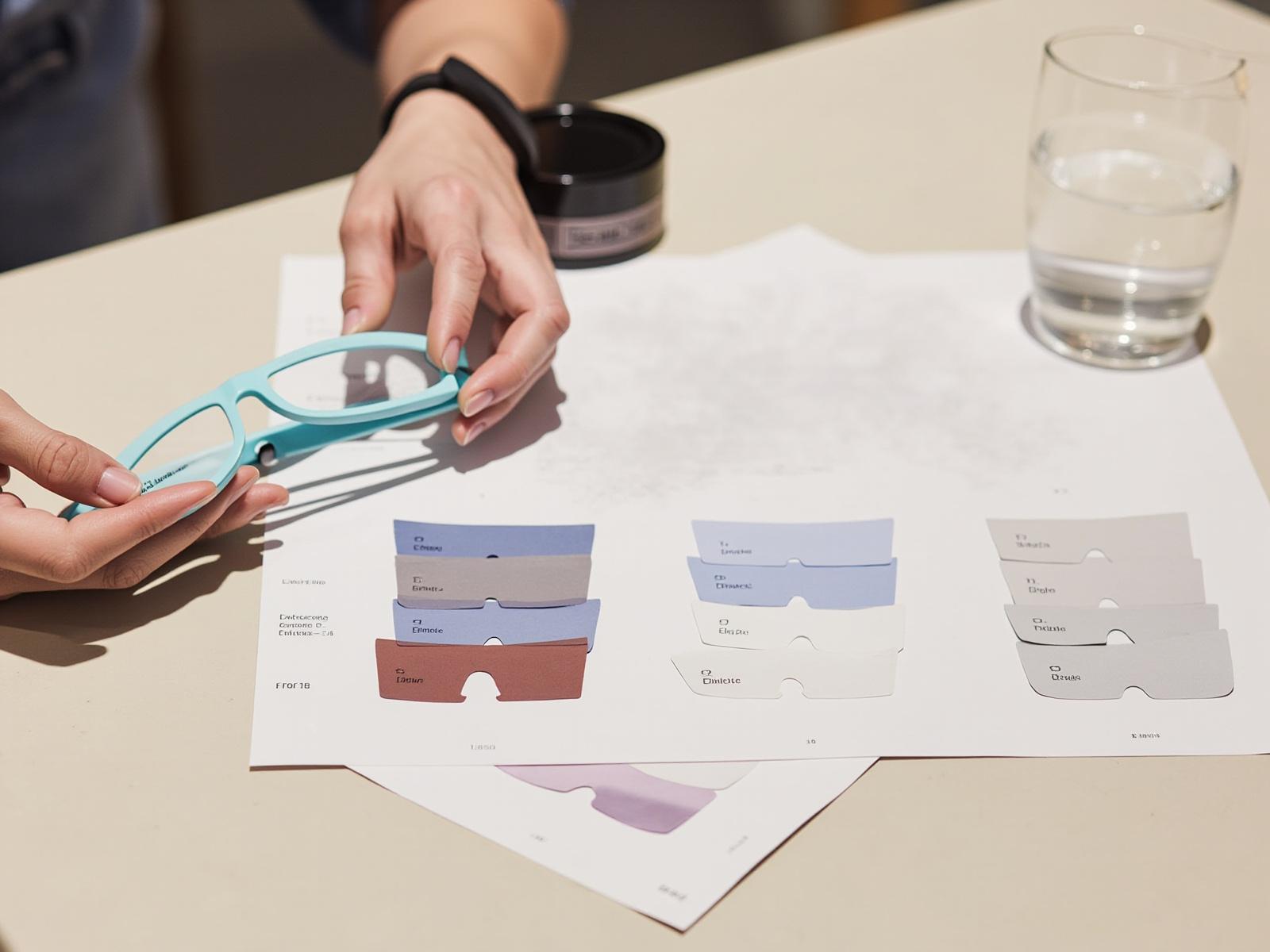
Step five: check the age grading and labelling on the actual artwork, not on the specification. Confirm the grading appears where the market requires it, and confirm the label content. Treat it as a pre-production check rather than a pre-shipment one, because a packaging change at pre-shipment costs an ocean freight delay.
Step six: run the document trail end to end. Ask where the technical file will be held, who owns it, how it is transferred if the relationship changes, and what evidence the file contains for the specific configuration being ordered. A file assembled for a different configuration is a file that does not cover this one.
The supplier verification trail is the longer version of this sequence, and it is worth reading alongside this article because the questions are the same questions asked in a different order.
How children's programmes fail
The claim that appeared in the listing copy. A marketing asset carried a wording the category does not permit. The root cause is that the claim set was agreed after the assets were produced rather than before. The control is to agree the permitted wording in writing first and to review every asset against it, including the ones produced by an agency.
The packaging without the age indication. The market required a grading that the artwork did not carry. The root cause is that the age grading was treated as a specification detail rather than as an artwork element. The control is to put it on the artwork checklist and to check the printed proof, not the design file.
The design that met the adult regime. The product was configured against a general consumer regime and the children's regime added constraints later. The root cause is that the destination markets were not fixed before the configuration was chosen. The control is to fix the markets first and then configure against the strictest of them, because reconfiguring late is a tooling event.
The technical file nobody owned. The file existed in somebody's inbox and the documentation trail was incomplete when the first market access question arrived. The root cause is that ownership was never assigned. The control is to name the owner, the location and the transfer terms at the start, and to include the transfer obligation in the agreement rather than in a courtesy email.
The returns nobody modelled. A channel was caught with a returns rate it had not budgeted for, made up of cases that were not defects and therefore not visible in the defect data. The root cause is that the aftersales position was inherited from an adult category. The control is to agree an explicit allowance and a returns classification with the channel before the first shipment.
None of these is a reason to change supplier. They are reasons to fix the sequence, and the sequence is cheap when it runs early.

The terms a children's programme can move, and the ones it cannot
The commercial shape of this category is set by one asymmetry: the documentation and the artwork are per market and per configuration, while the factory work is largely common. That means the buyer's leverage is in the number of markets, the number of configurations and the number of artwork rounds, and it is not in the certification itself.
The number of markets and the number of sealed or graded configurations are the live commercial numbers. Committing to a market list rather than a market ambition changes the per-market documentation cost and the per-configuration minimum. Where the programme can enter one market first and the rest later, say so in the quotation, because the price of the option is much lower than the price of doing all three at once.
Artwork rounds are negotiable and each round is a week. This is a small number in a quotation and a large number in a schedule. Agreeing the number of rounds in advance, and requiring each round to be a consolidated set rather than a trickle of individual corrections, is one of the cheapest schedule improvements available.
Sample cost, evaluation unit quantities and a first-article inspection allowance are negotiable and are frequently given away. A supplier under pressure on a first order will often concede these. They cost the supplier very little and they are worth taking before capital is spent on anything structural.
The claims wording is negotiable in detail and fixed in principle. A supplier will argue about the phrasing of an approved statement. The availability of the claim is not negotiable, and neither is the restriction on vision, hearing and development claims, because those are regulatory positions rather than commercial preferences.
Certification cost and certification time are fixed. They are a per-market, per-configuration cost and a queue at the test laboratory, and pressing on either produces a longer schedule rather than a shorter one. Tooling is a one-off cost amortised across the first order, so the useful questions are over what volume it is amortised and what happens to it if the programme is discontinued. A re-test caused by a configuration or an artwork change is charged per configuration, which makes it the line that compounds.
The product category itself is not a commercial variable. If a market requires a particular regime for a product placed for children, no negotiation changes which regime applies. What negotiation can do is change the number of markets, the number of configurations, the number of artwork rounds, the size of the first order, the documentation obligations and the acceptance criteria that bind them.
The clauses worth having in the agreement are these. The applicable regime per market, named. The permitted claim set, attached. The age grading and labelling requirement, with the artwork proof as the evidence. The documentation route, with its owner, its location and its transfer terms. The design constraints for cells, magnets and detachable parts, confirmed against the ordered configuration. And the warranty and returns position for the category, with the non-defect classification written down.
A worked example: a brand entering a children's range in two markets
This is a worked case rather than a customer case. Its aim is the decision sequence.
Assume a consumer brand with an existing adult open-ear line, considering a children's range for the same channel, with two candidate markets identified and a third considered for the following season. The constraint that matters is not the factory. It is that the brand has no compliance resource and has been warned by a listing reviewer on a previous cycle that an unsubstantiated claim in a listing copy can remove a product from a marketplace without much warning.
The first move is to write the claim set, and to write the list of claims that are not available. The brand asks its compliance adviser for the permitted wording in the first market, and it asks the factory for the published behaviour of the A05 and A06: posture and viewing-distance detection, with the lens element staying clear under good conditions and fogging under poor ones. That gives the brand a product description that is entirely about what the device does, with no reference to eyesight outcomes. The brand's marketing team finds this harder to write than they expect, which is usually the signal that the product is being described too optimistically rather than that the description is too narrow.
The second move is to apply the claim set to the A07 as well. The A07 is a children's audio model with Bluetooth V5.4 and a 70 mAh cell, and the temptation is to describe it as an audio product that helps a child hear better in a classroom. That is the hearing claim, and it is not available. The description instead covers what it does: an audio configuration with a stated runtime and a stated charging method, graded for an age range.
The third move is to fix the artwork early. The brand asks for the packaging artwork to be produced against the age grading and the permitted claim set before the technical file is complete, and negotiates the number of artwork rounds to three. It accepts the schedule dependency and front-loads the artwork so that the documentation route and the artwork approval run in parallel rather than in series.
The fourth move is the market decision. The brand asks what the documentation route costs and how long it takes for the third market, learns that the third market cannot start until the second is complete because the file is built in sequence, and decides to launch in one market, take the second market in the following season, and price the option rather than the full set. The unit price does not change and the total cost of the programme falls by more than a third.
The fifth move is commercial and it protects the margin. The brand negotiates a returns allowance with the channel, and asks for the non-defect classification to be written into the agreement so that the two categories of return are separated at the point of receipt. The channel accepts, because the alternative is that the brand absorbs the difference at the next order without any record of why.
The result is a launch with a claim the brand can defend in both a marketplace review and a retailer's compliance team, a schedule with two parallel tracks instead of three sequential ones, and an aftersales position that was priced rather than discovered.
What we publish for the children's category, and the claims we will not write
The published material for the children's category is the part of the specification we can stand behind, and everything else is a question for the supplier's own file or for the destination market. We publish the rows our catalogue states, we mark the open rows as open, and we will not fill an open row with a typical value from a general data sheet.
These are the rows we do not publish for this category:
- Certification status per model is not published. Our catalogue's export certification is a company-level capability, and a company-level capability cannot be used to infer that a particular model carries a particular approval in a particular market.
- The detection distance, the detection threshold and the sensor part numbers are not published.
- Frame weight is not published for any model in the range.
- The age grading and the labelling requirement per market are not published, because they are market decisions rather than catalogue rows.
These are the rows our published data does settle:
- The A05 and the A06 publish a 40 mAh cell, a charge time of two hours or less, a rated runtime of roughly twenty hours, magnetic charging, a lens element of the catalogue's lens-type electronic atomiser type, and the behaviour in which correct posture and viewing distance keep the lens clear while poor posture and distance fog it.
- The A07 publishes a 70 mAh cell, a charge time of two hours or less, a rated runtime of roughly twenty hours, magnetic charging and Bluetooth V5.4.
The three cell figures are different and the difference matters: the A05 and the A06 are 40 mAh and the A07 is 70 mAh, and the A07 should not be described as the same product with a different label. Separately, the 70 mAh × 2 arrangement belongs to the YKC02 sports model and has nothing to do with the children's A07, which is a single 70 mAh cell.
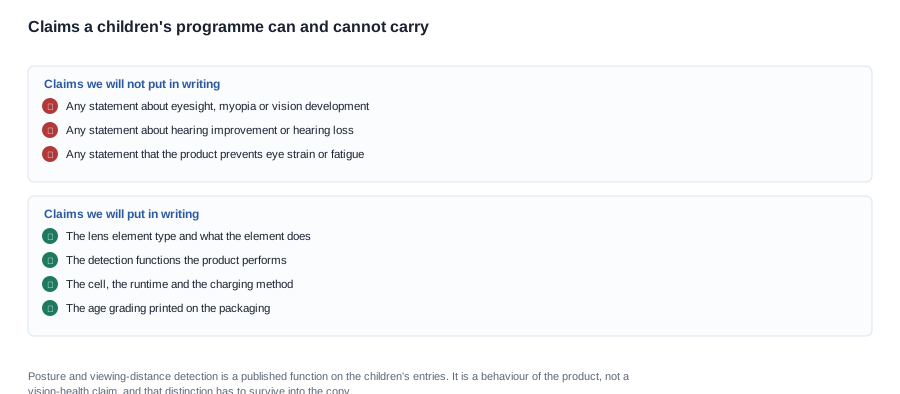
The claims we will not write, in any market and in any asset, are the following:
- Any statement about eyesight, myopia, vision development or the prevention of any of them.
- Any statement about hearing improvement, hearing loss or the treatment of any of them.
- Any statement that the product prevents eye strain, eye fatigue or a headache.
- Any implication of a medical effect, however it is phrased or illustrated.
What the product does can be described: what it detects, how the lens element behaves, what the cell and runtime are, how it charges, and the age grading the market requires. The distinction between detecting a posture and protecting an eyesight is the whole content of the claim set, and it has to survive into the copy, the packaging and the support scripts.
What we will do is take a use case, a configuration and the destination markets, and tell you which rows are settled, which are open, and which have to come from a sub-supplier or from a compliance adviser.
The action to take this week
Write the market list first, and the claim set second, before anything else in the programme. The market list decides the regime and the documentation set; the claim set decides the artwork. Doing them in the other order is what produces a reprint.
Then put six rows in the RFQ: the applicable regime per market, the permitted claim wording, the age grading and labelling requirement, the requirements for cells, magnets and detachable parts, the ownership and location of the technical file, and the detection distance, threshold and sensor part numbers for the model being ordered.
Finally, agree the returns position and the artwork round count before the first shipment, and put the claim set, the grading and the documentation route into the purchase order as attachments rather than as references to a conversation. Send us the configuration, the quantity and the destination markets and we will tell you which of the published rows apply and which questions belong to a compliance adviser rather than to a factory.
Related reading
- Turning these questions into a document trail: kids smart glasses supplier verification
- The regimes that may apply: kids eye protection smart glasses industry standards
- The conformity route in more detail: children's product compliance
- The three children's entries in the range: kids smart glasses
Send the configuration, the quantity and the markets, and we will say which parts of the children's specification are settled and which are yours.


