
Kids eye protection glasses technology: attributes decide regime
Which standards reach a children's device depends on what the device does, where it is sold and how it is classified — and the classification is the part that decides most of the work. Kids eye protection glasses technology smart glasses industry standards is a map of the regimes by trigger, with the conditional ones marked, so that a buyer can tell which are always in play and which depend on a decision that has not yet been made.
Published for the children's models: a lens-type electronic fogging function, a 40 mAh battery with roughly twenty hours of stated use and magnetic charging on two of them, Bluetooth V5.4 with a 70 mAh cell and the same stated runtime on the third, and posture and viewing-distance detection on two.
The standards answer, in three sentences
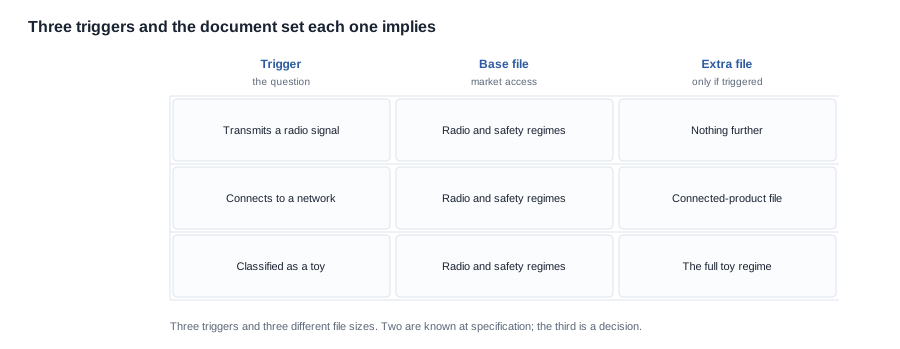
The standards question is decided by three triggers rather than by three markets: a device that transmits brings in the radio framework, a device connected to a network brings in the connected-product expectations, and a device classified as a toy brings in the toy regime on top. How to choose the order in which you establish them is straightforward, and the criteria a buyer's compliance team should use are the same in every market. The first two are known at the specification stage; the third is a decision somebody has to make, and it changes the file size by an order of magnitude. Decide the classification first, then the file.
What the compliance lead already has in hand
A buyer working through the standards is usually a compliance lead or a procurement manager, and holds a market list, a product description, a channel plan and a deadline. What they are not holding is the trigger map, because the frameworks are usually filed by document rather than by what causes them to apply, and the same document can be mandatory, conditional or irrelevant depending on three decisions.
Those three decisions are: does the device transmit, is it connected, and is it classified as a toy. A buyer's compliance team can work with any of them, but only if they are stated, and a due diligence checklist that does not force those three answers will produce a request the factory can answer with a general folder. A product that is sold as a children's accessory and is later reclassified is a different product in regulatory terms, and the reclassification is cheapest to avoid before the tooling is committed.
The three triggers, and what each one switches on
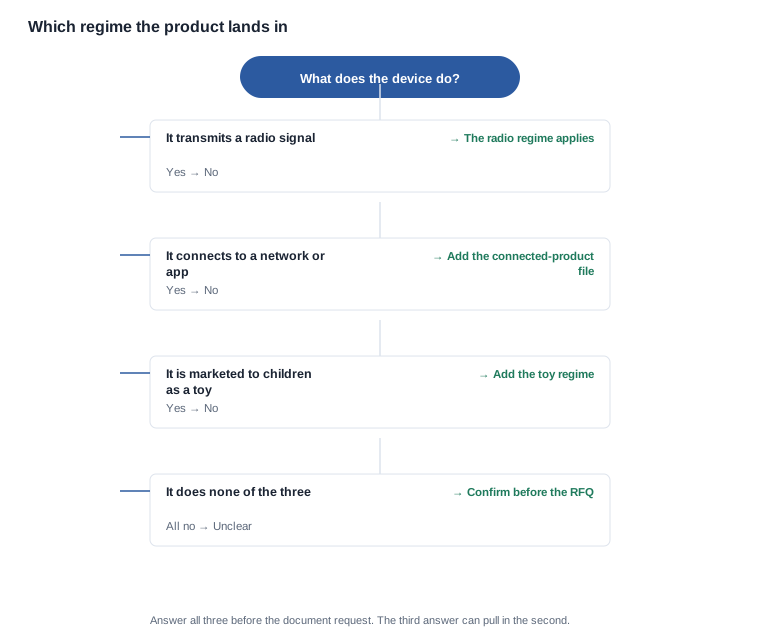
The transmit trigger is answered by a single technical fact: does the device emit a radio signal. A device that transmits falls within the radio framework, and for the A07 the answer is yes and documented, because it publishes Bluetooth V5.4. For the A05 and the A06, the published entries do not state a Bluetooth version at all, which does not mean the answer is no — it means the answer is not in the catalogue and has to be asked.
The connectivity trigger is answered by a different fact: does the device connect to a network or a companion application, and therefore carry an update path and a data-handling obligation. This is the trigger most often treated as a design detail rather than a compliance one, and it is the one that produces the most surprises, because connectivity arrives with features rather than as a compliance decision.
The toy trigger is a classification question rather than a technical one, and it is the most expensive of the three to reverse.

The radio regime and the safety regime arrive by different routes
The relevant instrument for general product safety in the European Union is Regulation (EU) 2023/988, the General Product Safety Regulation, applicable from 13 December 2024. It replaced the older directive and tightened several obligations at once: it expanded the categories of economic operators who must be identifiable, it made online marketplace duties explicit, and it tied safety expectations to what a consumer can reasonably infer from the product and its presentation. That last point is the one a marketing team needs to hear, because it means the listing copy is part of the compliance position rather than a marketing artefact that happens to need approval.
The radio framework arrives by a completely separate route. A device that transmits falls within Directive 2014/53/EU, which covers radio equipment, electromagnetic compatibility and electrical safety together rather than as three separate regimes. The models in our catalogue that publish a Bluetooth version carry V5.3 or V5.4 across the range, and the children's audio model states V5.4 — so the radio framework is in play for at least part of this category, and the question for the A05 and the A06 is a question rather than a lookup.
Two instruments that answer different questions
The separation that causes the most trouble in practice is between the radio framework and the children's safety regime. A valid CE declaration covering a radio device says nothing about whether that device is suitable for a child, and a product whose adult counterpart is approved does not inherit a children's safety file, because the requirements are different and because the frameworks work on an edition cycle where a new edition can require retesting a product that has already shipped. A buyer's shortlist should be checked against this separation before anything else, because it decides which of two files you are actually building.
The second separation is between CE marking and the General Product Safety Regulation. They are frequently used interchangeably in commercial conversation, and a buyer who treats a CE declaration as evidence of a general safety position will find that the risk assessment, the traceability and the accident-reporting route are all still missing. The regulation is a framework of obligations on the economic operator, and a declaration of conformity is a statement about one product.
A third separation catches people out regularly: the United States position. In the United States, ASTM F963 applies as the mandatory children's toy safety standard, alongside the Consumer Product Safety Commission rules, and the FCC filing addresses the radio and nothing about safety as a children's item. A buyer who treats an FCC certificate as the US equivalent of a children's safety file is working from the wrong document.
The instruments that sit alongside both
The EN 71 series in the European Union runs to multiple parts covering mechanical and physical properties, flammability, migration of certain elements and specific chemical testing, and REACH and RoHS sit alongside it as substance and chemical regimes with their own documentation pack. In the United States, ASTM F963 and the Consumer Product Safety Commission framework apply. And a battery transport document — the UN 38.3 test summary for the fitted cell — applies in transit, where it is a lead-time item as well as a compliance one.
A 40 mAh cell with roughly twenty hours of stated use does not exempt a product from any of it, and the smallness of the cell is not a factor in any of these frameworks. The cell size matters for one document only, and that is the transport summary, which is why the cell type is on the request list before the other seven.
The connected-product expectations that come with a parent-facing app
The EN 18031 series was cited into the General Product Safety Regulation and covers requirements for certain connected products, including children's connected toys. Its inclusion means a connected device aimed at children can attract cybersecurity expectations that a generic audio device would not.
The important observation is that a device which is connected by nature is connected whether or not anyone thought about it as a design decision. A product with a parent-facing app is a connected product, and the fact that the app was added to give a parent visibility does not make it a different regulatory object. A device that is connected because it was designed to be is exactly the case the expectations were written for.
The connected trigger also brings a second obligation that is easy to overlook because it is not a document. A connected product needs a story about how it is patched, and a supplier who cannot describe the update path has not thought about the obligation. That path is also the answer to a commercial question a buyer will have to answer anyway: how long will the firmware and the app keep being maintained, and what happens to a device in a household when the maintenance stops. A supplier who can describe the update mechanism can usually describe the maintenance term, and a supplier who cannot describe either is telling you the connected trigger was never addressed.
The third consequence of the connected trigger is the data question. Where a parent-facing component exists, there is data, and the data has a handling route, a retention position and an access story. For the A05, the A06 and the A07, the published entries do not document the delivery mechanism or any data handling, so none of it can be written into a specification until it is confirmed. This is a documentation gap, and like every gap in this category it is cheaper to close at the specification stage than at the launch stage.

The classification call that is cheapest before the tooling is committed
The toy regime is the largest of the three, and it is triggered by a classification decision that is often made by a marketing position rather than by a compliance one. A product positioned in a listing as a toy or a plaything attracts the toy regime, and a product positioned as a child's accessory or a study aid may not. The same hardware, the same electronics and the same function set can therefore sit in two different regulatory positions depending on how the listing is written, which is why this decision is a commercial one as much as a legal one.
Who should make the toy-classification call
Not the copywriter, and not the buyer who found the listing category with the best keyword volume. The call belongs to a compliance owner, taken on a documented basis, and it has to be recorded with the reason as well as the answer — because the reason is what lets you revisit it when the positioning changes, and positioning always changes.
There are three practical consequences of getting the call wrong. A product reclassified after the design is frozen means retesting a product that is nearly ready, and the elapsed time belongs to the laboratory. A product reclassified after launch means the documentation was wrong for the units already in the market, which is a much larger problem than a delay. And a product reclassified because the marketing position changed means the file and the listing are now describing different products, which is the specific failure that the general product safety regime's reference to what a consumer can reasonably infer from the product is written to address.
The three trigger questions, answered in writing and dated, are the cheapest insurance available in this category, and they cost one email before the RFQ. They are also the fastest way to find out whether a shortlist you have been given is even the right shortlist, and what to ask the supplier before you order.

Assembling the file by trigger rather than by document type
Most compliance packs go wrong by being organised as a folder of certificates rather than as an answer to a set of questions. The trigger map fixes that, because each trigger has a consequence and each consequence has a document, and the order in which they are requested determines how much of the schedule is yours to control.
Six steps from a trigger to a document request
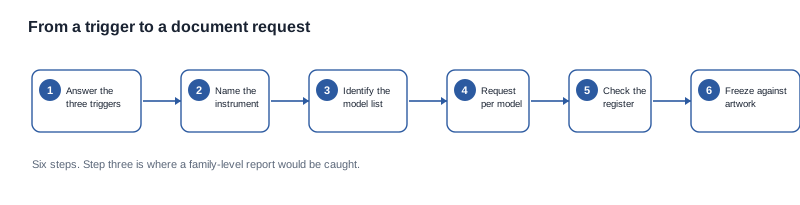
- Answer the three trigger questions in writing, before the RFQ. Every file request follows from those three answers, and the answers are cheap.
- Name the instrument for each trigger. The general product safety regulation for the base position, the radio directive for a transmitting device, the connected-product series for a connected one, the toy regime if the classification calls for it.
- Identify the model list each document covers. A report that covers a range rather than a model designation is not coverage for the units on your order, and this is the step at which a family-level document is caught.
- Request per model, not per family. The request names the model designation in the body of the email, along with the standard name, the edition and the issuing body.
- Check the certificate numbers in the issuing body's register. It takes minutes and it is the highest-yield check in the category.
- Freeze the set against the artwork. A change to a standard's edition, or to any trigger, reopens the file, and the artwork should not be approved against a file that is about to move.
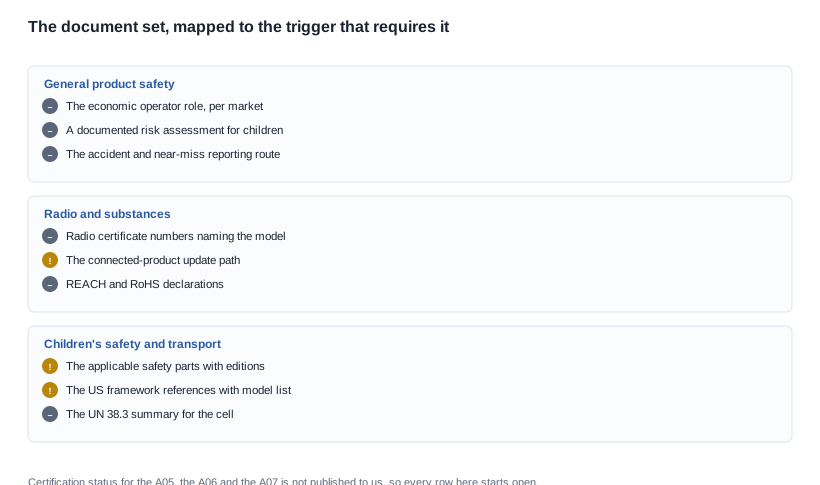
A worked case: a compliance lead answering the three triggers
This is a hypothetical case rather than a client project, and it is here to show the trigger map in use.
Assume a compliance lead has a children's line in front of them, a launch window, and a shortlist that already contains one model with a Bluetooth version and two without. The lead's job this week is to turn that shortlist into a document request that a factory can answer without a clarification round, and the way to do that is to answer the three trigger questions before writing the request.
The transmit trigger. The model with the published Bluetooth V5.4 answers it in one line: it transmits, so the radio framework is in play and the radio certificate numbers have to be requested against that model designation. The other two models publish no Bluetooth version, which is not an answer, so the question goes to the factory rather than to the catalogue. The lead's checklist now has one row marked from the catalogue and one open.
The connectivity trigger. The lead asks what the parent-facing component is and how it is delivered, and the answer is that the published entries do not document it. That makes the connected trigger an open question, and an open question about connectivity pulls in the connected-product expectations and the update-path question. The lead writes both into the request rather than deferring them, because a deferral here is the one that comes back after the artwork is approved.
The toy trigger. The lead asks who decided the positioning and on what basis, and finds that the decision was made in a listing category chosen for search volume, with no compliance owner named. The answer is not a yes or a no but a decision to be taken, and the lead turns it into a question with a deadline attached to it, because the tooling has not been committed yet and this is the last point at which the answer is cheap.
With the three answers in hand, the document request becomes specific rather than general: the general product safety position with the economic operator role stated, the radio certificate numbers for the transmitting model, the connected-product position and the update path for the models that turn out to be connected, the applicable safety parts with their edition numbers, the United States framework references with the model list, the chemical and substance declarations, the UN 38.3 summary for the cell, the documented risk assessment for the children's use case, and the accident-reporting route with a named owner.
The total cost of the pack is now visible before the quotation arrives, which is the whole point of doing it this way round: the buyer can see the fixed lines, compare the quotations on what is left, and negotiate the model list before the file is built rather than after. The decisive decisions were the three trigger answers, and the one that was hardest to get was not a technical fact at all.
Four ways a document pack goes wrong
The product is classified as a toy after the design is frozen. The symptom is a hold on the launch while something is retested. The root cause is that the classification was decided by a marketing position and never revisited. The prevention is to answer the three trigger questions at the specification stage and to have the classification reviewed rather than assumed.
A connected product ships with no cybersecurity position. The symptom is a channel that asks a question the supplier cannot answer. The root cause is that the connectivity was a feature decision and the compliance consequence was not attached to it. The prevention is to ask for the EN 18031 position and the update mechanism and to treat the update path as a requirement rather than a courtesy.
A document pack is assembled as one folder and applied to every market. The symptom is a market where a document turns out not to apply and another where a required one is missing. The root cause is that the documents were organised by type rather than by trigger and market. The prevention is to map each document to its trigger and its market before you ask for it.
The listing copy is written after the compliance pack and is inconsistent with it. The symptom is a claim that a reviewer rejects. The root cause is that the two workstreams never met. The prevention is to review the copy against the file and to treat what a consumer can reasonably infer from the product as a compliance question rather than a marketing one.
The standards position we hold and the one we do not
The boundary of what we publish on standards
The short answer: we publish the rows we hold for the children's models and mark the rest as open, and we will not infer a certification position for them. Certification status for the A05, the A06 and the A07 is not published to us, and we will not infer it from the company-level export certification shown at the front of our catalogue, nor from the radio and substance approvals that other models in the range carry. We publish no detection threshold, no delay, no fit dimension and no frame weight for this tier, and we will not estimate them.
We also make no vision, health or eye-protection efficacy claim for any of our products, in any market. That is partly a marketing discipline and partly a regulatory one, because what a consumer can reasonably infer from the product and its presentation is part of the safety position.
The three trigger answers
Send the three trigger answers, and we will tell you which document set each one implies, so the RFQ is specific and the classification question is settled early. The three answers are: does it transmit, is it connected, and is it classified as a toy.
Send the model list you intend to carry, and ask for every document against that list rather than against a product family. In this category the model list is what converts a folder into coverage.
Send the Bluetooth position for the A05 and the A06 as a specific question, because their published entries do not state a version and the radio trigger has to be answered rather than assumed. The A07's answer is already published as V5.4.
The background is under kids eye care technology, the wider compliance picture is under compliance, the supplier questions are in kids supplier verification, and the claims to be careful about are in kids myths.
Where the standards map comes from
Send us the three trigger answers and we will tell you which document set each one implies.


