
A child's day does not respect a rated endurance figure, and that is the whole difficulty. When a buyer asks about kids smart glasses battery life, they are usually asking one of two questions that sound alike: how long does it run, and will it survive a Tuesday. Only the first has a published answer, and that answer is a rating rather than a measurement, so the second question has to be closed on a sample before anybody writes a support promise or a specification sheet onto a listing.
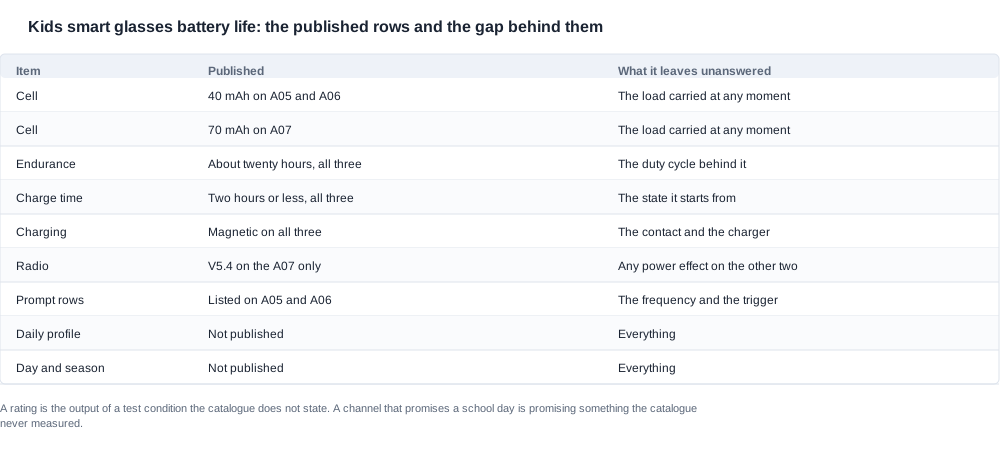
What the catalogue publishes is short. Forty milliampere-hours on the two protective models, seventy on the audio model. An endurance of about twenty hours on all three, rated. A charge time of two hours or less on all three, magnetic in every case. A radio generation against the audio model only.
The interesting part is the gap between those rows and a school week, and that gap is not evenly distributed across the three models. The protective pair carries rows for posture and distance prompts, and a prompt is a scheduled load that a listener does not have. A channel that treats the two as one endurance story will measure one of them and ship the other.
This article walks the routine in the order a household actually meets it, separates what is published from what has to be measured, and ends with the acceptance test a buyer should have written before the first order. Nothing here is a health or eyesight claim, and nothing here treats the unit as a clinical device. The boundary is set out on the medical boundary page and applies to every sentence below it.
How a rated twenty-hour figure is produced, and what it leaves out
A rated endurance is the output of a laboratory condition. Someone ran the unit for a defined number of hours under a defined load and recorded the result; the catalogue publishes the outcome and does not publish the condition. That is not an omission of care. It is the ordinary way a runtime figure is measured, and it is why the figure travels so badly once a child starts using the product.
Three things are missing from the published row, and each one is separately enough to change a Tuesday.
The duty cycle. Twenty hours of what? A unit that spends its time with the prompt function active and a unit that spends it idle are different machines, and the catalogue does not say which one was measured. For the protective pair, where the prompt rows are part of the product, the duty cycle is the largest single variable in the whole question. For the audio model, the duty cycle is the audio session pattern and the volume.
The starting state and the end point. A charge time of two hours or less is a ceiling, and it is a ceiling on an interval whose beginning and end the catalogue does not define. It is not a statement about how long a full charge takes from empty, and it is not a statement about what the battery looked like when the unit was put down the night before. A buyer who treats it as a turnaround number in a logistics plan is using the wrong number for the wrong purpose.
The condition of the radio and the sensor. A unit paired to a phone, a unit in an idle pocket and a unit on a charger all behave differently. None of those three states is described in the row.
The second point deserves more attention than it usually gets, because of what the two cell sizes imply. Two protective models carry a forty milliampere-hour cell. The audio model carries seventy. All three are rated at about twenty hours. The same headline figure on a cell roughly three-quarters the size is not a coincidence; it is evidence that the two products are not running the same load, or that they are running the same load under different conditions, or that the rating was produced under a condition that flatters the smaller cell. A buyer who compares these three products on the endurance row alone is comparing a rating against a rating and calling it a specification.
The three questions a rated figure cannot answer
- How many whole school days does a unit actually cover? Nobody knows until a log exists, and the log is a per-day record of use and recharge, not a stopwatch reading. See the battery life technical background for the general measurement approach.
- What happens on the worst day rather than the average day? A single afternoon of continuous prompts, or a school trip with a long return journey, is what produces the complaint. An average over a week hides it completely.
- What does the household have to do to keep the answer stable? A number that only holds if the unit is charged at a particular hour, on a particular surface, in a particular way, is not a number a channel can put on a listing without also putting the routine on it.
None of the three can be answered from the catalogue, and none of them is unusual. They are the questions a buyer asks about any device that is used by a person rather than by a machine.
The drain path across a school day, an activity session and a commute
The reason a child's day breaks a rated figure is that the day is not a single load. It is a sequence of very different states, and the transitions are where the energy goes.
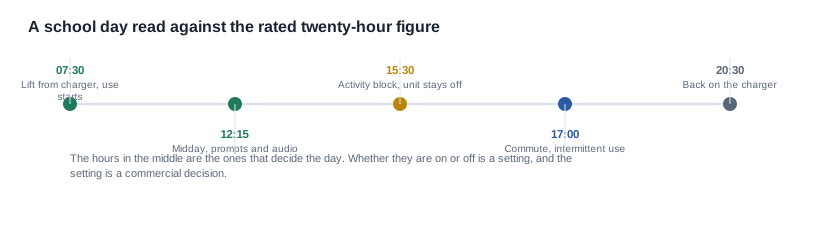
The morning is the cheapest part and the most commonly wasted. The unit comes off the magnetic charger at a specific hour, and everything from that moment to the end of the school day is spent. A household that lifts the unit off the charger at seven and then leaves it in a bag until lunch has already spent an hour of the day's allowance on nothing. This is the first habit worth designing, because it costs nothing and it is entirely under the family's control.
The classroom block is the part that distinguishes the two product ideas. On the audio model, the load is whatever the child plays and at what volume, and a classroom is a quiet, intermittent load. On the protective pair, the load is the prompt function, and a prompt function in a classroom fires on the schedule it was configured with, not on the schedule the classroom runs. Whether a unit can be left quiet for a lesson, and what happens to the product when it is, is a configuration question that belongs in the purchase order.
The activity block is where the honest answer is uncomfortable. Physical activity brings sweat, dust and impact into contact with a unit that carries no published ingress rating, and the catalogue publishes an ingress rating for two other models in the range and for none of these three. The available position is therefore not that the unit survives an activity session but that it is taken off for one, and the household routine has to say so. A channel that has not settled this will inherit the question as a support ticket within a month of launch.
The commute is intermittent and therefore inefficient. Short periods of use with the unit powered on cost more per minute of actual use than a continuous session does, because the radio and the sensing function are starting and stopping. This is a general property of small electronics rather than a property of these three models, but it lands on them harder because the cell is small.
The evening is the only point where the day can be reset. Charging happens here, and because the interface is magnetic in all three cases, the routine is a placement rather than a plug-in. That is a genuine advantage for a child handling it alone, and it is also a discipline problem, because a magnetic connector that can be left off after five minutes of use is a magnetic connector that will be left off.
The routine that keeps a child moving through a week

The flow above is the routine we would put in the box, and it is written to be followed by someone who is not a technician. Two details in it are deliberate. The unit goes back on the charger at the same hour every evening, because a comparison across a week only means something if the starting point is held constant. And the days on which the unit ran flat are written down rather than remembered, because the days it ran flat are the only part of the log that a channel can act on.
A buyer should note what this routine implies for the support policy, because it is rarely the same policy the manufacturer had in mind. A parent's first question when a unit runs short is not about the cell. It is about whether the routine was followed, which means the routine has to be visible, printed, and the same on every unit in the box.

The charging routine a household keeps, and the one it abandons
Most charging problems in a children's product are not power problems. They are habit problems, and the two habits that fail are the ones that require attention at the wrong moment.
The top-up in the afternoon. This is the routine that works. It is short, it happens at a desk, and it does not require the unit to be empty. Against that, the charge time is a ceiling of two hours or less, and a top-up taken at a desk is a partial charge whose result is not published. The buyer should therefore ask for guidance on partial charging behaviour, and should expect a general answer rather than a curve.
The overnight reset. This is the routine that works best, and the one that gets broken by exactly the thing the product is for: a child who puts the unit on at bedtime and then puts it on again in the morning without checking whether it took. A magnetic interface makes this easy to do and easy to miss. A channel can fix it with a single printed line on the box, or it can lose it in the support queue.
The charge when the unit is not needed. Charging at school, in a bag, wherever a charger is available, is a habit that appears the moment the family owns more than one charger, and it is the habit most likely to end with a unit left on a metal surface overnight. Nothing in the published rows describes the behaviour of the cell in that situation, so it belongs in the questions to the supplier rather than in a specification the channel writes for itself.
The trade-off in all of this is that the routine is part of the product, and a channel selling a rated number without the routine that sustains it has a promise it cannot keep. The honest version of the listing states both: the rated endurance, described as a rating, and the routine that produced the number in the first place.
The questions a buyer should ask about charging before the first order
The charging options piece covers the interface in more detail for the audio model. For a children's line, the questions below are the ones that decide whether the routine in the box is realistic.
- What is the partial-charge behaviour on the magnetic contact, and does the routine differ between a full night and a two-hour top-up? This is the question a household will actually face, and the answer is not published.
- What does the supplier recommend as the charging surface, position and duration, and can that guidance be printed in the box? A printed line from the supplier is defensible in a support conversation; a printed line invented by the channel is not.
- How should a channel describe a charge time of two hours or less in copy, given that it is a ceiling and not an observation? The wording matters, because a listing that says a unit recharges in under two hours is asserting something the catalogue does not support.
- What is the cell's expected behaviour across a school year, and what evidence supports that? The catalogue publishes no ageing data for the cell, so a channel that wants to talk about a second year of use is asking a question it cannot answer from a datasheet.
- Which unit failures are battery-related in a channel's own returns data, and how is that distinguished from other defects? A returns analysis that cannot separate the two will misread the rating for years.
What the support desk needs in order to answer the first question
The after-sales support checklist covers the wider service build. For a battery conversation specifically, the desk needs three things in front of it, and none of them is the cell specification. It needs the charging routine, printed and versioned. It needs the log the household kept, or at least the start and end times of use. And it needs the day's conditions, because a unit that ran short in a heatwave and a unit that ran short in a stationary classroom are two different problems.
Without those three, the desk can only repeat the rated figure, and repeating the rated figure to a parent whose child came home with a flat unit is the point at which a specification becomes a complaint.

The acceptance test a kids buyer should write before the first order
A rated figure is somebody else's test result. An acceptance test is yours, and it is the only way to turn a rating into a promise you can keep. The one below is written for a sample of units, over a school week, at the configuration the channel intends to ship.
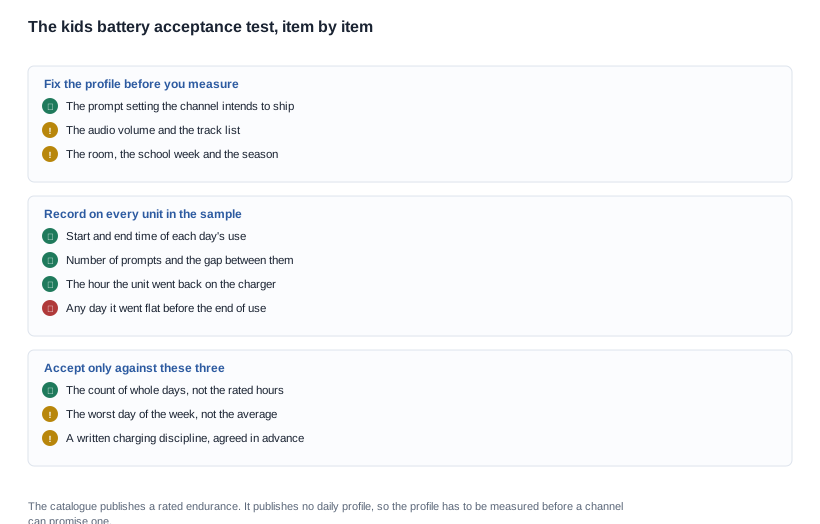
Two design decisions in that checklist are worth defending to a supplier, because both are usually resisted.
The profile is fixed before the measurement starts. A unit measured at a prompt setting nobody intends to ship produces a number that describes a product that does not exist. The setting, the audio volume and the track list, the room, the week and the season all belong in the written protocol, agreed in advance, and the first reading follows the protocol rather than the other way round.
The acceptance threshold is a count of whole days, and the worst case governs. Not an average of hours, and not a best day. A channel that accepts the average will discover the worst day through a customer, and a channel that accepts the best day will discover it through a recall. The threshold a buyer should evaluate is a number of complete days at a stated routine, with the least complete day in the week as the pass condition, and with the number written into the purchase order so that it binds.
Where a battery programme goes wrong
The rated hours are put straight onto the listing. A number with no condition attached is the easiest thing to copy and the easiest thing to be sued over, because nobody can say what it was measuring. The fix is procedural: a published endurance always travels with the condition that produced it, even when the condition is our own field test.
A partial charge is treated as a full cycle. A family that tops up for twenty minutes twice a day and a family that charges overnight are running two different regimes, and the numbers are not comparable. A channel that samples on the overnight regime and describes the result as the general case has misdescribed its own product.
The sample was taken in summer and the launch is in November. A channel that measures through a school week in the warm months is measuring short days and long hours of availability. The profile has to be measured in the season the product will actually be used, or the result has to be labelled with the season it came from.
The returns data is read as a battery signal. A unit returned because it does not fit, or because the prompt setting is wrong for the child, will appear in a returns report next to a unit that genuinely ran out. Sorting them requires the charging log, which is why the log is in the checklist rather than in a support article.
The sequence a distributor would actually run
The example that follows is constructed to illustrate the order of work rather than to describe a customer.
Assume a regional distributor is asked to add a children's line to an existing audio range, for two markets, with the promotional claim already written by somebody else as "twenty hours of battery life". The distributor's first task is not to test the claim but to find out whether it can be supported in a form that survives a retailer asking for the test behind it.
The distributor asks the supplier for the measurement condition behind the rated figure, and for the partial-charge behaviour of the magnetic contact. The first answer establishes that the claim as written is a rating and not a measurement, so the listing copy is rewritten to describe a rated endurance rather than a continuous one. The second answer tells the distributor whether the afternoon top-up routine in the box is realistic, which turns out to be the single most useful line in the whole exchange.
The distributor then fixes the profile, orders a sample set, and runs a school week. Two of the units run short before the end of use on one day each, both in the same week, both on a day with an unusually long activity block. That is enough to change the routine in the box, because the activity block is where the unit is now taken off, and it is enough to change the listing copy, because the count of whole days is now a measured statement rather than a rated one.
The distributor then goes back to the requirement set with the measured profile attached, rather than with the rating, and the file that results is the version a retailer's technical team can review. The decisive decisions were the wording of the claim and the discipline of the measurement, and neither of them was about the cell.
The commercial terms this decision creates
The scope that is genuinely open for negotiation is the size of the sample and the number of weeks it runs for, the configuration the channel intends to ship, the number of destinations the profile is measured in, and the artwork round count for the routine card. The sample size and the week count are the two numbers worth pushing on, because they set the whole measurement cost and a thin sample produces a number that nobody can defend later.
What is not open is the elapsed time of the laboratory work, and it is not open in the sense that a supplier cannot make it shorter by offering a better price. It is also not open in the sense that a channel can widen the acceptance threshold to fit the sample it happens to have. The threshold is decided before the sample is run, and that is the only arrangement that makes the result binding.
Five clauses earn their place in the purchase order, and they are written to bind rather than to inform: the acceptance criterion, stated as a count of whole days at a stated routine, with the profile attached; the profile itself, as a protocol the supplier has countersigned; an obligation to advise the buyer before firmware, the prompt default or the cell is altered; a commitment to reissue the documentation pack whenever a standard moves to a new edition; and a ruling on which side carries the cost of a lot that misses the acceptance criterion.
What our own rows can and cannot support
Our documentation answers the electrical side of the question for these three models and it does not extend beyond them. It gives the cell, the rated endurance, the ceiling on the charge time, the charging method, the radio generation of the audio model and the presence of the prompt rows on the protective pair, and it gives nothing else about power. The endurance figure is a rated value whose test condition is not part of the published data, and no daily profile exists in our documentation for any of the three.
We publish no ageing data for the cell, no partial-charge curve, no ingress rating for these models, and no comparison between the two protective models beyond the fact that their published rows are the same. We will not estimate any of those, because a channel that prints an estimate on a carton has made a claim on our behalf.
What we can do is tell a buyer which parts of the battery question are already settled by a published row, which need a supplier document, and which need a week of measurements in a real household. Send us the models, the intended configuration and the markets, and we will say which applies to each. The range is at kids smart glasses, a buyer's own pre-order checklist is at the A07 buyer review checklist, and the camera-side of the range is worth a separate look at AI camera glasses if the format itself is still open. A kids battery claim only becomes a specification once the routine behind it has been written down.


