
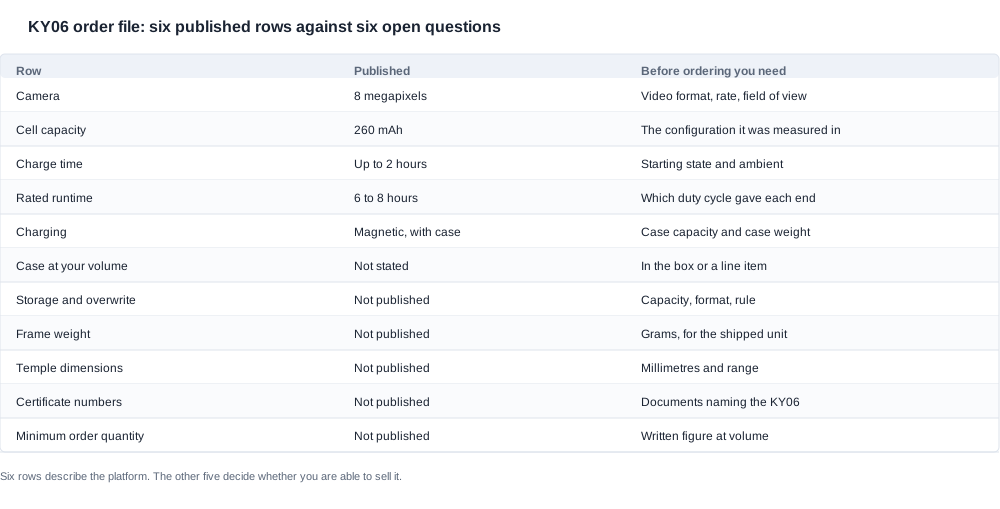
The KY06 is published with an 8-megapixel camera, a 260 mAh cell, a charge time of up to two hours, a rated runtime of six to eight hours, and magnetic charging with a charging case. Those six rows describe a mid-range camera glasses platform competently, and they are enough to put the model on a shortlist.
This article sets out the three stages in the order they should be asked, what each stage can settle, and what a no at each stage costs you. It is written for the buyer who has to decide whether to sign, not for the buyer who has to write the listing, because the two discover their answers at completely different points in the process.
They are not enough to sign against. The problem is not the length of the list; it is the order in which a buyer asks about these things. Ask the wrong question first and you will spend two weeks negotiating a price for a product that cannot do what your brief requires. Ask them in the right order and most of the answers arrive in the first supplier email.
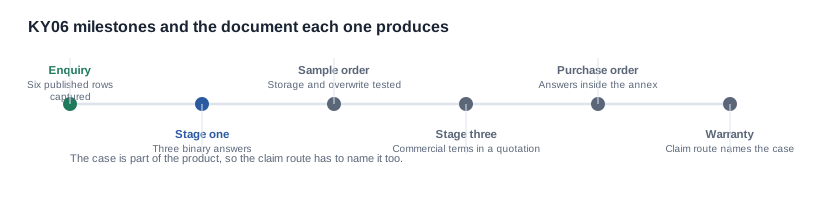
KY06 stage one: three binary questions that can stop the order
Does a certificate name the KY06? We hold no CE, FCC or RoHS document to hand you. The catalogue text names none of the three, there is no per-model certification row for the KY06 or for any other model in the range, and certificate numbers, issuing bodies, validity periods and covered model schedules are not published because none sits behind them. Ask for the document rather than a statement, and check that your exact model designation appears on the schedule attached to it. This question goes first because it is the cheapest to ask and the most expensive to discover late — a certificate that covers a sibling model does not cover your goods, and finding that out at the port is an expensive way to learn it.
What video resolution and frame rate does it record? Not published for this model or for any other in the range. An 8-megapixel figure tells you about stills; it says nothing about whether the product records video, at what frame rate, or across what field of view. If your proposition depends on video, this is the row that decides whether the KY06 is a candidate at all rather than a product you negotiate on price.
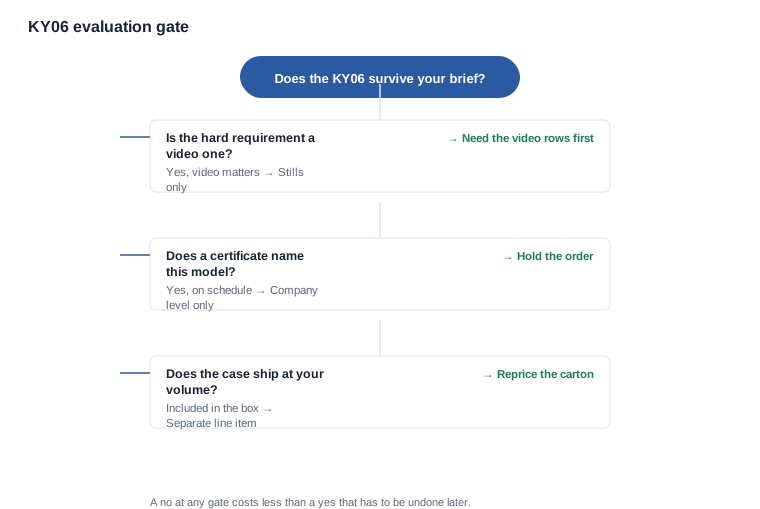
What is the case capacity, and is it included at your quantity? Magnetic charging with a case is published; the case figure is not. Published case capacities across our camera range run from 900 mAh to 1400 mAh, which tells you the case is a substantial component and not a formality. That single row decides your landed cost, your carton, your parcel weight and whether the product arrives to a customer as one object or as two.
Ask for the certificate in a form that can be checked rather than in a form that can be read. What you want is the document, the schedule of models it covers, the issuing body and the validity date, with your exact model designation visible on it. What most suppliers send first is a logo, a certificate number and a scan of a page that does not name the product. Both responses are normal, and only one of them answers the question. If the schedule arrives separately, ask whether it covers the case configuration as well as the frame, because a case that ships in the box is itself an electrical component and some schedules treat it separately.
All three of these are binary. You either hold a certificate that names the model or you do not; the product either records video to a usable specification or it does not; the case either arrives in the box at your quantity or it does not. Binary questions belong at the front of a supplier evaluation because a no on any of them ends the conversation and saves everything that would follow.

Stage two: the rows that decide your listing
What test condition produced the six-to-eight-hour range? A range rather than a figure implies two duty cycles were considered, and nobody publishes which is which. Ask what was active during each measurement, at what resolution, at what volume, across how many units, and whether each figure is a mean or a best case. On a camera platform the camera is the dominant load, so the answer decides whether six hours describes a product doing its job or a product sitting idle — and both numbers can be technically correct while describing entirely different products.
What are the storage, format and overwrite behaviours? Not published. This is a firmware question and it is a returns driver: a customer who fills the device mid-session and loses footage has experienced something indistinguishable from a fault, and a customer who experiences that once does not buy again. Ask whether overwrite is automatic, whether it is configurable, whether the frame has any indicator of remaining capacity, and what happens to a recording in progress when storage fills.
Frame weight and temple dimensions. Not published. On a product intended to be carried through a full working day, this single row decides whether it stays on and therefore decides your return rate. It is also the row most often deferred until after the first production run, at which point it is a tooling conversation rather than a specification request.
Two questions make this row answerable rather than evasive: does the weight differ by colourway, and does it change with the case configuration. Both are reasonable to vary, and both change your parcel calculation. A buyer who has asked and been told no has a number they can plan with; a buyer who has not asked has a guess with a currency symbol attached to it.
Ask for both figures for the specific configuration you will ship, including the cell and case arrangement, and ask whether the figures differ by colourway. A weight published for a different model on the same platform is not a proxy for this one, and a buyer who discovers that later has a reason to distrust every other number on the page.
The storage question deserves one more line of its own, because it is the row most often answered with a firmware version rather than with a behaviour. Ask what happens in practice rather than what is configured: fill the storage, start a recording, and let it run. A product that stops cleanly and tells the user is a support question. A product that stops silently is a defect report, and defect reports are the expensive kind. The same test tells you whether the storage is user-accessible, which is what decides whether your customer can retrieve a recording without your software.
The stage-two questions can largely be answered while sampling, which is why they sit after stage one. Ordering a sample before stage one clears is spending money on a product you may not be able to sell.
Stage three: commercial terms worth settling in parallel
Ask both questions per configuration rather than per model, and ask what happens at the boundary — whether the figure is a hard minimum or a starting point for negotiation, and whether it changes if you consolidate colourways into a single run. Consolidation is usually the cheapest lever available to a buyer at this stage, and it is a question worth asking before artwork is committed rather than after. On lead time, ask what happens to the stated period if a component is substituted late in production, and get the answer in writing, because a substitution that extends the schedule is the point at which an inventory plan built on a fixed date starts to fail.
Minimum order quantity and lead time. We hold conflicting internal figures on our own minimum order quantity and we will not pick one for you. Get the figure in writing for the KY06 specifically, and for the case configuration you want — a case-inclusive minimum and a case-optional minimum are different commitments and the difference shows up in the packaging plan.

What happens on a return where the case is missing? Magnetic charging makes this a real scenario rather than a theoretical one, and it is a support cost you can price in advance instead of discovering. Decide whether the case is a returnable accessory with a stated deposit, whether the frame is returnable without it, and what your channel tells a customer at the point of return.
Does the certification position change for a private-label version? A different module, cell or enclosure can change the configuration that a document covers. If you are branding this model, ask specifically what changes in the file, and get the answer for your configuration rather than for the catalogue one.
Where the supplier offers to hold a unit or a case against a return, get the deposit figure and the release conditions in the same message. A deposit policy that is described rather than written will change the first time somebody needs it, and it will change in the direction that is convenient for the supplier. For a private-label version, also confirm who owns the artwork revisions and how many are included, because that is a cost and a lead time rather than a preference and it arrives late when nobody has budgeted for it.
Payment terms, incoterms and the warranty belong in this stage as well, and they belong in writing. Ask which clock starts the lead time — deposit, artwork approval or confirmed purchase order — and whether it holds at your volume. Tie the balance payment to a passed pre-shipment inspection rather than to a shipping date, and write the defect allowance and its remedy beside each other so an allowance without a remedy does not become a negotiation that starts once the container has sailed.

Sample protocol for a camera platform
Order one unit per colourway plus two spares once stage one has cleared, and keep a signed test sheet with both party names on it. For a camera product the test order is different from an audio product, because the failure modes are different.
- Record a clip long enough to fill the available storage, then record another. This is the single most informative test on the list, because it tells you what a customer experiences at the exact moment they are most likely to complain.
- Check the indicator behaviour during recording and at low storage. If there is no indicator, note it: it becomes a line in your own documentation.
- Pull the files and check them. Format, resolution, frame rate and whether they play in standard software on a phone and on a desktop. A file that needs proprietary software is a support cost.
- Measure the runtime with the camera actually recording, at a stated resolution, and record what you measured rather than what was quoted.
- Time a case charge and a frame charge separately, and note whether the case charges the frame or replaces it.
- Weigh the frame and the case separately, then together as shipped. Those three numbers drive your freight calculation more than anything else on the sheet.
- Confirm the box contents line by line against the quotation, including whether the cable is present.
Where a supplier cannot answer a stage-two question, ask them to answer it on your sample instead, in writing afterwards. That arrangement is unusual, and a supplier who agrees to it is telling you something useful about how they will handle an inspection finding later. A supplier who declines both the answer and the test has given you a data point about their process rather than about their product, and it is cheaper to have it now.
Keep the sample units after the test. When the production lot arrives, repeating the fill-and-record test on a unit from the packed cartons is the cheapest possible check that the firmware behaviour survived manufacturing, and it is the check most often skipped because it seems obvious.
Give each test a written pass condition before you start, not after. "The clip plays in standard software" is a pass condition; "video looks fine" is not, because it cannot be repeated by somebody else six weeks later when a shipment arrives that behaves differently. The same applies to the runtime test, the charge test and the weight measurement: write the method down alongside the result, and the sample becomes a baseline you can compare a production lot against rather than an anecdote you have to defend.
Score the sample against the rows you asked to close rather than against an impression. Where the sample contradicts a written answer, send it back as a dated question before you commit, and treat the answer as part of due diligence on the supplier rather than as a defect notice. The distinction matters because the first framing produces a correction and the second produces a concession that changes the product you ordered.
Why the order of questions is the whole method
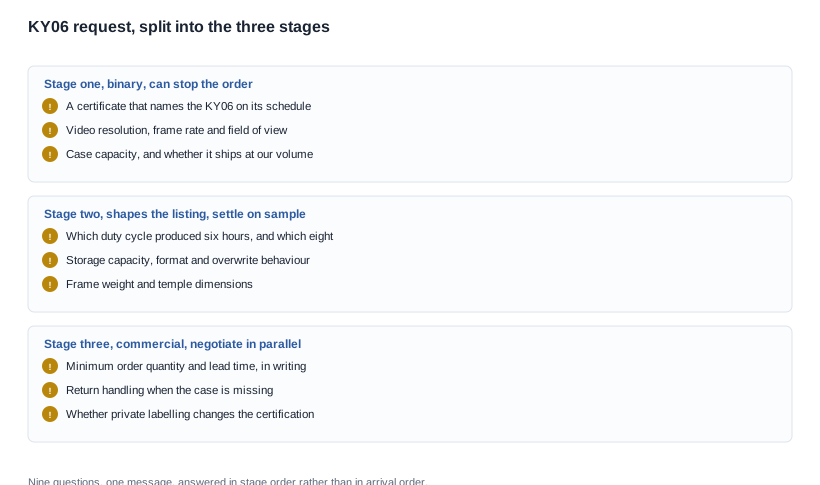
Three of the stage-one questions are binary, and binary questions are cheap to ask and expensive to get wrong. The stage-two questions shape a product listing and can largely be answered on a sample. The stage-three questions are commercial and can be negotiated in parallel with the sample period rather than after it. Sequencing them that way is not a stylistic preference; it changes how long the whole evaluation takes.
Write the stage-one questions so that a no is unambiguous. "Is it certified?" produces a yes and a document reference; "does a certificate name the KY06 on its schedule?" produces a yes or a no. The second form is the one worth sending, because it can be answered in a single line by somebody who knows the answer and cannot be answered with a general statement by somebody who does not. The same applies to the video row: asking for the resolution, the frame rate and the field of view together is what produces three numbers, where asking whether it records video produces a yes.
Buyers who ask the nine questions in one message and read the answers in stage order usually have a decision inside three weeks. Buyers who ask them in arrival order — whichever answer arrives first becomes the next question — typically spend that period negotiating price on a product they have not established is sellable.
It is worth putting a number on the cost of skipping the order. A certificate mismatch found at the port produces a customs hold, a re-inspection fee and a storage charge on a per-day basis, and the units stay immobile for as long as the dispute lasts. A video specification that fails your brief after tooling has been paid for produces artwork that cannot be used. A case that turns out to be a separate line item produces a carton redesign and a packaging reprint. None of these is catastrophic, and all of them are predictable, which is the real argument for asking first.
There is a second reason to hold the order. Three of these answers change what you would be buying. A certificate that names the model, a video specification that meets your brief, and a case that ships at your quantity are three different products with three different price points. Once those are settled, the remaining six questions are refinement rather than qualification, and the sample order becomes an evaluation rather than an investigation.
The order also protects the supplier relationship, which is worth more than it sounds. A supplier who receives nine structured questions in one message learns something about you; a supplier who receives nine questions across three weeks learns something else. The first conversation is the one you will need when something goes wrong with a shipment.
The KY06 against a hard requirement, honestly
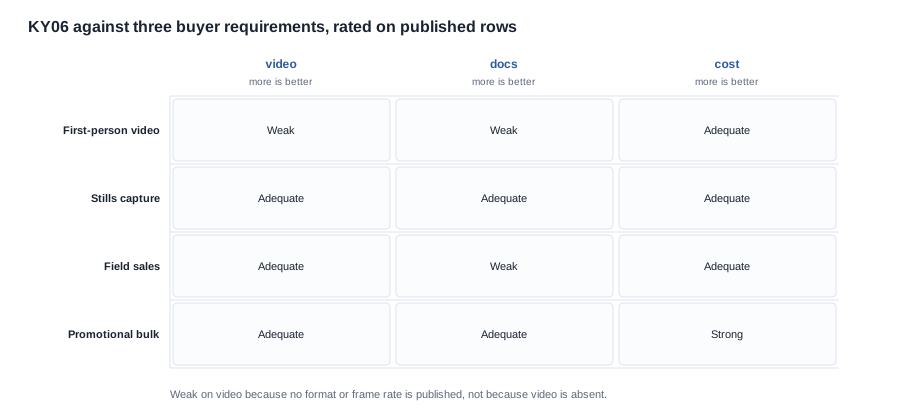
Name the requirement before you evaluate the model, because the same answer can be decisive in one brief and irrelevant in another. If your requirement is first-person video, the KY06 cannot be cleared on published data at all — no video format, frame rate or field of view is published, so the model stays on the list only until those rows arrive. If your requirement is stills capture with audio, the published camera figure and the 260 mAh cell are a reasonable basis and the open rows are refinements rather than blockers.
If your requirement is a sealed or rugged product, there is no published ingress rating for this model and the question is whether one exists. If your requirement is a full working day away from a socket, the six-to-eight-hour range is promising but unusable as a claim until the conditions behind both ends are known.
Buyers who want to move faster can run a three-question version first: the certificate schedule, the video rows, and the case inclusion at your volume. Those three answers will settle whether the KY06 belongs on your shortlist at all. Everything else on the list is refinement, and asking for refinement before qualification is what turns a two-week evaluation into a two-month one.
We can give you the six published rows for the KY06, and we can tell you item by item which of the nine questions are open in our documentation. We will not quote a video specification, a case capacity or a frame weight that the catalogue does not contain, and we will not present a company-level certification claim as a model-level certificate.
Send us the channel, the target retail price, the quantity and the one requirement that is genuinely non-negotiable, and we will tell you whether the KY06 survives it — or whether a different model in the range does.
Related reading
- The position of this model — which AI camera glasses model to pick
- How runtime and case capacity interact — battery comparison for AI camera glasses
- Checking a certificate rather than a claim — Bluetooth SIG certification checklist
- Packaging decisions that affect freight tier — packaging options
Send the channel, the price, the quantity and the hard requirement, and we will tell you where the KY06 stands.


