
Most checklists for a camera product treat the image as one item among many. For the L1 Pro the image is the item, because nothing in our published documentation would let you defend its resolution on paper. No sensor model, no field of view, no video resolution, no frame rate, no aperture, no pixel size. Thirteen megapixels is a number standing alone.
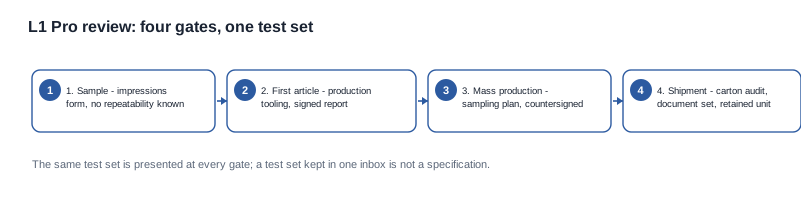
So the review of this sample carries a different centre of gravity from the review of an ordinary camera product: it is a photographic test, and everything else is bookkeeping around it. This article treats the review as a four-gate evidence line — sample, first article, mass production, shipment — because each gate has a different input, a different output and a different person whose signature closes it. A finding that stops production at the first-article gate costs you a week. The same finding discovered in a warehouse costs you a container and a season.
L1 Pro buyer review checklist: the four gates and who owns each one
The most common failure in this category is not a bad product. It is a sound product reviewed at the wrong gate, by the wrong person, against a standard that was never written down. Teams buy a sample, form an impression over an afternoon, and carry that impression unchanged into an order of several thousand units. Nothing in that process was designed to catch the distance between an impression and a decision, and the distance is where the money is lost.
The remedy is structural rather than heroic. Break the review into four gates, and for each gate write down three things before anyone starts work: what arrives, what has to leave with the unit, and whose signature closes it. That third column — the signature — is what most informal review processes are missing entirely, and it is the one that survives a difficult quarter.
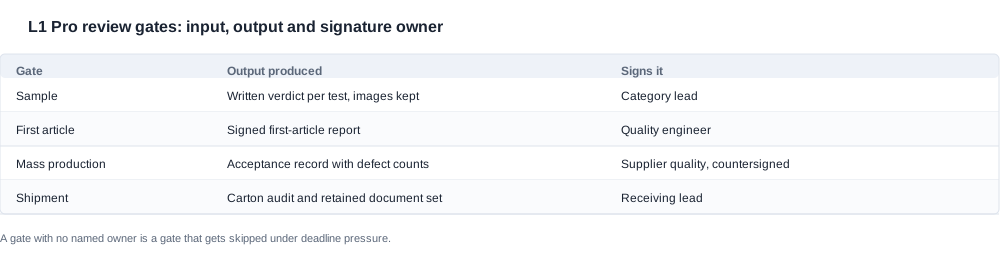
| Gate | Input you receive | Output you must produce | Owner of the signature |
|---|---|---|---|
| Sample | One or a few units plus any printed material | A written verdict per test, with the images retained | Your product or category lead |
| First article | A production unit built on production tooling | A signed first-article report against the same test set | Your quality engineer, not the buyer |
| Mass production | A production lot built to the same specification | An acceptance record per sampling plan, with defect counts | Supplier quality, countersigned by you |
| Shipment | Packed cartons, marking, and the document set | A shipment audit record and a retained document set | Your receiving or logistics lead |
Notice what moves between gates. At the sample gate the owner is commercial — someone deciding whether to proceed at all. At the first-article gate the owner is engineering, because the questions are dimensional and process questions. At mass production the owner is the supplier's quality function, with your countersignature, because only a countersignature makes the record binding. At the shipment gate the owner is receiving, because that is the last point at which cartons can still be opened and counted before they enter your warehouse as accepted stock.
A gate whose owner is unclear is a gate that gets skipped under pressure, and skipping always happens at the worst possible moment — usually a week before a shipping deadline, when the person who would have run the check is already working on something else.
The second structural point is that the test set travels. The same photograph, the same measurement and the same document request should be presented at every gate. If the sample passes a test that nobody repeats at first article, you have learned something about the sample and nothing about production. If the first article passes a test that the sampling plan never repeats, you have learned something about one unit and nothing about the lot. Write the test set once, put it in the purchase order, and require it at every gate. A test set that lives in somebody's inbox is not a specification.
A third point, easy to miss: the four gates need different tolerances for the same observation. At the sample gate, "the hinge feels acceptable" is a reasonable input to a decision. At the shipment gate, "acceptable" is not a measurement and cannot be recorded. Decide in advance what each observation has to look like at each gate, so that the standard tightens as the commitment grows rather than staying informally constant.
What the sample hands you, and what it does not
A sample is a demonstration of one unit built on a line whose repeatability is unknown. It tells you that something is achievable. It tells you nothing about spread, defect rate or consistency, and it cannot tell you about anything that varies across a production run. Treating a sample verdict as a production standard is the specific error that this gate structure exists to prevent.
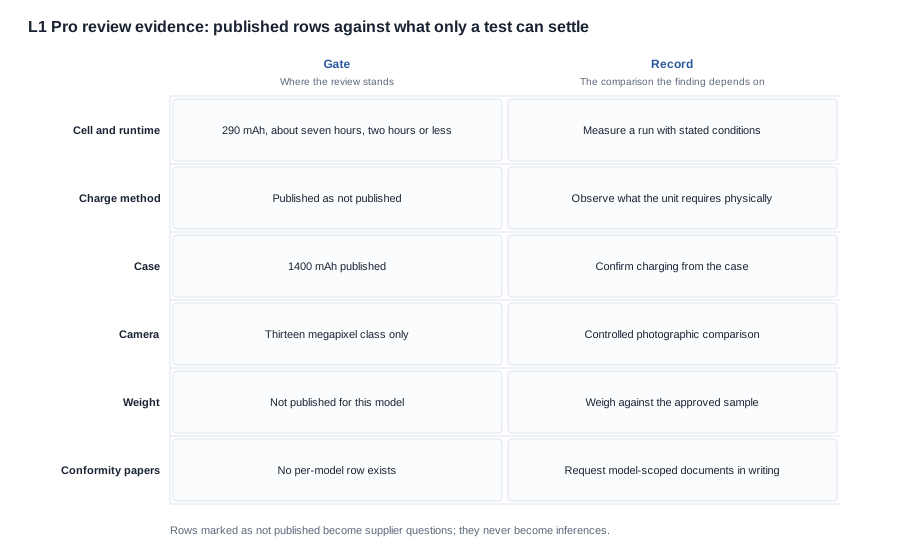
Begin with what the published rows already establish, so that you do not spend the sample week re-discovering facts that are already written down. Four rows are published for this model: 290 mAh of cell capacity, a rated runtime of approximately seven hours, a charge ceiling stated as two hours or less, and a case of 1400 mAh. The charge method itself is published as unpublished. The resolution class is published as thirteen megapixels, with nothing behind it. Rows a buyer normally expects — weight, lens material, ingress rating, Bluetooth version, storage capacity, video format, frame rate — are not published, and for several of those the sample is the only place an observation is possible at all.
Then run the photographic test, because choosing this model in preference to the eight-megapixel platforms rests entirely on that single published figure. A resolution comparison is a controlled test, and the control is what makes it worth anything. Shoot the same scene, on the same unit, at the same moment, in the same light, then crop both outputs to the same region and examine them at the same magnification. Do less than that and you are comparing two colour-processing pipelines and calling the result resolution.
- A daylight interior scene with flat areas and fine detail. Text on a screen or a printed page in the middle distance, a window in the frame, and something with a regular pattern such as a grille, a railing or foliage. Flat areas reveal noise, fine detail reveals the pixel grid, and the high-contrast edge reveals whether the lens is resolving at all.
- A low-light scene at a fixed short exposure. This is where a small pixel size shows itself. More megapixels packed onto the same area means a smaller light-gathering area per pixel, so a higher resolution can produce a worse photograph than a lower one. If your channel sells on image quality rather than on specification sheets, this is the test that decides the question. If your channel sells on image quality rather than on specification sheets, this is the test that decides the question.
- A moving scene. What matters for a first-person camera is not a still taken from a tripod. Move with it, then examine a still frame taken from the footage. Motion handling is where a high-resolution sensor with a modest sensor area gives itself away.
- A frame of the frame itself. Photograph the lens at close range and check for corner softness and for a fixed pattern of vignetting. Those are optical and mechanical conditions rather than sensor conditions, and no resolution figure describes them.
- A video segment, and then that same segment as stills. If your product sells video, stills extracted from a video stream are usually the worst image quality the product can produce, and that is precisely what a customer screenshots when they complain.
Write down what you found before you read anything else. A verdict formed after reading a specification sheet is contaminated by that sheet, and thirteen megapixels is a strong prior to argue against. The discipline sounds pedantic until you notice how often a review meeting opens with the specification and closes with a decision the specification had already predetermined.
Then the bookkeeping, in the order it costs you least to run. Inspect the physical unit against the approved sample and the artwork: lens surfaces for scratches or haze, the temple hinge, lens alignment as the frame moves, and the markings and batch or serial identification. Our own record of this model carries a naming inconsistency that has to be confirmed in writing — it is listed as the L1 Pro, and the naming question in this family is not something to leave to chance before artwork is printed.
On charging, record rather than check. The catalogue publishes the charge method as unpublished for this model, which means there is no specification to test against and no interface you should assume. Observe what the unit requires physically to take a charge, how long a charge takes from the state the unit ships in, and whether it takes charge from the 1400 mAh case as well as from a direct supply. Write the observations as observations. If your channel documentation later needs to state an interface, that statement has to come from the supplier in writing, not from your inference.
Confirm the case arrived, that the frames charge from it, how the case indicates its own state, and how the case itself is replenished. The case's own recharge time is not published, and it is the number a travelling customer asks about first, because it decides whether the case needs its own cable in the same pocket as the frames.
Run the unit the way a customer runs it, and record what you measured rather than what you hoped for. Approximately seven hours is a rating with no stated test condition — no starting state, no workload definition, no ambient description. Your own measured number, recorded with the conditions attached, is the one you can stand behind in a support conversation.
Finally, establish what every control does, whether a companion application is required, which phone systems it supports, and what happens to a customer when that application is updated or withdrawn. None of this is published for this model. All of it becomes a support ticket, and support tickets are the part of a camera product that customers remember.

The first article is a different test from the sample
The first article is the unit your production tooling actually produces. Its job is to answer a question the sample cannot: does the specification survive being built repeatedly, by more than one person, on a line rather than on a bench?
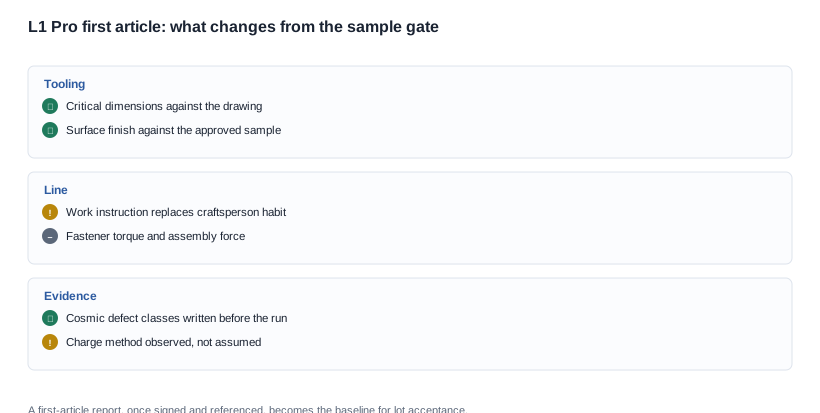
Three things change at this gate, and a review process that ignores them wastes the gate entirely. The tooling changes, so dimensions and surface finish that matched a sample may now sit outside tolerance. The line changes, so assembly force, fastener torque and cosmetic acceptance become a supplier's work instruction rather than one craftsperson's habit. And the volume changes, so cosmetic conditions that were invisible on a single unit become visible as a trend you can measure.
Review the first article against the same test set used at the sample gate, and add three checks that only make sense here. Measure critical dimensions against the approved drawing rather than against the sample unit, because the drawing is the contract and the sample is only an example. Record cosmetic acceptance against a written standard with named defect classes, because an unwritten cosmetic standard reliably turns into a negotiation at the moment you least want one. And confirm that the paperwork delivered with this unit describes this unit, matched by model designation and batch or serial marking.
The paperwork check deserves particular emphasis for this model, because its exposure is unusual. Our published material offers only a company-level export certification page, and that page is made of images rather than readable text. Nothing in the catalogue text names a conformity mark, and no model in the range carries a row of its own. Certificate numbers, issuing bodies, validity periods and covered model schedules are therefore not published for this model. At the first-article gate you either receive that documentation, or you record the gap in writing and attach the record to the purchase order. Recording the gap is entirely legitimate and is often the only available action. Discovering it after a production run has shipped is not.
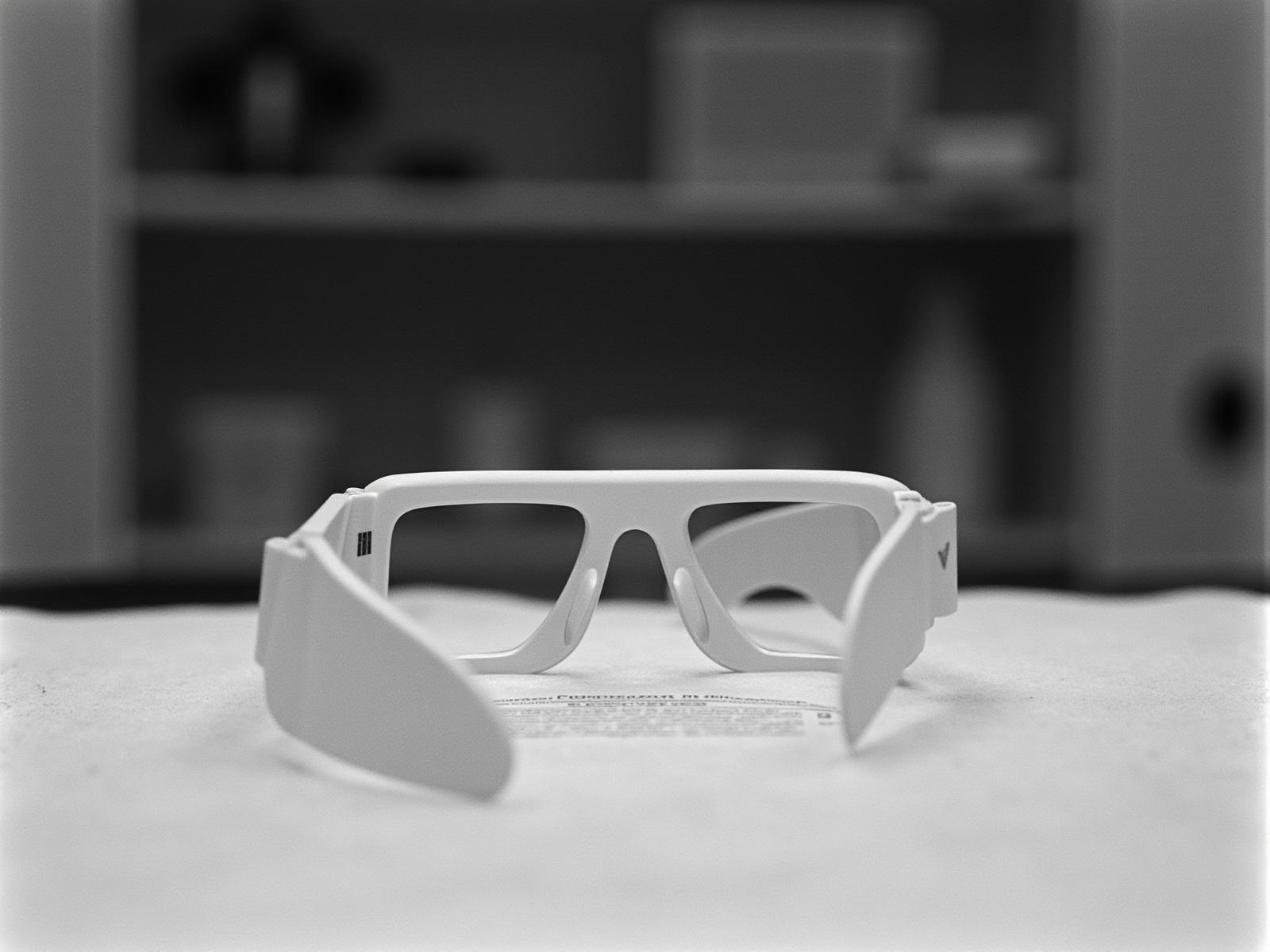
Two further checks earn their place at this gate specifically because the row is unpublished. Weigh the unit against the approved sample and record the result, since weight is not published for this model and the only figure in the entire range that is published belongs to a different model. And photograph the charging case with the frames seated, since the charge method row is absent and the physical arrangement is the only evidence available about how the case and the frames relate.
The output of this gate is a document, not a conversation. A signed first-article report, referenced by number in the purchase order, becomes the baseline every later gate is measured against. Without that document, the lot acceptance two months later is an argument about memory.
Mass production: sampling plans, not inspections
The mistake most teams make at mass production is treating every unit as if it were inspected. It cannot be done at any price a channel can bear, and the attempt usually ends with the inspector looking at boxes instead of units. What you actually need is a sampling plan, agreed before the lot runs, with defect classes defined and a threshold that triggers a defined consequence.
Four inputs must be fixed in advance, not reconstructed afterwards. The sampling ratio, expressed in a form both parties read identically — a ratio described only as "normal QC sampling" is a ratio that will be interpreted generously in whichever direction suits the conversation. The defect classification, separating critical from major from minor, with a written example for each class, because a defect class without an example is not a defect class. The threshold that converts a count into a rejection, together with what happens when it is crossed: rework, replacement, or a price concession. And the traceability rule, stating which units carry which batch marking, so that a defect found in a market can be walked back to a production window rather than to a season.
Then apply the discipline that matters more than the ratio: state what the sample proves and what it does not. A passing inspection of a lot proves that the inspected units contain no defects of the classified types. It does not prove the lot is free of those defects. Acceptance language written stronger than the evidence is a liability that someone signs personally, usually later than they expected.
Where a specification row is unpublished, the sampling plan has to carry the burden instead. The charge method for this model is not published, so a charging-related defect class cannot be written against a specification. Define it by behaviour — the unit does not take a charge within the stated ceiling, or it does not take charge from the case at a defined state — and record each observation against the unit it came from. Behavioural defect classes survive missing specifications; specification-based ones collapse the first time a supplier and a buyer read the same sentence differently.
Two further habits belong in this gate. Fix the line before you fix the lot: an inspection that changes halfway through a run tells you two different things about two halves of an order, and only one of them is a fact. And write the retention rule into the acceptance record, not into a separate note — one sealed unit per lot, labelled with the lot number, stored where a photograph can be taken of it a year later. A retained unit nobody can locate is not a retained unit.
The shipment audit and the records that travel with the cartons
The final gate happens after the goods are packed, and it is where the last recoverable money sits. A carton-level audit costs a day. A short shipment, a marking error or a missing document set costs a season.
Audit four things. The marking against the approved artwork and the approved dieline: print quality, colour accuracy, insert fit, and whether the unit sits in the position the packaging was designed to protect. The count against the packing list, including the treatment of the charging cases, which are a separate line from the frames and are the easiest item to miscount when the two ship in the same carton. The document set against the unit it describes, matched by model designation and batch or serial marking. And the retention of one sealed unit per lot, so that a market complaint has something physical to compare against.
The document set is where this model generates the most friction, and it should be settled before the lot runs rather than resolved at the dock. Because there is no per-model certification row, a shipment that arrives carrying only a company-level page leaves you with nothing that ties a conformity claim to a carton in your warehouse. Ask for the per-model conformity documents as a condition of the purchase order, so the obligation exists before anyone packs anything and before anyone pays the balance.
One practical note on how that request is worded. Specify what you want — the model designation covered, the issuing body, the issue and validity dates, the batch or serial range the document applies to — rather than asking for "certificates" in general. A general request receives a general answer, which is usually a company brochure. A specific request either produces the document or produces a clear refusal, and a refusal recorded at the sample stage is far more useful than an ambiguity discovered at the dock.
Three shortcuts account for most of the defects that reach customers from this category, and all three are procedural rather than technical. The first is reviewing the sample and treating the verdict as the specification; because nothing was written down, nothing is enforceable at first article, and production inherits an impression instead of a requirement. The second is accepting the documentation question on the strength of a company-level capability page, which is not a per-model conformity record — the difference becomes visible the first time a market enforcement question is asked. The third is dropping the photographic test because the unit performed well in a demonstration under showroom light, when a demonstration and a measurement are different activities and only one of them is repeatable.
What should stop the order rather than be noted for its own sake: a model designation that differs between the artwork and the supplier's documents; image quality the channel cannot carry, judged under the controlled test rather than in a demonstration; a charging case that does not charge the frames; a frame that does not hold alignment; a conformity document that does not cover the model in your hand. Everything else is a negotiation, and most of it is a question rather than a defect.
The position we can defend is narrow and worth stating plainly. The published specification for the L1 Pro supports a decision about capacity, runtime, charge ceiling and case, and it does not support a decision about image quality at all. The sample is the only place that question can be answered, and the test above is built so that the answer survives a competitor comparison. We will not tell you that the sample passed, and we will not tell you that a fault is acceptable. The product decision is yours, and our documentation will not stand in for the sample.
Four gates, one test set, and a named signature at each. Send us the destination market, the order quantity and the configuration you intend to brief, and we will tell you which of these rows can go in front of you today and which have to be answered by the supplier. This model sits on our camera range page; its published rows and its charging gap are set out separately.
Related reading
- The rows this review starts from — L1 Pro specifications and features
- Charging behaviour at each gate — L1 Pro charging options
- Its standing among the camera tier — L1 Pro compared across the catalogue
- How a sample programme is normally run — sample evaluation
Give us the market, the quantity and the configuration, and we will answer from the published rows.


