
Most comparisons of this model are written against a single rival, and they are the least useful comparisons available, because they pretend that one other model is the alternative. In practice a buyer is choosing from a range of twenty-eight models, and this model's position inside that range is defined by three relationships: it sits in a cluster of near-identical power rows, it shares a cell capacity with one model that publishes a charge method this one does not, and it carries a case whose published capacity is at the top of the range.
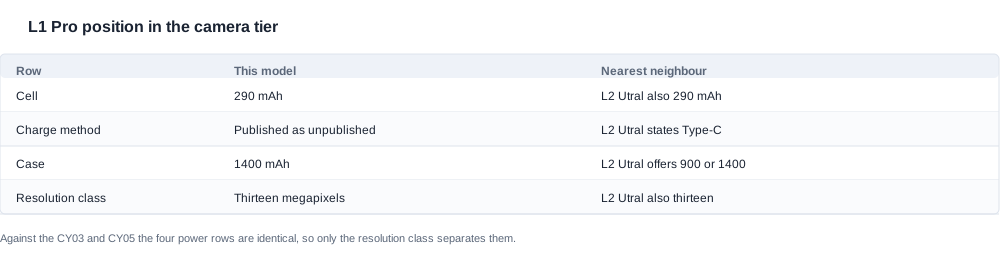
What follows compares this model horizontally against the catalogue rather than vertically against itself. It reads across the range and asks, for each published row, where this model sits.
Where L1 Pro sits among the eleven camera models
The camera tier in this catalogue contains eleven models, and this model is one of them. That matters before any row-by-row comparison, because the tier is defined by the presence of a camera rather than by any shared power specification, and the power rows inside it vary considerably.
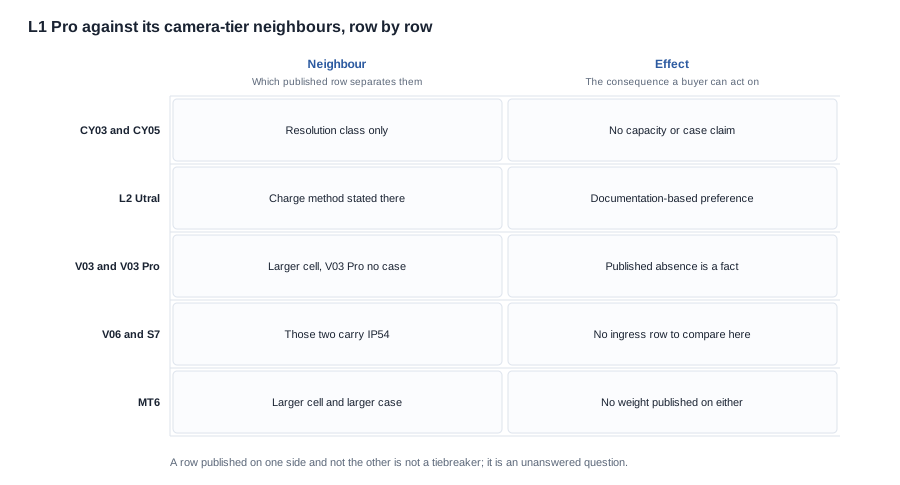
Within that tier, this model belongs to a group of three — alongside the CY03 and the CY05 — whose published power rows are identical to each other: a shared 290 mAh cell, a seven-hour runtime rating, a no-more-than-two-hour charge limit, and one 1400 mAh case between them. Three models publishing four identical rows is a genuine finding about how the catalogue is built, and it has a direct consequence for a buyer: a comparison between this model and either of those two cannot be made on the power rows at all, because there is nothing in those rows to compare.
What distinguishes this model from that group is its resolution class. Across the eleven camera models, the published resolution classes are eight megapixels on eight models and thirteen megapixels on three. This model is in the thirteen-megapixel group, alongside the L2 Utral and the S7. That is the row on which this model can actually be compared to its neighbours, and it is also the row that carries the most commercial weight, because it is the reason a channel would choose this model at all.
So the honest summary of the first relationship is narrow: against the CY03 and the CY05, this model is distinguished by resolution class and by nothing else that is published. Any comparison that claims a capacity advantage, a runtime advantage or a case advantage over those two models is not supported by the catalogue, because the four power rows are the same on all three pages.
The same cell capacity, a different charging position
The second relationship is with the L2 Utral, and it is the most instructive comparison in the range because the two models share a cell and diverge on exactly the row that matters most operationally.
Both publish a 290 mAh cell, a rated runtime of approximately seven hours, and a charge time of two hours or less. The L2 Utral publishes a Type-C charge interface. This model publishes the charge method as unpublished. That is the whole of the difference, and it is a documentation difference rather than a specification difference — or rather, it is a difference in what each page is willing to commit to.
The case row is the second point of divergence. The L2 Utral publishes two case capacities, 900 mAh and 1400 mAh, which reads as two case options rather than one. This model publishes a single 1400 mAh case, which is the larger of the two options the neighbouring model offers. A buyer choosing between them is therefore choosing between an interface that is stated and two case sizes, and an interface that is not stated and one larger case.
| Row | This model | The L2 Utral | What the difference means |
|---|---|---|---|
| Cell | 290 mAh | 290 mAh | No capacity basis for preferring either |
| Rated runtime | About seven hours | About seven hours | Not a differentiator |
| Charge ceiling | Two hours or less | Two hours or less | A ceiling, not a target |
| Charge method | Published as unpublished | Type-C published | Documentation gap, not a feature gap |
| Case | 1400 mAh | 900 mAh or 1400 mAh | One larger case here, two options there |
| Resolution class | Thirteen megapixels | Thirteen megapixels | Same tier |
Read that table carefully and the selection logic becomes clear without any invented criteria. A buyer who needs the charging interface stated in advance — because their packaging, their listing or their customers will name it — has a documentation-based reason to look elsewhere. A buyer who has confirmed the interface through a supplier conversation has no such reason, and gains a larger published case capacity. Neither conclusion is a recommendation; both are consequences of which rows are published.
Against the models that differ on power rows
The rest of the camera tier is where this model's power specification can actually be compared, and the differences are real ones.
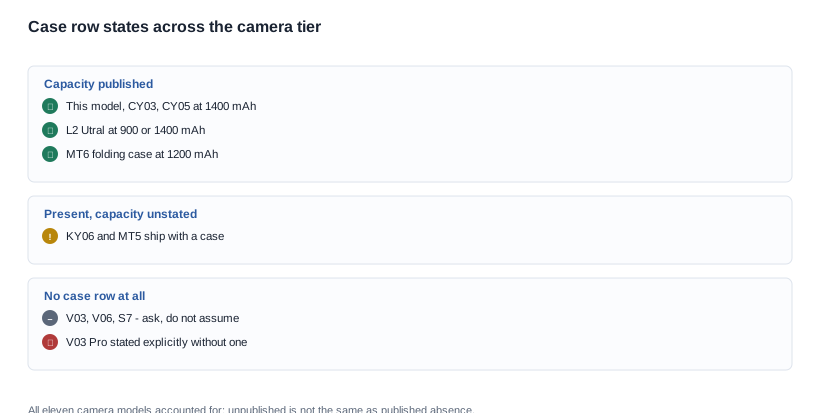
Against the V03 and the V03 Pro, which publish a 220 mAh cell and a rated runtime expressed as a range of five to eight hours, this model publishes both a larger cell and a tighter runtime figure. The V03 Pro also publishes a Type-C charge interface and describes itself as a photo-photo variant with a flexible temple and a photo-chromic lens, and the catalogue prints no charging-case row for it — which puts it in the same position as the other three silent rows rather than in a position of its own.
Against the KY06, which publishes a 260 mAh cell, a runtime range of six to eight hours and a magnetic charge method with a case of unstated capacity, this model publishes a larger cell and a charging method that is unstated.
Against the MT6, which publishes a 265 mAh cell, a rated seven hours and a folding case of 1200 mAh — along with a 158 g weight that is the only weight figure published anywhere in the range — this model publishes a larger cell and a larger case, and no weight at all.
Against the MT5, which publishes a 220 mAh cell, a runtime range of six to eight hours and a case whose capacity is not published, this model publishes a larger cell and a published case capacity.
Against the V06 and the S7, which publish 260 mAh cells, runtime ranges of five to eight hours, magnetic charging, and — uniquely in the whole catalogue — an IP54 marking, this model publishes a larger cell and no ingress rating at all.
That last comparison is the one worth dwelling on. Two models in this tier carry a published IP54 rating and this model does not, which means a buyer whose requirement includes splash or dust protection cannot evaluate this model against those two on that requirement at all. It is not that this model fails the requirement; it is that the catalogue publishes nothing about it, and the two readings require different actions.
Against the remaining models in the tier, the separation is a single row rather than a group of them. The KY06 shares the thirteen-megapixel-free bracket but publishes an eight-megapixel class alongside a magnetic charge method and a case of unstated capacity, so a buyer choosing between the two is choosing between a published interface and a published resolution class. The MT5 sits at 220 mAh with a case of unstated capacity and an eight-megapixel class, making it the model to consider when capacity is secondary and the interface is not. Each of these is a different trade rather than a ranking, and the selection criteria that produce them differ from case to case.
The most useful way to hold the whole tier in view is to sort it by which rows are published rather than by any performance estimate. Group one: models whose charge method is published, which is fifteen of the twenty-eight across the range and most of this tier. Group two: models where it is not, four across the range including this model. Group three: models whose case capacity is published, which in this tier is five. A buyer can evaluate within a group on published rows and can only ask questions across groups — and building a shortlist that ignores that line produces a comparison whose conclusions depend on assumptions the reader cannot see.
That framing also explains why so many published comparisons of this category read strangely. They tend to treat an unpublished row as a neutral value rather than as a missing one, which quietly ranks a model with a stated interface above one without. Sometimes that ranking is right — a channel that cannot carry an assumption gains real value from a published row. Sometimes it is simply an artefact of the table, because the question was never one the buyer needed answered. Deciding which is which requires knowing whether your specification will ever name the interface, and that is a question about your own documents rather than about the models.
Two further range-level facts help frame the tier. Across the twenty-eight models, the charge method divides into magnetic on seventeen, Type-C on seven, and unpublished on four — so the unpublished group is small enough that a supplier can probably answer it directly. And the resolution classes divide into eight megapixels on eight camera models and thirteen on three, which means the thirteen-megapixel group is small enough to reason about model by model rather than as a tier. Both facts reduce the amount of comparison work a buyer actually has to do.

Reading the case row as a positioning signal
The case row deserves more attention than it usually gets, because in this tier it separates into four different states and the differences are commercial rather than cosmetic.
Five models publish a case capacity: this model, the CY03 and the CY05 at 1400 mAh, the L2 Utral at 900 or 1400 mAh, and the MT6 with a 1200 mAh folding case. Two more ship with a case whose capacity is not published — the KY06 and the MT5. Three models have no case row in the catalogue at all — the S7 and the V03, and the V06 — which is an unpublished row rather than an absence of a case. And the V03 Pro is a fourth, in the same position: no charging-case row is printed for it either.
That third group is where buyers most often go wrong. An unpublished row is not the same statement as a published absence, and the two carry different consequences: an unpublished row means you must ask, and a published absence means you already know. Accounting for all eleven camera models across those four states is more useful to a buyer than listing only the ones whose capacities happen to be stated.
For this model specifically, the published 1400 mAh case is a positioning fact. It is the larger published case capacity in the tier, it sits alongside a 290 mAh cell in the frames, and combined the two give a mobile product whose day is carried by the case rather than by the frames. That is a real and statable advantage — provided it is stated as what it is, and provided nobody reads the 1400 mAh as a runtime figure.
Three cautions follow from reading the case row this way. First, a case capacity is not a runtime multiplier, and the temptation to present 1400 mAh as "so many hours" is the most common misreading of this row in the range. The frames publish a rated seven hours and the case publishes a capacity; nothing in the catalogue connects them arithmetically, and a derived figure built on that connection would be ours rather than the catalogue's. Second, the case is a physical accessory with its own supply chain, its own charging requirements and its own failure modes, and a channel promising the case is promising a second product. Third, the difference between a published capacity and an unpublished one is a documentation difference, not a quality difference — the KY06 and MT5 both ship with a case, and the catalogue simply does not state its size.
What this horizontal reading cannot settle
Three things a horizontal comparison cannot resolve, however carefully the rows are read.
It cannot settle image quality. The resolution class is published and everything downstream of it is not. A thirteen-megapixel class says what the catalogue states and nothing about what a photograph looks like, which remains a matter for a sample rather than for a comparison table.
It cannot settle price or value position, because no pricing is published for any model in the range and because the charge method gap would in any case make an unsupported row the obvious place for a price difference to be built. A model whose only distinguishing rows are unpublished does not carry a price story that can be defended in a tender.
It cannot settle documentation and compliance, because there is no per-model certification row anywhere in the catalogue, and the company-level page presents ten patent certificates which establish design registration rather than conformity to any requirement.
Note that this limitation is not specific to this model. Every model in the range sits in the same position on conformity documentation, which means a horizontal comparison cannot help a buyer rank models on that criterion at all. What it can do is tell a buyer which models to ask about, and in a range where several models publish an interface and a few do not, the models worth asking about are the ones whose other rows are strong — because that is where an unanswered question is most expensive.
The same logic applies to the rows that are published for everyone, such as cell capacity. Those rows support comparison, but a comparison on capacity alone is a comparison on one dimension of a product that a buyer will use in several ways. Capacity matters when a user is away from a supply; the case matters when they are away from both; the interface matters when their documents have to name it; the resolution class matters when the photographs are the product. A horizontal reading is a map of which question belongs to which requirement, and the selection follows from the requirement rather than from the table.
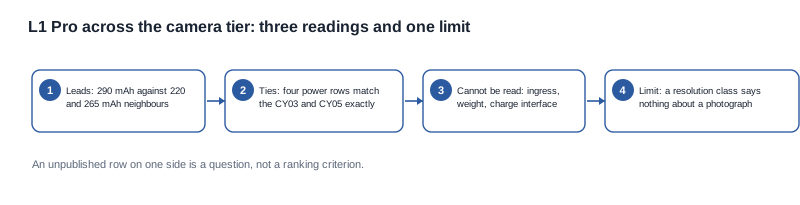
What the horizontal reading does settle is narrower and more useful: this model is a thirteen-megapixel camera product in a 290 mAh bracket, with the largest published case in the tier, and with a charging row that is not stated where its nearest neighbour's is. A buyer who needs an interface in writing, or an ingress rating, or a weight, should look at whether those rows are decisive for their channel — and if they are, this model cannot be evaluated on them until a supplier answers.
Stated as criteria rather than as conclusions, the selection reads like this. Choose on the resolution class when image quality is the reason for the purchase, because that is the row that separates this model from most of its tier and the only published row that does so. Choose on the case capacity when a mobile working pattern is the reason, because 1400 mAh is the largest published figure in the tier and because a case of that size changes the number of days a user can spend away from a supply. Do not choose on the charge interface until a supplier confirms it, because on this model it is not published and any comparison that ranks it there is ranking an assumption.
And the exclusions matter as much as the inclusions: if a published ingress rating is a requirement in your specification, this model cannot be shortlisted on that basis today; if a stated charge interface is required in your packaging, the same applies; if a weight figure is required for a fit calculation, the same again. In each case the answer is not to reject the model but to ask the question, because all three are answerable by a supplier and none of them is currently answered by the catalogue.
The one decision this model does not force is whether it is worth buying. That is a commercial judgement about your market, your margin structure and your customers, and it is not something a comparison table can settle. What the comparison can do is tell you which questions to put on the quotation so that the commercial judgement is made with facts rather than around them — and for this model that list is short, because the power rows are strong and published, the resolution class is the largest published in the tier, and what remains outstanding concerns the interface rather than the capability.
A closing caution about how these published rows decay. The gap on this model is a gap in our published material, not a statement about the product, and published material is exactly the kind of thing that gets corrected without announcement. Treat every row in this article as current as of the catalogue that produced it, re-check the charge method row before you commit to artwork or to a listing, and if your order is long enough that a revision would matter, put a written confirmation of the interface into the purchase order rather than relying on the catalogue you read today.
We will not rank it against the rest of the range, because the published rows do not support a ranking and inventing one would misrepresent the catalogue. The rows are published; what you can do with them depends on your channel.
A horizontal reading gives you a map of which question belongs to which requirement; the selection follows from the requirement rather than from the table. Send us your shortlist, the destination market and the quantity, and we will return the published rows for each candidate side by side. Every model referenced here appears on our camera range page, and the figures for this one are set out in the specification reading.
Related reading
- The published data for this model — L1 Pro specifications and features
- The charge method gap in practice — L1 Pro charging options
- Questions buyers ask first — L1 Pro common questions
Send the shortlist and the market, and we will answer row by row.


