

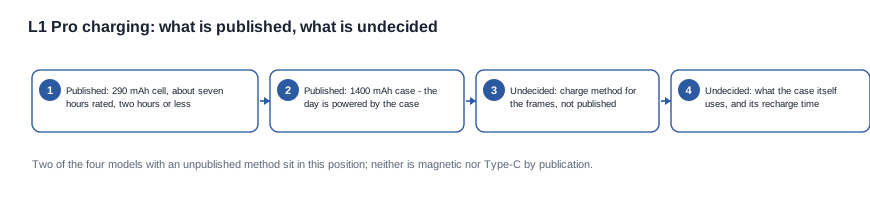
There is a version of this article that lists charging options, and it cannot be written, because the catalogue does not publish a charge method for this model. Four power numbers do appear on the page — 290 mAh of cell, a runtime rating near seven hours, a charge limit no greater than two hours, a case of 1400 mAh — and then the listing stops. No interface, no dock, no connector, no charging protocol.
That absence is not a minor documentation gap. It is the single most operationally consequential unpublished row on this model, because charging is the one thing a customer touches every single day and the one thing a support organisation cannot improvise around. What follows is how to plan a charging routine, a stock line and a customer instruction set when the interface is genuinely unknown.
L1 Pro charging options: the published rows and the one that is missing
Start from what is established, because two of these rows are more useful than buyers usually make them.
The 290 mAh cell in the frames and the 1400 mAh case mean that the primary power story is the case, not the frames. The case holds close to five times the capacity of the frames. For an operational plan, that ratio is the fact worth designing around: the question is how many case recharges a user gets per case charge, not how long the frames run on their own.
The rated runtime of approximately seven hours is a rating, not a measurement, and it comes with no test conditions attached — no workload definition, no ambient temperature, no statement of what the radio was doing. Treat it as a ceiling under favourable conditions rather than as a figure to plan shifts against. Your own measured figure, recorded with conditions attached, is the one that belongs in a planning document.
The charge time of two hours or less is a ceiling in the strict sense. It says the unit can be brought to a full charge in no more than two hours; it does not say how much longer it might take in poor conditions, and it says nothing about the starting state or the criterion for completion. Two hours or less is the correct way to restate it, and it is the wording that should appear in any material you publish.
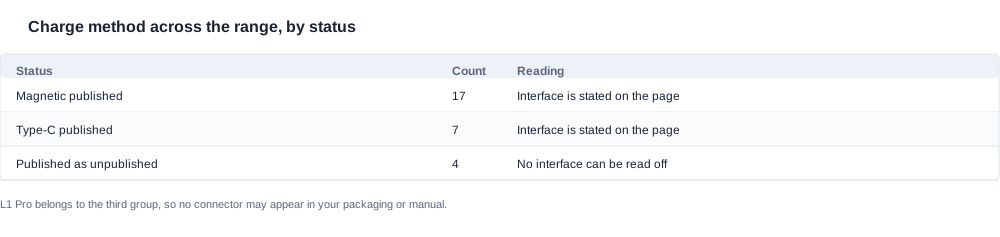
And then the missing row. Across the full catalogue, charge methods divide into magnetic charging on seventeen models, Type-C on seven, and unpublished on four. This model is one of the four where the catalogue does not state the method at all. It is not grouped with the magnetic models and it is not grouped with the Type-C models. It belongs to a third category, and the practical consequence is that you cannot plan an interface, a cable standard or a dock ecosystem from published information.
It is worth being clear about the two things this gap does not mean. It does not mean the product cannot be charged — it plainly can, since a charge time is published. It does not mean the product is unusual among the range; four models share this status. It means only that the published material will not tell you how.

Three operating patterns and the evidence each one needs
Because the interface is unknown, the useful exercise is to define operating patterns in terms of what they require physically, and then to see which ones survive the gap.
Pattern one: the desk pattern. The frames sit at a fixed point during a working day and are charged from a known supply. What it requires is a single known interface and a known supply — a cable or a dock that stays with the desk. What it survives: nothing about the gap blocks it, because the unit is in one place and one method serves it. The unknown here is narrow and closable: you need to know what the unit requires physically, and that is a single question.
Pattern two: the travelling pattern. The frames and the case go out together and are replenished away from any known supply. What it requires is that the case itself takes a charge from something a traveller carries, plus a second unknown: how the case is replenished, given that its own recharge time is not published either. This pattern is the most exposed to the gap, because it needs two interfaces confirmed rather than one, and the second one is not visible in the sample in the way the first is.
Pattern three: the field-service pattern. Multiple units circulate between staff or between sites, and each unit's state is unknown at the point of handover. What it requires is a known charge protocol, a way to know whether a unit is charged without powering it on, and a defined convention for a unit returned in a low state. This pattern does not fail because of the charge method — it fails because of the indication, which is a separate unpublished row, and because a charging routine that depends on a specific dock orientation fails when a dock is missing from a kit.
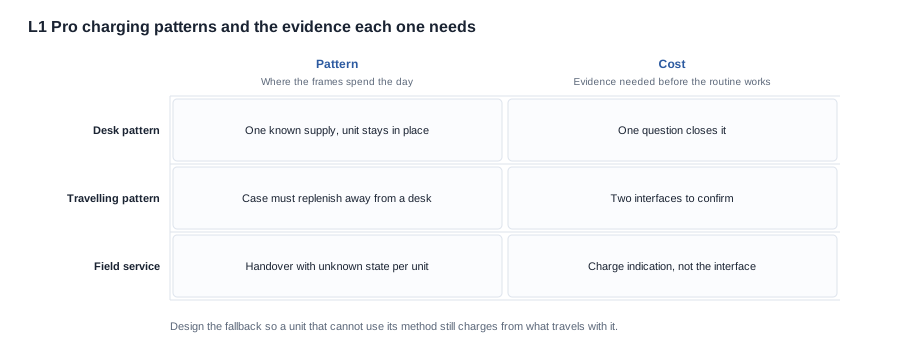
Ranking them by exposure to the gap gives a practical order of work: confirm the desk pattern first, since one question closes it; treat the travelling pattern as a two-question problem; and treat the field-service pattern as an indicator problem that has to be solved regardless of interface.
One point applies to all three. A routine that depends on a specific physical arrangement is fragile when the arrangement is unpublished. If your kit list, your shelf plan or your printed instruction sheet names a dock and the unit turns out to take a cable, every one of those documents is wrong and every customer who follows them is disappointed. Until the interface is confirmed, design the routine so that the fallback is graceful — for instance, so that a unit that cannot use its intended method can still be charged from a case or a supply that travels with it.
Laying out chargers before the interface is confirmed
There is a way to build a stock and packaging line that holds up whatever the interface turns out to be, and it is to buy certainty rather than guesswork.
The first move is a physical confirmation, not a documentary one. Ask for a unit, or use the sample you already have, and establish what it requires to take a charge: what is physically presented, where it is located on the frame or the case, and whether anything has to be aligned in a particular way. This is an observation you can make in an afternoon, and it closes the largest part of the gap. A documentary request for a product specification section is slower and less reliable than simply looking.
The second move is to define your accessory line by function rather than by connector. If you specify "the cable that recharges a 1400 mAh case in the region of a two-hour ceiling" rather than a connector type, your purchase order survives the answer. If you specify a connector type, you have pre-committed to an answer you do not have. The same logic applies to anything you print: artwork that shows a specific connector becomes wrong artwork the moment the answer arrives.
The third move is to hold the packaging change. It is normal to want artwork that shows the charging arrangement, and it is normal for the artwork to be frozen months before the confirmation arrives. The workable approach is to design the panel so the charging arrangement is either shown generically or shown through the case rather than through a connector, and to schedule any connector-specific artwork after confirmation. Artwork is the most expensive place to be wrong about a detail you have not confirmed, because it is printed, distributed and, in some markets, subject to its own labelling requirements.
The fourth move is to write the stock line to absorb two outcomes. A modest quantity of both plausible solutions costs less than one reprint of wrong artwork or one support contact per unit sold. Where the volume makes that impractical, make the decision explicitly, record which assumption it rests on, and put a review date on it.
This is a sourcing decision, not a packaging decision, and it belongs in the quotation rather than in the artwork brief. When you go back to the supplier for the eight questions below, ask for the interface detail as a line in the quotation response, with a date attached. A supplier who treats it as a technical question to be answered later will answer it later; a supplier who treats it as a quotation line answers it while they still have the tooling schedule in front of them.
The cost of guessing is worth putting in numbers your own finance team recognises, even though we cannot put a figure on it. If the interface turns out to be something your packaging did not show, the exposure is not the connector itself — it is the reprint run, the shelf stock already distributed, the listings already live, the support contacts already opened, and the review cycles needed to correct all of it. If the interface turns out to be compatible with a cable your buyers already stock, the same guess has cost you the difference between one accessory line and none. The asymmetry is large enough that a single afternoon of physical confirmation is cheap by any measure.
There is one more sourcing habit worth building in: ask the supplier to confirm the interface per model designation, in a list, at quotation stage. Not a general statement about how the range charges, but a specific row for this model. General statements are how the four unpublished-method models ended up grouped together in the first place, and they are also how a buyer ends up with a product listing that quietly assumes a connector nobody confirmed.

Questions that close the L1 Pro charging gap in writing
Ask these in a single message, with the model designation named, and expect either answers or a clear statement that the information is not yet available. Both outcomes are usable; silence is not.
- What physical connection does the frames use to take a charge, and where is it located?
- Does the unit charge from the 1400 mAh case, and does the case charge the frames when seated?
- What does the case itself use to take a charge?
- What is the case's own recharge time, and is there a stated ceiling or an approximate figure?
- Is a charge indicator available, and what does it show — level, state of charge, or only charging status?
- Is alignment required, and what happens if the unit is placed incorrectly?
- What happens to stored charge over a period of non-use, and is there a recommended storage practice?
- Is the charging method identical to any other model in the range, or specific to this one?
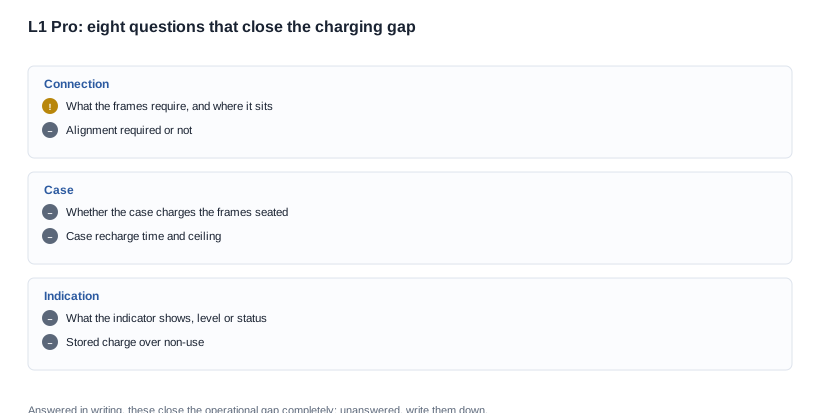
Those eight questions, answered in writing, close the operational gap completely. Until they are answered, the honest position in your own materials is that the charge method is published as unpublished — which is exactly the wording to use with a customer who asks, and considerably better than an interface guessed from a neighbouring model.
A last caution on sourcing. It is tempting to infer this model's method from the models around it in the catalogue, on the reasoning that a shared platform usually shares a charging approach. The catalogue does not support that inference for this model, and the four unpublished-method models are not described as a single design family. Treat any assumption of that kind as an assumption, write it down as one, and put a date on it.
The same caution applies to the supplier relationship rather than only to the catalogue. A supplier's answer on the telephone is not a commitment, and a commitment reached verbally is not something you can put in front of a compliance reviewer or a platform compliance team. Ask for it in writing, and if the reply is that the information is not yet finalised, ask what will change it and when you should ask again. A supplier who can answer both questions is one you can build a supply relationship with; a supplier who answers only the first is telling you something about how the rest of the documentation will go.

The supplier questions, grouped by what they close
Eight questions is a manageable message, but it helps to know which question closes which operational risk, because that determines what happens if it is left unanswered.
- Questions 1 and 2 close the desk pattern. If the frames take a charge and the case replenishes them, a stationary user needs nothing else. If question 2 comes back negative — if the case does not charge the frames — then the 1400 mAh case changes its role from a power bank to a carrying case, and every channel statement built on it has to be rewritten. That single answer is worth more than the other seven combined, because it determines whether the product's primary power story is real.
- Questions 3 and 4 close the travelling pattern. Two interfaces, and the second one is the one nobody sees in a showroom. An unanswered case interface is the difference between a product that travels and one that needs a desk.
- Questions 5 and 6 close the field-service pattern, and they would need answering even if the interface were published. An indicator that shows only charging status, rather than level, changes how a service organisation manages a pool of units — it moves the check from an inspection to a cycle count.
- Questions 7 and 8 close the assumption risk. Storage behaviour matters to a channel because returned stock accumulates, and the "is this the same as another model" answer is what stops an unsupported inference entering your documentation.
Grouping them this way also gives you a defensible escalation. If a supplier cannot answer questions 1 and 2, that is a different conversation from a supplier who cannot answer question 8, and the first one is worth escalating before you place an order while the second is merely worth chasing.
A shortlist built on this model should carry its own caveats. Before you compare this model against any other in the range, write down which of your criteria it can actually be evaluated on, because a shortlist that silently mixes published rows with assumed ones produces a comparison that no longer means anything once the assumption is tested. The criteria this model can be evaluated on today are capacity, rated runtime, charge ceiling, case capacity and resolution class. The criteria it cannot be evaluated on are charge method, charge indication, weight, ingress rating and anything about the application. Where a shortlist mixes the two sets, the honest move is to evaluate on the first set and mark the second as pending for every model that has it — not to quietly rank models on a row that will be revised.
Two trade-offs deserve naming before you order rather than after. The first is between a model whose charging is published and one whose charging is not: you are trading a smaller set of unknowns for a set of unknowns that are larger but individually cheap to close. The second is between confirming the interface yourself from a sample and waiting for a written answer: the sample is faster and produces a fact you own, while the written answer is slower and produces a commitment the supplier stands behind. For most buyers the second option is worth the delay on any order where the interface will appear in printed material, and not worth the delay on an order where it will not.
What the charging rows can and cannot carry into a channel
The two published numbers that do real work in a channel are the 290 mAh cell and the 1400 mAh case, because together they describe a product whose day is powered by its case rather than by its frames. A channel can build around that honestly — describe the case as the primary power source, describe the frame runtime as a rated figure, and describe the charge time as a ceiling.
The claim the channel cannot build, until the interface is confirmed, is any statement about how the product is charged. That covers the product listing, the printed manual, the unboxing insert, the retail shelf talker and the support article, and getting any of them wrong is expensive in a way that a wrong specification number is not.
The version that works in the meantime is procedural rather than promotional. Publish the routine you have actually set up, name what is confirmed and what is pending, and give customers a route to report an interface question. Buyers respect that more than a confident answer, because a confident answer that turns out to be wrong costs them a second purchase decision.
There is a selection question hiding underneath all of this, and a buyer should answer it explicitly rather than drift into it. The decision is not whether this model is good enough — it is whether an unpublished charge method is a cost you can absorb in your channel. Some channels can: a business-to-business sale where the buyer already knows the hardware, a range sold alongside models whose interfaces are published so the packaging never names a connector, a channel whose support organisation is staffed to handle interface questions on the first contact. Other channels cannot: a marketplace listing where the connector appears in the title, a retail line where the shelf talker shows the charging arrangement, or a consumer brand whose marketing materials are produced six months ahead of the confirmation.
Assess it as a total cost question rather than a specifications question. The unit price of the model is identical whichever way the question resolves; what differs is the cost of the accessory line, the artwork, the listing rewrites and the support load. Run that comparison before ordering, and if the answer is that the channel can absorb it, record the decision and the assumptions behind it so that a later order inherits a considered choice rather than a re-litigation.
The red flag to watch for is a channel plan that depends on the interface being convenient rather than merely confirmed. Convenience is a preference, and preferences are what generate the artwork that has to be reprinted. Confirmation is a fact, and facts can be designed around.
What we will not do is fill the gap with a plausible interface. This model is one of four in the range where the catalogue does not publish the charge method, and treating that silence as permission to infer one would make everything else we publish less trustworthy.
An unpublished interface is a planning constraint rather than a defect, and it is manageable once it has been designed around instead of guessed at. Tell us the working pattern you need to support — desk, travelling or field service — and we will work out which of the eight questions has to be answered first. The models are listed on our camera range page; what our material states for each is set out row by row in the specification reading.
Related reading
- Reading the rows a charging plan is built on — L1 Pro specifications and features
- The eight questions, and what each one unblocks — L1 Pro charging options
- Where the missing documents come from — L1 Pro certification status
Tell us the working pattern, and we will order the questions for you.


