

The honest answer to a certification question about this model is short: there is no per-model certification record in our published material, and no conformity document should be inferred from anything we have published. What follows is not a workaround for that. It is the request list you should send instead, written so that the reply either produces documents or produces a clear refusal you can act on.
That distinction matters more than it first appears. A buyer who assumes a document exists and only discovers otherwise at a market enforcement enquiry has lost the one thing they cannot buy back — time. A buyer who asked, in writing, before signing, holds a different position entirely.
L1 Pro certification status: what the catalogue records and what it does not
Three statements describe our published position accurately, and it is worth keeping them separate because each answers a different question.
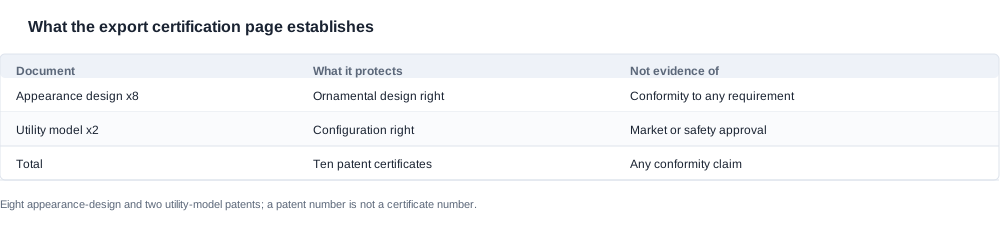
First, the catalogue carries a company-level export certification page, and the content of that page is images rather than extractable text. What the page presents is ten patent certificates — eight appearance-design patents and two utility-model patents.
Second, no reference to CE, FCC or RoHS is written into the catalogue text, and no per-model certification row exists anywhere in the published material. There is no table mapping a model designation to a certificate number, an issuing body or a validity period.
Third, and this is the part most often assumed rather than checked, a patent certificate and a conformity document are different instruments with different purposes. A patent protects an invention. A conformity document records that a product was assessed against a stated requirement by a stated body for a stated market. Neither substitutes for the other, and holding the first tells you nothing about the second.
What this means practically is that no one can answer a certification question about the L1 Pro from our published material, including us. Any statement of the form "the catalogue states the product is certified" would be a statement we cannot support. The useful response to that situation is not a more confident paraphrase — it is a precise request, sent early, with the recipient named.
It also helps to be clear about what a gap here does and does not imply. It does not imply the product is uncertified, and it does not imply anything about quality. It implies one narrow thing: the evidence is not in the document you have. A buyer who needs that evidence for a market decision has a legitimate need for the underlying document, and the supplier is the only party who can supply it.

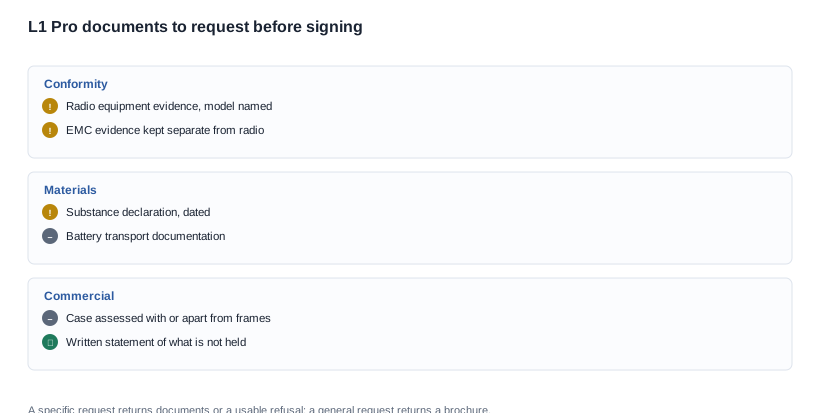
The document list to request before signing
Send this as a list, not as a single general question. Ask the whole question at once and the reply tends to arrive as a company brochure; ask for the named document and the reply tends to arrive as the document or as a dated refusal you can act on. Each line below states the document, who issues it, which models it must cover, and which market it serves.
- Radio equipment conformity documentation for the L1 Pro. Issued by a notified body or the manufacturer's own conformity assessment file, depending on the route taken. Must name the L1 Pro designation explicitly, list the standards applied, carry the issue date and the validity period, and identify the batch or serial range it covers. Required for any market that applies radio equipment rules.
- Electromagnetic compatibility documentation for the same model, kept separate from the radio line. The radio equipment directive (EU) 2014/53/EU and the electromagnetic compatibility directive (EU) 2014/32/EU are distinct instruments with distinct scopes. A single document described loosely as covering "the EU requirements" does not establish which directive was assessed.
- Material and substance documentation. An up-to-date declaration covering the substances restricted in your destination market, with the issuing party and the date stated. The applicable regime differs by market and by material, so this is a per-destination request rather than a universal one.
- Battery and transport documentation. Transport documentation for the lithium cell and the 2900-class cell pack used in this model, plus whatever cell-safety documentation your destination and your logistics provider require. The catalogue publishes the cell capacity at 290 mAh for the frames and 1400 mAh for the case, and publishes no transport documentation of any kind.
- Charging and power-supply documentation covering the case. The case is a separate power source and is frequently treated as a separate product by customs and market surveillance authorities. Ask whether the case is assessed with the frames or independently.
- Labelling and packaging documentation for each destination market, including the language requirements, the importer-responsibility marking, and any disposal or recycling marking your market requires.
- A written statement of what is not held. Ask the supplier to state plainly which of the above do not exist. A supplier who answers this question accurately is giving you more usable information than one who answers optimistically.
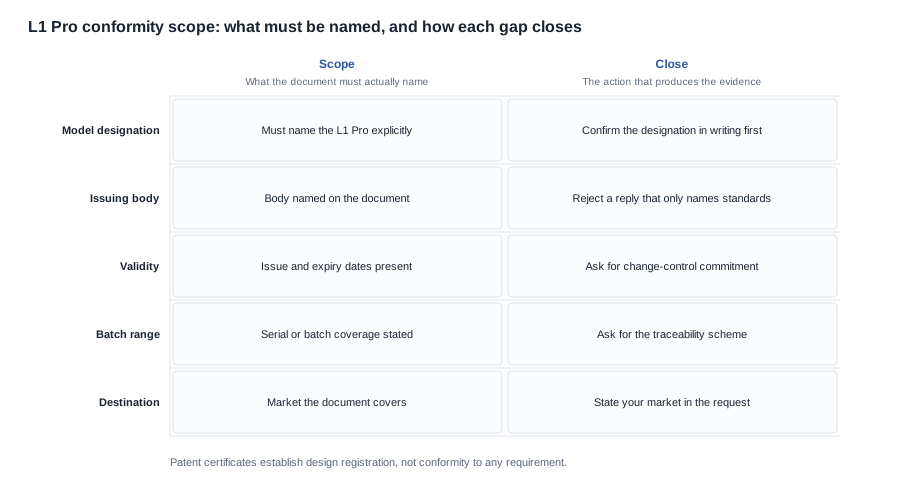
Add two more lines that cost nothing and are frequently the ones that turn out to matter. Ask for the batch traceability scheme — how a unit on a shelf maps back to the documentation covering it — and ask for the change-control commitment, meaning what the supplier commits to notify if a component, a supplier or a process changes in a way that would affect the documentation. A conformity document without change control is a snapshot, and a snapshot of what was true eighteen months ago.
Three further lines earn their place depending on how you intend to sell. If the product will be sold under your own brand, ask explicitly who becomes the manufacturer on the documentation in your market — it is not always the supplier, and the answer determines which entity a regulator contacts. If the product connects to a phone, ask what the companion application requires of the distribution channel, since an application distributed outside its original ecosystem attracts its own questions. And if the product ships in retail packaging, ask for the packaging conformity documentation separately from the product documentation, because packaging requirements are assessed independently and are a frequent late-stage discovery.
One deliberate item belongs on the list even though it is unusual: ask the supplier to state whether the documentation covers the frames alone, the charging case alone, or both. The 1400 mAh case is a power source in its own right, and suppliers differ on whether they treat it as part of the assessed product. Getting this answered in writing prevents the situation where the product documentation turns out not to cover the accessory your channel markets as an included item.
Finally, ask for the documents in a language your reviewer can use, and note that a translated copy is not a certified copy. If your review is going into a compliance file, what you need is the document as issued, plus a translation if nobody internally reads the original language.
Why a patent certificate is not a conformity document
The export certification page in our catalogue presents ten patent certificates, and it is easy to assume that a page titled in that way is offering something more substantial than it is. It is worth being precise about what those ten documents are.
An appearance-design patent protects the ornamental design of a product — the shape, configuration or surface ornamentation that gives a product its visual identity. A utility-model patent protects an invention in its configuration, at a lower threshold of inventive step than a full patent, with correspondingly shorter terms. Both are rights to exclude. Neither is an assessment of whether a product meets a safety, health, environmental or electromagnetic requirement, because neither is issued by a body that performs that kind of assessment, and neither carries a validity period tied to a market.
That distinction has a practical consequence that buyers discover at the worst possible moment: a patent number cannot be presented to a customs authority, a market surveillance body or a platform compliance team as evidence of conformity. Asked to produce conformity evidence, a patent certificate answers a question nobody asked. You are then back at the start of the enquiry, with less time than you had.
The other half of the mistake is arithmetic. Eight appearance-design patents and two utility-model patents is ten patent certificates, not ten design patents. The counts matter when you are reconciling the page against a supplier's document set, and misstating them in a compliance file is the kind of small error that invites a follow-up question.
There is one more thing the patent page does establish, and it is genuinely useful. It establishes that design work exists and has been registered. That is relevant to a different question entirely — whether the product you are buying is the product that was designed, or a variant of it. It says nothing about conformity.

Radio, EMC and the general product safety regulation
Three frameworks get conflated constantly in conversations about wearable electronics, and keeping them apart makes a request much easier to write.
Radio equipment rules govern the radio behaviour of a product — the transmission characteristics and the spectrum use. For the European Union the instrument is the Radio Equipment Directive (EU) 2014/53/EU. A camera glasses product with a camera is still a radio product, and the radio requirements apply to it in full. If you are writing a request, name the directive by its number and full title so the reply cannot be vague.
Electromagnetic compatibility is a separate question about whether a product's emissions and immunity interfere with other equipment. For the European Union the instrument is the Electromagnetic Compatibility Directive (EU) 2014/32/EU. It is not a synonym for the radio directive, and a supplier who cites one number when asked for the other has not answered the question. The distinction is not pedantic in a compliance file, where the two are assessed and referenced separately.
Harmonised standards are the technical standards a manufacturer applies to demonstrate conformity with those directives — the EN 301 489 series on electromagnetic compatibility and the EN 300 328 series on radio spectrum use are the ones most often named for a product of this type. A standard is not a certificate. Applying a standard is a manufacturer activity that produces evidence; the standard itself is a published document that anyone may hold. If a supplier replies to a request for certificates by naming standards, that is a partial answer: it tells you the route, and you still need the evidence generated along it.
The General Product Safety Regulation (EU) 2023/988 sits underneath all of this and applies to consumer products placed on the market, independently of any sector-specific directive. It is worth naming in a request, because it is the framework a market surveillance authority will apply when assessing a consumer product generally — which is exactly the situation a camera glasses product occupies. Naming it does not create a document; it does make sure the reply is addressed to the right framework.
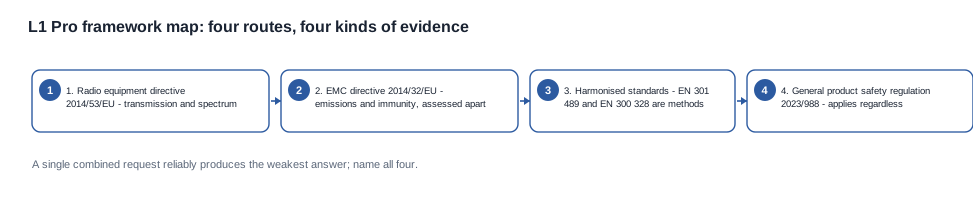
The point of the framework map is not legal detail for its own sake. It is that each framework produces a different kind of evidence, and a request that names all four gets four answers instead of one vague one. It is also the reason a single combined request — "please send your certificates for Europe" — reliably produces the weakest possible answer.
A practical consequence follows from the standards being methods rather than certificates. When a supplier names EN 301 489 and EN 300 328, the useful follow-up question is: which test report was produced against them, by which laboratory, on which unit? That question converts a general reference into evidence. It is also the question that separates a supplier who has run the assessment from one who has read about it, and the difference shows up in the quality of the answer rather than in its confidence.
There is a sequencing point worth observing. The radio and EMC routes are ordinarily run together in a single laboratory programme, because the same test setup covers much of both. That means a supplier who has done the work properly will usually produce both documents from one engagement, and a supplier who produces only one of them may not have completed the programme at all. Asking for both is not bureaucracy; it is a completeness check on the assessment itself.
The general product safety regulation is the one most often left unmentioned, and its omission has a specific cause: it is not a directive with a conformity assessment procedure attached, so there is no certificate to request and nothing appears on a product label. The evidence it produces looks different — risk analysis, traceability, incident handling, and the corrective-action process that a manufacturer maintains internally. Asking for it therefore means asking for process evidence rather than a document, and it is worth asking because that process is what a regulator examines after something goes wrong.
What none of these frameworks does is make a product good. Conformity evidence says a product was assessed against a stated requirement and met it. It says nothing about image quality, nothing about how the product handles in the hand, and nothing about whether it is the right product for your channel. Those are separate decisions, made against separate evidence, and a compliance file should never be allowed to stand in for a product review.

Turning the gap into a written supplier request
A gap in published information is only useful if it converts into a request. There is a second habit that makes the difference between a request that returns documents and a request that returns reassurance: attach a decision to every line. "Please send the radio documentation" is a request. "Without the radio documentation we cannot complete the compliance review for this order, so please send it before the purchase order is signed" is a request with a consequence attached, and the consequence is one only you can decide whether to enforce.
The habit works because it forces the sorting exercise, and the sorting is where the value is. Split your list into three columns: documents whose absence stops the order, documents whose absence creates work later, and documents you would like but can live without. Send the first column as a condition in the purchase order, the second column as a request with a date, and keep the third out of the conversation entirely until the first two are resolved. Buyers who send one undifferentiated list get one undifferentiated answer; buyers who send a sorted list get a sequence they can act on.
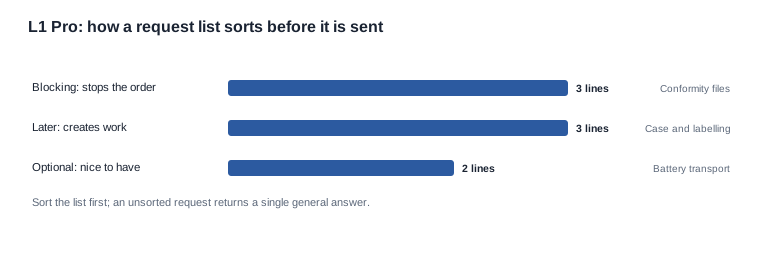
A useful discipline for the first column is to phrase each line as the question a reviewer will actually ask. Reviewers do not ask "do you hold the radio report"; they ask "what evidence supports this product's radio conformity for our market". Writing the line in the second person tends to produce a better document than writing it in the abstract, because it tells the supplier exactly which page of their own file you need.
Sorting this way also tells you when to stop waiting. If a supplier answers the first column promptly and stalls on the second, the stall is not blocking your order and you should stop chasing it. If the first column stalls, that is a commercial signal in its own right — a supplier unwilling to provide documentation it holds is behaving the same way towards documentation it does not hold, and that is worth knowing before you place an order rather than after.
A gap in published information is only useful if it converts into a request. Three habits make the difference between a request that returns documents and a request that returns reassurance, and the first is specificity about the model.
Be specific about the model designation. Our published material lists this product as the L1 Pro, yet a naming inconsistency has appeared within this family in our own record. Settle it in writing rather than assuming it resolves itself, because a reviewer will check the designation on the document against the designation on the unit. A conformity document that names a slightly different designation is a document your reviewer may not accept, so the designation has to be agreed before the request is sent, not after the reply arrives.
State the market, because the answer depends on it. The same model can carry different requirements in different destinations, and a supplier who assumes a single global answer will give you a document for the market they usually ship to rather than the market you are shipping to.
Attach a deadline and a consequence, both stated commercially. "Before the purchase order is signed" is actionable. "At your earliest convenience" is not, and an un-actionable request is the same as no request. If the documents cannot be provided before signature, the correct handling is to make the provision of documents a condition in the purchase order — which is a normal commercial structure and one suppliers accept routinely, because it transfers a documentation obligation rather than a price obligation.
Finally, keep the record. Save the request, the reply and the documents themselves, and store them against the model designation rather than against the individual who sent them. When the question recurs at a later order, the fastest answer is the one already on file, and the second-fastest is the one you cannot find.
Two habits make that record survive contact with a busy team. Set a named expiry review for each document — conformity documentation has a validity period and a change-control trigger, and a document you stopped looking at two years ago is an assumption rather than evidence. And keep the supplier's refusals alongside their documents, because a dated, specific refusal ("we do not hold a report covering the case as a separate product") is itself useful: it tells your reviewer that the question was asked and answered, which is a materially better position than a silent absence.
It is worth being explicit about what a refusal does and does not let you do. It lets you record the gap with a date attached, and lets you tell a reviewer what was asked and what was not available. It does not let you market the product on the strength of the document you did not receive. Those are different activities and conflating them is how a well-meaning channel ends up making a claim nobody has verified.
If your company has never run a request like this before, the efficient version is to send it once for a model you are buying anyway and build a small standing template from the reply. The second and subsequent orders then take minutes rather than a fortnight, because the questions are already written and the answer is already on file.
Where this leaves a buyer deciding today
If your decision can be made without conformity documentation in hand, our material is enough to proceed on the technical rows: a published cell of 290 mAh, a runtime rating close to seven hours, a charge limit set at no more than two hours, and a case holding 1400 mAh. The charge method stays unpublished alongside them. What they cannot support is a claim to a market-ready, compliant product — and no amount of careful reading of the catalogue changes that, because the information is not there to read.
If your decision does require that documentation, then the request list above is the whole of the work. Name the model, name the framework, name the market, set the deadline, and keep the record. That is a bounded task with a clear finish, which is a much better position than discovering the absence of documents at a customs gate.
What we will not do is fill the gap with reassurance. We do not publish a conformity claim we cannot evidence, and we do not present a company-level page as though it were a per-model record. Where the answer is that the material does not exist in published form, that is the answer we give, together with the list of what to ask the supplier for.
Every line on that list is a question you can write; none of them is a question our catalogue answers. Send us the markets you intend to ship into and the document list your review requires, and we will mark each item as held, unavailable, or supplier-held. The model is on our camera range page; the technical rows appear in its specification reading.
Related reading
- Who issues what, and which line to request from whom — L1 Pro certification status
- The framework split, radio against electromagnetic compatibility — L1 Pro limitations
- What a company-level page does not settle — L1 Pro buyer review checklist
Draft the request as a named document, a named issuer and a named market, and we will tell you which of the three we cannot supply.


