

This article is organised around a habit that saves procurement teams a great deal of time: asking why a question is being asked before spending a week answering it. A large share of the questions buyers bring to this model are not arbitrary. Each one traces back to a specific row the catalogue publishes or refuses to publish, and knowing which row is at stake tells you how urgent the answer is and what a good answer looks like.
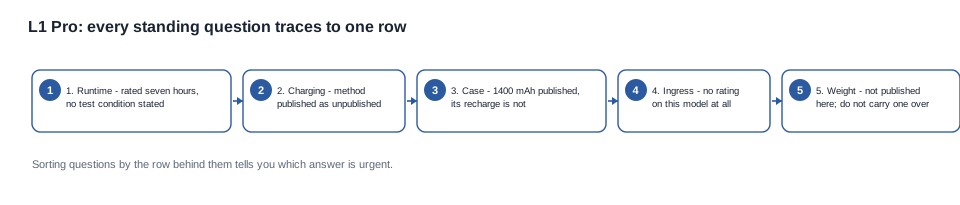
Two answer shapes come up in almost every conversation, and naming them early prevents most of the back-and-forth. Some questions have a published answer on the model page — the cell is 290 mAh, the rated runtime is near seven hours, the charge ceiling is two hours or less, and the case is 1400 mAh. The rest have no published answer at all: the charge method, the weight, the ingress rating, the Bluetooth version, storage, and how the application behaves. Neither category is ever filled from the other.
The questions buyers ask most often on L1 Pro
"How long does the battery last?"
Why it gets asked: because a rated figure is not a working figure, and the person asking is usually going to be held responsible for a shift plan built on the answer. The catalogue publishes approximately seven hours as a rating, with no test condition attached — no workload, no ambient description, no starting state. The answer is therefore: that is the rating; your own measurement is the number you can plan against. If you need a defensible figure for a tender, the honest route is to run the unit the way your users will run it and record the conditions with the result.
"How do I charge it?"
Why it gets asked: because charging is the one interaction a user has every day, and because an unanswered question here produces support contacts rather than lost sales. This is the sharpest gap on the model. The charge method is published as unpublished — this model is one of four in the range where the catalogue states no method at all, as distinct from the seventeen where magnetic charging is published and the seven where Type-C is published. Any answer that names an interface for this model is an assumption, including one derived from a neighbouring model.
"Does it come with a charging case?"
Why it gets asked: because the case changes what the product is in daily use, and because "with a case" and "with a case of a stated size" are different commercial statements. The catalogue publishes a 1400 mAh charging case for this model, which is close to five times the capacity of the frames. That is a substantial, published fact. What is not published is how the case is itself replenished, or how long the case takes to recharge.
"Is it waterproof?"
Why it gets asked: because it is a routine screening question and because the answer is unusually easy to get wrong here. Across the whole range, an IP54 marking is published on two models only. This model carries no ingress rating at all, and no splash, sweat or rain resistance is published for it. A buyer who assumes protection because the product looks like an outdoor item is making an assumption the catalogue does not support in either direction.
"Is it a thirteen-megapixel camera?"
Why it gets asked: because the resolution class is the reason to choose this model over the eight-megapixel options, and because the number invites follow-up questions it cannot answer. The catalogue publishes a thirteen-megapixel resolution class for this model and nothing beyond it — no sensor model, no field of view, no frame rate, no video format, no storage capacity. So the answer to the first question is yes, and the answer to every follow-up is that the detail is not published.
"What does it weigh?"
Why it gets asked: because it decides whether the product suits a long-wear context, and because the number is genuinely absent. No weight is published for this model. Across the range, one weight figure is published and it belongs to a different model — the MT6 frames at 158 g, which excludes its case. Do not carry that figure across; it is not this product.
"Which phone systems does it work with?"
Why it gets asked: because a connected product that does not connect is unsellable, and because the compatibility question has more layers than buyers expect. Neither the Bluetooth version nor the application behaviour is published for this model. What is published is a camera product in a range where several models carry a Bluetooth row and several do not; this model's page does not. The answer is a question to the supplier, not a specification to read off.
"Is there a mobile app, and who maintains it?"
Why it gets asked: because application ownership outlives the product, and because an abandoned application is a support liability rather than a technical detail. Not published for this model. What a buyer can reasonably ask the supplier to state is which phone systems are supported, what the application does, and what happens to it if the model is discontinued. Those are answerable questions with a date attached to them.
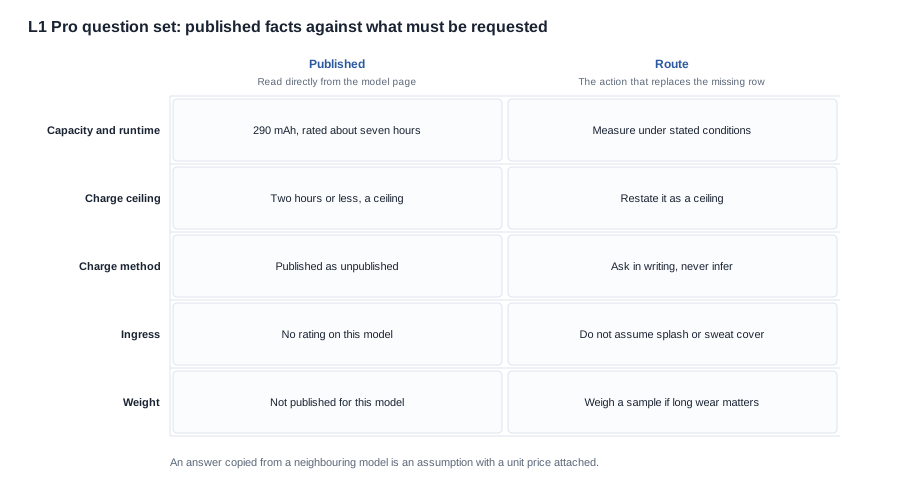

Why these particular gaps cluster on this model
The pattern in the questions above is not random, and understanding it changes how you prioritise your supplier conversation.
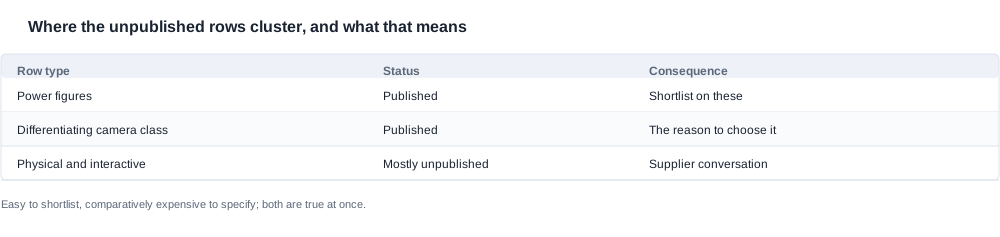
The gaps cluster around anything physical or interactive — the interface, the weight, the protection, the indicator — while the gaps do not cluster around the power figures. That is because the power figures were captured when the product was designed for a catalogue, and the physical details were left to a conversation with the buyer. A catalogue built to sell models publishes the rows that differentiate them; it publishes little about the rows that are common to the category, on the reasonable assumption that a buyer already knows those.
That assumption fails in three situations, and they are the situations where this model is usually bought. When the product is rebranded for a channel, the buyer no longer has the category knowledge the catalogue assumed. When the product is sold in a market with its own labelling and documentation expectations, the general knowledge is no longer sufficient. And when the product is bought as a component rather than as a finished item, every detail the catalogue treated as background becomes a specification someone has to write down.
The practical consequence is that this model is comparatively easy to shortlist and comparatively expensive to specify. Shortlisting is easy because the differentiating row — the resolution class — is published plainly. Specifying is expensive because the specification a retailer, a brand owner or a tender evaluator requires will reach well past the published rows, and each of those will need an answer from the supplier.
There is a second clustering effect worth naming: the charge method gap is shared with three other models in the range, so a buyer who has already worked through this question for one of them has a head start. It is also worth asking the supplier whether the four unpublished-method models share a design platform, because that is precisely the question you should not answer by assumption. If the supplier confirms a shared approach, the question is closed. If they do not, the assumption has at least been tested.
A third pattern is worth adding to the two above, because it explains why some buyers find this model easy and others find it impossible. The fewer assumptions your channel has to carry, the more the unpublished rows matter. A reseller selling under an existing brand, into a market where the listing text is the only specification a customer ever sees, has almost no room for an assumption: every published row has to stand on its own. A commercial buyer supplying a team with a known device profile has considerably more room, because the specification reaches an internal document rather than a public listing.
The same model can therefore be an easy or a difficult purchase depending entirely on what sits downstream of it, and it is worth deciding which you are before you decide whether the gaps matter. If your specification reaches a public listing, an unboxing insert or a shelf talker, treat every unpublished row as blocking, because each one will eventually be read by somebody who cannot ask you. If your specification reaches an internal provisioning document, the same rows are questions rather than blockers, and can be carried as pending items with owners and dates.
This is also the reason the answers to the questions in this article are framed around what is published rather than around what the product is. A buyer who has decided to buy does not need to be persuaded the product is good; a buyer needs to know which sentences they may print, and that is a different question.

Questions worth asking that buyers forget
Several questions come up late in a project, when the answer is expensive, and they are worth moving to the front.
- Does the documented model designation match what I will receive? A naming inconsistency has surfaced inside this family in our own material, which lists the product as the L1 Pro. Put it in writing before artwork is printed, before a listing goes live and before any document is drafted, because each of those carries the name somewhere a reviewer may check it.
- Is the charging case assessed and documented separately from the frames? The 1400 mAh case is a power source in its own right, and whether it travels with the documentation or separately is a question with commercial consequences.
- What happens to a unit that arrives uncharged, and what is the shipping charge state? Relevant to any channel holding stock, and relevant to the return process.
- Is there a batch or serial marking, and how does it map to the documentation that covers the unit? Without traceability, a documentation file is a decoration.
- What is the defect classification for this model, and who signs lot acceptance? The published specification rows are few enough that behavioural defect classes will carry more of the work than they do on a model with a fuller specification sheet.
- Which destination markets have you shipped this model to, and what documentation accompanied it? A supplier's answer to this is the fastest available evidence of what documentation actually exists.
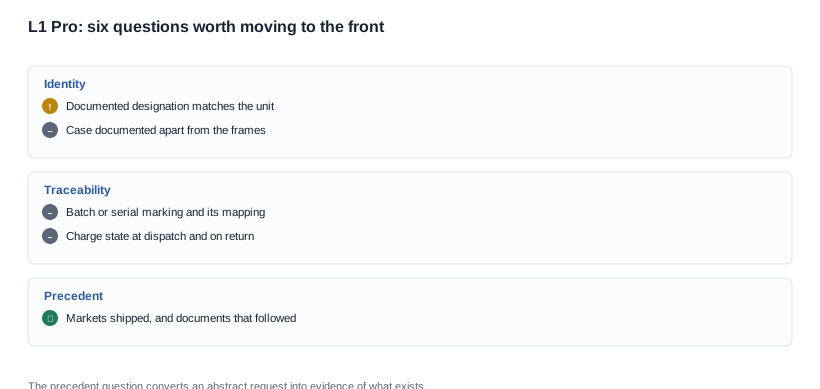
That last question is the most useful of the six, because it converts an abstract request into a concrete precedent. A supplier who can name the markets and the documentation they shipped with has told you what exists. A supplier who answers evasively has told you something equally useful.
Two of the six deserve a note on their own. The documentation question about the charging case is the one that most often changes a product description: if the case is assessed apart from the frames, then a channel that markets the case as an included accessory has a second product to specify. The charge state question sounds trivial and is not, because a channel holding returned stock needs to know whether a returned unit arrives usable, and that is a different decision from the one about how the unit is charged.
There is a reason these questions surface late. Each of them belongs to a document somebody else owns — the listing, the packaging copy, the compliance file, the returns policy — so each one waits for that document to be drafted. Pulling them forward costs nothing and shortens the review cycle, because the answers arrive while the drafting is still open rather than after it has been approved.

Turning an unanswered question into a written request
The practical technique for this model is to stop treating questions as one-off enquiries and start treating them as a standing list attached to the model designation. Each line carries three things: the question, why it matters, and what a usable answer looks like.
Writing the third part matters more than it appears. "What is the charge method?" invites "we will confirm". "What is the charge method, and does the answer apply to the frames, the case or both?" invites a specific answer, because it tells the reader which of two things is being asked. The same applies across the set: name the model, name the destination market, and say what you will do with the answer.
It also helps to separate questions into those that block an order and those that do not. The charge method blocks any channel whose printed or listed material would name an interface. It does not block an order sold to a buyer who already holds the hardware. The weight blocks any use case defined around long wear. The conformity documentation blocks any order with a compliance review attached. Sorting the list this way means an unanswered low-priority question does not hold up a purchase order, and a high-priority one cannot be quietly deferred.
The criteria to apply when sorting are worth stating, because different teams sort differently by default. A question blocks an order if an unanswered version of it produces a direct cost — a reprint, a listing correction, a returned unit, a compliance finding, or a customer complaint that reaches support. A question does not block an order if an unanswered version of it produces only an internal inconvenience — a specification filed as pending, a reviewer who notes the gap, a document revised next quarter. Applying those criteria consistently is what turns a long question list into a short work queue, and it is the difference between a procurement process that keeps moving and one that stalls on the least important item.
A third category is worth naming explicitly: questions that change what you buy. Where an answer might reveal that the product does not suit the channel at all, ask that one first, however minor it looks on the list. On this model, the two candidates are the ingress rating, where an assumption of protection would be wrong in a way that matters outdoors, and the application, where an unsupported or abandoned application removes the connected value of the product entirely. Neither is likely to change the order, and both are cheap to ask about early.
A last habit: when a question is answered, record the answer against the model designation with the date and the source, so that the next order inherits a considered answer rather than repeating the enquiry. On a model with this many unpublished rows, that file is worth more than anything else you accumulate about it.
Sort the list by whether the answer blocks an order, and record which it is. A blocking answer is one where proceeding without it produces a cost: a reprint, a listing correction, a returned unit, a compliance finding. A non-blocking answer is one where the gap can be carried as a pending item, because the specification it feeds is internal and revisable. Recording the distinction prevents both failure modes at once — the order that stalls forever waiting for an answer nobody was ever going to give, and the order that sails past an answer that would have mattered.
Where a question is genuinely unanswerable, say so in the file rather than leaving it blank. A documented unknown is a manageable item; an undocumented one is a trap, because the next person to read the specification will treat the silence as permission to assume. This is the whole difference between a model with several unpublished rows and a model whose specification is quietly full of guesses — and the second is far more common than the first.
Where these answers leave a buyer
Most of what a buyer actually needs in order to proceed on this model is published: a 290 mAh cell, a rated seven hours, a charge time of two hours or less, and a 1400 mAh case, in a thirteen-megapixel resolution class. On the technical rows, this model is straightforward.
The way to choose between this model and another in the range, given that several rows are unpublished, is to compare on what can be compared and to mark the rest as pending on both sides. Where two models share an unpublished row, that row cancels out of the comparison entirely rather than becoming a tiebreaker; where only one model has it published, that asymmetry favours the model with the fuller documentation, because it means fewer questions before an order can proceed. A comparison that quietly assumes the missing row for one model is worse than no comparison at all, because it produces a ranking that reverses when the assumption is tested.
So the selection criteria that survive on this model are: the resolution class, if image quality is the reason for the purchase; capacity and rated runtime, if a long day away from a supply matters; case capacity, if the channel's use is mobile. The criteria that do not survive are the interface, the weight and the protection rating, because for those this model publishes nothing and a comparison built on them would be built on air.
It is worth stating the threshold that turns the pending items into a decision. If three or four of the pending rows would each cost a reprint or a listing correction if answered badly, treat the model as blocked until they are answered. If the pending rows feed internal documents only, carry them as open items with an owner and a date, and order on the published rows. That threshold is a commercial judgement rather than a technical one, and making it explicitly is better than discovering which kind of channel you are in after the artwork is printed.
The difficulty is concentrated in the physical and interactive rows, and it is the kind of difficulty that closes with a supplier conversation rather than with more reading. That is worth stating plainly, because a buyer who spends a week analysing published material will not get a better answer than one who spends an afternoon asking.
What we will not do is manufacture the missing answers to fill the gap. We do not publish a charge method we have not stated, we do not carry a weight from another model, and we do not present a company-level page as a per-model record. The catalogue is what it is, and the questions above are the honest way to work around what it does not cover.
Most of what you will be asked is answered on the model page, and what is not answered is a manageable list rather than a mystery. Send us the questions your team keeps re-asking and we will say which have published answers and which belong on your supplier request. You can find this model among the rest of the range on our camera page; the figures behind it are broken down elsewhere on this site.
Related reading
- The question buyers most often get wrong — L1 Pro common questions
- Whether a figure is published, rated or simply absent — L1 Pro limitations
- What a neighbouring model's rows do not transfer — L1 Pro compared across the catalogue
Write down the question your customers keep asking, and we will say whether the catalogue answers it or whether it has to go to the supplier.


