

A limitation is only useful to a buyer when it is specific. "This product may not meet your needs" tells nobody anything actionable; "the published runtime carries no test condition, so it cannot be used to plan a shift" tells a buyer exactly which document to write. This article goes through the published rows of this model one at a time and states, for each, what it can support and what it cannot.
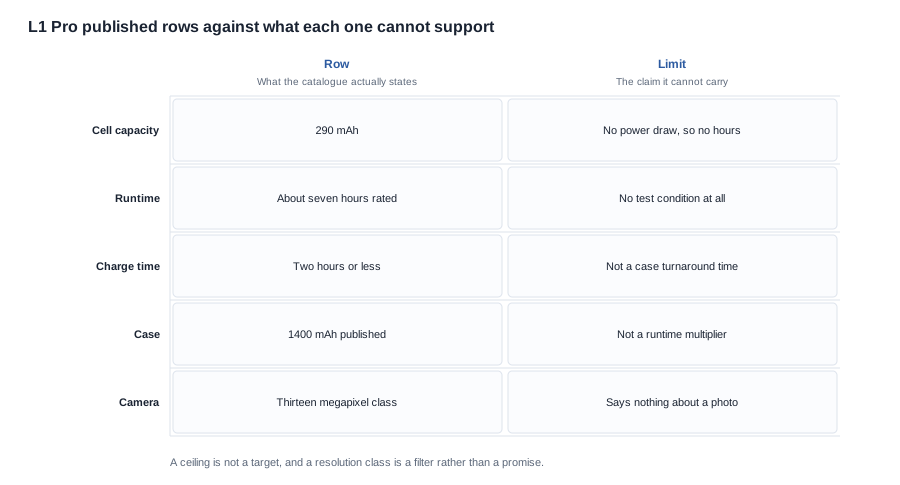
The published rows for this model are few, which is helpful in one sense — there is not much to misread — and unhelpful in another, because most of what a buyer needs to specify simply is not there.
L1 Pro limitations: the rows that exist and the rows that do not
Five things are published for this model, and it is worth stating them together before picking any apart. A 290 mAh cell. A rated runtime of approximately seven hours. A charge time of two hours or less. A 1400 mAh charging case. And a thirteen-megapixel resolution class, with nothing published beyond that class.
Everything else a buyer might expect on a model page is absent: no weight, no lens material, no ingress rating, no Bluetooth version, no storage capacity, no video format, no frame rate, no sensor model, no field of view, and no charge method. The absence of the charge method is the most consequential of these, and it is treated in its own section below because it carries a different kind of limitation from the others.
It is worth being precise about why a short list of published rows is normal rather than suspicious. A catalogue built for distribution publishes the rows that differentiate models from one another, because that is what a buyer uses it to decide. It publishes very little about the rows that are common across the category, on the reasonable assumption that an industry buyer already knows them. That assumption holds well for a buyer who knows the category and badly for a buyer who is entering it, rebranding into it, or specifying into a tender where every parameter must be stated and sourced.
So the practical question is not whether the specification is complete — it never is — but whether the gaps fall in places your particular documentation will expose. For a channel whose public materials name the charging arrangement, the interface gap is expensive. For a commercial buyer whose specification feeds an internal provisioning document, the same gap is a line in a pending-items list. The published rows are identical in both cases; what differs is the consequence of each gap, and the consequence is a property of your channel rather than of the model.
One clarification about what is not absent, because getting this backwards is a real error. This model publishes a camera resolution class, so any statement that the catalogue carries no camera specification for it would be wrong. What the catalogue does not publish is everything behind the class — the sensor, the optics, the video pipeline, the storage. The correct formulation is that only the resolution class is published and nothing beyond it, not that the camera is unspecified.

Capacity and runtime: a rated pair, not a working day
The 290 mAh cell and the approximately seven-hour runtime are published together, and the temptation is to read them as one continuous claim. They are not, and separating them is the whole point.
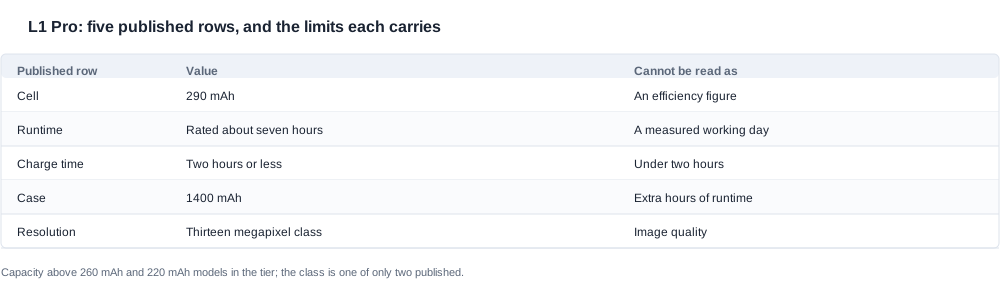
What the capacity row supports. A comparison against other models in the range, because capacity is published for every model. Among the camera models this cell figure is the highest published, matching only the L2 Utral. The tier's other capacities sit below it: a 265 mAh entry for the MT6, 260 mAh for the KY06 and for the two sport photo models, and 220 mAh for the V03 pair and the MT5. That is a legitimate and useful comparison.
What the runtime row supports. Very little beyond the fact that a runtime was published and that its value is approximately seven hours. A rated runtime carries no test condition: no statement of what the radio was doing, no ambient temperature, no starting state, no workload definition, no indication of whether the figure was measured with the case connected. Any of those would change the answer substantially.
What neither row supports. A working-day claim. Seven hours is a rating, and a rating is a ceiling under favourable conditions rather than a planning figure. A buyer who needs to know how many hours a user gets between charges has to measure it on a unit under the conditions that user will impose. That measurement is easy to run and is genuinely the buyer's own figure to defend.
There is a subtler trap in the pairing. A larger cell and a similar runtime across models does not tell you which is more efficient, because efficiency depends on everything the catalogue does not publish. Do not convert capacity into hours, and do not rank models on a capacity-to-runtime ratio — both require assumptions about power draw that no published row supports.
The runtime row has one further limitation that matters specifically to anyone writing customer-facing material. Because the figure is a rating rather than a measurement, quoting it as a guaranteed figure in a listing or a manual creates a commitment the catalogue does not support. A listing that says "up to seven hours" is closer to defensible than one that says "seven hours of use", and even the first is only defensible if the rating conditions are stated. Where a customer will act on the number — a field team planning a day, a buyer building a case study — the honest move is to describe it as a rated figure and to publish the measured figure from your own units alongside it.
Note also what is absent from both rows. There is no statement of how the runtime behaves with the case connected, no partial-discharge behaviour, no self-discharge rate, and no retention information for a unit in storage. Each of those matters to a channel holding inventory, and each is a question rather than a published limitation.
The charge ceiling is a ceiling
The charge time is published as two hours or less, and the limitation here is one of wording rather than of data.
What it supports. A statement that the unit can reach a full charge in no more than two hours. That is exactly what two hours or less means, and it is a useful statement for a channel planning a return-to-stock time.
What it does not support. Any claim of a charge time shorter than the ceiling. The two phrases describe different commitments: the ceiling wording allows a two-hour charge to qualify, whereas the stricter phrasing would not. Twenty-six of the models in this range use the ceiling form and just two give an approximate hour, which suggests the distinction was drawn deliberately rather than by accident. Copy promising a quicker charge than the ceiling states more than our material supports.
What it cannot tell you at all. How long a charge takes from a partial state, whether the charge rate varies with the state of charge, what criterion is used to declare the unit charged, and how long the case itself takes to recharge. None of these are published. A buyer planning a turnaround — for returns, for stock rotation, for a service process — needs the partial-charge behaviour and the completion criterion, and both are questions for the supplier.
There is a second limitation attached to any charge time, and it applies to every model in the range rather than this one alone. A charge time is not a case turnaround time. The 1400 mAh case is a second power source with its own replenishment, and the two numbers describe different operations on different objects. A document that presents the two-hour figure as "time to replenish the case" is conflating them.
For a buyer running a stock rotation or a service process, the distinction determines which questions to ask. If the number you need is "how long from empty to usable", that is a charge-time question with a stated starting state, and the catalogue gives you the ceiling without the conditions. If the number you need is "how long before a returned unit can go back into stock", that is a case-replenishment question, a process question about how many units you hold, and a labour question about who checks it — and the catalogue supports none of the three. Ask for the starting state and the completion criterion along with the ceiling, because a ceiling without them is not a turnaround time for anything.

The resolution class and what it cannot promise
The thirteen-megapixel resolution class is the row that justifies choosing this model, and it is also the row most likely to produce a disappointed customer.
What it supports. A comparison of resolution class across the camera tier: thirteen megapixels on three models, including this one and the L2 Utral and the S7, and eight megapixels on the other eight camera models. The division is genuine, and of everything published here it is the single row that can support a preference by itself.
What it does not support. Any statement about image quality. A resolution class is a count, not a result. It says nothing about lens quality, sensor size, pixel size, dynamic range, low-light behaviour, colour rendering, motion handling or stabilisation, and none of those are published. A thirteen-megapixel sensor built on small pixels can produce a worse photograph than an eight-megapixel sensor built on large ones, and the catalogue gives no basis for deciding which case applies here.
What it cannot promise at all. The camera details that follow a resolution class in any real specification — video resolution, frame rate, storage capacity, file format, microphone behaviour, and whether the application supports capture at all. A buyer whose channel will make claims about video needs answers the catalogue does not contain.
The practical handling of this row is to treat it as a filter rather than a promise. It is entirely sufficient for removing eight-megapixel models from a shortlist, and entirely insufficient for justifying the model to a customer who has read the word "megapixels" and expects a camera to perform like one.
That distinction has a direct consequence for how a channel should use the row. It is a legitimate basis for a selection decision, where the question is which models to carry. It is not a legitimate basis for a marketing claim, where the question is what a customer will experience. A buyer writing a product specification can legitimately record "thirteen-megapixel resolution class, per the published catalogue" and stop there. A buyer writing a listing has nothing further to write, and the honest listing describes the capability in terms the catalogue supports rather than in terms the word "megapixels" implies.
The same care applies to any comparative claim against the eight-megapixel models. The catalogue supports saying that this model's resolution class is higher. It does not support saying that its photographs are better, because the variables that determine photograph quality are precisely the ones not published, and a higher count on a smaller sensor is a familiar route to a worse result.

The charge method: the limitation that changes operations
Every other unpublished row on this model is an inconvenience. The unpublished charge method is different, because charging is the interaction a user has every day and because it appears in materials that are expensive to correct.
What is published. Nothing about the interface. Of the twenty-eight models in the range, magnetic charging appears on seventeen pages and Type-C on seven, which leaves a small remainder of models whose interface is simply not described. This is one of them. The distinction matters: the absence is a third status, not a variant of the other two, and this model cannot be grouped with either.
Why it cannot be inferred. The obvious move is to assume a shared platform implies a shared interface, since three models in the range do publish a Type-C charging interface and the four with unpublished methods sit near them in the catalogue. That inference is unsupported. The catalogue does not describe the four unpublished-method models as a single design family, and a charge method is exactly the kind of detail that varies within a family.
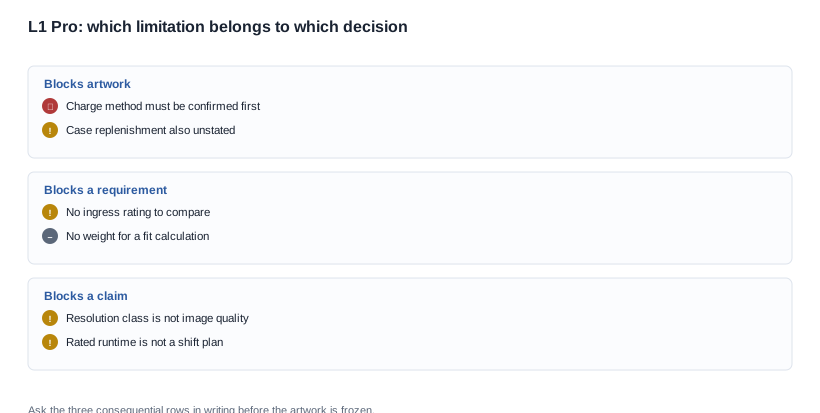
What the limitation costs. Anything printed or listed that names an interface becomes wrong if the assumption is wrong, and correcting it means a reprint, a listing revision and a support cycle. That is why the correct handling is to ask the supplier rather than to reason about the neighbour — and why the answer belongs in the purchase order if it will appear in artwork.
What must not be done with it. Do not describe this model as magnetic, do not describe it as Type-C, and do not describe it as "like" another model in the range. Each of those is a claim about hardware that no published row supports, and each is the kind of claim that reaches a customer before anyone has confirmed it.
A related constraint applies to how this model is described relative to its own range. Because the charge method is unpublished rather than unusual, a buyer is not choosing between two charging approaches by choosing this model — they are choosing between a stated approach and no statement at all. That is a documentation asymmetry, not a capability difference, and any comparison presenting it as the latter misrepresents what the catalogue says. Where the asymmetry genuinely matters commercially is in documentation review: a channel that must name an interface in its own materials gains real value from a published row, and that value is worth weighing during a shortlist.
What the limitations leave a buyer able to decide
The honest summary is that this model is well specified on power and camera class, and thinly specified everywhere else — and that the thin areas are predictable enough to plan around.
A buyer can proceed on the published rows: the capacity sits at the top of the tier, the runtime is a rating they can measure themselves, the charge ceiling is a ceiling they can restate correctly, the case is the largest published in the tier, and the resolution class is the larger of the two published classes. What a buyer cannot do is write a full product specification from the catalogue, because the rows that would fill it are absent.
The gap between those two statements is narrower than it looks, and it is worth naming precisely because buyers routinely overestimate it. Everything the catalogue is silent on is a question, not a constraint — with one exception. The rows that are published constrain what you may claim, because they are the only claims you can support. The rows that are unpublished constrain nothing about the product and everything about your documentation, because you simply cannot make a sourced statement about them today.
That asymmetry is why the same model can be a straightforward purchase for one buyer and a difficult one for another. If your specification is a shortlist of published rows, this model is well positioned: top-tier capacity, the larger resolution class, and the largest published case in the tier. If your specification is a tender document requiring every parameter to be sourced, it is thin — and the work required is the same in both cases, because it consists entirely of questions you would have to ask about any model in the range.
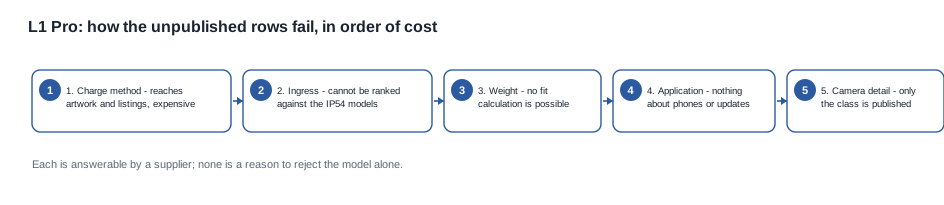
The three limitations worth carrying into a quotation are the charge method, the ingress rating and the weight. Each is answerable by a supplier, each affects a real decision, and none is a reason to reject the model on its own. Ask for them in writing, record the answers with their dates, and the model becomes as specifiable as any other.
How to weigh each of them during a shortlist, in the order they tend to matter. The charge method is blocking for any channel whose printed, listed or packaged material would name an interface, because the correction cost falls on artwork and listings that have already shipped. The ingress rating is blocking wherever a specification contains a protection requirement, because a model with no published rating cannot be shown to meet one — and across the range only the V06 and the S7 carry a published marking, so a buyer with that requirement has a very short candidate list. The weight is blocking wherever a fit calculation or a long-wear argument is load-bearing. In all three cases the correct response is the same: ask, and record the answer.
One further limitation of the limitation list itself is worth naming. A gap in our published material is not a statement about the product, and published material changes without notice. So the useful discipline is to treat every row here as current as of the catalogue version that produced it, re-check the charge method row before committing to artwork or a listing, and — where an order is long enough for a revision to matter — put a written confirmation into the purchase order rather than relying on what you read today.
We will not fill these gaps with plausible values, and we will not present the model as more fully specified than it is. A limitation stated plainly is something a buyer can plan for; a limitation hidden behind an invented number is something a buyer discovers at the worst moment.
A published row limits what you may claim; an unpublished row limits what you may specify. Both are workable once they are separated. Send us the specification you are writing and we will mark each parameter as answered by the catalogue or dependent on the supplier. This model is on our camera range page, with its rows in the specification reading.
Related reading
- What each published row is quietly unable to carry — L1 Pro limitations
- Where the published rows stop and the requests begin — L1 Pro specifications and features
- What a gap costs inside an order rather than on a datasheet — L1 Pro buyer review checklist
List the boundaries you cannot accept on this model, and we will say which of them an order can be structured around.


