

A value argument for this model cannot begin with price, because we publish no price for it or for anything else in the range. It has to begin with evidence: what the model demonstrably does, what it does not tell you, and what a buyer therefore avoids paying for twice. This article works that question as a decision tree, opening on your budget envelope and your channel, and closing on either a defensible purchase or an honest reason to look at a different model.
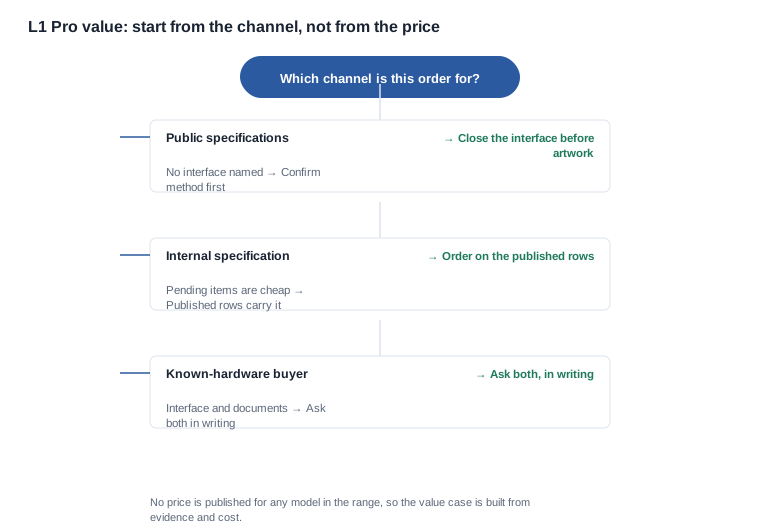
Two things follow from the absence of published pricing, and both shape the tree. A value claim you cannot source becomes an assertion, and an assertion about worth is not something a procurement file can carry. So the branches below never ask whether this model is good value in the abstract. They ask what you would have to buy again, re-order or correct later if you chose it — a question you can answer from published rows and from your own documentation requirements.
The published rows this model can argue from
Four figures are published for this model, and each carries a different kind of argument. Cell capacity is stated at 290 mAh, the highest figure in the camera tier and level with the L2 Utral. A runtime of approximately seven hours is published as a rating rather than a measurement, so it supports a power-scale comparison and not a working-day promise. The charge limit of two hours or less supports a turnaround statement, provided it is restated as a ceiling rather than a target. The charging case is published at 1400 mAh, the largest case capacity stated anywhere in that tier.
Arranged the other way round — by what each figure can and cannot carry — the same four rows divide cleanly. Capacity compares, because every model in the range publishes it and nothing has to be derived to compare two of them. The runtime compares in scale but not in hours, because no power draw is published for any model and therefore no capacity figure anywhere in the range converts into hours. The charge ceiling supports process planning only if it is written as a ceiling, since two hours or less permits exactly two hours and is a different claim from anything shorter. The case figure compares as a physical accessory and does not convert into additional use time, for the same reason the capacity figure does not.
That last point is the one that most often slips into channel copy. A 1400 mAh case beside a 290 mAh frame invites the reader to do arithmetic, and the arithmetic has no published basis: no efficiency, no power draw, no conversion rate appears anywhere in our material. A value argument that quietly performs that calculation is asserting something the catalogue does not support, and it is asserting it in the one place where a customer is most likely to check — the moment they discover the day is shorter than the numbers implied.
One row blocks the rest. No charge method is published for this model, which places it among four of the twenty-eight where the interface is simply not described — as distinct from the seventeen that state magnetic charging and the seven that state Type-C. Any value argument resting on seamless charging or on ecosystem convenience has no published source and cannot be defended.
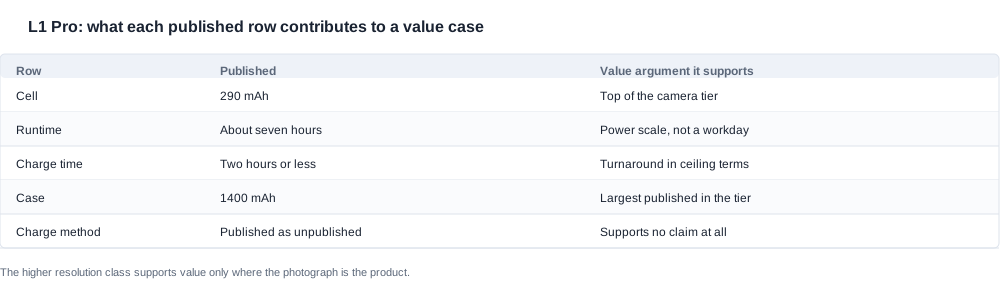
Resolution class is the other row buyers over-weight. Thirteen megapixels places this model in the smaller of the two classes published across the eleven camera models — three against eight. That is a real segmentation and a legitimate reason to prefer the model, but it supports value only in a channel whose product is the photograph. In a channel selling utility, it is a specification rather than a benefit.
It is worth being careful about what a resolution class can be used to argue, because the number carries more persuasive weight than its evidential content. A class tells you how many pixels a sensor carries and nothing about what any of them records. Sensor area, lens quality, pixel size, processing, and the behaviour of the camera in low light are all unpublished for this model, and each of them changes the outcome more than the count does. On this row the count is reliable and the implication is not, which is an uncomfortable combination for anyone writing a listing, and a good reason to treat the class as a reason to test the product rather than a reason to sell it.
The runtime row carries a comparable caution. Approximately seven hours is a rating published without a workload, an ambient condition, a starting state, or a statement of what the radio was doing — so it describes one favourable condition and no other. Where a buyer needs a shift-length figure, the only defensible route is to measure units under their own conditions and use that number, with the conditions attached. The rating remains useful for scale comparisons across the tier, where two camera models publish their runtimes as ranges rather than single values and the precision of any of them is visibly limited.

Branch one: the channel decides what the gaps cost
The same unpublished rows cost different channels wildly different amounts, which is why channel comes before budget in the tree.
A channel that publishes specifications — a marketplace listing, a retail line, printed packaging — pays for every gap. Each public sentence has to be sourced, and roughly half of this product's interesting properties cannot be sourced today. The value of the model in that channel is real but conditional: it holds if the interface question is closed before artwork freezes, and if nothing claims protection or runtime certainty in the meantime.
The conditional is doing more work here than it first appears. A listing that shows no charging arrangement at all stays correct whatever the answer turns out to be, and so does a listing that describes the case without depicting how either part connects. What makes the copy wrong is depicting a connection, and depicting one is nearly unavoidable in a visual format — which is why the interface question is the single most consequential item on any supplier request for this model, and why it belongs at the top of the request list rather than the bottom.
A channel whose specification is internal pays almost nothing for the same gaps. A provisioning sheet can carry pending items, and a pending item is invisible until a customer asks. Here the published rows carry the whole argument — tier-leading capacity, a stated charge ceiling, the largest published case in the tier, and the higher of two resolution classes.
Marking an item as pending rather than leaving it blank is what makes this branch cheap. A blank invites whoever reads the sheet next to fill the space with whatever a comparable product does, and that assumption then travels into a procurement decision as though it were a figure. A pending item instead assigns an owner and a date, which converts an invisible risk into a tracked task — and in most organisations that single change is the difference between a documentation gap and a documentation incident.
A sale to a buyer who already knows the hardware reduces the question to two items: whether the unit meets their stated interface requirement, and whether documentation travels with the shipment. Both are answerable by a supplier. Neither is answerable from our catalogue.
Under this last branch the value case is at its most straightforward, because the published rows stop being the whole argument and become supporting evidence for a decision made on other grounds. A buyer who already holds compatible equipment is choosing between supplier relationships, lead times and support quality, and the specification sheet is there to confirm that nothing disqualifies the model rather than to persuade. That is a comfortable position, because the published rows are strong enough to do exactly that job and short enough not to invite scrutiny of what is missing.
That ordering is the reverse of how value arguments are usually made. Buyers ask which model yields the most for their money; on this model the more productive question is which channel they are in, because that determines how much of the value survives the documentation gaps.
The reason sits in who reads the specification and when. Public-facing material has an audience that will never ask you what the catalogue says, and it is read long after anyone involved in the purchase remembers which rows were gaps. Internal material is read by a small number of colleagues who already know the product and who will ask. The same missing row therefore produces a reprint in one channel and a footnote in the other, and the difference between those two outcomes is where the real cost of this model lives.
Worth naming explicitly, because it inverts an intuition: more documentation is not automatically more value for a buyer who already knows the hardware. A channel staffed by people who can call the supplier and ask is sometimes better served by a model with fewer published rows and a supplier who answers, than by one with a complete sheet produced for a different audience. Completeness in published material and readiness in a working relationship are different properties, and the decision here turns on which one your process can actually use.

Branch two: the budget envelope, priced in corrections
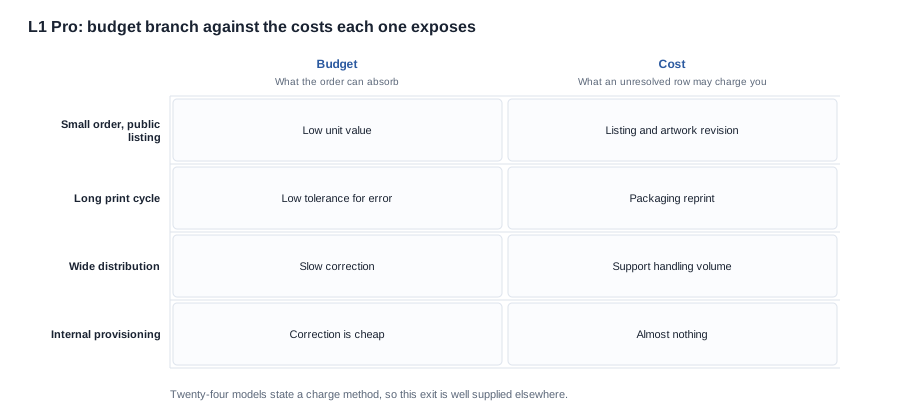
Because no price tier is published, the usable comparison is not unit price against unit price. It is the cost of the gaps set against the cost of choosing a model whose corresponding rows are published.
Three correction costs are worth estimating honestly before deciding. Artwork and packaging, if your channel depicts the charging arrangement and the real interface differs from what you assumed. Listing and documentation revision, if a listing or a compliance file has to be corrected after it is live. Support handling, if customers raise an interface, a protection or a runtime expectation that your own material never supported.
Put a number against each, even a rough one, and compare the total with the order value. A small total on a large order makes this model straightforward; a large total — a wide retail distribution with a long print cycle, say — means the documentation asymmetry has a price attached, and a model that states its interface may be worth more than its specification advantage implies.
The mistake to avoid is treating an unpublished price as an absent value case. It removes one route to a decision and leaves three intact: the evidence route, the correction-cost route, and the fit-with-your-channel route. What it does mean is that the argument has to be assembled by the buyer rather than read off a page, which is work — and work that a supplier can help with or cannot.
There is a second mistake, subtler and more expensive. Costing the gaps and then deciding they are affordable does not mean the gaps go away — it means you have decided who absorbs their consequences. If the interface question resolves badly and your correction budget was generous, the cost still lands somewhere: in a reprint nobody budgeted for, in a support queue you staffed for normal volume, or in a customer who decided not to buy a second unit. A cost you have decided to absorb is still a cost, and it is usually cheaper to remove it than to budget for it.
That is the strongest practical argument for closing the interface question early rather than late. The question itself is cheap — one request, one reply, and frequently an afternoon with a sample that settles it physically. Everything downstream of that answer is expensive and slow. Where an order has both a real budget and a real timeline, spending an hour on the question is almost always the best available use of the hour.
Where the L1 Pro tree exits, and what each exit requires
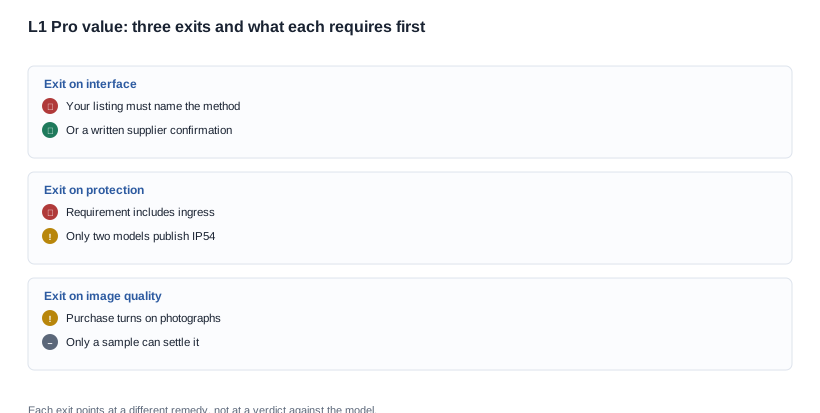
Three exits stop the tree early, and each names a different next step.
Exit on the interface. If your packaging, listing or tender response must name the charge method, this model cannot meet that requirement from published material, and a model stating its method will serve the same order better. The range is well supplied here: twenty-four models state one.
Exit on protection. Only two models across the whole range publish an IP54 marking. Where ingress protection is a hard requirement, this model is not evaluable on it today, and a shortlist built on that requirement narrows sharply.
This exit is narrower than it first appears, and that matters for the arithmetic earlier in the tree. Because only two models state an ingress marking, a buyer with that requirement is choosing between two candidates rather than filtering a list, and the correction-cost calculation on this model is largely academic — the decision has effectively been made by the published rows before any budget question arises.
Exit on image quality. Where the decision turns on how photographs perform rather than on which figures are printed, published rows cannot settle it — the resolution class is a filter, and everything that determines picture quality is unstated. That exit hands the decision to a sample rather than ending it.
None of the three is a verdict against the model. Each is a statement about which questions a specification sheet cannot answer, and each points at a different remedy: a written supplier confirmation, a requirement review, or a physical test.
It is worth distinguishing the exits by how firmly they close. The interface exit is firm, because the requirement is clear and a model stating its method is plentiful. The protection exit is firm for a different reason: with only two models carrying a published marking in the entire range, a buyer with that requirement has a short list whether or not this model belongs on it. The image-quality exit is not firm at all — it removes this model from a decision it never qualified for, and hands the decision to a sample.
That third exit is the one worth building into a plan rather than treating as a dead end. A sample settles image quality in a way no specification sheet can, for any model in the range, not only this one. Where photographs are the product, the efficient sequence is to narrow candidates on the published rows first, then test the survivors — and on the resolution class this model is one of only three candidates, which makes it cheap to include in a test set rather than expensive to argue about.
What the tree leaves behind
Reach the end of the branches and you have something more durable than a value verdict: which channel you are in, which rows you can state, which rows must be earned from a supplier, and what each unresolved row costs if it resolves badly. That survives the next order and the next catalogue revision, because it describes your situation rather than ours.
Stated as far as published evidence permits, the value of this model is that it pairs tier-leading capacity and the higher resolution class within the camera tier with the largest published case capacity in that tier. Stated just as precisely, its cost is that the interface and several physical rows remain open questions your own materials must answer.
We will not attach a price to this model, and we will not declare it the best value in the range. What we will do is mark which rows support an argument and which have to be earned from a supplier, so the decision survives a year of use.
Two closing cautions for anyone running this tree on a real order.
Run it before the artwork is committed rather than after. The cheapest branch of this tree is the supplier question — one request, one reply — and its most expensive branch is the packaging reprint, and only the first of those can still be avoided once artwork is signed off. A buyer who runs the tree after the print date discovers that the tree's answers arrived too late to be useful and that the corrections are now unavoidable. The sequence matters more than the analysis: decide, then ask, then print.
Second, write the answers down as they arrive, against the model designation rather than against the person who received them. A value argument assembled from a supplier conversation is worth nothing six months later if the conversation cannot be found, and the next buyer will not know which parts of your specification were confirmed and which were inferred. Keep a short file: the question, the answer, the date, and the source. On a model whose published rows run out quickly, that file becomes the most valuable document in the procurement folder — more useful than the specification it supports, because it is the only record of which parts of that specification were ever actually established.
None of this makes the decision harder. It makes it repeatable, which is the property a buyer wants when the same model appears in the next order, the next market and the next channel.
Put in a form you can hand across a desk, the short criteria run like this. Take this model where the photograph is the product, where the working pattern is mobile, and where your specification is able to hold a pending marker. Leave it where a public claim has to name the interface, where protection is a hard requirement, or where the decision is made on how images look rather than on what the pages print. On each of those three, something else in the range answers more directly — and working out which is a worthwhile comparison rather than a compromise to be avoided.
If you want to see which rows are ready, our camera page lists the models and the comparison reading sets this one against its neighbours.
Related reading
- How this model stacks up beside the rest — L1 Pro compared across the catalogue
- What each published row is unable to carry — L1 Pro limitations
- Costing the unstated interface — L1 Pro charging options
Mark the rows you intend to write into your own specification sheet, and we will tell you which of them are already answered.


