

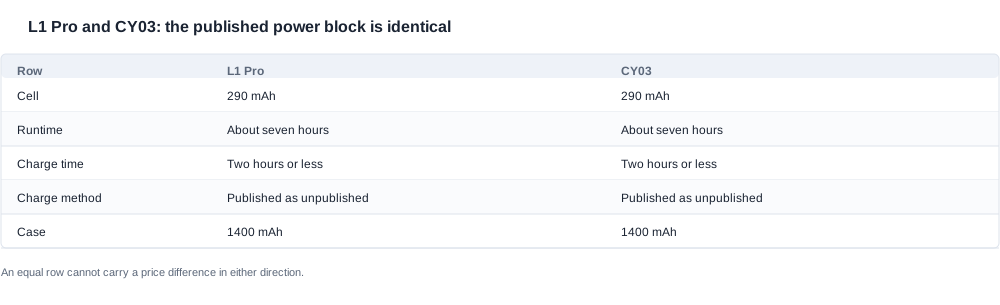
The conclusion first, because it is the one that saves time: a price difference between these two models cannot be built on any published power row, because every published power row is identical. Both sit at 290 mAh, both carry a runtime rated near seven hours, both give a charge ceiling of two hours or less, and both publish a 1400 mAh charging case. The charge method is unpublished on both. A positioning argument that reaches for capacity, runtime, charge ceiling or case size is reaching for something that does not separate them.
That leaves two kinds of position that can be defended, and a set that cannot. Below, the two defensible ones are set out with the evidence each needs, and the indefensible ones are named so they can be recognised on sight.
The shared rows, and what they rule out
Read the two model pages side by side and the power block is a copy: 290 mAh in the frames, approximately seven hours rated, two hours or less to charge, 1400 mAh in the case, and no charge method stated for either. In a catalogue of twenty-eight models, the CY03 is one of three that publish exactly this set, alongside the CY05 and this model.
Read that block in the order a buyer reads it, and something becomes obvious: there is no row on which to start. Most comparison work begins with the largest figure on the page and works down. Here the largest figure is the same on both sides, as is the figure beside it, and the one after that. The comparison has no starting point in the published material, which is why it has to be constructed rather than read.
Three consequences follow, and they are the backbone of any honest positioning work between them.
No capacity argument is available. Neither model has more energy, so a channel cannot price one above the other on endurance grounds without inventing a difference. No runtime argument is available, for the same reason — and note that both figures are ratings without test conditions, so neither supports a working-day claim in the first place. No case argument is available, because 1400 mAh is published for both and a case size that is equal cannot be a differentiator.
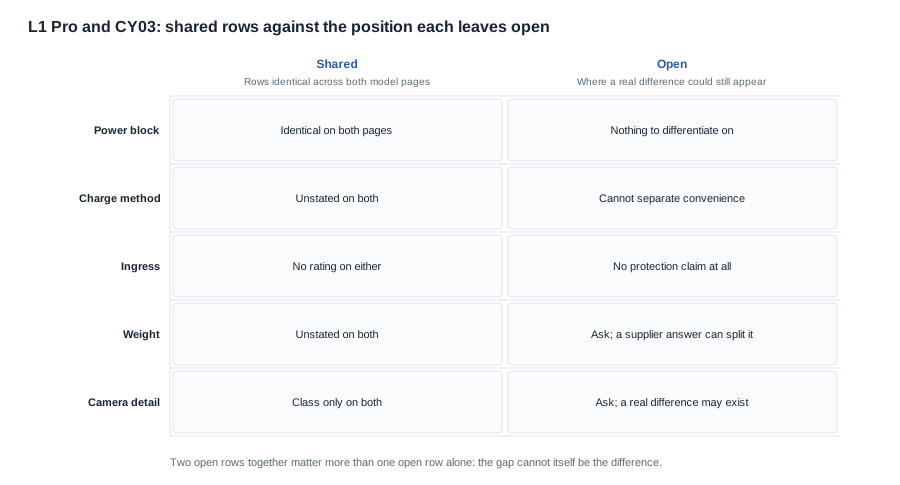
There is a fourth consequence that is easy to miss. Because the charge method is unpublished on both models, an interface cannot be used to separate them either. A channel cannot say that one of these two is easier to charge than the other, because our material says nothing about either. That closes off a surprisingly common line of positioning, and it closes it more firmly than it would if only one model were unpublished — with one gap, the gap itself becomes the differentiator, and here there are two.
The asymmetry worth understanding is between a row that is published and equal, and a row that is published and absent. Equal rows are dead ground: there is nothing to argue about. Absent rows are open ground: the question is unanswered on both sides, which means neither model can be credited for it. A gap on one model is a marketing opportunity; a gap on two models is a question for the supplier, because opportunity requires that the other side has something you do not.
That is also why the shared block above is not merely a limitation but a useful piece of information. A procurement reader who sees that two candidate models publish the same power block learns in ten seconds that the decision between them will not be settled by capacity. Every minute of specification work that would otherwise go into comparing runtime figures is better spent closing one of the rows that are genuinely open — which is a faster path to a decision than an exhaustive comparison of identical numbers.

The two positions that can carry evidence
Position one: the published camera row. This is the only published specification difference the catalogue supports between these two models, and a position built on it has to be phrased with care. A resolution class is a count, not a performance result, and the material behind it — sensor, optics, frame rate, video, storage — is unpublished for both models. So the defensible statement is a statement about what is published, and the comparison belongs in a channel where the class is itself meaningful to the buyer.
A position built this way has a specific and limited shape, and it is worth being precise about it because buyers often attempt more than the row allows. What it supports is a statement of class and a statement of difference from the eight-megapixel models. What it does not support is any claim about the photographs themselves, any claim about the other model being inferior, and any inference that a higher count produces a better result — which is precisely the inference a smaller sensor makes risky and which our material gives you no way to assess.
The honest form of this position is therefore modest: it identifies what is published, states that it differs between the two models, and stops there. A reader who wants more than that needs evidence the catalogue does not carry, and the way to get it is the same as for every other open row on these two pages.
Position two: a difference that exists but is not published. Here the answer comes from the supplier rather than the catalogue, and it is the stronger of the two positions precisely because it rests on something the other model does not have.
The order in which to pursue those answers matters as much as the list. The charge method comes first because it is the only open row on either model that appears in printed material, and therefore the only one where a late answer is expensive rather than merely inconvenient. The camera details come second if the channel sells video, and the weight comes second if the use case is defined around wear duration. Conformity documentation runs in parallel rather than in sequence, because it depends on the destination market rather than on anything about the product itself.
Working them in that order also keeps the comparison honest as it develops. Each answer you obtain narrows the field, and narrowing is exactly what a price difference needs behind it: a reason a buyer gives for accepting the figure you have quoted. What is available: a written confirmation of the charge method for the model you are buying; the weight, if a fit calculation matters; the camera details behind the published class; the conformity documentation for your destination market. None of these are published for either model today, so each is a question — but a question that, once answered, gives one model an attribute the other lacks in your written evidence.
The second position has a property the first does not. It can be built before delivery, written into your specification, and defended in a tender. A resolution-class comparison is defensible but narrow; a supplier-confirmed attribute is defensible and specific. Where a price difference has to survive a procurement review, the second is the one worth paying for.
Before working through what to request, it is worth being concrete about what "confirmed" means, because the word is used loosely and a loose confirmation is no confirmation at all. A usable answer names the attribute, states the method or standard behind it, carries a date, and identifies the model designation it applies to. An answer that says only "the CY03 is lighter" tells you nothing you can put in a specification, and it will be unusable the moment a reviewer asks what it weighs without the case, or measured with what, or on how many units.
The same applies to the charge method, which is the row most likely to be asked about and the one where a verbal answer is most tempting. Get it in writing, get it against the designation, and get it before the artwork is committed. On a comparison where every published row is identical, this single answer is often the whole basis on which one model is preferred — which means it is worth exactly as much attention as the price argument it is going to support.

What a price difference cannot rest on
Three arguments fail on the published material, and each fails in a way that is recognisable.
It cannot rest on charging convenience. Both models leave the interface unstated. Any copy naming an interface for either of them is unsupported, and a difference between them is doubly unsupported. It is worth noting how easily this particular failure occurs in practice, because a channel that has already written an interface description for one model in this family will find it tempting to reuse the wording for the other — and the temptation is strongest precisely where the two models are otherwise indistinguishable, which is exactly where a reader is most likely to accept it.
It cannot rest on runtime certainty. Both publish a rating of approximately seven hours with no test conditions attached. Neither supports a working-day claim, so a price difference framed on one model lasting longer than the other has no basis — and if you have measured both yourself under identical conditions, that measurement is your evidence rather than ours, and it belongs in your specification with its conditions attached.
It cannot rest on protection. Neither model publishes an ingress rating. Across the range, only two models carry one, and neither of these is among them, so a protection claim fails for both and separates neither.
Note the shape of this failure, because it differs from the others. Where a claim rests on a row that is published and equal, it fails because the two models agree. Where a claim rests on a row that is unpublished, it fails because neither model can be credited for anything. Protection falls into the second category for both models at once, and it is worth noticing how rarely a buyer checks: an ingress claim is one of the easiest sentences in this category to write by accident, because it appears in ordinary product copy and nobody flags it as technical.
It cannot rest on the case, or on how either is charged from it. The published case capacity is identical, so there is nothing to compare, and how the case replenishes the frames is unpublished for both models — as is the case's own recharge time. A channel tempted to build positioning around a shared case should recognise that everything visible about it is shared.
It cannot rest on durability, weight or application behaviour. All of these are unpublished for both models. These are the rows where a supplier answer could create a real difference — and equally where an invented difference would be most damaging, because customers notice weight and reliability far more readily than they notice a millisecond difference.
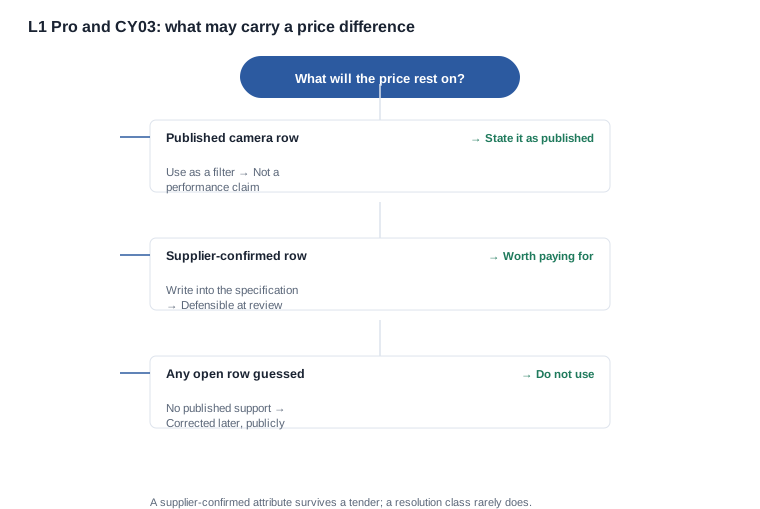
A price difference built on any of these is not merely weakly supported — it is a claim about a row that our material leaves open for both products. If it later resolves the other way, or resolves differently for the two, the channel carrying that claim absorbs the correction.
There is a commercial asymmetry in getting this wrong that is worth weighing before you commit to a number. A positioning argument built on a published row costs nothing to make and is immediately checkable by any reviewer who reads carefully. A positioning argument built on an assumed row costs nothing to make either, and will not be checkable by anyone until a customer tests it. The first kind is limited but safe; the second is flexible and dangerous. The gap between them is where most pricing disputes in this category actually begin, and it is a gap that can be closed for the price of one question.
A related discipline applies to how the comparison is presented internally. If the sales conversation leads with a difference that procurement cannot verify, the two teams are working from different documents, and the disagreement surfaces at contract stage where it is most expensive. Leading with the shared block instead keeps everyone working from the same published material — and it tends to make the supplementary evidence you have gathered look more credible, not less, because it arrives as the reason for a difference rather than as a claim about one.

Building the L1 Pro and CY03 comparison so it survives review
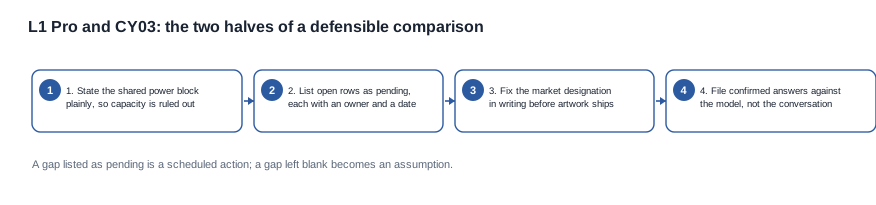
The way to make this positioning defensible is to write it as a comparison with two halves: what the published rows settle, and what remains open on both sides.
On the published side, state the shared block plainly. Two models at 290 mAh, both rated near seven hours, both with a two-hour-or-less ceiling, both with a 1400 mAh case, and neither stating a charge method. A procurement reader who sees that block knows immediately that capacity is not the argument, and the rest of your proposal is read more seriously as a result.
There is a reason for this that matters more than it appears. Leading with a difference you cannot substantiate invites the reader to check it, and a reader who checks finds the specification thin and stops reading. Leading with an identity they can verify against our own material establishes the proposal as accurate, and a reader who trusts the first page tends to read the rest of it the same way. The shared block is not a concession; it is the most persuasive thing available at this stage.
On the open side, list the rows where a supplier answer would create a difference, marked pending with an owner and a date. This is what turns an unfavourable comparison into a managed one: instead of a gap in your proposal, each item is a scheduled action with a commercial owner.
Two practical points follow.
The market designation must be named and held in writing before any customer-facing material goes out. Our published material lists this product as the L1 Pro, and a designation that differs between your artwork and your supplier documents becomes a correction that surfaces publicly and expensively — on packaging that has already been distributed rather than on a file somebody can still edit. Confirming it is a single exchange and it protects every downstream artefact.
The confirmed answers belong on file against the model designation, not against the conversation in which they arrived. On a comparison where the published rows are identical, that file is the only thing that distinguishes this order from the next one, and a reviewer six months from now will have no way to tell which parts of the specification were established and which were assumed. Keep the question, the answer, the date and the source for each, and the comparison becomes reusable rather than one-off.
There is a third point that only matters at volume. If a price difference between these two models is going to appear across a range of listings, packaging variants and market entries, decide once — at the level of the product rather than the campaign — which evidence it rests on, and apply it everywhere. A difference justified one way in one market and another way in the next is the kind of inconsistency that surfaces eventually, and the cost of consistency at the outset is far lower than the cost of a correction applied three times.
We publish no price for either model, and we will not tell you which one is worth more. What we will tell you is that the published rows do not separate them, so any positioning you build has to come from evidence you go and get — and the evidence is available, it simply is not on the catalogue page.
That is the whole of the case, and it is worth restating without decoration because it is easy to lose inside a longer argument. Two models that publish the same capacity, the same runtime rating, the same charge ceiling, the same case size and the same unstated interface are not separable by their published specifications. Where a buyer needs them to be separable, the separation has to be manufactured with evidence — obtained, dated, written down and attached to the model designation — or it has to be acknowledged as absent.
A comparison that does this honestly looks less impressive in a meeting and performs better in a tender, because every claim in it can be traced to something. A comparison that asserts a difference the catalogue does not support looks stronger in the meeting and fails at the first challenge, usually from a reviewer who checked. Which of those two documents you would rather be holding depends on how long you expect the account to last.
If you want the row-by-row picture before you write anything, our camera page lists both models and the comparison reading shows where each sits among the tier.
One last practical note, and it applies to whichever way you decide. Whichever model you take forward, record the reason in the same words you used to reach it. A comparison assembled over six weeks from four conversations and a specification sheet will not be reproducible in six months, and the next buyer will either rebuild it from scratch or drop the reasoning and keep only the number — which is the outcome this whole approach exists to prevent.
Related reading
- The tier context for both models — L1 Pro compared across the catalogue
- What the open rows actually cost in an order — L1 Pro value for money
- The evidence a comparison has to carry — L1 Pro buyer review checklist
Name the market and the channel you intend to sell into, and we will mark which rows of this comparison you can state and which you have to source.


