

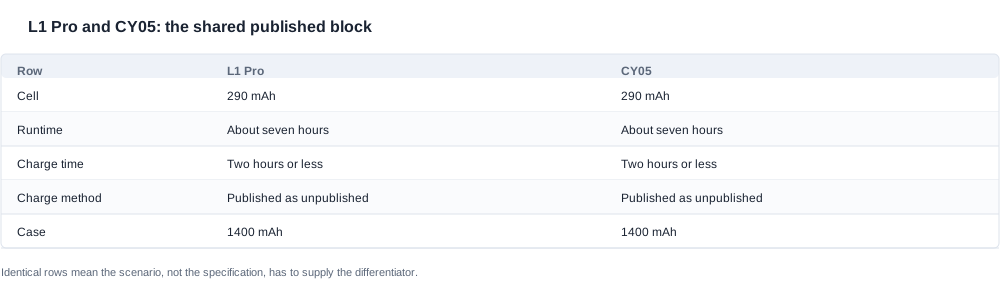
These two models publish the same numbers. Both carry a 290 mAh cell, both publish a rated runtime of approximately seven hours, both publish a charge time of two hours or less, both publish a 1400 mAh charging case, and neither states a charge method. A use-case comparison that leans on those rows is comparing nothing. What is left is a different kind of question, and this article takes it in a fixed order: start with the channel scenario, work out what evidence that scenario actually demands, and identify which unanswered item blocks the decision first.
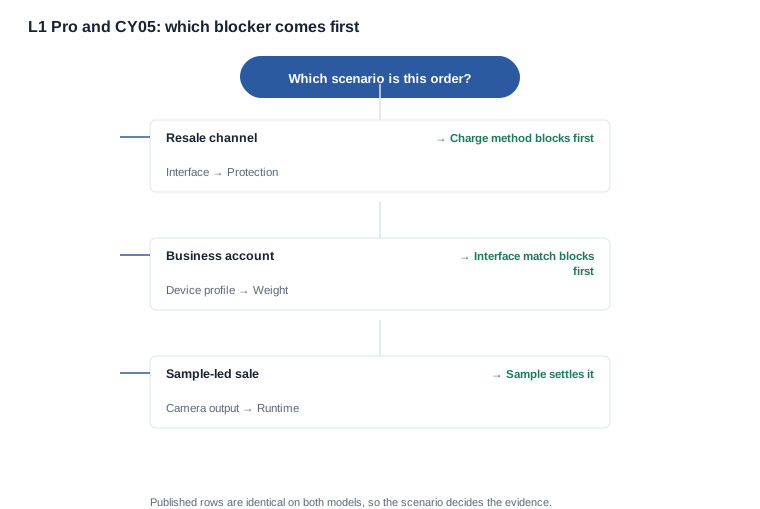
The third step is the one buyers skip. Knowing what evidence you would need is comfortable; knowing which missing fact will stop the decision dead is the part that determines whether you can choose today or whether you have to go and ask first.
That framing matters because it changes what a comparison is for. A use-case comparison is often treated as a way to arrive at a preference between two models, and on this pair of models that project cannot succeed, because the published specifications are the same on both pages. What the comparison can do is arrive at a decision procedure — a short list of questions, ordered so the one that blocks the decision comes first. A procedure is worth more than a preference here, because it survives the next order, the next market and the next pair of candidates, whereas a preference has to be rebuilt from nothing each time.
The scenario comes first, and it is not the same for every buyer
Because the published rows are identical, the differentiator between these two models has to live outside the specification sheet. Where it lives is decided by the scenario you are buying into, and the scenarios diverge sharply.
A resale channel is buying for an end customer the supplier will never meet, and whose only evidence is whatever the listing says. Every sentence in that listing has to be sourced before publication, and a large share of what makes either model interesting cannot be sourced today. For this channel the comparison collapses into a single commercial question: how much unrecoverable correction cost is the business prepared to carry, given that both models arrive with the same gaps.
That question is answerable before either model is chosen. Estimate what a reprint of the artwork and a revision of the listings would cost in each market, weigh it against the order, and you have the resale-channel position on both models — which is to say, no position at all. The models are equivalent on what can be sourced, so the channel is choosing between two identical documentation risks.
A business account is buying for a defined population with a defined device profile. The specification feeds an internal provisioning document rather than anything a customer will read, so a pending item costs nothing until somebody asks. Here the published rows carry most of the argument, and the comparison becomes a straightforward matching exercise between a requirement the buyer already holds and a model that may or may not meet it.
The advantage of this scenario is that it is decidable early. A buyer can work through the requirements against the published block without any supplier contact, eliminate whichever model fails them, and only then approach the remaining question — which of the surviving models has the open row their process cannot carry.
A sampler-led sale decides on a physical unit rather than on paper. The specification contributes the shortlist and the sample settles the rest. For this channel the two models are not differentiated by their published rows at all, and the useful question is which evidence a sample can produce — because that determines how much of the open ground one unit closes.
The scenarios do not merely weight the evidence differently. They change which evidence is worth chasing, which changes which unknown blocks first, and that is the whole decision path this article is describing.
It is worth noticing what the three scenarios have in common, because the shared part is usually overlooked. In none of them can the decision be completed from the catalogue alone. The resale channel, the business account and the sample-led sale each need something that our material does not contain — a confirmation, a match against the buyer's own equipment, or a physical unit. The scenarios differ in how expensive that missing piece is and in how long it takes, not in whether it is needed. A buyer who believes either model can be chosen today from the published rows is mistaken in all three cases, and the nature of the mistake is the same: treating an unanswered row as though its answer were known and not material.

What each scenario demands as evidence
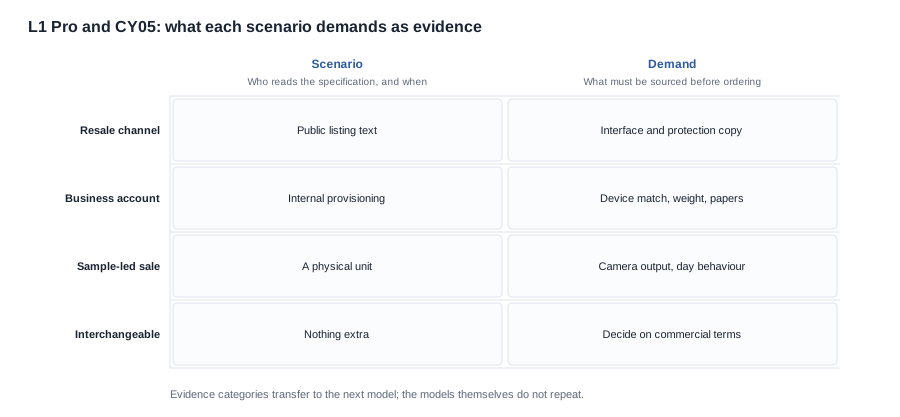
Once the scenario is fixed, the evidence requirement follows fairly directly, and it is worth writing it out rather than assuming it.
For a resale channel, the evidence demanded is complete public-facing text: an interface description, a protection statement, a runtime claim strong enough to survive a customer test, and camera detail sufficient for whatever the listing promises. Almost none of that is published for either model. The demand is heavy on rows that touch printed or listed material, which makes the charge method the single most valuable answer available.
For a business account, the evidence demanded is narrower and more specific: does the unit meet the interface requirement the buyer's own devices impose, does the weight suit the wear context, and does documentation arrive with the shipment. These are precise questions with short answers, and the specification can carry a pending marker on each while the answers are gathered.
The reason this scenario resolves fastest is structural rather than behavioural. A business account already holds the requirement — it was written to buy something — and the models are simply tested against it. There is no need to construct a requirement from the outside, which is what a resale channel must do, and the difference in effort between the two is considerable. A buyer with a written requirement can eliminate candidates on paper before contacting anyone, and that is the cheapest procurement work available in this category.
It is worth flagging one trap in this scenario. A written requirement that is too loose will let both models through and leave the comparison with nothing to decide on, at which point the choice becomes arbitrary and the specification inherits an assumption nobody actually made. Where a requirement is going to be used to select between two models whose published rows are identical, it has to be specific enough to separate them — usually by naming the interface, the weight or the camera detail that matters to the deployment. A requirement that cannot separate the candidates has not yet been written.
For a sampler-led sale, the evidence demanded is what a physical unit can show: what it requires physically to take a charge, how it behaves across a working day, what it weighs against an approved unit, and whether the camera output matches what the channel intends to sell. None of this is observable in a catalogue and none of it is observable in a written specification, which is why a sample is the correct instrument here rather than an inconvenience to be minimised.
It is worth being clear about the limits of a sample, because the instrument is powerful enough to encourage over-reading. A sample establishes what one unit does on one day, observed by one person. It does not establish what a production lot does, it does not carry the evidentiary weight of a supplier confirmation, and it does not tell you what the next unit from the same batch will do. Treat a sample as an efficient way to close the questions that only observation can close, and route everything else to documentation — which is also the reason a business account should not substitute a sample for a specification.

The unknown that blocks the L1 Pro and CY05 decision first
Each scenario has a different first blocker, and naming it is the decision this comparison actually enables.
Resale channel: the charge method blocks first. Not because it is the most consequential property, but because it is the only open row that appears in printed and listed material simultaneously. Until it is answered, no listing or packaging for either model can depict a charging arrangement, and the correction cost lands on artwork that has already been distributed to retail. It is also the cheapest blocker to clear: one written question to the supplier, and frequently an afternoon with a unit that settles it physically. Nothing else on either page combines this much consequence with this little cost.
Business account: the interface requirement blocks first, framed rather differently. The buyer's existing equipment defines the requirement, and whether either model meets it is a yes-or-no question about what the buyer already owns rather than about the models in front of them. That question can be answered from the buyer's own inventory without contacting a supplier at all, and in a populated account it frequently eliminates one of the two models before any documentation request is made.
Sampler-led sale: the camera output blocks first, because that is the product being sold. Every other open row on these two pages can eventually be closed by documentation, and this cannot be closed by documentation at all. Both models publish a resolution class and neither publishes anything behind it, so a channel selling on the photograph has to see the output. It makes this the shortest decision path in the scenario despite being the only one that requires physical goods to be handled and returned.
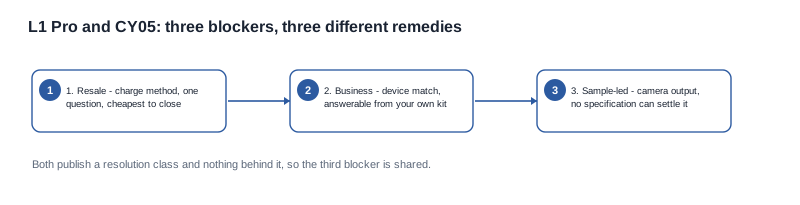
The third blocker is the one worth dwelling on, because it applies identically to both models and neither published row can help with it, and because it is the only one of the three that no amount of supplier documentation can close. Both publish a camera resolution class, and neither publishes the detail behind it — sensor, optics, frame rate, video, storage. A resolution class is a filter, not a result, so a channel whose product is the photograph cannot tell these two models apart from their specification pages at all. That is not a limitation of the comparison; it is the honest answer, and it hands the decision to a test.

When the two models are simply interchangeable
A fourth outcome is worth stating plainly, because buyers often assume a comparison must produce a preference and it frequently should not, and because a comparison that ends without a preference can look like a failure when it is actually the accurate result.
If the requirement set contains no open row and no scenario-dependent row — if the buyer's specification is already satisfied by the published block, and the channel does not print anything that would expose a gap, and the sale is not driven by the photograph — then these two models are, on published evidence, interchangeable. Choosing one over the other on anything else is choosing on a difference that our material does not describe.
That is a legitimate outcome of a use-case comparison, and it is a useful one. It means the decision can be made on supply, lead time, relationship or commercial terms — all real grounds, none of which belong in a specification sheet — rather than on a manufactured technical difference.
What it does not permit is pretending the technical difference exists. A comparison that asserts one, where the published rows are identical, is not doing procurement work; it is doing sales work, and the two require different standards of evidence.
Interchangeability is a stronger result than it first looks, and it is worth being clear about why. These two models are not interchangeable because they are similar; they are interchangeable on the evidence available today, which is a narrower and more conditional claim. The moment either model produces a supplier-confirmed attribute the other lacks, the equivalence breaks — which is why the exercise is worth running even when the outcome is no preference at all. A buyer who has established equivalence on published rows can then say precisely which answer would change it, and ask for that answer by name rather than assembling a general enquiry.
That framing also protects the commercial relationship. Telling a supplier that two of their models are interchangeable on published evidence is a statement about the specification, not about their products, and it invites the specific question that might resolve it: which of these two carries an attribute the other does not. A general enquiry about "the differences" invites a general answer and gets one.
How to run this comparison once, and reuse it
Because the published rows will not change the structure of this comparison from one order to the next, the useful investment is running it properly the first time and keeping the result rather than rebuilding it each time a candidate is added.
Keep the record per model, not per comparison. A file that records, for each model: the published rows with their citation, each supplier-confirmed attribute with the date and the source it came from, each physical observation with the unit it was taken from, and each item still pending with an owner attached. When the next candidate arrives, the existing models need no re-interviews — only the new model needs the evidence gathered, and the comparison across all three is assembled from records of the same grade.
For each scenario you actually operate in, write down the evidence that scenario demands and mark each item as published, supplier-confirmed, or physically observed. That is a short document, and it becomes the answer to the next comparison with the next model because the evidence categories — not the models — are what transfer.
Where an item is supplier-confirmed, record the date and the source against the model designation. Where it is physically observed, record who observed it and on which unit. Where it is published, cite it and move on, because published rows are the only items in this comparison that will not need revisiting.
The discipline worth keeping is the distinction between the three. A comparison that blends an observed weight, a confirmed interface and a published capacity into one confident paragraph looks complete and is actually three grades of evidence wearing the same clothes — and that is precisely how an unsupported claim survives into a tender.
There is a commercial reason to keep the grades separate even when it feels cumbersome. A supplier-confirmed answer can be put into a purchase order as a condition. A published figure can be cited. A physical observation can be repeated by anyone who handles a unit. Treating them as interchangeable means writing a specification in which the strongest-sounding evidence supports the weakest contractual standing, and that is the specification that fails when the first reviewer pushes back. Separating the three costs a column in a table and saves an argument at contract stage.
For a buyer running this comparison across several candidate models rather than just two, the three-grade structure is what makes the work repeatable. Published rows are compared against published rows. Supplier-confirmed attributes are compared against confirmed attributes, with dates checked so a stale answer is not treated as current. Physical observations are noted as observations from a particular unit, and are treated as indicative rather than as production evidence until they are repeated across units from the actual production run. A comparison built that way is slower to assemble and considerably faster to defend.
We publish no price for either model and no preference between them, and we will not manufacture a distinction the material does not carry. What the comparison gives you, once the scenario is fixed, is a short list of questions and an honest account of which one is stopping you.
That is a smaller deliverable than a recommendation, and it is worth saying why it is the right one. A recommendation between two models whose published specifications are identical would be an assertion rather than a finding, and an assertion of that kind tends to be discovered later — by a customer, a reviewer or your own procurement team — at a point where correcting it is expensive. A decision procedure, by contrast, tells you what to ask and what the answer would change, and it remains valid whether the answer supports one model, the other, or neither.
If you take one thing from this comparison, take the order of the questions rather than the list of them. Most of the list can be rearranged without consequence: a supplier will answer six queries in whatever order you send them. What changes the outcome is knowing which single answer, if it arrives unfavourably, stops the order — because that is the one worth chasing first, and the one worth building a deadline around. For a resale channel that answer concerns how the product is charged; for a business account it concerns whether the product fits the equipment already in place; for a sample-led sale it concerns what the camera actually produces, and it cannot be answered on paper at all.
That ordering is what turns a specification review into procurement work. Everything else in the comparison is bookkeeping, useful but not decisive.
If you want the criteria in a form you can hand to a colleague, the short version runs like this. Evaluate these two models on the requirement you already hold rather than on the differences you can find. Where the requirement is written and specific, it selects between them on its own. Where the requirement is loose, write it tighter before you compare anything. Where the requirement is about the photograph, no specification will decide it, and the sample is the instrument. And where the requirement is empty — no written criteria at all — then the correct answer is that the two models are equivalent on published evidence and the choice belongs to the commercial terms rather than to the technical comparison.
That last case deserves a moment, because it is the one a specification review is most likely to reach by accident. A comparison that has eliminated everything it can and separated nothing it can has found an equivalence, and the honest response to an equivalence is to stop comparing and start choosing on grounds the comparison was never about: supplier capability, lead time, order flexibility, or the commercial relationship itself. Those are real grounds for a decision, and they are grounds that a procurement file is entirely entitled to record.
If you want the tier context before you ask them, our camera page lists both models and the range comparison shows where each sits.
Related reading
- How the two models sit within the tier — L1 Pro compared across the catalogue
- The commercial weight of an unresolved row — L1 Pro value for money
- Questions a buyer asks before ordering — L1 Pro common questions
Set out the channel scenario you are buying into, and we will tell you which evidence it demands and which unknown blocks it first.


