

The L2 Utral is the most configurable model in the camera range, with a 900 mAh or a 1400 mAh charging case, a Type-C frame and a 13-megapixel camera on the 290 mAh platform. It is also the model carrying a naming problem that has to be settled before anything else, because the designation ends up on your packaging, your listing, your certificate application and your customs paperwork — and it is currently written two different ways.
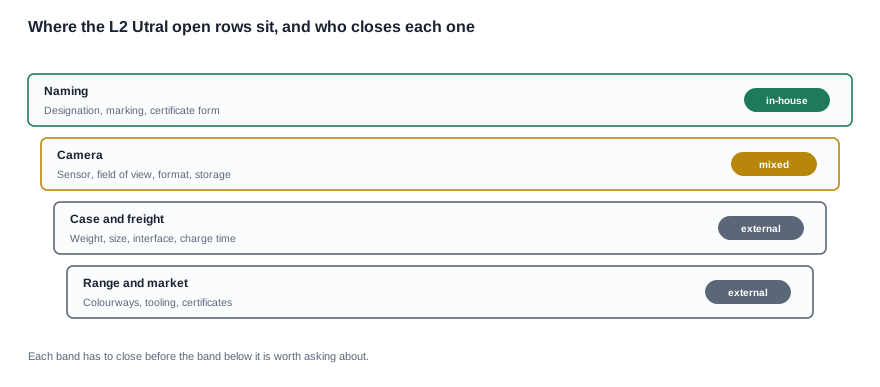
The naming question is free to ask and expensive to leave open, and everything below it is either a characterise-this-feature problem or a freight problem. Seven items are worth resolving, and this article sets them out in the order they are worth resolving rather than in the order they appear on a datasheet.
That makes the order of the checks unusual. The naming question is free to ask and expensive to leave open, and everything below it is either a characterise-this-feature problem or a freight problem. This article sets out all seven in the order they are worth resolving.
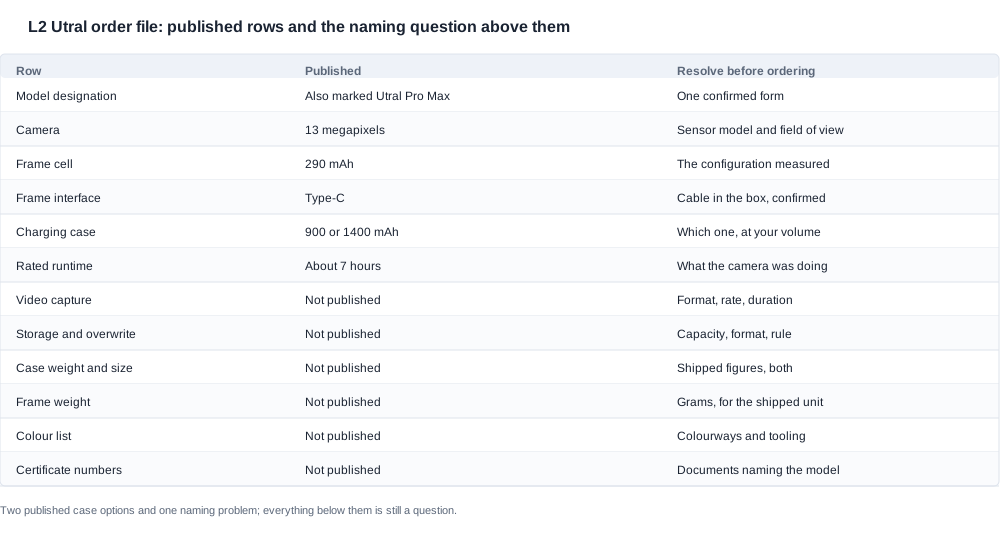
L2 Utral naming: settle the designation before you print anything
Before you send the question, check the three places the designation already appears in your own material: the product listing, the catalogue entry and any artwork you have drafted. Buyers who discover the mismatch after they have paid for artwork describe the experience as a factory error, when it is actually a documentation error that was visible before the order. Two minutes spent checking your own side of the paperwork is cheaper than the correction, and it makes the question easier to ask.
Our source material writes this model as the L2 Utral and also carries the marking Utral Pro Max. Both readings look like a typographical rendering of Ultra, and we are not going to pick between them from the outside — a designation is not something to guess at when it ends up in a customs declaration.
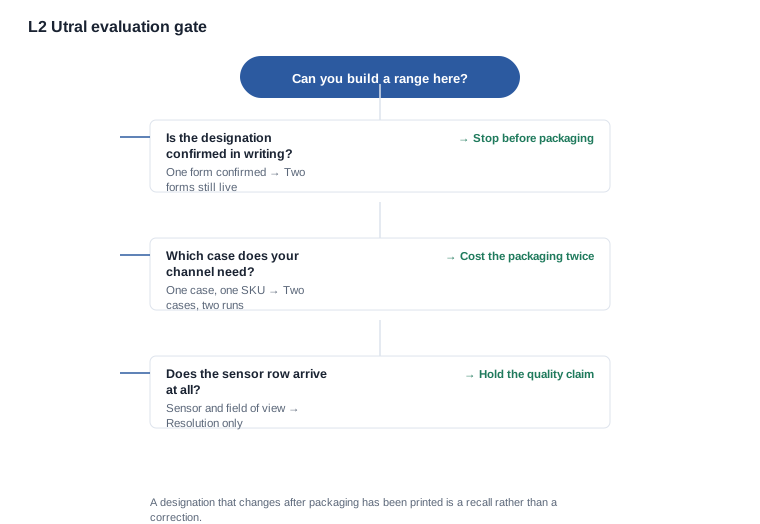
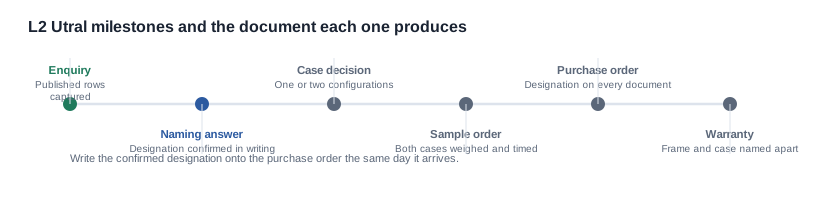
Settle it in one message, in writing, and then use exactly the confirmed form everywhere: the packaging artwork, the product listing, the certificate application, the purchase order and the shipping documentation. Three consequences follow if you do not. Customs will query a mismatch between the invoice and the certificate schedule, which costs days. A quality claim will be harder to pursue if the name on the unit does not match the name on the file. And a listing title corrected after launch is a permanent record in your own catalogue of a product you were not sure how to name.
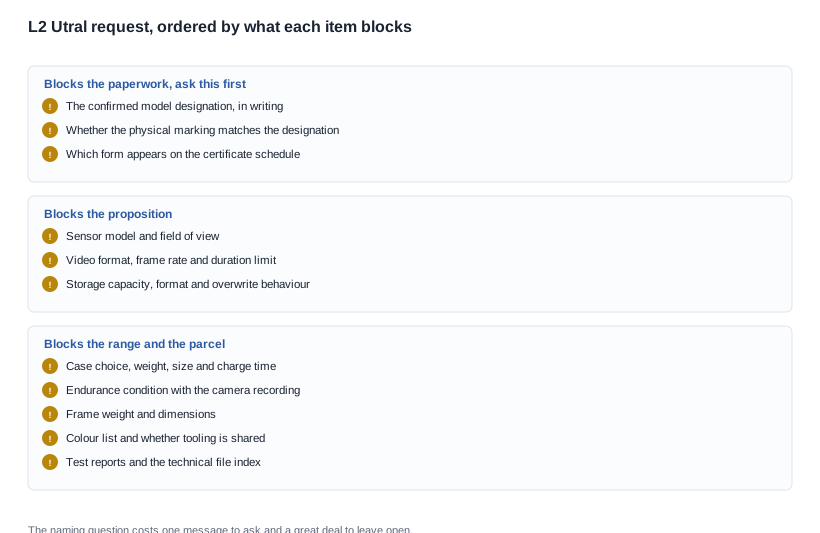
Ask three specific questions rather than one. What is the confirmed model designation? What appears as the physical marking on the unit and on the carton? Which form appears on the schedule attached to the certificate? All three can be answered in a single reply, and all three can differ, which is exactly why the general question produces an unsatisfying answer.
Ask at the same time whether the designation differs between the standard and the private-label version, because a branding project that changes the name has to change it on four documents at once rather than one. It is a small question that becomes expensive the first time somebody prints several thousand cartons with a name that a customs authority then declines to match against the certificate schedule.
Ask at the same time whether the marking is laser-etched, printed or moulded into the shell, because that determines whether a private-label version can carry your own brand without a tooling change. A moulded marking is a permanent commitment to that name, and a private-label buyer who discovers it late has a much larger problem than a printed label.
Once the answer arrives, record it on the purchase order the same day. A designation confirmed in an email thread is a designation you will have to reconstruct when the shipment is on a vessel and somebody in the destination country is looking for it on a document.

The camera tier that carries the premium argument
Thirteen megapixels is published, and nothing else about the imaging is: no sensor model, no field of view, no video format, no frame rate, no low-light behaviour, no storage arrangement.
This is the model where the resolution tier matters most, because the whole case for the L2 Utral over the CY05 is image quality. A 13-megapixel sensor with small pixels produces a worse image than an 8-megapixel sensor with large ones, so the sensor model is the only thing that turns the resolution figure into a quality argument. The field of view decides whether the product works for first-person video at all rather than merely recording something compositionally narrow. And the storage arrangement decides whether it stops recording silently in the middle of a session, which is the failure mode a camera product cannot afford.

Ask for the four camera rows as four questions, not as one request for camera details. A single question invites a single general paragraph; four specific questions produce four specific answers. Record which produced numbers and which produced descriptions, because that record is what you will want if the premium is challenged by somebody who was not in the conversation.
There is a commercial argument for accepting that position rather than waiting. A buyer who markets on resolution alone is a real buyer, and the resolution figure is the one number in the imaging set that is already published. What you should not do is write copy implying a quality conclusion, because a quality conclusion without a sensor model is a claim you cannot evidence when a customer compares your product against one whose supplier was willing to name the sensor.
The honest position is narrow and worth stating clearly in your own copy: the model is published with a 13-megapixel camera. The quality claim waits for the sensor model and the field of view. A buyer who knows to ask those two questions will thank you for having the answers, and a buyer who does not know to ask them will buy on the resolution figure and be satisfied — which is fine, and is a legitimate reason to stock this model.
Two case options, and what each one costs to run
This is the only published case choice in the range: 900 mAh or 1400 mAh, on the same frame. It is a genuine lever. Two case options give you two price points from one platform, or a lighter parcel for a customer who does not need the full case, and the lever is real because the difference is 500 mAh of cell rather than a different product.
The cost of using it is equally real, and buyers consistently underestimate it. Each case configuration becomes its own packaging SKU and its own artwork revision. Each becomes its own production run per colourway, which divides your volume into smaller lots and makes a per-unit price harder to hold. And each becomes its own cell declaration in transit, which is paperwork rather than cost but is still work that has to happen before the first carton ships.
Also ask whether the two cases share a shell or differ in tooling, because that determines whether a second case is a packaging revision or a new mould. It is a question with a large cost difference behind it and a one-line answer, which makes it a good example of the rows that buyers routinely skip because the answer feels like a detail.
Ask for the case's own weight, dimensions, charging interface and charge time for both configurations. None of those four numbers is published, and all four decide the carton and the parcel. A case that is charged over the same cable as the frame is a different accessory from one that needs its own, and the weekly routine difference decides how often the customer charges it — which decides how often it runs flat.
Write it as a total cost comparison rather than a unit cost comparison. Two configurations double the packaging work, split the production volume and double the cell declarations, while saving nothing on the frame itself. If the price difference between the two cases is smaller than the administrative cost of running both, the configurability is a liability at your volume rather than an asset.
Ask what the minimum order is for each case configuration separately. A single frame minimum quoted across both options is usually shorthand for the larger of the two, and discovering the difference after you have planned a range around the cheaper option is a costly way to learn it.
The decision rule is worth writing down before you start costing it. If your channel can hold two product pages per platform, two case options are an asset. If it can hold one, the larger case is simpler and the smaller case is a freight saving you may not be able to monetise. Buyers who work this out before committing artwork avoid the expensive version of the mistake, which is discovering it after the packaging is tooled.

Endurance, weight and the proxy you should refuse
About seven hours is published, with no stated condition. On a 13-megapixel camera platform the camera is the dominant load, so the questions are whether the camera was recording during the measurement, whether the Bluetooth link was active and at what volume, and whether the figure came from one unit or was averaged across a batch.
Ask whether the figure was taken with the case attached as well as with the frame on the dock, because an endurance claim made with a case in the box is a different claim from one made with the frame alone. Write the method down beside your own number too, so the two can be compared later rather than argued about.
Ask those three, then measure it yourself on the sample with the camera actually recording at a stated resolution, and write the method down beside the number. The general principle applies across the whole range: capacity is not endurance, and a figure with no condition attached is a ceiling rather than an expectation.
Frame weight and dimensions are not published either. The only weight figure in this catalogue belongs to the MT6, which is a different model on a different platform with a foldable case — which is exactly why it cannot be used as a proxy. A proxy is only useful when the two products share the things that determine the number, and here the cell, the camera module and the case arrangement all differ.
Weigh five units rather than one, and record the spread as well as the average. A tight spread is evidence of a stable bill of materials; a wide spread points at component substitution, which puts the certificate file in question as well. It is the same thirty seconds of work and it answers a question one sample cannot.
Weigh five units rather than one, and record the spread as well as the average. A tight spread is evidence of a stable bill of materials; a wide spread points at component substitution, which puts the certificate file in question as well. It is the same thirty seconds of work and it answers a question a single sample cannot.
Weigh the sample instead. On a 290 mAh frame carrying a 13-megapixel module, weight is a real variable rather than a rounding error, and it decides three separate things: whether the product stays on through a working day, whether your retail channel can fit it to a range of head sizes, and which freight class the parcel falls into. It is also the number a reviewer measures and publishes, which means an incorrect figure in your own documentation eventually becomes an argument you are having with a stranger.

Colour, tooling and the two-SKU decision
The colour list is not published for this model. A brand with a merchandising plan needs to know which colourways exist, and — more usefully — whether the tooling is shared with the CY models on the same platform. If it is shared, a new colour is a shorter lead time and a lower setup cost than the same colour on a model with its own tooling. If it is not, a new colour is a cost and a lead time rather than a preference, and it needs to be in the range plan rather than discovered at reorder.
Where the answer is that new colourways are subject to a minimum order, get the figure for each rather than a general statement, and ask whether the colourway minimum differs from the frame's own minimum. A colourway minimum is often higher than a frame minimum, and it is the kind of term that turns a reorder into a negotiation.
Ask which colourways exist today, whether new colourways are available at your volume, and what each one does to the minimum order and the lead time. Then ask the question that actually matters commercially: does adding a colourway split your production run further, and at what volume does the split stop being worth it?
Ask for the certificate or grant references with the issuing body and the expiry date, and check that the model designation you received in the naming answer appears on the schedule. The two questions are related and arriving together: a certificate that names the platform rather than the model tells you nothing about the market you can actually ship into, and a designation that has not been confirmed tells you nothing about which schedule to check.
The certification row follows the same logic as the naming row. No document in our material names this model. Ask for the test reports, the certificate or grant references with issuing body and expiry, the Bluetooth listing and declaration identifiers, the cell test summaries for the frame and for the case separately, and the index of the technical file. The two cell summaries are worth separating explicitly, because a frame cell and a case cell are two declarations and a single combined document will not satisfy either.
Who the L2 Utral fits, and where the CY tier is wiser
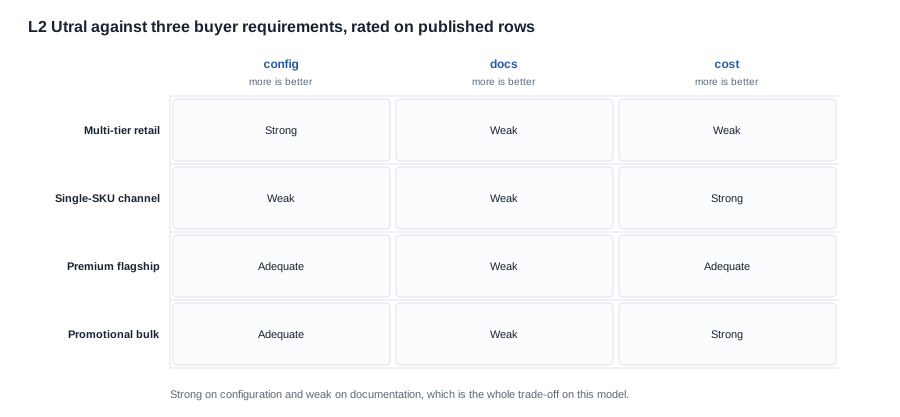
Name the cases. If your channel runs a tiered range where the top tier has to justify itself on image quality, the L2 Utral is the model whose premium depends on camera rows that are not yet published — which means the premium is currently being paid for on the strength of a resolution figure alone. That is a legitimate choice at a given price, and it is a weaker one at a high one.
If your channel is single-SKU and freight-sensitive, the configurability is a distraction rather than an asset: two cases means two packaging SKUs and two production runs, and the model with a single published configuration would be cheaper to operate even at a lower specification. If your channel needs a sealed or rugged product, no ingress rating is published for this model and the question is whether one exists.
Before you commit, run the short version: the designation, the sensor row and the case decision. Those three answers will tell you whether a tiered range is viable here or whether a single-configuration model is the sensible shape for your channel. The remaining four items are refinement rather than qualification, and asking for them first is what turns a three-week evaluation into a two-month one.
Where the L2 Utral is the right choice: a brand that has already decided to run a tiered camera range and wants two price points from one frame, and that is prepared to close the camera rows before the first product page goes live.
The L2 Utral is a well-specified platform whose naming needs settling and whose camera needs characterising before either can be sold. We will not publish a designation we have not seen confirmed, we will not present 13 MP as an image quality claim, we will not present the seven-hour figure as a working day, and we will not quote a weight, a colour or a certificate number that the documentation does not contain.
Minimum order quantity, lead time and price are not published for this model, and our internal documentation holds conflicting minimum order figures that we will not arbitrate on your behalf. Ask for the figure at your volume, per case configuration, in a quotation where it can be committed to, and ask which clock starts the lead time. The questions to ask are short; the cost of planning a range on a number nobody has confirmed is not.
The seven-item first-order list is short: the confirmed model designation in writing; sensor model, field of view, video format, frame rate and the storage arrangement; which case configuration, plus case weight, dimensions and charge time; the endurance test condition; frame weight and dimensions; the colour list; and the documents that name this model.
Send all seven in a single message with a deadline, and treat the first three answers as the gate: the designation, the sensor row and the case decision. If those do not arrive, nothing downstream of them is worth paying for yet.
Related reading
- The catalogue rows for this model — L2 Utral smart glasses specifications and features
- The accessory decision — AI camera glasses charging case options
- Checking a certificate rather than a claim — Bluetooth SIG certification checklist
- The model's place in the line-up — which AI camera glasses model to pick
Send us the target market, the volume and the configuration you have in mind, and we will tell you which of the seven items are already answered and which have to be closed first.


