

Importers usually open the conversation about this model with one question: which certificates can you actually show me? Our catalogue holds an export certification section made of images rather than searchable text, and it publishes no certificate number, no validity date and no laboratory name for the LC-105-1. That means the conformity file for this product has to be supplied by the factory before an order is committed, and an order placed before it arrives is an order placed on a verbal assurance. What follows sets out the position item by item, the three evidence states we use to describe what a catalogue can and cannot support, and the sequence in which the missing documents should be requested.

What our catalogue contains, and the three evidence states behind it
Because a catalogue is a publication and not a certificate register, a truthful certification status has to describe what kind of record exists rather than assert a compliance verdict. We therefore grade every conformity item in our range against three states, and we state which state applies instead of describing an item as certified.
State one — named as a framework, with no document behind it. A conformity framework appears somewhere in the source material, but no reference, scope or expiry is published alongside it. The framework is recorded as a framework and nothing more. A buyer cannot cite it, and a customs authority cannot be shown it, so the item stays open until the factory produces a document that names the model.
State two — claimed, and marked as having no report on file. The record explicitly states that no test report or certificate exists for that item, either for the model or for the platform. This is the most useful of the three states for a buyer, because it ends the conversation about that item. A file that does not exist cannot be produced later; the decision it forces is about the product, the market, or the test budget, and it is better taken at quotation stage than after the goods are on the water.
State three — not provided in any form. The source material is silent. Nothing is claimed and nothing is denied, and the item has to be opened by the buyer's own question list. Silence is the most common state for the items that are missing from a consumer electronics catalogue, and it is where due diligence earns its keep.
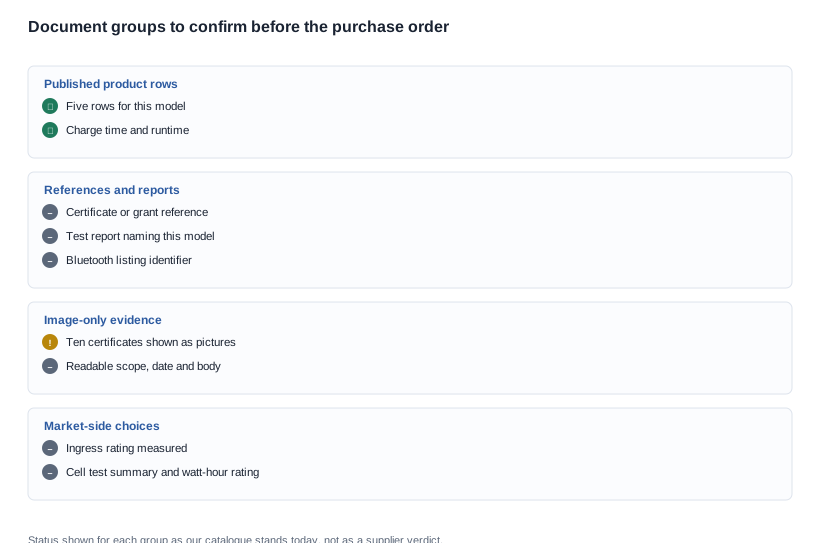
Applied to this model, the three states spread across the item list: the industrial-property filings exist and are visible, the conformity references are claimed without numbers, and the model-level test reports are simply not in the file. Sections below go through each class and name the state that applies.
Grading an item rather than scoring it also keeps a conversation civil. Nobody disputes that a document is missing; people dispute whether a claim counts as compliance. If a catalogue records an item as claimed with an open reference, the discussion can start from what will close the reference — a number, a scope, an expiry — and what that costs to close. That framing usually settles faster than a question about whether a product is compliant, because it asks for something that can be answered on paper.
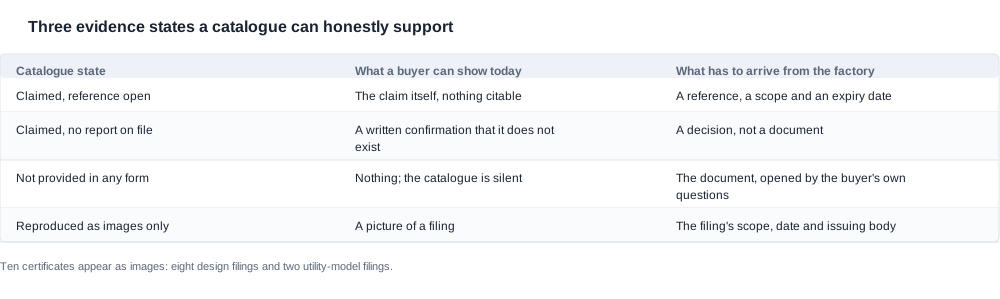
What the certification section actually contains. The certification section of our catalogue is a page of pictures. Ten certificates are reproduced on it: eight of them appearance-design registrations and two of them utility-model registrations. An image is useful evidence that a document was shown to the person who built the catalogue, and it is useless evidence for a buyer who needs a scope, a date, an issuing body or a model designation. That distinction is the whole content of this article.
Those ten filings also answer a question importers ask separately: they are intellectual-property documents, not market-access documents. They establish that a design was registered and that a mechanism was patented. They do not establish that a product placed on a market meets the radio, safety, chemical or transport requirements that market enforces. Keeping the two families apart is the single most useful thing a buyer can do with a catalogue certification page, because the temptation to read a certificate image as a compliance answer is strong and the cost of the confusion is paid later, at a customs inspection or a market withdrawal.
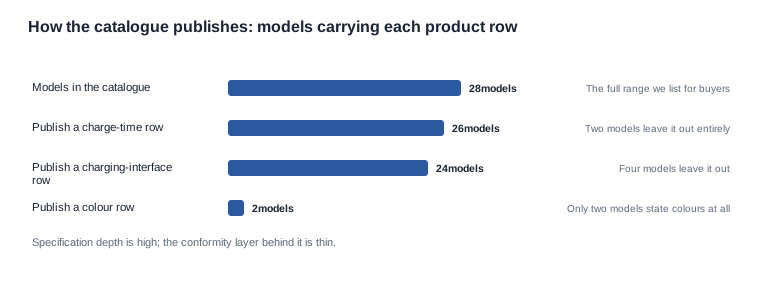
Around the pictures, the catalogue carries no textual conformity statement at all. There is no line anywhere in it that says CE, FCC or RoHS for this model or for the range, and there is no Bluetooth listing identifier, no grant reference, no test-report number, no laboratory name and no expiry date. What the catalogue does publish is unusually thorough on the product side: of the twenty-eight models we list, twenty-six carry a charge-time row, twenty-four carry a charging-interface row, and only two carry a colour row. The shape of that record is informative. This catalogue is a specification publication with a thin conformity layer attached, and a buyer should treat the thickness of the specification layer as no indication at all about the thickness of the paperwork layer.

The document classes a radio product actually needs
For a battery-powered product with a wireless radio, importers are usually working against a six-class list. Below is the class, the state that applies to this model, and the specific artefact we would ask the factory to send. The list is ordered by how much downstream work each artefact unblocks, not by legal hierarchy.
1. Bluetooth listing and declaration identifiers. The published specification for this model states a Bluetooth version, which means a qualified product listing should exist upstream of it. Our catalogue carries no listing identifier and no declaration identifier for this model. This is the quickest class to close: the identifiers are issued on request, and they can be checked independently by the buyer's own engineer without waiting for the factory to compile anything. It is also the class that proves a specific model was submitted for evaluation rather than being covered by a family statement.
2. The signed declaration of conformity and the file behind it. In the EU market, conformity for a radio product rests on three linked pieces: the construction of the product, the tests that were run against that construction, and the signed declaration that ties the two together. Our catalogue holds none of these as text for this model, so the state is one — claimed without a reference. Ask for the declaration itself, signed and dated, plus an index of the file it rests on. The index matters more than the declaration, because an index shows the scope of what was tested: which variants, which battery, which radio configuration.
3. The FCC grant and its test report. For the United States, the question is narrower and the document is heavier. A grant reference names a specific piece of equipment; a test report names a specific laboratory and a specific date. Our catalogue records neither for this model. This is the class that separates a factory with a document library from a factory that has tested one product and moved on, so it is worth asking for the report and not only the reference, and worth asking which laboratory performed it.
4. Substance declarations for restricted materials. A material compliance statement tied to a model designation, with the substance declarations attached, is a normal part of an import file. Our catalogue holds no such statement as text for this model, so this class sits in state one or three depending on what the factory has actually run for this configuration. The practical point for a buyer is that a range-level declaration covering material usage across many models is usually acceptable to importers and customs, while a model-level declaration removes the argument entirely.
5. Cell test summary and the packing instruction that follows from it. Lithium cells travel under their own rules, and the test summary for the fitted cell determines the packing instruction that determines the freight lane. Our catalogue publishes the cell configuration for this model, so the cell exists and is identified, but it publishes no test summary and no watt-hour rating. Ask for the cell's own test summary and the declared watt-hour rating, then derive the packing instruction from the rating rather than accepting a packing instruction as an instruction. A packaging label without the underlying summary is a label.
6. Ingress rating. Only two models in our range publish an ingress rating. For this model nothing is published, so the state is three. If the application involves commuting, cycling, site visits or any outdoor use, this is a laboratory question rather than a listing question, and the answer costs money to produce — which is why it belongs in the quotation conversation rather than after it.
Which configuration the LC-105-1 file has to cover
Conformity documents attach to a configuration, not to a product name in the abstract, and this model has a narrow published configuration to point at. Five rows are published: a pair of 55 mAh cells, roughly eight hours of rated runtime, a two-hour charge ceiling, magnetic charging and Bluetooth 5.4. That is the complete published description of this product, and a conformity file that covers this configuration has to be readable against it.
The check is easy to run and worth running. Take the model designation on each report and confirm that the configuration described in the report matches the published rows above. If a report describes a different cell count, a different charge arrangement or a different radio version than the ones published for this model, the report describes something else, no matter how official the paper looks.
There is a second reason this configuration check matters here. Another model in our range publishes exactly these same five rows — the same pair of 55 mAh cells, the same eight-hour rating, the same two-hour ceiling, magnetic charging and the same radio version — and the catalogue does not state what separates the two. Two models therefore share an identical published configuration, and that shared description is exactly why a document naming a platform is not automatically a document naming this model. A test report carries a model designation; a report written for the other model in this pair does not cover this one, even when the electrical content is the same.
Finally, note what the published rows leave out. Weight, dimensions, sensor specification, storage capacity and field of view are not published for this model. A conformity file will normally contain those values, and their absence from the catalogue is not a warning sign in itself — it is normal for a catalogue to omit them. But it does mean that the file cannot be checked against our publication, only against the factory's own records and your own sample. Budget for that: it is the point at which a buyer stops relying on a document and starts verifying a unit.

The order in which we would ask
Sequence is not a formality here, because each artefact determines what the next one can be. Asking in the right order also answers the order in which the factory can compile a file, which keeps the exchange short and reduces the chance of receiving a bundle that is internally inconsistent.
- Ask for the model designation first. Send the request with the exact model designation and ask which documents carry that designation. This one question filters every later answer.
- Ask for the Bluetooth listing and declaration identifiers next. They are quick to issue, they are independent, and they confirm that this model was submitted in its own name.
- Then ask for the radio test report and its grant or certificate reference, including the issuing body and the expiry date, and ask for the file index that the declaration rests on.
- Then ask for the cell test summary and the declared watt-hour rating for the fitted cell, because the packing instruction and the freight lane derive from it.
- Then ask for the material declaration covering this configuration.
- Then ask whether an ingress rating exists, and if it does, ask for the laboratory report rather than the marking.
- Then fix the economic operator and traceability details that will appear on the packaging, because those are your side of the file and they cannot be supplied by the factory.
Two rules make this list work in practice. First, ask for documents in writing and ask for a written confirmation of anything that does not exist; a verbal answer that no report exists is not a record, and it leaves the importer with the risk. Second, ask for the document set rather than for assurances — "we are fully compliant" is not an artefact, while a declaration with an index is.
Before you order, the questions to ask are therefore not a single question but a short sequence, and the criteria for a usable answer are the same in every case: does the document name this model, whether it carries a reference, whether it carries a date or a validity window, and whether the configuration inside it matches the published rows.
Reading the replies: what an answer reveals
Suppliers answer document requests in a small number of recognisable ways, and each one carries information. These are the replies we hear most often in this product area, and what each one actually tells a buyer.
- "The platform is covered." This is the reply that causes the most downstream work. It means a document exists for a platform, and that the model designation may or may not appear on it. Follow it with a single request: show where this model's designation appears on the document. If it does not appear, the file does not cover the unit you are buying.
- "We will send everything after the order." This is a statement about internal readiness, not a refusal. It usually means no model-level report exists yet for this configuration. It is acceptable when the factory can produce a dated plan, and it is a serious problem when the answer is the only one available.
- "The certificates are in the catalogue." Answer this by pointing out that a catalogue page of images is not a reference. Ask for the number, the scope and the expiry. A factory that can read its own documents can supply these in minutes.
- "It is identical to the other model in the range." Technically true at the configuration level, because two models publish the same five rows, and still not enough, because a report is written against a designation.
- "Our file is comprehensive; we send a summary to customers." This is the red flag to watch. A summary is a marketing document, and a market-access file is not summarised. Ask for the underlying items by name.
Signs that a file has not been assembled are usually visible earlier than the file itself. If a supplier cannot say which laboratory performed the radio test, or cannot state the expiry of the grant, or answers the cell question with the packing instruction, the documents are not in the supplier's hands. If a supplier quotes a compliance claim without a scope, treat the claim as unevidenced until the scope arrives.
The total cost of a missing file. Compliance paperwork has no unit price, so it disappears from most comparisons — which is how a cheap unit with an unavailable file becomes an expensive shipment. It is worth writing the consequences into the total cost of the purchase rather than treating the paperwork as free.
A file that arrives after the goods have shipped changes the lane, the label and sometimes the carrier. A file that names the other model in the pair requires re-testing or a re-issued report, which is a laboratory cost plus a calendar cost. A file that arrives with an economic operator detail that does not match the importer of record can block customs clearance at the port, where the delay is charged per day and cannot be negotiated afterwards. A file that never arrives ends the sale instead of delaying it.
None of these numbers can be quoted in advance, which is why the saving comes from asking early rather than from negotiating hard. The questions to ask before you commit, the checklist of artefacts, and the criteria for judging the reply are all in the sequence above.
Keeping the evidence after the order. A conformity file is only worth what the record of it is worth. Keep the file itself in a folder that is organised by model designation rather than by document type, because the first question after a customs query is always which model a document covers. Keep the signed declaration in a version that cannot be silently replaced — a dated PDF, not a link to a shared folder that changes content underneath you.
Keep the supporting evidence too: photographs of the product packaging and its markings, the packaging artwork as approved, and the written confirmations of anything the factory said does not exist. If a document set is replaced in the second year of a supply relationship, the photographs and the written confirmations are what let you establish that the original file had a narrower scope than the replacement suggests.
A short register of the destination market, the shipping mode and the documents held against each lane prevents most of the repeat work. Most importers who struggle with this area are not failing on technical difficulty; they are re-collecting files they already hold because nobody recorded where they were kept.
What our own documentation cannot settle
We are a manufacturer with a published catalogue, and it is worth being plain about where that leaves us. Our position is that a conformity claim without a reference is the beginning of a conversation rather than the end of one, and we will not publish a certificate number, an expiry date or a laboratory name that our source material does not contain. We do not treat the absence of a document in our catalogue as proof that the factory cannot produce it, and we do not treat the presence of ten certificate images as proof that a product meets a market's requirements.
What we will do is hold the published configuration for this model against whatever document set arrives, and tell a buyer in plain terms whether the file that arrives names this model, whether its configuration matches the five published rows, and which items remain open. If the answer to that last question is that several items remain open, we would rather say so before the order than after it. The five published rows for this model are the honest baseline for the product, and the criteria for checking a document against them are the ones set out above.
Seven questions to put in writing
- Which documents carry the model designation of this unit, and which laboratory produced them.
- What are the Bluetooth listing and declaration identifiers for this model.
- What are the certificate and grant references, the issuing body and the expiry date.
- Which cell is fitted, where is its test summary, and what watt-hour rating is declared.
- What packing instruction follows from that rating, and which lane it applies to.
- Whether an ingress rating has been measured for this model, and if so, the laboratory report behind the marking.
- Which economic operator and traceability details will appear on the packaging, and who confirms them.
Related reading
- The five published rows this model is judged against — the specification sheet for this model
- The shared-configuration question in full — LC-105-1 versus LC-105-2 on battery and charging
- The questions a buyer asks before signing — LC-105-1 buyer review checklist
Send the destination market and the shipping mode with your first enquiry, and we will mark which of the seven items sit on the critical path for that lane.


