
Buying an LC-105-1 starts from an uncomfortable fact: the catalogue prints the same row for it and for the LC-105-2, and a buyer review checklist for LC-105-1 smart glasses therefore has to do two jobs at once. The first is to quote the five rows page 24 actually carries — Bluetooth V5.4, a 55mAh*2 cell configuration, a charge time of two hours or less, a rated runtime of about eight hours and magnetic charging — without quietly adding a sixth. The second is to build the acceptance criteria the catalogue never publishes, so that a purchase order can be signed against something firmer than an expectation.
Four kinds of row sit behind any sourcing decision, and mixing them up is how buyers end up accepting goods they cannot receive against. Some rows can be quoted straight out of the catalogue. Some exist only as questions for the supplier, put in writing before the order is committed. Some can be settled only by running a sample under a condition the buyer defines. And some will never be published at all, which means each one has to be carried consciously as a risk or closed with a written answer from the supplier.
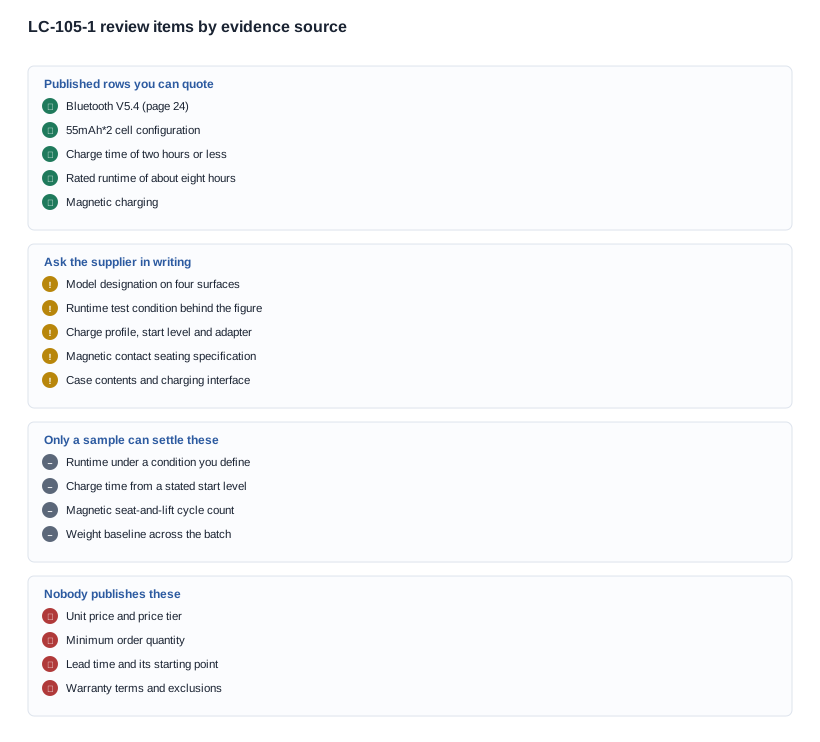
The review below separates the published rows from the missing ones, settles the identity question before any measurement is taken, converts the runtime and charge figures into criteria you can actually test, and treats the four commercial rows no catalogue can supply — unit price, minimum order quantity, lead time and warranty — as questions to ask rather than numbers to estimate.
The published rows the LC-105-1 checklist starts from
Page 24 is the whole published position for this model. It carries five specification rows and nothing else: no feature row, no colour row, no variant row. That absence is worth flagging early, because five of the eight audio models publish no feature row on their pages — the K01 and the LC-105-2, the D12 and the K02, and the LC-105-1 — while the other three audio pages do print one. A buyer who assumes a feature line exists for the LC-105-1 ends up specifying against something the catalogue never claimed.
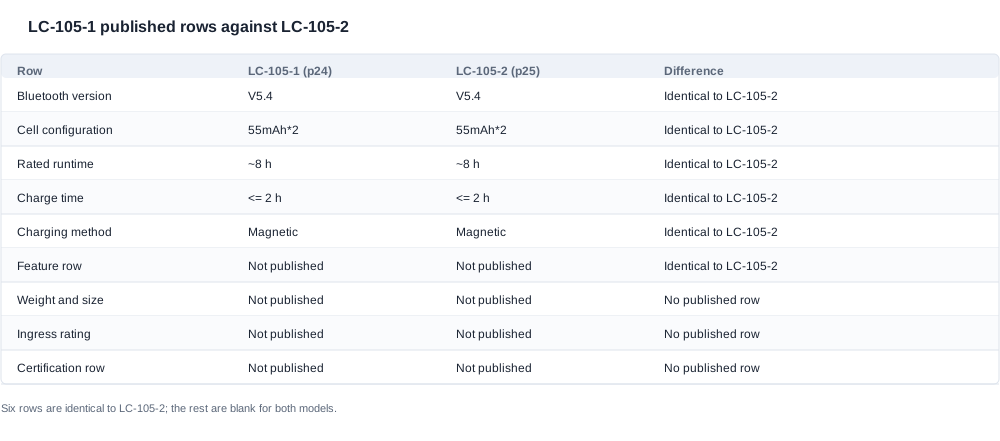
The comparison that decides how this review has to be built is with page 25, where the LC-105-2 sits. Read the two pages line by line and the outcome is the same on every line: the LC-105-1 row and the LC-105-2 row are identical. There is no specification-level difference to write into a selection matrix, and a quotation that separates the two models must be separating them on packaging, branding, commercial terms or something our material does not publish.
| Catalogue row | LC-105-1 (p24) | LC-105-2 (p25) | Difference |
|---|---|---|---|
| Bluetooth version | V5.4 | V5.4 | Identical |
| Cell configuration | 55mAh*2 | 55mAh*2 | Identical |
| Rated runtime | ~8 h | ~8 h | Identical |
| Charge time | <= 2 h | <= 2 h | Identical |
| Charging method | Magnetic | Magnetic | Identical |
| Feature row | Not published | Not published | Identical |
| Weight and dimensions | Not published | Not published | Identical |
| Ingress rating | Not published | Not published | Identical |
| Certification row | Not published | Not published | Identical |
Read the cell tier rather than the single model and the runtime figure stops looking like a measurement. Four audio models sit on the 55mAh*2 configuration — the YK12 and the G07, and the LC-105-1 and the LC-105-2 — and their published runtimes split into two values, about eight hours on the LC-105-1 and the LC-105-2 and about six hours on the G07 and the YK12. Neither figure carries a test condition, so the defensible way to quote the tier is a band of roughly six to eight hours with the two models behind each end named.
Wider still, six models across the catalogue print the same ~8 h figure: the K02 and the LC-105-1, the YKC02 and the LC-105-2, and the ZH12 and the K01. They sit on four different cell configurations — 90mAh2, 55mAh2, 70mAh*2 and a single 100 mAh cell — and not one of the six publishes the conditions the figure was taken under. A runtime that does not move with cell capacity across four configurations is a catalogue convention. It can be quoted, and it can be put on a quotation, but it cannot be used as a proxy for anything else on the review sheet.
Charging follows the same pattern. Magnetic charging is the default across the audio side of the range, and Type-C appears there only on the D11 and the D12. Nothing in the catalogue promises a USB-C port on the LC-105-1, so the packing list and the accessory line have to be written from a supplier answer rather than from a generalisation about the range.
Two structural absences deserve to be raised before the first sample arrives. The audio group carries no charging-case row of any kind, which is a different statement from publishing that a case is absent: nothing in our material allows the LC-105-1 to be described as supplied with a case or as supplied without one. The audio group also publishes no ingress row, since IP54 sits with the V06 and the S7, so an ingress criterion for this model would have no published row to stand on.
Weight, dimensions, sensor specification, storage, unit price, order minimum, delivery window, warranty terms and certificate numbers are all unlisted for this model. One weight exists elsewhere in the catalogue and belongs to a different product altogether — the 158 g published for the MT6 glasses body. Carrying that number across to an audio model would put a false criterion into the purchase order from the very first sample.
Compliance is the clearest gap of all. CE, FCC and RoHS do not appear in the catalogue text at all, and there is no per-model certification row, so the catalogue cannot be cited as evidence that the LC-105-1 holds any certificate. What can be named is the framework to write into the request: the Radio Equipment Directive (EU) 2014/53/EU, with electromagnetic compatibility governed by the separate EMC Directive 2014/32/EU. Those two names tell a supplier which regime the documents have to cover; they are not evidence that a document exists. The certification position for this model is set out in LC-105-1 certification status, and the runtime comparison with its twin is covered in LC-105-1 and LC-105-2 battery and charging.
The identity questions to settle first
Because two catalogue pages print identical rows, the opening block of this review is a paperwork question rather than a hardware question. Before any number is measured, the buyer has to know which model string arrives in the carton. A runtime criterion written against the wrong string is unenforceable, and a certificate request that names the wrong model returns the wrong document — usually the paperwork for the other product in the pair.
Put four questions to the supplier in writing. First, the exact designation to appear on the unit itself, on the retail carton, on the shipping carton and on the packing list, with confirmation that all four carry the same string. Second, whether the sample unit and the production unit carry that same designation. Third, the rule for a batch in which the carton designation does not match the purchase order — held for inspection, refused at goods-in, or accepted on the supplier's own judgement. Fourth, who signs the acceptance record once the sample has been measured.
A supplier that answers the first question with a general assurance that the two models are effectively the same product has not answered it. The receiving team needs a string that can be read off a carton, photographed and compared against the order; anything vaguer cannot function as a rejection right. A supplier that answers the third question with a clear procedure has already handed the buyer a receiving criterion, which is the cheapest line on the whole sheet to obtain and the most expensive one to be missing.
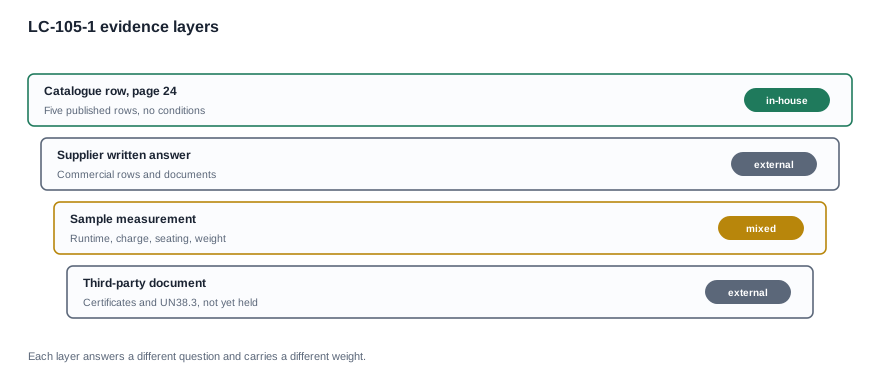
Evidence for any row on this sheet arrives in four layers, and naming them before the review starts is useful because each layer carries a different weight and answers a different question. The catalogue row is the layer already in your hands: five lines, no conditions, no tolerances, no documents. The supplier's written answer is the layer where the commercial rows become usable, and it is only usable once it arrives tied to the model designation. What the sample stage gives you instead is a number produced under a condition of your own choosing, and nothing else can do that job. Third-party documents are the layer for compliance, and in our own material that layer is empty today, which is exactly why it belongs in the written request rather than in an assumption.
Keep the identity evidence at batch level rather than at order level. A photograph of the designation label on the carton, stored against the batch number on the packing list, is what lets a goods-in team settle a query months later. The cost of keeping that record is negligible; the cost of not keeping it is a sourcing file that cannot close its own identity question. The rows behind this section are listed in LC-105-1 specifications and features.

Runtime, charge time and the accessory question
The rated runtime on page 24 reads about eight hours, and the row carries no test condition of any kind: no volume level, no codec, no source device, no distance, no ambient temperature, no sample size, and no statement of whether the figure is a mean or a best case. Inside the same 55mAh*2 tier the catalogue also prints about six hours, on the G07 and the YK12, which is roughly three-quarters of the eight-hour figure. The two values together mean the tier's published runtime spans roughly six to eight hours rather than settling on a single number, and neither end of the band says what produced it.
The way out of this is to replace the number with a condition of your own. Seven clauses, fixed before the sample is opened: the volume level, the source device, the duration of the run, the distance between the unit and that device, the ambient temperature, the number of units in the sample, and whether the figure is a mean or a best case. Written in that order, the runtime row stops being a slogan that both sides read their own way and becomes a criterion they measure the same way.
The published charge ceiling is unusable on its own. A unit charged from empty and a unit charged from part-full can both be reported as compliant, and the buyer cannot tell which one arrived in the channel. What the catalogue does not publish is where the charge starts, what counts as finished, and what the adapter delivers, so the criterion that survives a dispute has to name the start level, the end level, the adapter rating and the ambient condition.
Magnetic charging adds an alignment dependency that a single bench charge cannot expose. A contact that seats slightly off can still light an indicator while progressing slowly, so the acceptance test for this model is a stated number of seat-and-lift cycles with a named indicator state. The cycle count, the indicator behaviour and the tolerance on the contact are three lines the supplier has to fill in before the sample is worth running.
Accessories fall out of the catalogue structure rather than out of this model's page. Because the audio group prints no charging-case row, the LC-105-1 cannot be described as supplied with a case or as supplied without one. Put the accessory question in writing as five separate items: what the carton contains at your ordered quantity, whether a capacity figure accompanies the case, which charging method the case itself uses, whether the case appears as its own line on the quotation and on the invoice, and the rule applied to a returned unit whose case has gone missing. The same request should settle the charging interface, because Type-C is published only for the D11 and the D12 within the audio group and nothing in the catalogue extends it to the LC-105-1. The charging rows for this model are set out in LC-105-1 charging options.
The acceptance criteria to write into the purchase order
Only three things turn a catalogue row into a contractual criterion: it has to be published, it has to be checkable at goods-in or against a document, and it has to be precise enough that two parties measure it the same way. Rows that fail the second of those tests cannot be checked by opening a carton. The cell configuration is the clear example — nobody confirms 55mAh*2 cells by inspecting a box — so that row belongs in the document block, supported by the supplier's declaration and by the UN38.3 test summary for the cells, and not in the inspection block.
The rows that survive the test each need a written method attached. Bluetooth version becomes a criterion when the inspection records a scan result of V5.4 for every batch received. Charge time becomes one when the start level, the end level, the adapter and the ambient condition are named. The charging method becomes one when the seat-cycle count and the indicator state are named. Runtime becomes one only when the full condition clause is attached, because the published figure without conditions is not a measurement. The cell configuration stays a documentary criterion, checked against the two 55 mAh cells published for this model.
Some rows have to be kept out of the purchase order altogether even though they sound checkable. Do not write the 158 g weight, because it belongs to the MT6 glasses body and would be a false criterion from the first sample. Do not write an ingress rating, because the audio group publishes no IP row and IP54 sits with the V06 and the S7. Do not write a runtime clause without a condition. And do not write a certification clause that merely asks the supplier to be certified. Ask instead for four particulars — which document, which issuing body, how long it stays valid and which models it covers — because a claim of certification without those four elements survives the purchase order and then fails at the point of sale.
The commercial block that sits alongside the technical criteria carries the same discipline, because every row inside it is currently unlisted and every row inside it is a normal part of a purchase order for this product. It runs to unit price and price tier, minimum order quantity and whether it varies by configuration, lead time and the point the lead time starts from, warranty terms and what they exclude, the landed cost basis and the terms it assumes, the defect categories and the quality control inspection that applies at goods-in, and the sample order terms that let one unit be judged before the bulk order is released. None of those numbers exist in our catalogue, and an estimate is not an answer — a written figure tied to the model designation is.
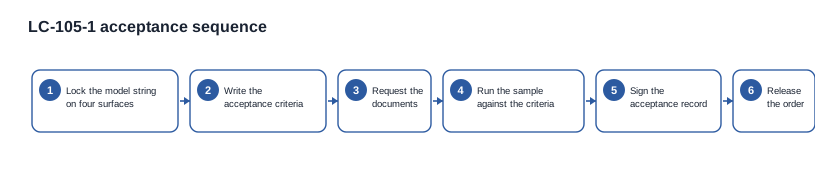
The order of work matters as much as the content, and the sequence in the chart below is the one to follow. Lock the model string first, because a criterion written against the wrong model is unenforceable and a request that names the wrong model returns the wrong document. Write the acceptance criteria before asking for anything, because a supplier answers what is the start level far more usefully than it answers tell us about the battery. Request the documents against the written criteria, run the sample against those same criteria, sign the acceptance record, and only then release the order — a sample that has not been signed off is a demonstration, and a demonstration is not evidence.
The LC-105-1 smart glasses buyer review checklist item by item
The review itself is set out below in the order a buyer works it. Items 1 to 6 are already answerable from the catalogue and cost nothing but care. Items 7 to 13 need one written answer from the supplier before the order is signed. Items 14 to 19 need a sample and a condition you define in advance. Items 20 to 24 are the rows nobody publishes, and each of them needs a decision from you rather than a request from us.
- Transcribe the five published rows. Bluetooth V5.4, a 55mAh*2 a charge time of two hours or less, magnetic charging, cell configuration and a rated runtime of about eight hours. Write them into the specification as quoted lines with the page reference attached, and extend them with nothing.
- Record that the twin row is identical. Page 25 prints the same five rows for the LC-105-2 and neither page carries a feature row, so nothing in the catalogue separates the two models on specification.
- Quote the tier as a range, not a number. Four audio models sit on the 55mAh*2 configuration, and the published runtime inside it runs from about six to eight hours, with the model behind each end of the range named.
- Check what the audio group leaves out. No charging-case row, no ingress row, no weight, no dimensions, no sensor line, no storage line and no commercial line — and five of the eight audio pages, this one among them, print no feature row at all.
- Check the certification position. CE, FCC and RoHS do not appear in the catalogue text and there is no per-model certification row; name the Radio Equipment Directive (EU) 2014/53/EU, with electromagnetic compatibility handled by the EMC Directive 2014/32/EU, as the framework for your request.
- Check the figures you must not borrow. The 158 g weight belongs to the MT6 glasses body and the case capacities belong to camera models; neither can be quoted for this audio model.
- Ask for the model designation on four surfaces. The unit itself, the retail carton, the shipping carton and the packing list, with one string across all four, confirmed in writing before the order is signed.
- Ask whether the sample matches production. Confirm in writing that the unit you test and the units you order carry one and the same designation, and state how that equivalence is checked before shipment.
- Ask for the rejection rule in writing. Where a carton whose designation does not match the purchase order is held, what the inspection looks at, and on what ground it is turned away at goods-in.
- Ask for the test condition behind the eight-hour figure. Volume level, codec, source device, distance, ambient temperature, sample size, mean or best case; and if the supplier declines to describe it, the condition has to be written into your own criterion instead.
- Ask for the charge timing. The level the charge starts from, the level that counts as finished, input current and voltage, the time taken to reach that end level, and the adapter the timing was taken with.
- Ask for the magnetic contact details. What shows that the contact has seated, how many cycles it is rated for, and what the indicator does while a charge is running.
- Ask for the accessory and interface answers in writing. Whether a charging case is included at your quantity, whether a capacity is stated for it, what charging method it uses, whether it appears as its own line on the quotation and on the invoice, the rule applied to a returned unit whose case has gone missing, and whether the charging interface on this model is the magnetic contact published for it.
- Ask for the compliance papers. The certificate number, the issuing body, the validity period, the list of models covered, and the UN38.3 test summary covering the cells — every one of them tied to the model designation.
- Measure runtime under your own condition. Write the seven clauses first, measure across the sample size you named, and report a mean.
- Measure charge time from a stated start level. A unit charged from empty and a unit charged from part-full are not comparable, and the second is what arrives in your channel.
- Run a seat-cycle count. Repeat the lift-and-reseat action the number of times your criterion names, and log every occasion on which the contact did not seat cleanly.
- Scan the Bluetooth version at goods-in. Log the scan result for every batch received, against the purchase order.
- Establish a weight baseline for yourself. No weight is published for this model, so weigh several units from the batch and record the spread, and treat a tight spread as an acceptance criterion in its own right.
- Keep the identity evidence with the batch. Photograph the carton designation label and file it against the packing-list batch number.
- Decide how to handle unit price and price tier. Not published. Either close it in writing before you commit, or set a commercial review point after the sample passes.
- Decide how to handle minimum order quantity. Not published, and it usually varies by configuration; obtain it in writing and state whether it varies for the LC-105-1 specifically.
- Decide how to handle lead time. Not published. A quoted number only becomes a plan once the moment it starts counting from is named, so get that moment confirmed in writing.
- Decide how to handle warranty terms and exclusions. Not published. Obtain the terms in writing, then confirm that the scope actually covers a two-cell product and the magnetic charging contacts rather than stopping short of them.
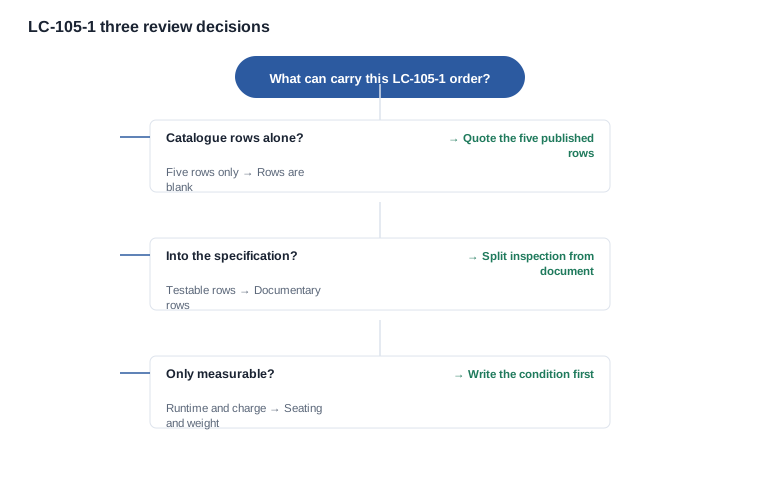
Three questions decide whether this batch of LC-105-1 smart glasses can move. The first is whether the identity is committed in writing, because without a designation on the carton and the packing list there is no rejection right at goods-in and every later check inherits the same weakness. The second is which rows enter the specification — the five published rows plus the documentary rows that travel with them, and nothing our catalogue cannot support. The third is which rows can only be measured: runtime, charge time, magnetic seating and a weight baseline are the four, and all four need a condition written down before the sample is opened, not afterwards.
What we will and will not do here is narrow, and stating it plainly is more useful than a wider claim. The catalogue publishes five rows for the LC-105-1 and nothing beyond them, and we will not fill an acceptance criterion with a figure belonging to another model, nor present an untested runtime figure as a measurement. What we can do is tell you which rows close from the catalogue alone, which close with one written answer from the supplier, and which close only with a sample run under a condition you write down first.
When the carton designation is settled, the runtime condition is written down and the commercial rows you need are listed, send all three in one message and we will answer with what is already on record, and with what cannot be answered until a unit is in front of you.
Related reading
- What the two published rows of this pair say — the battery and charging comparison
- The approval position, and where it stops — LC-105-1 certification status
- The accessory and interface rows in context — LC-105-1 charging options
- The audio range this model belongs to — Bluetooth audio glasses


