
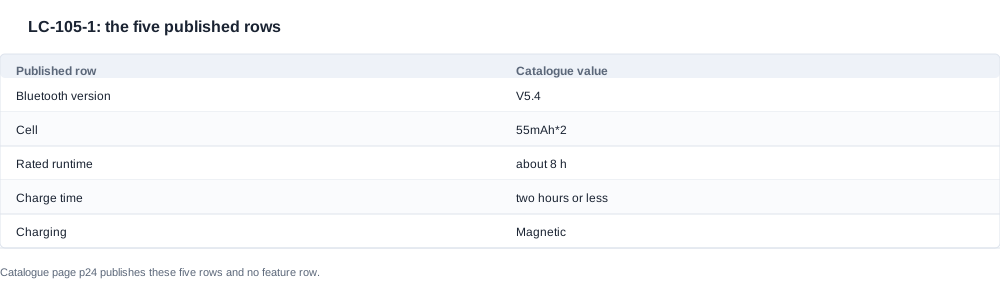
The LC-105-1's catalogue page carries five specification rows and nothing beyond them: Bluetooth V5.4, a 55mAh*2 cell, a rated runtime of roughly eight hours, a two-hour charge ceiling, and magnetic charging. Its catalogue page holds no feature row. For a procurement team that is not a thin description but a precise instruction — quote the five rows as they stand, and treat every other attribute as an open request to the supplier.
Four rows a complete specification file would normally hold are not published for this model: weight, dimensions, sensor specification and storage. The commercial rows are empty as well. There is no unit price, no minimum order quantity, no lead time, no warranty period and no certificate number in the catalogue, and the catalogue text contains no reference to CE, FCC or RoHS at all.
What the catalogue does support is a structural reading. The LC-105-1 sits inside an eight-model audio range, it shares its cell configuration with three other audio models, and it publishes the same five rows as the LC-105-2. That makes this model a platform decision rather than a feature decision. The published rows narrow the shortlist; the unpublished rows define the questions to ask before you order.
The work splits cleanly in two, and a procurement file should keep them apart. Selecting this model is the easy half, because five published rows are enough to place it in or out of a requirement. Qualifying it is the expensive half, because nothing in the catalogue closes the four missing rows, and every row left open past the sample stage turns into total cost that nobody priced: a returned unit, a listing correction, or a compliance exposure a buyer carries alone.
The five rows the LC-105-1 publishes
Read in the order a specification file normally uses them, the five rows are a radio version, a cell configuration, a rated runtime, a charge time and a charging method. Each one supports a limited decision, and each one also leaves a specific question open. How to evaluate them is a separate matter from how many there are, and the differences between them matter more than the count.
Bluetooth version V5.4. Within the eight audio models the radio version is published for every model: K01 and K02 publish V5.3, and LC-105-1 and D12, LC-105-2 and D11, and G07 and YK12 publish V5.4. Camera models publish no Bluetooth version, so this is a row the audio range can be compared on directly. What it does not settle is radio compliance evidence for a European market — the version number is a design fact, and the conformity documentation behind it is a separate written request against the instrument that applies in Europe, the Radio Equipment Directive (EU) 2014/53/EU, with the EMC Directive 2014/32/EU sitting alongside it.
Cell 55mAh*2. Four audio models publish this configuration: LC-105-1, LC-105-2, G07 and YK12. Write it exactly as the catalogue writes it, because the cell configuration is what groups the range: 90mAh2 for K01 and K02, 55mAh2 for the four models above, and a single 100 mAh for D11 and D12. A buyer who wants to reason about power draw starts from this row, and a buyer who wants to compare runtime figures should note that this row does not by itself determine them — as the next paragraph shows.
Rated runtime of about eight hours. This is a rated figure, and the catalogue publishes no test condition with it: no duty cycle, no volume level, no codec, no ambient temperature and no number of connected devices. The two models on the same cell configuration that publish around six hours — G07 and YK12 — are the reason this caveat matters. One cell configuration, two runtime figures, zero stated conditions. Keep the wording in your own file as "a rated runtime of about eight hours" rather than converting it into a playback promise.
Charge time of two hours or less. This is an upper bound, not a measurement. The catalogue publishes no starting state of charge and no end-of-charge criterion, so the figure cannot be turned into a shift-break plan or a dock turnaround calculation. It is still a usable planning number, because every model in the range publishes a charge time and 26 of the 28 catalogue models publish the same "two hours or less" ceiling.
Magnetic charging. Magnetic is the default across the audio side of the range; only D11 and D12 publish Type-C. For the LC-105-1 this row decides which dock and which cable strategy apply, and it is the reason the charging questions in your request list should focus on dock alignment and on what the frame indicates when it is seated.
And then the page stops. No feature row appears for the LC-105-1. Across the eight audio models, three publish a feature row — D11 with surround sound and long battery life, G07 with ultra-slim detachable temples, YK12 with surround sound and a slim temple — and five publish none: K02, K01, D12, LC-105-1 and LC-105-2. An unlisted feature here is an unstated feature, not an absent one, and the distinction is what keeps a quotation defensible.
The practical use of these rows is narrow, and the criteria for using them are worth stating plainly, because procurement teams often try to make them carry more than they can:
- Classify the model. The five rows place the LC-105-1 in the audio range, on the 55mAh*2 group, with a current radio version and a magnetic interface. That is enough to exclude it from any requirement that involves capture or Type-C charging.
- Set the comparison frame. Any comparison against the G07 or the YK12 has to be argued on the cell configuration and the runtime band, because the LC-105-1 publishes no feature row that the other two could be set against.
- Open the request list. Everything the five rows do not cover becomes a question with a named owner, rather than a blank space in the specification file.
The four rows the LC-105-1 does not publish
Four specification rows that a buyer will expect to find are missing, and each one is a different assessment gap, with a different reason for being requested in writing rather than guessed.
Weight. No weight is published for the LC-105-1. The only weight anywhere in the catalogue is 158 g, and that figure belongs to the MT6 glasses body — a camera model with a folding charging case — so it cannot be transferred to an audio model in any quotation, specification file or comparison sheet. Frame weight for the LC-105-1 is therefore a supplier question or a sample measurement, and it should be recorded as such.
Dimensions. Temple length, lens dimensions and the geometry of the frame are not published for this model. These are the numbers that decide whether the frame suits a specific customer population, and they are also the numbers a distributor needs for the listing data set and the packaging. Without them, the specification file cannot be completed, so this row belongs at the top of the request list with the tolerance band you are willing to accept.
Sensor specification. The catalogue publishes no camera row for any of the eight audio models, so a sensor specification cannot be quoted for the LC-105-1 at all — not even the resolution class that camera models do publish. Camera models are divided into a 13 MP group (L1 Pro and S7, and L2 Utral) and an 8 MP group (MT5 and V06, CY05 and KY06, and MT6 and V03 Pro, and V03 and CY03), and none of that applies to a model with no camera row.
Storage. Storage capacity and file format are not published for this model, and with no camera row and no storage row there is nothing to quote in either case.
The commercial rows sit in the same condition. Unit price, minimum order quantity, lead time, warranty period and certificate numbers are not published for the LC-105-1. Our catalogue's company-level export-certification page is reproduced as pictures rather than as text, there is no per-model certification row anywhere, and the catalogue text contains no reference to CE, FCC or RoHS. Buyers ask for CE, FCC and RoHS because those are the frameworks their market and their logistics chain expect to see, and the correct answer here is that the catalogue publishes none of them for this model. What can be written is the framework — the Radio Equipment Directive (EU) 2014/53/EU and the EMC Directive 2014/32/EU — and the coverage scope for this specific model is material to obtain in writing before you order, and it is due diligence rather than paperwork, together with the transport documentation normally required for lithium cells, such as the UN38.3 test summary.
How the four missing rows should be handled in the file:
- Ask the supplier in writing, one row at a time. A single bundled question produces a single bundled non-answer. Weight, dimensions, sensor scope and storage each need their own line in the request so that a partial answer can still be logged against it.
- Set the acceptance rule before the answer arrives. For weight and dimensions, decide the tolerance you will accept, and write it into the request, so the reply can be judged rather than merely received.
- Separate what is measured from what is documented. A figure taken from a sample is a measurement you own; a figure given in writing by the supplier is a claim you can hold them to. Label them differently in the file.
- Do not fill a gap with a neighbouring model's figure. The 158 g weight belongs to the MT6 glasses body. Transferring it into an audio specification file is a false statement, and it is the kind of error that survives all the way to a published listing.

Where the LC-105-1 sits among the eight audio models
The audio range holds eight models: K02 and LC-105-2, D12 and D11, K01 and YK12, and LC-105-1 and G07. Published rows only, nothing inferred:
| Model | Bluetooth | Cell | Rated runtime | Charge ceiling | Charging | Feature note |
|---|---|---|---|---|---|---|
| K02 | V5.3 | 90mAh*2 | ~8 h | two hours or less | Magnetic | none published |
| K01 | V5.3 | 90mAh*2 | ~8 h | two hours or less | Magnetic | none published |
| D11 | V5.4 | 100 mAh | ~7 h | two hours or less | Type-C | surround sound, long battery life |
| D12 | V5.4 | 100 mAh | ~7 h | two hours or less | Type-C | none published |
| LC-105-1 | V5.4 | 55mAh*2 | ~8 h | two hours or less | Magnetic | none published |
| LC-105-2 | V5.4 | 55mAh*2 | ~8 h | two hours or less | Magnetic | none published |
| G07 | V5.4 | 55mAh*2 | ~6 h | two hours or less | Magnetic | ultra-slim, detachable temples |
| YK12 | V5.4 | 55mAh*2 | ~6 h | two hours or less | Magnetic | surround sound, slim temple |
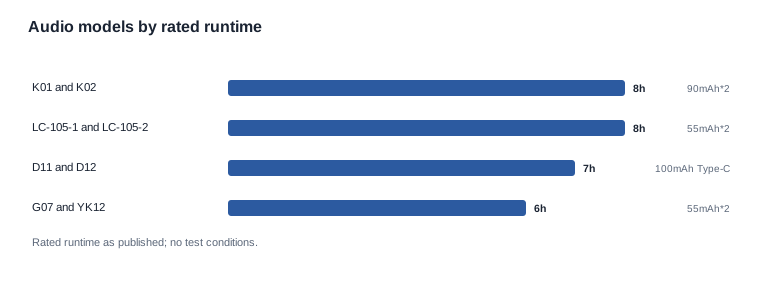
Three cell configurations and three runtime figures run across this table, and they do not line up. The 90mAh2 pair publishes around eight hours, the single 100 mAh pair publishes around seven, and the 55mAh2 group publishes around eight hours for two models and around six for the other two. A capacity-to-runtime mapping is therefore not available from the catalogue, and any shortlist built on the assumption that the larger cell automatically produces the longer run is built on an assumption the catalogue does not support. The grouping that does hold is the cell configuration itself, and that is why the range-level battery comparison is more useful as a structure than as a ranking.
Inside the audio range the LC-105-1 is one of two models whose published rows are identical in every position. The LC-105-2 publishes the same radio version, the same cell configuration, the same rated runtime, the same charge-time ceiling, the same charging method and no feature row. A decision on which model to take cannot be made from the catalogue at all, and a price-led selection between two documented-identical items is a decision where the whole risk sits in the specification file rather than in the range sheet. The ways to close that gap are a written difference statement from the supplier, a physical comparison of both units, or a decision to treat them as the same product under two names.
The camera models are worth placing in the same frame, because the class boundary is the first filter any buyer should apply. If a requirement involves capture, the eight audio models are excluded by class, and the camera models then sort by published resolution class, then by published charging-case capacity (five camera models publish one), then by ingress rating, where IP54 appears on V06 and S7. On the audio side the position is the reverse: no charging-case row is published for any of the eight audio models, and no ingress row either. That is what a platform decision looks like in practice — the audio models are structurally quieter, and the specification file has to be built from supplier answers rather than from catalogue rows.
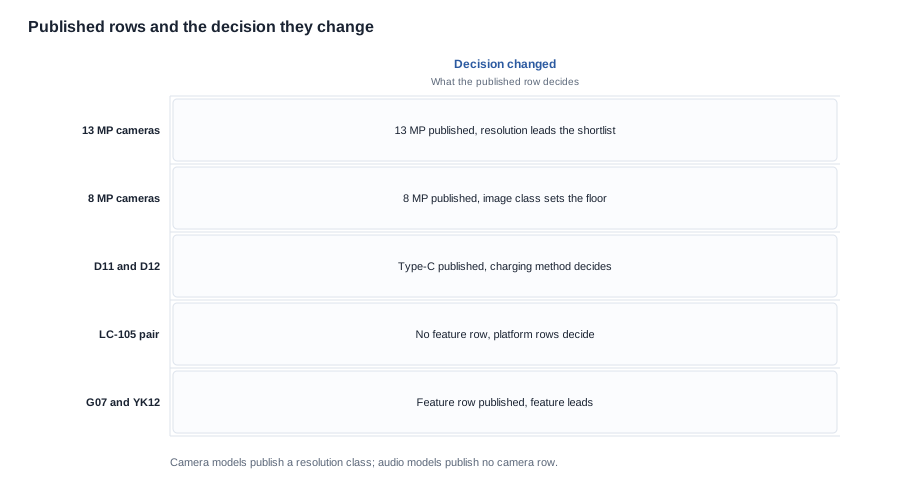
What each published row changes, in decision terms:
- A resolution class changes whether you shortlist camera models at all. A 13 MP requirement removes the 8 MP group from consideration before any other attribute is read.
- A published case capacity changes the accessory line on a quotation. A model with a published case capacity and a model with no published case row produce two different bills of materials, and the second one carries an open item.
- An ingress rating changes the deployment argument. IP54 on two camera models supports an outdoor claim that the audio models cannot support from catalogue evidence.
- A feature row changes the argument you make to a customer. Where D11, G07 and YK12 publish something, a listing can say what the model does. Where the LC-105-1 publishes nothing, the listing has to make its case on the platform rows instead.
- The absence of all of these changes what you can promise. For the LC-105-1, every attribute beyond the five rows is a request, and that is a procurement workload rather than a marketing problem.

The 55mAh*2 endurance band across four audio models
Four audio models publish the 55mAh*2 configuration, and they split into two runtime figures. The LC-105-1 and the LC-105-2 publish about eight hours. The G07 and the YK12 publish about six hours. Same cell configuration, different published runtime, and no test condition attached to either number. The honest reading is that the band runs from about six to about eight hours, that the figure describes a duty cycle and a measurement method rather than a battery, and that neither number can be compared with anything outside this group unless both sides used the same method.
The wider catalogue makes the same point in a different direction. Six models publish a rated runtime of about eight hours — K01, K02, LC-105-1 and LC-105-2 in the audio range, and YKC02 and ZH12 in the sport range — and they span four different cell configurations: 90mAh2, 55mAh2, 70mAh*2 and a single 100 mAh. A runtime that stays flat while the cell changes four different ways cannot be derived from capacity. The number is a rated claim, and the only way to compare two claims of that kind is to reproduce the conditions behind them.
That is how to verify a rated figure for this model, and the criteria are more specific than "test the battery":
- Write the protocol before the sample arrives. Fix the volume level, the codec, the duty cycle, the ambient temperature and the number of connected devices. Without a fixed protocol, two results cannot be compared and neither can be challenged.
- Run the same protocol on every shortlisted model. A result for the LC-105-1 alone tells you about the LC-105-1. A result for the LC-105-1, the G07 and the K01 tells you which of the three survives your conditions.
- Record the start and end conditions with the number. Start state of charge, end state, session length and interruptions belong next to the figure in the file.
- Treat an unconditioned figure as a rating, not as evidence. A supplier figure with no stated conditions is usable for shortlisting on paper and unusable as an acceptance criterion in a contract.
- Put your own protocol into the purchase order if the runtime matters to the deployment, so that the acceptance test is a written obligation rather than a conversation.
There are trade-offs in this, and they are commercial rather than technical. Asking a supplier to state a test condition narrows the pool of suppliers willing to answer, because some of them have no single test method across their range. Accepting unconditioned ratings keeps the pool wide and leaves your own file unable to compare anything. The way to hold both ends is to make the request in writing at quotation stage, to record the absence of an answer as a fact about that supplier, and to carry your own protocol into the sample stage. Buyers who want a general view of how charging options differ across this range can read the charging options note, but the acceptance criterion has to come from your own protocol.
The LC-105-1 specifications and features, row by row
Taken one at a time, with the decision each row supports and the question each row leaves open, the five published rows form a workable starting point for a specification file.
- Bluetooth V5.4 — decides radio generation, not compliance. It places the model with the newer half of the audio range and lets you exclude the V5.3 pair on protocol grounds. It does not supply the conformity evidence a European buyer needs, and that evidence is a written request.
- 55mAh*2 — decides the comparison group, not the runtime. It tells you which four audio models to compare against and which supplier questions matter, and it does not let you compute an expected run time from it.
- A rated runtime of about eight hours — decides which band you are shopping in. It is a rating without conditions, so it selects a band of roughly six to eight hours on this cell configuration and nothing more precise.
- A charge time of two hours or less — decides the planning assumption. It is a ceiling, useful for dock planning and useless for computing a break in a shift, because no starting state and no end criterion are published.
- Magnetic charging — decides the accessory and the interface. It separates the model from the Type-C pair, and it puts dock alignment and charge indication on the request list where they belong.
- No feature row — decides what your listing may claim. The catalogue publishes nothing beyond the five rows for this model, so a customer-facing description has to be built from platform facts and stated absences rather than from adjectives.
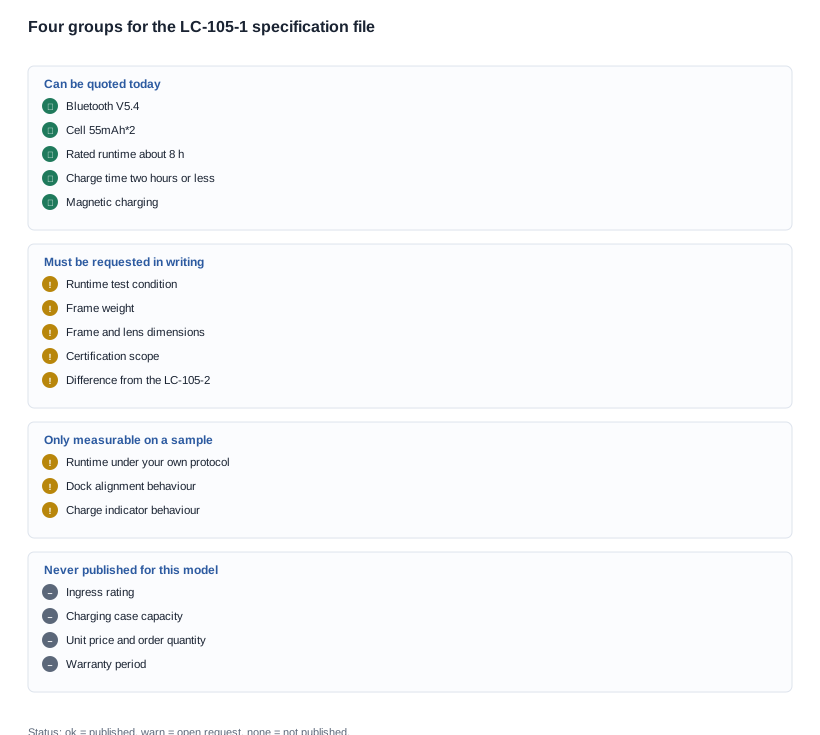
Four groups organise everything above into what can go into the file today, what has to be requested, what can only be established on a sample, and what the catalogue will never publish. The last group is worth naming explicitly, because a spec file that quietly omits an unpublished attribute reads as a finished document, and that is one of the red flags a procurement review should catch: ingress rating, charging-case capacity, unit price, minimum order quantity, lead time, warranty period and certificate numbers are not published for this model, and no amount of supplier questioning turns a catalogue gap into a published row. If a customer or a compliance reviewer needs one of them, the correct source is a supplier document that says so in writing.
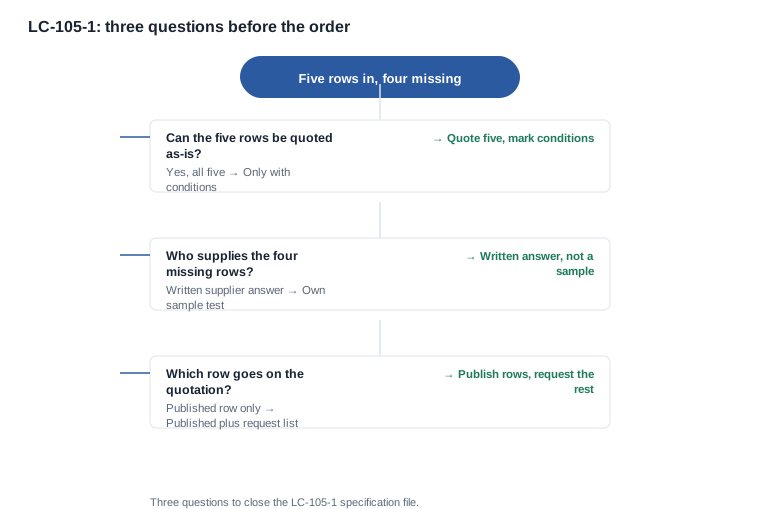
Three questions close the file before you order, and they close it in this order. First, can the five rows be quoted as they stand? Yes — with a condition note attached, because the runtime is rated and the charge time is a ceiling. Second, who supplies the four unpublished rows? The supplier, in writing, for anything documented, and your own measurement on a sample for anything physical. Third, which rows go on the quotation? The five published rows go on the quotation as the specification, and the four unpublished rows go on a request list attached to it, so that the two documents stay distinguishable and nobody downstream reads an open item as a published attribute.
That structure also settles how this model should be compared against its neighbours. Against the G07, the comparison runs on the cell configuration and the runtime band rather than on features, because the G07 publishes a detachable temple and the LC-105-1 does not — the form factor comparison is where that argument is set out in full. Against the LC-105-2, no catalogue comparison exists at all, and any difference you rely on must be a written supplier statement or a physical finding. Against the camera models, the class boundary settles it before any attribute is read.
For buyers building a shortlist rather than a single file, the audio range buying guide covers how these rows translate into a procurement sequence, and bulk ordering across the audio range covers the commercial side of the same models — where the catalogue leaves the terms open and what a quotation has to state on your side.
What can be confirmed for the LC-105-1 is this: five published rows, one cell group shared with three other audio models, one runtime band of roughly six to eight hours, one charging method, one feature row that does not exist, and one model — the LC-105-2 — whose published rows are identical to its own. Everything else is a request, and the LC-105-1 is listed on the Bluetooth audio glasses range page with the other seven models in the audio range. If you send the request list and the protocol you intend to test against, we can mark which rows can be closed from published information and which ones have to come back in writing from the factory.
Related reading
- How the two models differ on the rows that are published — LC-105-1 against the G07 on form factor
- The runtime figures across the audio models, set out row by row — audio glasses battery comparison
- How to judge a runtime figure before you accept it — choosing on battery life
- What the charging rows do and do not tell a buyer — charging options across the audio range
For the LC-105-1 the specification file starts with five published rows and ends with four written answers — send us your request list and your test protocol and we will mark which lines can be closed from published information.


