
Two model designations, one pair of catalogue pages, and a specification block that repeats itself line for line: 55mAh*2, about 8 hours, two hours or less to charge, magnetic charging, Bluetooth V5.4. A buyer searching lc-105-1 smart glasses vs lc-105-2 battery and charging is therefore not comparing two battery architectures. The comparison is between buying one product and buying two, and the price of buying two is paid in accessory SKUs, warranty lines and model strings rather than in specification rows.
That distinction matters because the LC-105-1 and the LC-105-2 are published on adjacent pages — the LC-105-1 on page 24, the LC-105-2 on page 25 — and neither page carries a feature line. The catalogue does not record a difference between them, which means a reader of the catalogue, including a customer comparing your two listings, cannot find one either.
The useful question is therefore not "which of the two has the better battery" but "what does each model string force me to run twice". Below is the row-by-row record of what the two designations publish, then the two places where a magnetic twin pair becomes expensive in practice: the endurance row, where the same figure is published with no test condition attached, and the charging row, where a single method word opens two accessory chains. The decision at the end is not which model is better on paper — the catalogue does not support that question — but whether your catalogue pages, your stock room and your warranty process can carry two identical products under two different names.
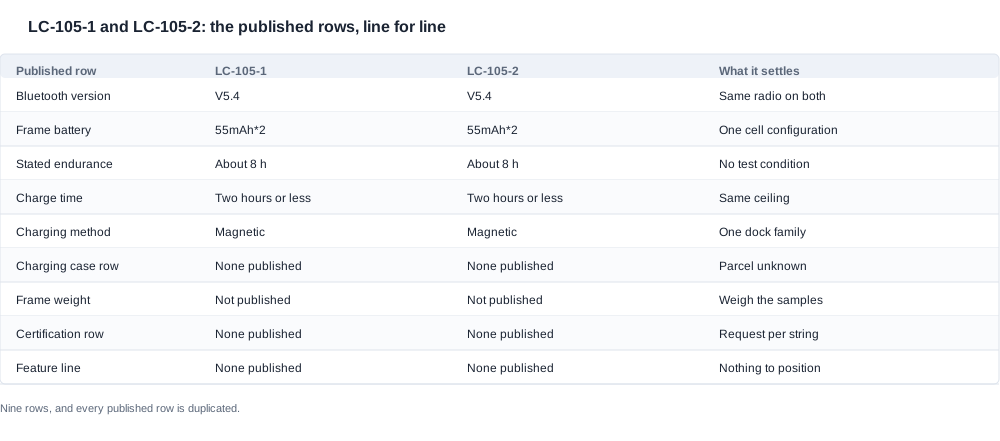
What the LC-105-1 and the LC-105-2 publish, row by row
The chart above is the whole of the published comparison: five specification rows that are identical across the two designations, and four rows that exist for neither. The identical rows are the interesting half. Bluetooth V5.4 on both. 55mAh*2 on both — written as a paired cell rather than a single number, which is how the catalogue expresses it. About 8 hours of stated endurance on both. Two hours or less to charge on both. Magnetic charging on both.
Then the four rows that are missing, and missing in a way that matters more than a duplicated row does. Neither designation publishes a charging case row, and the only case capacities in this catalogue belong to camera models, so no audio case figure exists to compare against or borrow. Neither designation publishes a frame weight, and the single published weight in the range — 158 g for the MT6 glasses unit — belongs to a camera model, so it cannot be used as a proxy for either LC-105. Neither designation publishes a per-model certification row. Neither designation publishes a feature line at all, and that is the row that would normally carry the difference between two otherwise identical products.
| Published row | LC-105-1 | LC-105-2 | What a buyer has to do |
|---|---|---|---|
| Bluetooth version | V5.4 | V5.4 | Use the same radio file |
| Frame battery | 55mAh*2 | 55mAh*2 | Order one cell configuration |
| Stated endurance | About 8 h | About 8 h | Do not rank it against a 6 h row |
| Charge time | Two hours or less | Two hours or less | One acceptance ceiling |
| Charging method | Magnetic | Magnetic | One dock family, two SKU chains |
| Charging case row | Not published | Not published | Request it per model string |
| Frame weight | Not published | Not published | Weigh the samples |
| Per-model certification row | None published | None published | Request documents per string |
| Feature line | None published | None published | Get the difference in writing |
Read as a pair, the LC-105-1 and the LC-105-2 publish no difference at all on battery or charging. Read as a system, they publish something else entirely: the model string is the only surviving differentiator between them, and every downstream process in a hardware business keys off the model string. Two designations therefore mean two artwork files, two barcode values, two accessory purchase orders, two serial ranges and two warranty lines — all of them managing products whose published specification rows are identical.
The certification point is worth separating out, because it is the one place where duplicated rows do not protect you. Radio identifiers and conformity documents are keyed to the model designation: a document naming the LC-105-1 does not automatically cover the LC-105-2, even when the two publish the same radio version. Our catalogue records no CE, FCC or RoHS marking for any model in the range, and it carries no per-model certification row for either designation; the only framework references published alongside the range are the RED (EU) 2014/53/EU and the EMC (EU) 2014/32/EU directives. The document request is therefore per model string, and it has to be made before either designation reaches a purchase order.
The page pair also tells you something about how the range is structured. The LC-105-1 and the LC-105-2 sit among eight audio models — the LC-105-1 and the G07, the D12 and the K02, the YK12 and the LC-105-2, and the K01 and the D11 — and they are one of three pairs inside that eight that publish the same rows as each other. That is a catalogue convention for platform families: the pair shares the platform, and the second designation is reserved for a variant the specification table has not yet described. Whether it describes one for the LC-105 pair is the question worth asking, and it is answerable.
The row-by-row read therefore hands you one commercially decisive number. The LC-105-1 and the LC-105-2 are the same product as published. Whether that is a manufacturing reality or a catalogue simplification is exactly what has to be put in writing, and the answer decides the rest of this article — how many accessory chains you run, how many warranty lines you open, and how many model strings a customer sees on your storefront.
The endurance row: same figure, same configuration, no test condition
The chart below is the reason an "about 8 hours" figure cannot be used as a comparison value anywhere in this catalogue.
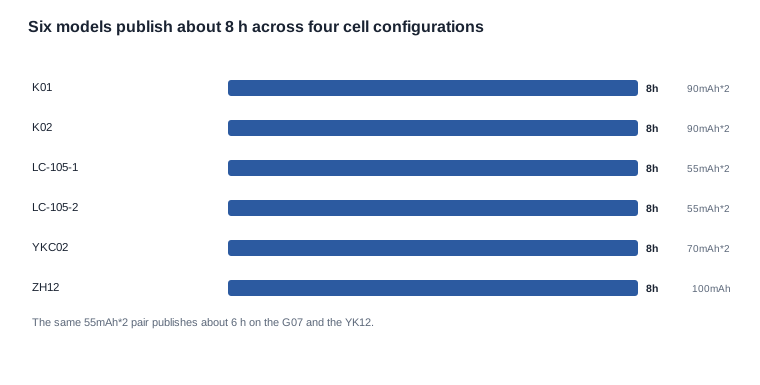
Six models publish about 8 hours: the K02 and the LC-105-1, the LC-105-2 and the ZH12, and the K01 and the YKC02. They do it on four different cell configurations — 90mAh2 on the K01 and the K02, 55mAh2 on the LC-105-1 and the LC-105-2, 70mAh*2 on the YKC02, and 100mAh on the ZH12. If capacity set the outcome, those four configurations could not carry the same number. They do, which means the figure is a label attached to a test or to a habit, not a consequence of the published cell.
The 55mAh2 pair makes the point sharper. Within that single configuration the published endurance spans a two-hour range: the G07 and the YK12 publish about 6 hours on the same paired cell that the LC-105-1 and the LC-105-2 publish as about 8 hours. Both numbers belong to the same catalogue, both are written against 55mAh2, and neither is a misprint of the other. Write the G07 or the YK12 as an 8-hour model and you have misstated a published row; write 8 hours as though it were the uniform value of the 55mAh*2 tier and you have made a claim the catalogue contradicts a few pages earlier.
The LC-105-1 and the LC-105-2 also publish no test condition, and no model in the range publishes one. Missing from every endurance row here are the things that make a runtime number reproducible: the playback volume, the audio source and codec, whether playback is continuous or intermittent, the state of charge at the start, the criterion for a finished run, the ambient temperature, and the number of units sampled. Without those, "about 8 hours" cannot be converted into shift length, cannot be sorted against another model, and cannot be reproduced by anyone who buys a sample.
There is a commercial consequence for the two LC-105 designations specifically. If the endurance figure appears on your listing page, you are making the claim in your own name, and your customer will hold you to the number rather than to the catalogue. You have three honest options: publish it as a ceiling, publish it as a class label such as "rated for approximately 8 hours of playback", or obtain the test condition and publish the figure with the condition attached. The third is the only one that survives a customer complaint, and it is a request you can make in a single line.
A figure published without a condition is not a specification, and the LC-105-1 and the LC-105-2 publish two of them side by side. Decide which model string to list the runtime under before any artwork is produced, because a claim that lands on the wrong listing page is a support question you will answer twice, once for each string.
Another consequence sits on the wearer's side of the same row. An end user charging a magnetic pair at a desk, in an airport queue, or between meetings is working with a two-hour ceiling and a contact that has to seat correctly, and the eight-hour figure is what decides how often that interruption has to happen. Two designations that publish the same runtime therefore produce the same daily rhythm for the wearer, and any channel promise built on "the 8-hour model" applies identically to both strings.
There is a second-order point about the two-hour spread inside the 55mAh*2 tier. Amplifier efficiency, firmware power management and inconsistent measurement between models are all plausible causes, and none of them is documented. If the spread is a firmware artefact, then a difference between the LC-105-1 and the LC-105-2 could exist in exactly the dimension the published rows hide, and it would show up in your own measurement while remaining invisible on the page. A sample round that covers both strings is therefore the cheapest way to find out whether you are really shipping two products or one product with two labels.
For a single SKU the runtime question stays a documentation request: get the condition, write it into your product file, and quote the figure with a qualifier. For two SKUs you have a second reason to measure, because your own result becomes the only defensible way to tell the two designations apart if the written difference turns out to be about power management rather than colour.
The charging row: one method word, two accessory chains
The published charging word for both LC-105 designations is "magnetic", and that one word carries more operational weight in a hardware business than its length suggests.

The audio group in this catalogue holds eight models: the K01 and the LC-105-2, the LC-105-1 and the K02, the D12 and the YK12, and the D11 and the G07. Six of the eight publish magnetic charging — the K01 and the YK12, the G07 and the LC-105-1, and the K02 and the LC-105-2 — and Type-C appears on exactly one pair, the D11 and the D12. The LC-105-1 and the LC-105-2 therefore sit inside the majority method family of the audio group, which is good news for accessory planning: the interface they need is the one you are most likely stocking already.
What "magnetic" does not tell you is the chain behind it. For each model string a real chain runs: the model string on the purchase order and the carton, the contact geometry and the dock or cable that ships with the unit, the accessory SKU you buy as spares, the packaging line that holds it, the state-of-charge reporting in the app, and the warranty and return routing that identifies the unit by its serial label. The chain is keyed to the model string, not to the specification row. Two designations with identical rows still run two chains, and the chains diverge at the SKU and the serial range even where the docks look identical on a shelf.
The dock is the first request. Neither the LC-105-1 nor the LC-105-2 publishes a charging case row, so nothing in the catalogue tells you whether a dock or a cable ships with the unit, whether that dock is charged over a cable of its own, and which cable it is. If a dock ships, the cable question moves one step down the chain: it becomes a packaging line, a carton dimension, and a claim on your listing about what is in the box. Note the limit of what can be inferred here — because no case row is published for either audio designation, you cannot conclude that a case ships and you cannot conclude that one does not. It is an open request, and it has to be answered in writing for each model string separately.
The accessory order should name which model string to buy against, because the same dock will sit under two references in one catalogue. A buyer who leaves that line blank ends up with a warehouse holding one dock for half the range and a returns process that cannot tell the two strings apart.
The alignment tolerance is the second request, and it is the one that reaches the end user. A magnetic contact that seats slightly off can present to the wearer as charging while progressing slowly, which is the most common early support contact in this form factor. For a single SKU that is a support script. For two designations it is two support scripts, two acceptance-test setups, and two sets of measured contact positions on the factory floor.
The third request sits with logistics rather than with the product. The state of charge permitted for air shipment is not published for either LC-105 designation, and lithium battery shipment documentation depends on it. The freight file is keyed to the model string too, so a two-model catalogue produces two freight files, two carrier profiles and two sets of paperwork for goods that are electrically identical.
The last request is about what you may not promise. Neither designation publishes a fast-charge option or an alternate charging interface, so a fast-charge variant cannot be planned into the listing, the carton or the price. And because no audio model in this range publishes a weight, the charging accessory you plan around cannot be sized from a catalogue figure either; that number has to come from weighing the sample.
Taken together, the charging row is where the two-model decision becomes expensive. A duplicated specification table costs a paragraph. A duplicated accessory chain costs a SKU, a spare-stock line, a carton print, a support script, a freight profile and a warranty route — six cost lines that all key off a model string that the catalogue publishes as interchangeable.

What running both the LC-105-1 and the LC-105-2 costs you
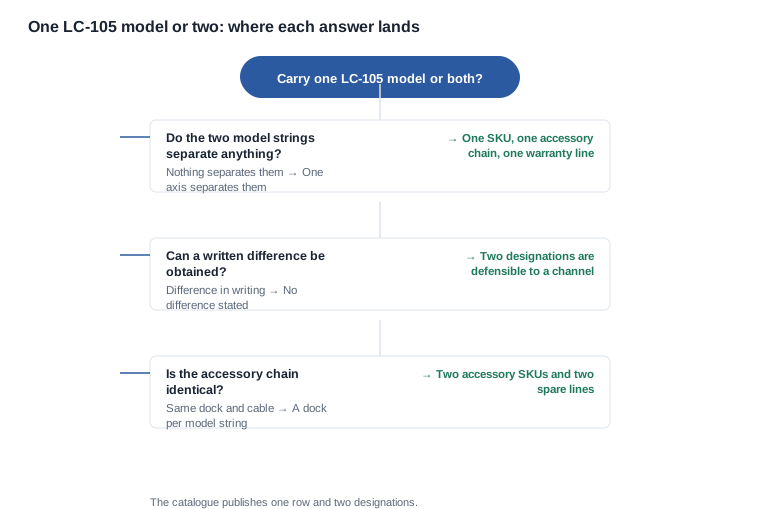
The decision chart above reduces the two-model question to three questions, and each answer lands on a different cost line.
The first question is whether the designations differ at all. If the supplier confirms in writing that nothing separates the LC-105-1 from the LC-105-2 — same cell, same power management behaviour, same dock, same everything the catalogue can see — then the defensible commercial decision is to run one SKU, because a range that cannot be explained to a customer is a range that generates returns. If a difference exists but is known only internally, the decision is to get it in writing before the first artwork is released, because an undocumented difference is a difference you cannot merchandise and cannot defend in a returns dispute.
Here is where the cost lands if you carry both designations:
- Catalogue and artwork: two SKU codes, two listings, two sets of claims. With identical published rows, one of the two listings is effectively a copy of the other, and a channel that sees two identical listings at two prices will take the cheaper one and then query the difference.
- Stock and packaging: two accessory SKUs, two carton print runs, two sets of minimum order quantities, and more dead stock in a range where nothing separates the two items.
- Warranty and returns: two warranty lines, two serial ranges, two return routings. A technician asked to diagnose a magnetic charging fault on an LC-105-1 has no way to tell from the specification which string the unit carries.
- Documentation scope: radio identifiers, test reports and declarations of conformity are requested per model string, so two designations mean two document sets to track through approval before shipment.
- Sampling and testing: two strings to cover in the sample round, and if you measure runtime at all, the result has to be recorded per string or it cannot settle anything.
- Channel credibility: a distributor asking what separates the two models receives the catalogue answer, which is that nothing is published. That answer has to be replaced with something of your own, and the only defensible something is the supplier's written difference.
The counter-argument for carrying both is real and it is the one to test first. If the difference is genuine but unpublished — a colourway, a fit, a firmware revision, a dock interface, a regional SKU — then two model strings become a legitimate commercial axis, and the cost of the second chain buys you a second shelf position. The sequence is what matters. The difference has to exist in writing before the second SKU exists in your system, because the catalogue row is what your customer, your distributor and your freight forwarder will all hold you to, and that row is identical.
The order in which you take those decisions matters more than most buyers expect, because only one of them is genuinely reversible. Choosing which accessory chain to run is a purchasing decision that can be redone at the next reorder, but publishing two model strings on a storefront is a customer-facing decision that has to be undone through listings, packaging artwork, serial ranges and warranty paperwork. The LC-105-1 and the LC-105-2 make that sequencing concrete, because the specification row has already been decided for you — identical on both pages — so the only decision still open to you is how many model strings you want to carry, and what the second one is worth.
There is one more cost the chart cannot show: the cost of the question itself. Every month the LC-105-1 and the LC-105-2 sit side by side in your system with identical rows, a colleague will eventually ask which one to order, and the answer will have to come from someone. Write the difference down once and the question has a permanent answer. Leave it open and it is re-asked at every reorder, with a slightly different person each time.
The questions to settle before you commit to one LC-105 model
The list below is the documentation request that has to close before either designation goes on a purchase order, into artwork, or onto a storefront listing. Every item is answerable in writing by a supplier, and every item changes a cost line rather than a specification.
- What physically separates the LC-105-1 from the LC-105-2 — the cell, the power management, the dock interface, the colour, or nothing at all? A written answer, not a verbal one.
- If the cells or the power management differ, what is the stated endurance for each designation under the same stated test condition?
- What is the test condition behind "about 8 hours" for each model string: playback volume, audio source and codec, continuous or intermittent playback, state of charge at the start, the criterion for a finished run, ambient temperature, and how many units were sampled?
- What ships in the box with each model — a dock, a cable, both — and if a dock ships, what cable charges the dock, and does that cable ship as well?
- Is the charging interface identical on both designations, or does the contact geometry differ? A different contact means a different accessory SKU and a different spare-stock line.
- Is a charging case available for either designation, and if so at what capacity? No case row is published for either, and the case capacities that do exist in this catalogue belong to camera models, so they cannot be transferred to an audio designation.
- Is there a fast-charge option or any alternate charging interface for either designation? Nothing of that kind is published, so any such promise needs a written basis.
- What magnetic alignment tolerance should be written into the acceptance plan and into the support script for each designation?
- What state of charge is permitted at shipment for each model string, and which carrier and documentation profile applies to each?
- Do the radio identifier and the conformity documents for each designation need to be filed separately, and against which standards framework? The only framework references published for this range are the RED (EU) 2014/53/EU and the EMC (EU) 2014/32/EU directives.
- Which model string is the master record for warranty, returns and serial tracking, and which one is the sales-facing alias? Decide this before the first order, because the two roles are hard to swap later.
- If you run a single SKU, which designation does it carry, and does the other catalogue page stay live as a redirect or an archive?
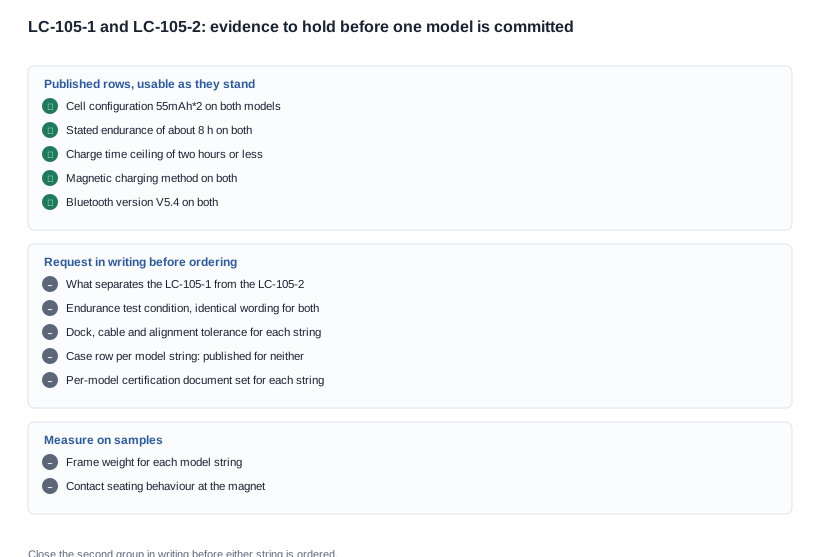
One decision on that list is commercial rather than technical: decide which model string to put in front of a customer, and what the second one is for. The catalogue gives no permission to answer that from the specification page, because the specification page is identical on both designations, and any answer you give has to be one your customer will accept rather than one you can prove.
A buyer should also decide which of those questions belongs to the sample stage and which belongs to the document stage, because the two carry very different costs. Cell behaviour, contact seating and frame weight can only be measured on a unit in your hand, while the endurance condition, the accessory scope and the certification position are all answerable in writing by a supplier before anything ships. Deciding that split early keeps the sample round small, and it stops a documentation gap from being discovered once the units are already in your warehouse.
The first three items decide whether the endurance row can appear on a listing at all. The fourth through ninth decide the accessory chain and the freight file. The last three decide whether one model string or two runs through your back office for the next few years, and they are the cheapest of the twelve to get right, because they cost nothing to answer and everything to answer late.
Write the decision down with a date and an owner, the same way the certification file is written down. The decision to carry one LC-105 designation or two is the one most likely to be reopened by a new colleague who has never read the answer, and a recorded decision with a date attached is what stops that loop. The reply your team should be able to give without looking anything up is one sentence in the product file, naming the difference that justified the second designation and the date it was confirmed.
The honest summary for the LC-105-1 and the LC-105-2 is this. They publish the same cell, the same stated endurance, the same charge time, the same charging method and the same radio version, and neither publishes a feature line to tell a buyer apart. That is not a comparison; it is a duplicated row. What the duplication buys a buyer is a choice of model string, and what it costs is a second accessory SKU, a second warranty line and a second document trail. The decision to run both should be made against a written difference, and the decision to run one should be made against the cost of carrying two identical products — not against a specification that does not exist.
Related reading
- The published rows for the other designation — LC-105-2 smart glasses limitations
- Where the LC-105-1 sits in the range — LC-105-1 smart glasses how it compares
- The other twin pair in the audio group — K01 vs K02 spec comparison
- The charging families across the audio group — Bluetooth audio glasses charging options
- The battery rows on the camera side — AI camera glasses battery comparison
- The document set that travels with the goods — Bluetooth audio glasses export considerations
Send us the two model strings you are holding and we will tell you which accessory chain each one forces on you — and where the published rows stop and a written supplier answer has to take over.


