
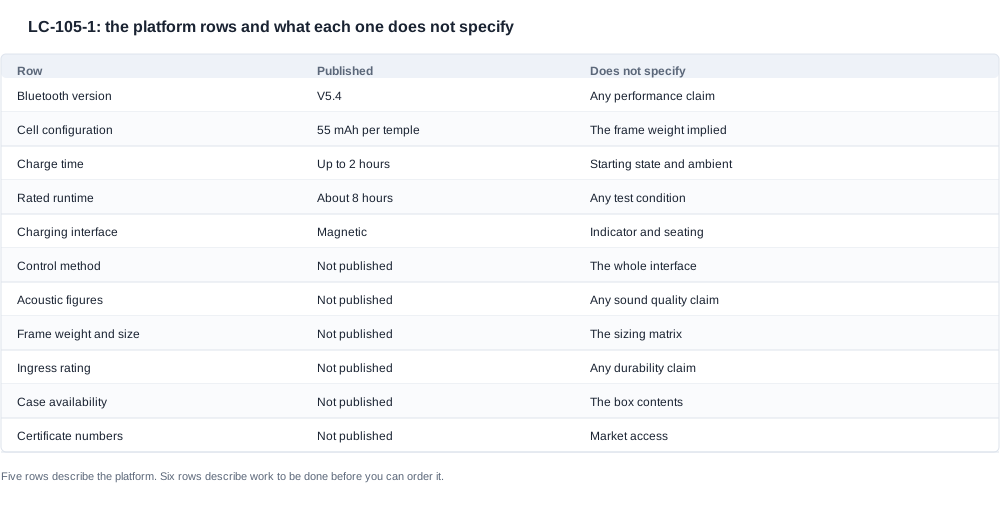
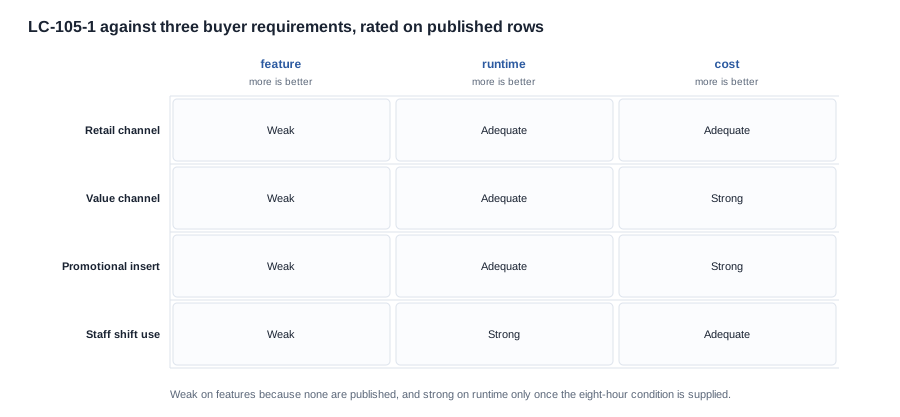
The conclusion first, because the checklist for this model is unusual. The LC-105-1 has no distinctive published feature at all. It publishes Bluetooth V5.4, a 55 mAh × 2 battery, a charge time of up to two hours, a rated runtime of approximately eight hours and magnetic charging. There is no touch control, no surround sound descriptor, no application, no translation, no photochromic lens, no charging case and no temple description.
That does not make it a weak product. It makes the pre-ordering work different in kind. On a model with features, you verify claims; on this one, you resolve unspecified things. Three of them are load-bearing — how the product is controlled, what distinguishes it from its identically specified sibling, and how it is sized. Everything else follows from the platform rows, and this article is about the three, plus the eleven rows that belong in a quotation.
LC-105-1 has no distinctive feature, which changes what diligence means
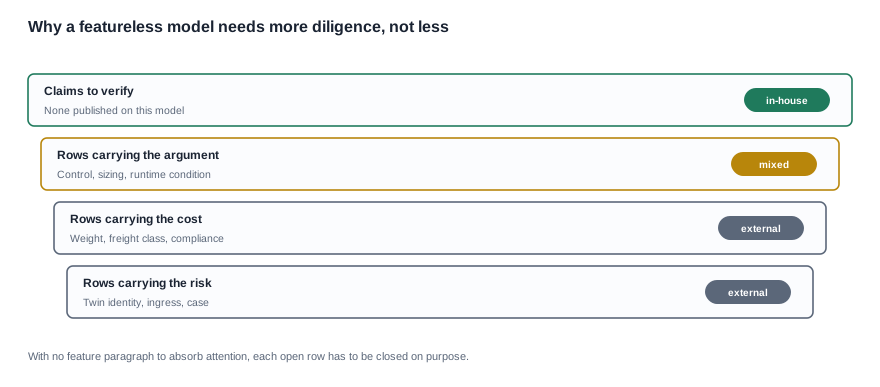
A feature-led model gives you something to verify. You ask whether the translation runs on the device, whether a touch surface false-activates, whether the photochromic lens darkens fast enough for the claim. The questions are specific and the answers are checkable.
This model gives you nothing to verify, which is not the same as nothing to ask. When a specification sheet has no features on it, every remaining row carries the whole argument for the product, and there is no compelling row to hide behind while the others are closed. Buyers routinely observe that the model with the fewest claims is the one where their own diligence matters most, and that observation is correct for a mechanical reason rather than a rhetorical one: there is no feature paragraph to absorb the attention that would otherwise be spent on the specification.
The practical consequence for procurement is that the evaluation is shorter in one sense and longer in another. It is shorter because there is nothing to test beyond the basics. It is longer because the three unspecified things have to be closed before anything else can be planned, and none of them can be closed from a catalogue.
It is worth being concrete about the failure mode this creates. A buyer who assumes a feature because every competitor model has it will write copy for a capability the product does not have, and the correction will arrive as a customer complaint rather than as a specification review. On this model that risk is lower than anywhere else in the range, because there is nothing in the published file to mislead anybody. The risk has simply moved to the rows that are empty.
That is also why the sample order carries more weight here than on a feature-led model. On a feature-led model the sample confirms a claim. On this one the sample is where the three answers get measured, because none of them is available in writing for a model with this little published.

The platform rows, and the two-hour spread inside one family
Read the published row as a description of a platform rather than of a differentiated model. Bluetooth V5.4 puts it with the newest radio generation in the range. The 55 mAh × 2 configuration places it with the G07, the YK12 and the LC-105-2, all of which share the cell configuration, the charge time and the charging method. A rated runtime of approximately eight hours is at the top of the published audio range.
Two-cell configuration, one family, and two published hours above the G07 and the YK12 on the same cells. That difference is worth understanding rather than repeating, because it is either a platform-tuning difference or a measurement difference, and no test condition is published for any of the figures. Ask whether the LC-105-1 and the G07 runtimes were measured the same way. If they were not, the numbers cannot sit in the same comparison chart on your site, and the chart is the thing customers actually read.
The magnetic interface is published and settles the packaging question, but it introduces a behaviour your own documentation has to cover. A temple seated slightly off the dock can appear to charge while progressing slowly, which reads to a customer as an intermittent fault rather than as a seating problem. Confirm the seating instruction and the indicator behaviour before you write a quick-start guide, because that guide is also the first line of your support macro.
That distinction also tells you how to write the request. An absent row needs a different question from an unpublished one, and a supplier who answers both in the same paragraph has probably not read either. Asking "does this row exist for this model?" and asking "what is the value for this model?" produce different replies, and the first one is the question worth asking first.
Ask which of these rows are genuinely absent and which are simply unpublished, because the two cases lead to different decisions. A row that exists and is not published is a documentation request that will be answered in a day. A row that does not exist cannot be created by asking, and if your channel needs it, the model is the wrong one regardless of how the request is phrased.
What the row does not say about the product itself is the more important half. No input method is published, no acoustic figures are published, there is no application, no weight, no dimensions, no ingress rating, no certification detail and no storage specification. This is the most ordinary model in our audio range, and it is the one where the buyer's own questions carry the most weight.
Three unresolved items: control, identity and sizing
How is it controlled? Nothing is published. No model in the range publishes a touch control row — not the K01, not the D11, not the D12. A product with no documented control method has no documented user experience, which means your customer instruction leaflet cannot be written from the specification, and it means your support desk has no reference to work from. This is the question that gets asked first after the first hundred units, and it should be answered before the first unit ships.
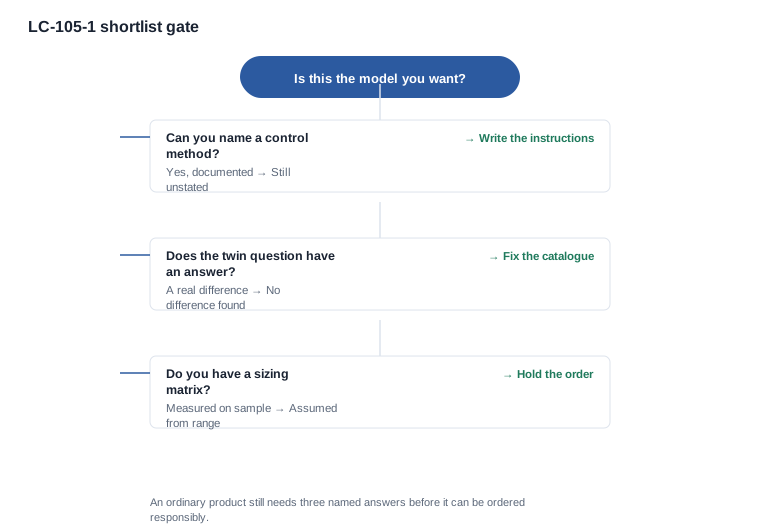
What distinguishes the LC-105-1 from the LC-105-2? The published specifications are identical in every row, and our own documentation does not say what separates them. We are not going to invent a difference. If the answer is a colour, a temple, a shell revision or a firmware change, that is workable and you can price it. If the answer is that they are the same product under two designations, your catalogue should say so, and your inventory and your product pages should not both carry it.
How is it sized? No frame weight, no temple length, no lens dimension, no head-size range and no temple description are published. This is the item that decides your return rate, and it is the one the specification cannot help with at all. Weigh a sample, measure it, and build a sizing matrix from the measurements rather than from the range average.
Where the identity answer is that the two models are the same product under two designations, the right response is not to keep both for range breadth but to consolidate your catalogue and your inventory, and to negotiate the single configuration you actually need. Two entries for one product is a cost in packaging, in stock and in search results, and it buys you nothing a buyer can see.
Order them that way in practice: settle identity first because it determines whether your two catalogue pages are describing two products or one, then settle control and sizing together on a single sample order, because both are measured on the same unit and the same session.
The three are related in a useful way. Control and sizing are things a sample settles. Identity is not a thing a sample settles at all — it is a documentation question, and the answer determines whether the other two are being measured on one product or two.

The eleven rows that belong in a quotation
Some of these are the gaps every model in this range carries, and some are specific to this one. Either way they belong in the quotation rather than in an email thread, because they end up in your listing and in your technical file.
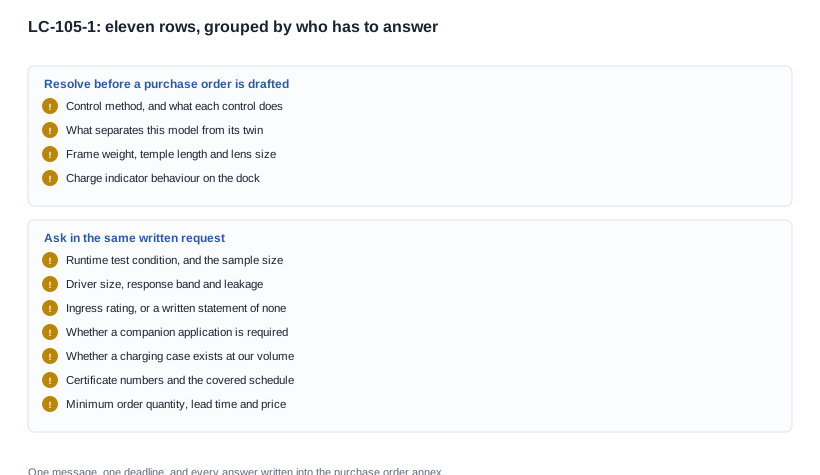
- The control method, and the physical behaviour of each control — including whether a long press does something different from a short press.
- Whether a companion application is required, and if so who publishes it — not published.
- The charge indication behaviour — what the customer sees when the temple is seated on the magnetic dock, and how remaining charge is shown.
- The rated runtime and the test condition behind it — and whether it is comparable with the figures published for the G07 and the YK12.
- The difference between the two LC-105 models — not published.
- Frame weight, temple length, lens dimensions and adjustability — not published.
- Acoustic figures — no leakage, driver size, frequency response, microphone count or pickup distance published. An open-ear frame with no acoustic specification is a frame whose sound quality has to be judged by ear.
- Ingress protection — not published.
- Certificate numbers, issuing bodies, validity periods and covered model schedules — not published, and the compliance work sits inside your landed cost.
- Whether a charging case is available at your quantity — not published, and no model in the audio range publishes one. If your retail model needs a case in the box, that is a question to ask now rather than after the packaging is designed.
- Minimum order quantity, lead time and price — not published. Our internal documentation holds conflicting minimum order figures that have not been arbitrated, and we will not put one in an article.

Score the answers by shape rather than by content. A number with a stated method and an attached document is usable; a number without a method is a starting point for negotiation; a confident adjective is nothing at all and should be recorded as absent rather than as answered. Put the eleven replies in a single sheet with a column for the answer type and one for the evidence, because a structured comparison takes about ten minutes per supplier and converts an opinion into a record.
The commercial terms belong in the same exchange rather than in a follow-up. Ask the minimum order quantity, the lead time and the price per colourway in the quotation, where they can be committed to, and ask which clock starts the lead time — deposit, artwork approval or a confirmed purchase order. Our internal documentation currently holds conflicting minimum order figures that have not been arbitrated, so treat any figure given verbally as provisional until it appears in writing.
The commercial terms belong in the same exchange rather than in a follow-up. Ask the minimum order quantity, the lead time and the price per colourway in the quotation, where they can be committed to, and ask which clock starts the lead time. Our internal documentation currently holds conflicting minimum order figures that have not been arbitrated, so treat any figure given verbally as provisional until it appears in writing, and negotiate from the written version.
Send all eleven as one request with a deadline, and write the answers into the purchase order annex rather than leaving them in correspondence. A term that exists only in an email is not a term, and a figure that exists only in an email will not survive the first inspection finding.

Sample work that the specification cannot do for you
On this model the sample is not a confirmation exercise. It is where two of the three unresolved items get their answer, and the test list should reflect that.
- Find and operate every control, and write down what each one does. Do not assume the behaviour from a similar model — the absence of a published method is exactly why this test is necessary.
- Charge each temple separately, timing both, and note the indicator at three points: seated, mid-charge and complete.
- Weigh five assembled units and record the spread as well as the average. A tight spread is evidence of a stable bill of materials; a wide spread is a question about component substitution.
- Measure temple length, lens dimension and bridge, and check the adjustment range if the temples move.
- Run to depletion at a stated volume with the Bluetooth link continuously active, and write the method beside the number.
- Test the call path in reproduced background noise, with a fixed source, a fixed distance and a fixed position.
- Confirm the box contents line by line against the quotation, including whether a cable ships.
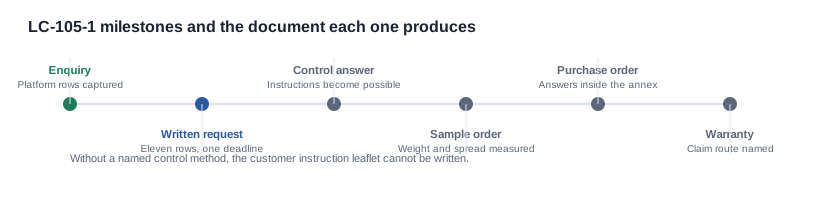
Ask also what happens to the sample units after testing — whether they can be folded into a production run, shipped separately, or must be disposed of. Each answer changes the arithmetic and none of them is obvious from outside, which is a good description of most of the commercial rows on this model.
State the sample order policy in the same quotation — units, cost, dispatch time, and whether the cost is credited against a first bulk order. A sample that is neither credited nor discounted is a real cost on a product at this price point, and it is the kind of term that is agreed in principle and never revisited.
Tie the balance payment to a passed pre-shipment inspection rather than to a shipping date, so the money and the evidence move together, and write the defect allowance and its remedy beside each other. An allowance without a remedy becomes a negotiation that starts once the container has sailed.
Keep the sample units. When the production lot arrives, repeating the weight spread and the runtime test on a unit drawn from the packed cartons turns the sample into a baseline rather than an anecdote, and that comparison is what you want in a quality conversation rather than a dispute about whether anything was ever wrong.
Who should buy this model, and what we will not fill in
The LC-105-1 is a straightforward, well-powered open-ear frame on a current radio version, and a buyer who wants an uncomplicated product with a good published runtime and no feature claims to defend is looking at the right model. It suits channels that compete on price and on simplicity, where the product page can be short because the product is short, and where a customer who asks two questions gets two answers.
Where they do, the empty rows are a cost of doing business rather than a defect in the product, and the right response is to change the page rather than to find a different model. Describe what the product is, list what is published, and let the buyer complete the comparison themselves — a page that admits its gaps reads as more reliable than one that fills them in.
The practical test is whether your buyers read a comparison table before they read a photograph. If they do, this model loses to a competitor with a fuller file, and no amount of sampling will change that outcome. If they do not, the empty rows cost you nothing and the price and the simplicity carry the sale.
It is the wrong model for channels that compete on specifications. A channel whose buyers read a comparison table will find the control method, the acoustic figures, the sizing data and the certificate numbers empty, and they will choose the competitor whose table is fuller even when the products are comparable. That is not a criticism of the model; it is a statement about which argument the model is built to win.
Buyers who want to move quickly can run a three-question version first: the control method, the twin difference, and the frame weight. Those three answers will settle whether this model belongs on your shortlist at all. The remaining eight rows are refinement rather than qualification, and asking for refinement before qualification is what turns a three-week evaluation into a two-month one.
The LC-105-1 is a well-built platform whose specification is complete enough to plan a range with and too thin to write a product page from. We will not fill any of the eleven rows above with typical values from the industry. The industry-typical value is how a product ends up failing its own specification sheet, and in this case the gaps are simply the gaps.
One closing note on timing. Every row on this list is cheaper to ask before the sample order than after it, because the sample is the only part of the evaluation that costs real money. A buyer who sends the eleven rows in a single message with a stated deadline will usually have the control method, the twin difference and the frame weight answered inside a week, and can then order one sample and measure everything else in a single session.
If you tell us the channel, the volume, the target market and whether you need a case and a control method documented, we will come back with what is available and what is not.
Related reading
- The platform this model sits on — YK12 specifications
- How a detachable temple changes the comparison — LC-105-1 against the G07
- Reading competing runtime figures honestly — battery comparison for Bluetooth audio glasses
- The document set to request — Bluetooth SIG certification checklist
Tell us the channel, the volume and the target market, and we will come back with what is available and what is not.


