

Two products that sit in the same audio section of the range, with the same radio generation and the same charge ceiling, are compared by buyers on price. The comparison is legitimate, and in this case it is also more interesting than usual, because the published rows for the two differ in a way that has direct commercial consequences: one of them charges over a magnetic contact and the other charges over a standard connector, and that single difference creates a per-unit cost that never appears in either unit price.
This page works through what a price position between the two can actually be based on, what the published rows do and do not settle, and how to build the comparison so that it survives contact with two real quotations. It is worth reading alongside the deployment match against the D12, which isolates a different variable.
LC-105-2 against the D11: what a price comparison can be based on
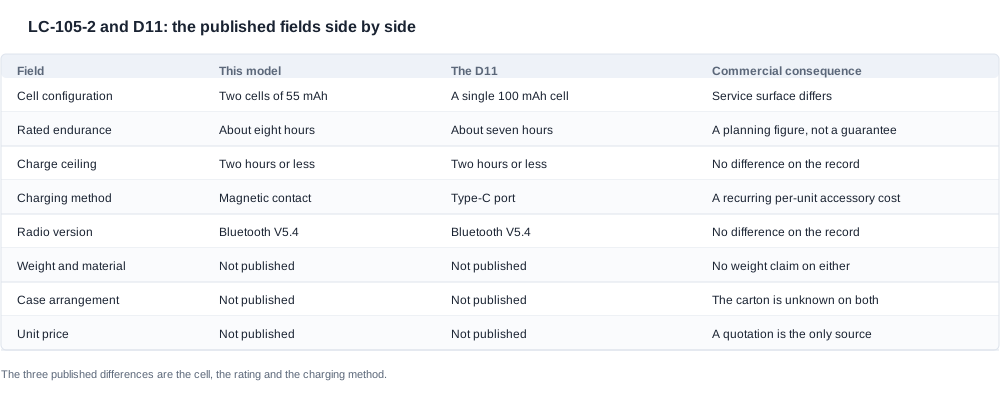
The starting point is the published rows, and they are worth putting in one place because the differences between them are easy to misread. The D11 is published with a single 100 mAh cell, a rated endurance of about seven hours, a charge time of two hours or less, Type-C charging, and a radio at version 5.4. This model is published with a pair of 55 mAh cells, roughly eight hours of rated use, an upper bound of two hours on a charge, and magnetic charging, with the same radio generation as the other product.
Three things follow from that, and only three.
The cell arrangements differ. One of these products carries a single larger cell; the other carries two smaller ones. The catalogue publishes the values and the count for each, and it does not publish the total for either, so a buyer who adds the two values has derived a figure and should say so. The arrangement question is not cosmetic: a product with one cell has one cell to manage in service, while a product with two may present a state that is not the same on both sides, and the catalogue publishes nothing about how the two are arranged or what state the product reports in that case.
The rated endurances differ by about an hour. That is a real published difference, and it is the one most likely to be quoted in a comparison. It is also the difference most likely to be over-read, because a rating without a test condition is a planning figure rather than a measurement, and two ratings published without conditions are not necessarily measured on the same basis. The hour is a fact about the published rows and is not, on its own, a fact about which product runs longer in a particular deployment.
The charging methods differ, and this is the commercially significant one. A Type-C product charges with a standard cable that a customer, a distributor or a technician is almost certain to already own. A magnetic product charges with a proprietary lead that has to be stocked, counted, replaced and explained. That difference has no effect on the device cost and a large effect on everything around the device.
The radio generation is the same on both, so it does not discriminate between them, and neither does the charge ceiling. A buyer looking for a technical differentiator between these two products on the published record will find the cell configuration, the rating and the charging method, and that is the whole list.

Where a price difference between them is genuinely created
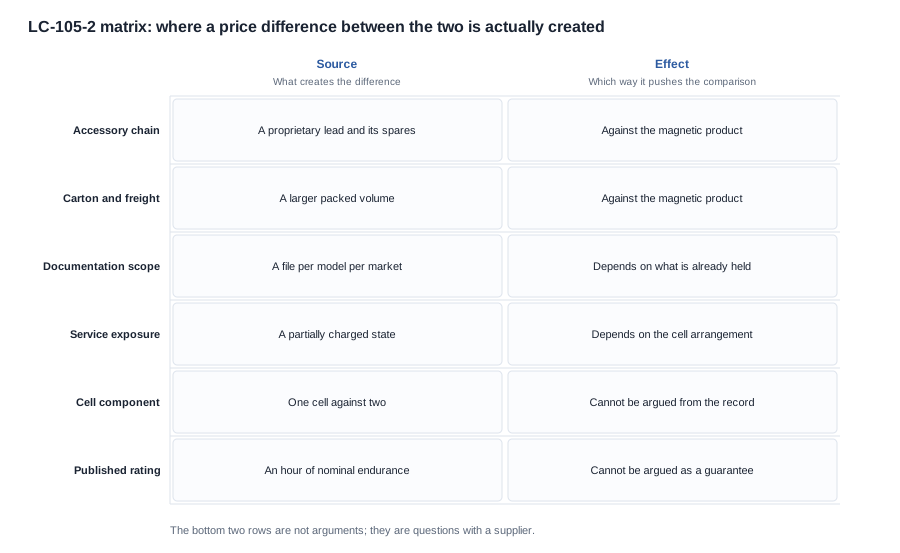
A price position between two products is not a number, it is an argument. The argument has to identify where the money is, and in this case the published rows point at four places where it can be, and at one place where it cannot.
The accessory chain. A proprietary charging lead is a stocked item with a part number, a minimum order quantity of its own and a loss rate that has to be budgeted, and a buyer who does not stock spares will find the loss rate in its service costs instead. Against that, a standard connector has an accessory cost of approximately nothing, because the cable is already in the customer's possession and in the technician's case. This is the largest and most reliable correction to a naive comparison of the two unit prices, and it runs in one direction: it works against the magnetic product.
The packaging and the freight. The two products may not share a carton. A product that ships with a lead, a spare lead allowance and an accessory box is a different volumetric object from one that ships with a short cable or none at all, and the freight cost per unit follows the carton. This is a second correction in the same direction, and it is the one most often missed because the carton is decided late in a programme.
The documentation scope. The two products sit in the same range, and neither carries a per-model conformity row, so the file has to be requested for either of them. Where a buyer is already holding one file, the second product may need less work; where it is holding neither, the scope may be identical. Neither of those is knowable before the request is made, and both are per-market rather than per-unit costs.
The service exposure. A single-cell product and a two-cell product do not present the same failure surface. A single cell that has degraded is one component to replace; a two-cell product whose cells are arranged in a way the buyer has not been told about is a product that may report a partially charged state, and a customer reporting a product that charges only on one side is a support conversation rather than a straight replacement. The size of this exposure depends on the arrangement, which is not published.
The one place a price difference cannot come from is the published specification itself. The two rows do not differ by enough for one of them to be more expensive to build in any way a buyer can identify from the record, and a buyer who explains a price gap by saying that one product has a bigger cell is making an argument that the published rows do not support in either direction. A single 100 mAh cell and a pair of 55 mAh cells are not the same component list, and the record does not say what the two arrangements cost.
That is the honest position, and it is more useful than it sounds. A price gap that has been explained properly is a gap a buyer can negotiate, and a price gap that has been explained with a component the record does not support is a gap that dissolves the moment a bill of materials is produced. There is a third possibility worth naming as well, which is that the two quotations differ because one of them includes work the other omits, such as the documentation package, the packaging artwork or the service commitment. That possibility is the most common one of the three, and it is also the one that a buyer checks for last when they have already decided which product they prefer. Checking for it first, and writing the scope into both requests, is what stops a comparison from becoming a negotiation about two different products.
There is a fourth consideration that sits outside the price position entirely and is worth raising before a comparison is closed. The two products are not interchangeable in a channel. A buyer who stocks both has to answer a question a customer will ask: why are there two of these, and which one should I have? A channel that carries two products with a similar radio generation and a similar published rating needs a reason for the shopper to pick one, and the reasons available to this comparison are the charging method, the rating and the cell configuration. If none of those three is a reason the channel can explain, the second product is a duplicate that halves the volume of both and it should not be in the range at all. That is a decision about the range rather than about the price, and it is the decision the price comparison is supposed to inform. A buyer who has located the difference in the accessory chain and the carton has a position they can negotiate; a buyer who has located it in the cell has a position that collapses the first time the supplier points at the bill of materials.

Why the charging method outweighs the cell number
The instinct in a comparison like this is to let the largest visible number decide, and the largest visible number is usually the cell. It is worth resisting that, because the cell is a component and the charging method is a system, and systems cost more to get wrong.
The mechanism is straightforward. A Type-C product is charged by a cable the buyer does not have to think about, and the cost of a charging session falls to zero because the customer owns the cable. A magnetic product is charged by placing it on a lead that the buyer has to own, count and replace, and the cost of a charging session is therefore a recurring per-unit cost that begins with the first shipment and continues for as long as the product is in the field. The two designs are not being compared on their merits here; they are being compared on what they oblige the buyer to carry.
That obligation has four parts, and a buyer who is building a comparison should cost all four.
- The initial stock. The leads shipped with the units, at whatever quantity the supplier includes, and the question of whether that quantity is enough to cover the loss rate.
- The spare stock. The replacement leads, held centrally, which have their own minimum order quantity and their own lead time.
- The loss rate. The percentage of units that come back with a missing or damaged lead, and whether that is absorbed as a service cost or recharged.
- The instruction cost. The explanation in the carton, in the instruction insert and on the retail product page, which is a one-off cost in time rather than in money and is still a cost.
A standard connector has an equivalent list of four items, and all four of them are close to zero. That asymmetry is the single most reliable difference in the total cost of the two products, and it is worth more than the hour of published rating that separates them.
There is a second-order effect that matters at volume, and it is the one buyers discover late. A product charged over a standard connector can be handed to a customer in a box with nothing else in it, and the customer can start using it. A product charged over a proprietary contact cannot be handed over without the lead, which means the lead is in the box, which means the carton has an accessory compartment, which means the carton is bigger, which means the freight is higher and the shelving requirement is different. One decision about the charging method propagates into four others, and a buyer who prices the lead but not the carton has priced a quarter of the difference.


Building the price position before the quotations arrive
The sequence below is what turns two quotations into a price position, and it is ordered so that the decisions that change the numbers are taken before the numbers arrive.
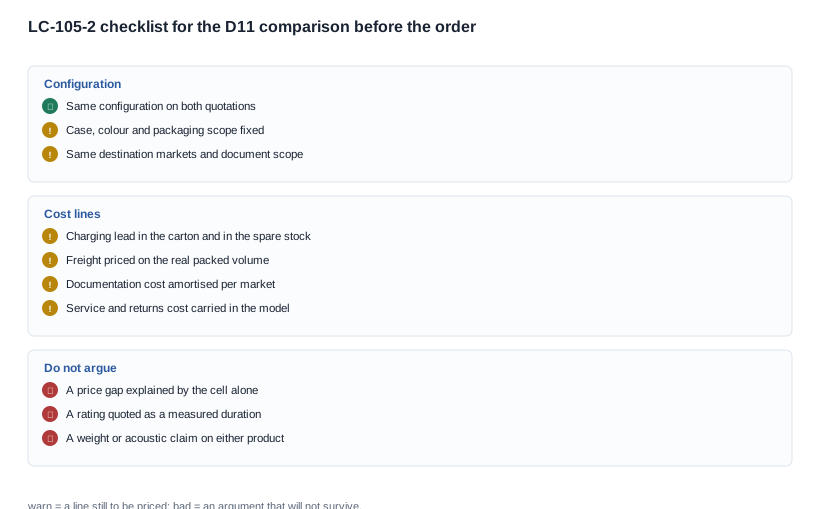
- Fix the configuration of both products, including any case, the colour set, the packaging scope, the number of destination markets and the documentation scope per market. Two quotations for two different configurations are not a comparison.
- Establish the accessory line for each product separately, as a quoted line rather than as an assumption, and include the shipping quantity of the lead in the carton, not only the spare stock held centrally.
- Obtain the carton dimensions and the packed weight for both, and price the freight against the real volumetric rather than against a per-unit average.
- Request the cell arrangement for the two-cell product, and ask what state the product reports when the two halves are at different charge levels. This one answer removes a service uncertainty that no published row touches.
- Ask for the measured charge time and the reference condition behind each published rating, so that the two ratings are compared on a stated basis or explicitly not compared at all.
- Put both quotations on a single scope, and write down what each one had to change in order to get there, because the differences that survive that step are the real ones and the rest were scope in disguise.
- Set the price position in terms of the landed per-unit cost, with the accessory and freight lines visible, and then decide which of the two products the business actually wants to be selling — because a price position is an argument for a decision, not a substitute for one.
Two rules keep this honest. First, no claim about either product may be made from a field the catalogue does not publish, which is the usual place a price argument falls apart. Second, the published row remains the common ground: if two quotations describe the same configuration, scope and terms, and the two devices are described in the published rows, then any remaining price difference is a real difference in cost or in margin, and it belongs in the negotiation rather than in the specification.
There is a third rule that costs nothing to state and saves a week when it is forgotten. A price position is not a price promise. Once a buyer has argued that the magnetic product is more expensive to run than the standard-connector one, that argument has to be carried through every downstream document consistently: the retail listing, the channel presentation, the tender response and the forecast. A business that argues one way to a supplier and another way to a customer is not optimising its position, it is creating a dispute it will have to settle later at whatever point the documents are compared. The argument works only if it is the same argument in all of them, and the easiest way to guarantee that is to write it down once, in a form that can be reused, before the first quotation arrives rather than reconstructing it afterwards.
The sequence also produces a defensible internal answer, which matters more than the external one. When somebody inside the business asks why the cheaper-looking option was not selected, the answer is not a judgement about value that has to be repeated and defended each time it is asked. It is a line in a model, and the line can be inspected, challenged and updated as the volumes change. That is a materially different kind of decision from the one a buyer makes when the reasoning exists only in a conversation, and it is the difference between a purchasing decision that can survive an audit and one that cannot.
One further question belongs in the model, and it is the one that most often changes the answer. The published rows describe a device, but a device is deployed in a context, and the context has a charging habit attached to it. An office where every desk has a socket and a cable, a warehouse where devices are charged in a cage at the end of a shift, a retail counter where the product has to be charged between demonstrations, and a fleet where the unit is handed from one person to another are four different charging habits, and they do not all suit a proprietary contact. A buyer who treats the charging method as a specification detail rather than as a property of the deployment will select a product that fits the shelf and not the shift, and will discover the mismatch in the returns rather than in the purchase order. The question is therefore not which product is cheaper but which charging habit the deployment actually has, and the published rows answer that question only once somebody asks it.
There is also a version of this comparison that a buyer can run without any supplier at all, and it is worth running before the first request goes out. Take the two published rows, and the two deployment profiles that a business already knows it has, and ask which of the four cost sources the two profiles actually trigger. A profile that charges in a fixed dock at the end of every shift triggers the accessory chain, because the dock is proprietary. A profile where the device is charged from a personal phone overnight triggers it twice, because the lead is personal and the loss rate is higher. A profile where the device is charged from a shared cabinet triggers the carton cost, because the cable has to be in the box. A profile where the device is barely charged at all triggers none of them, and for that profile the charging method is not a cost decision at all. Four profiles, four cost lines, and no supplier involved. That is the analysis a buyer can complete on day one, and it usually identifies the right product before anyone has quoted anything.
Our own position is that we do not publish a price for this model or for the D11, and we will not quote a price here that a buyer cannot check against a quotation. What we do publish is the row for each, and what we will do is explain what the differences between the rows mean commercially: a proprietary charging method creates a recurring per-unit cost that a standard connector does not, a higher published rating is a planning figure rather than a measured duration, and a difference in cell configuration is a question for the supplier rather than a price argument. Those three things are enough to build a comparison that holds up.
If you want the landed cost model built for both products on your own figures, send us the duty cycle, the volumes, the destination markets and the packaging scope, and we will return the two models side by side with the accessory, freight, documentation and service lines separated from the device line, so that the part of the difference that is a genuine cost difference is visible.


