

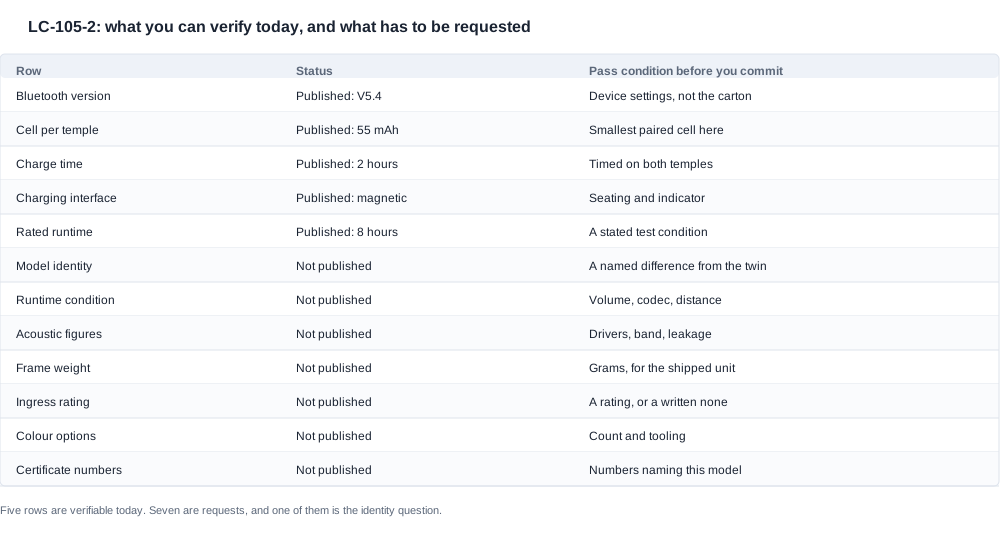
The first check on the LC-105-2 is not a specification. The catalogue publishes rows identical to its twin, the LC-105-1, and does not state what separates them — so before you verify anything about the product, establish whether these are two products or one product under two names. Everything else on the list divides cleanly into five rows you can act on today and five that need a written answer, and the identity question sits above both groups because it changes what every other row means.
LC-105-2 identity: one product, or two designations?
Our own documentation does not say what distinguishes the LC-105-2 from the LC-105-1, and we are not going to invent a difference. The honest basis is that the published electrical rows are identical in every case, and that a decision between two models whose specifications match has to rest on something other than the specification.
The cost is also visible to your own team rather than only to finance. Two entries means two sets of instructions to maintain, two sets of claims to keep consistent with whatever the supplier later confirms, and two opportunities for somebody to update one and forget the other. Buyers who have been through it generally describe the second set as duplicate work rather than as growth, and they are right.
It is worth being clear about why this is not a documentation nicety. Two catalogue entries for one product divide your production volume, double your packaging revisions, and split your inventory across lines that cannot be substituted for one another at reorder. A buyer who discovers after the reorder that the two entries were the same product has learned it from their own stock records rather than from the supplier, which is the version of the discovery that generates a complaint.
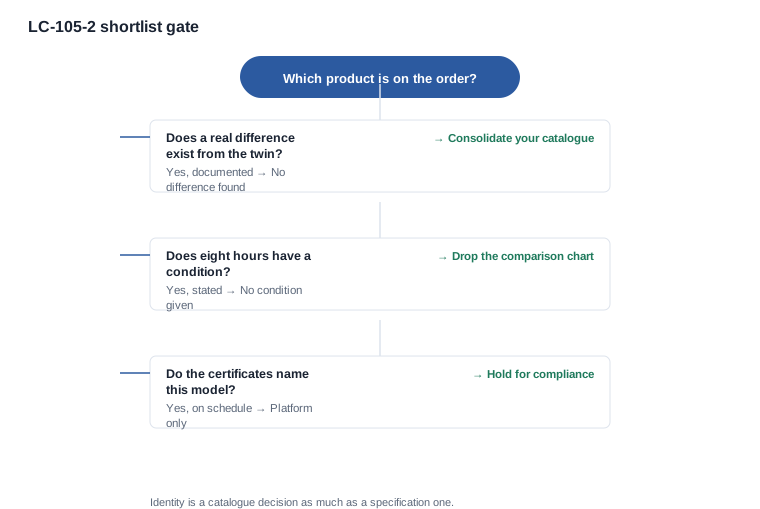
That makes the identity question a commercial one rather than a technical one, which is why it goes first. If a real difference exists — a colour, a temple, a shell revision, a firmware version — you can price it, document it and list it. If the answer is that they are the same product under two designations, then keeping both entries in your catalogue is costing you packaging, inventory and search results in exchange for nothing a buyer can see.

Ask it as one specific question rather than as a general one. What is the confirmed difference between this model and its twin, expressed as a specification row, a document reference or a price difference? That formulation returns something you can act on. The general version — what is different? — returns a description, and a description is not something you can put in a purchase order annex or defend to a retailer.
There is a practical test for whether the difference is real. If you can describe it in one sentence a customer would repeat back to you, it is real. If you can only describe it by reference to a component internally, or by reference to a price difference, it is a variant rather than a product, and it should be listed as one.
Two models with identical published electrical rows are not interchangeable on paper alone. Saying that plainly to a supplier is not a challenge; it is the opening of a useful conversation, because suppliers usually know the answer and rarely volunteer it.

Five rows you can act on today
A named version supports a compatibility statement rather than a performance one, which is worth remembering when a supplier offers to trade a radio revision for a better price. In this category the version is rarely the reason a buyer chooses, and treating it as one wastes a negotiation you will need later.
Bluetooth version. V5.4 is published — the current radio generation, alongside the D11, the D12, the G07 and the YK12. A named version supports a compatibility statement, not a performance one, so verify it in device settings on the sample rather than reading it off the carton.
Weigh five assembled units rather than one, and record the spread as well as the average. The spread is evidence about the bill of materials, and a wide one is worth raising before a production run rather than after it.
Cell configuration. 55 mAh per temple is published, and this is the smallest paired cell configuration in the audio range. Weigh several sample units and record the spread; the figure that actually matters for a product carried through a working day is the assembled frame weight, and that is not published at all.
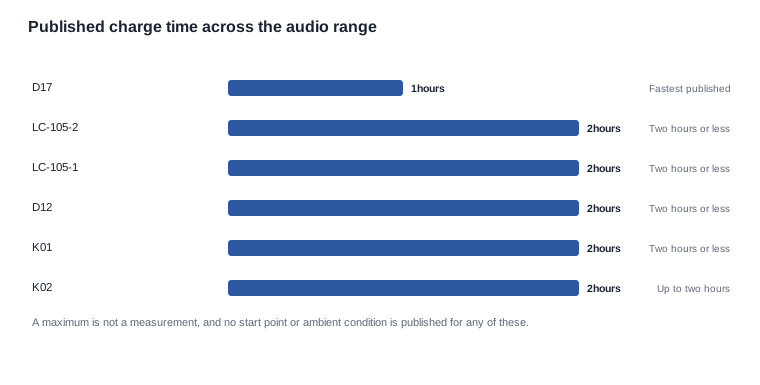
Time it from a stated low state rather than from whatever charge level the unit happened to arrive with, and note the ambient condition. Published charge figures across this range are maxima rather than measurements, so the difference between a maximum and a measurement is the difference between a specification and a claim.
Charge time. Two hours or less is published. Time it yourself rather than accepting the claim, and time both temples rather than one — a paired design can differ between sides, and the side that charges slowly is the side that generates the support contact.
Charging interface. Magnetic is published, which settles the packaging question but introduces an alignment behaviour. A temple seated slightly off can appear to charge while progressing slowly, and to a customer that reads as an intermittent fault rather than a seating problem. Confirm the seating instruction and the indicator behaviour before you write any quick-start guide, because that guide becomes your first line of support.
Compare it honestly rather than favourably. The G07 and the YK12 publish six hours on the same paired cells, and this model publishes eight. That is either a tuning difference or a measurement difference, and the two have very different implications for how you use the figure: the first is a property of the product, the second is a property of the test.
Runtime. Roughly eight hours is published, at the top of the audio range. Treat it as an untested figure until the condition is stated. The G07 and the YK12 sit on the same paired cells and publish six, so the family produces a two-hour spread inside one cell configuration — which tells you the published figures are describing a duty cycle rather than a battery, and tells you the two numbers cannot sit in the same chart.
A buyer with a merchandising plan needs three things about colour: how many exist today, whether new ones are available at their volume, and whether the tooling is shared with the models on the same platform. The third is the one that determines whether a new colourway is a packaging revision or a new mould, and it is the one that most often gets asked too late.
Note also that no colour option is listed for this model. That is worth asking about: the V03 Pro lists three and the V06 lists four, so a brand with a merchandising plan needs to know whether colourways exist here and whether the tooling is shared.
Five rows that need a written answer
Send the identity question with enough specificity that it can be answered in writing rather than paraphrased: ask for the difference expressed as a specification row, a document reference or a price difference, and ask whether that difference is fixed for your order or selected at production time. The second half of that question is what separates a range asset from a range risk.
- Which model are you buying? The LC-105-1 or the LC-105-2, and what differs between them. This is first because it may change what every other row means.
- The runtime test condition. Specifically whether Bluetooth was continuously active, at what volume and codec, at what distance, and across how many units.
- Acoustic detail. Driver size, frequency response and leakage figures. Without them no sound quality claim is available, and an open-ear frame with no acoustic specification is one whose sound quality has to be judged by ear.
- This is the row that decides your return rate, and it is the one a specification sheet can never settle. Ask for grams, temple length and the adjustment range, then measure the sample yourself and build a sizing matrix from what you find rather than from the range average.
Frame weight and sizing. The most useful absent row in this category, and the one most correlated with returns. Ask for grams, temple length and the adjustment range, for the configuration you will ship. 5. Certification evidence. Number, issuing body and validity date, with the model designation matching your purchase order.
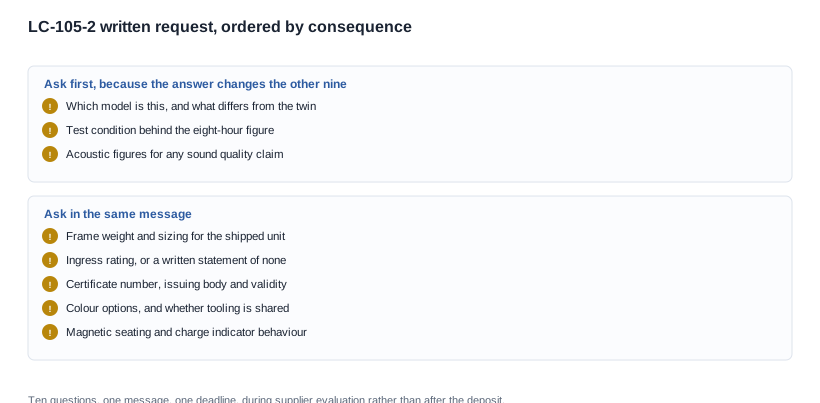
Attach a deadline, because a request without one produces a reply on somebody else's schedule. Where a question is genuinely blocking — identity, runtime condition, acoustic figures — say so, so the supplier can answer those three first and the rest afterwards.
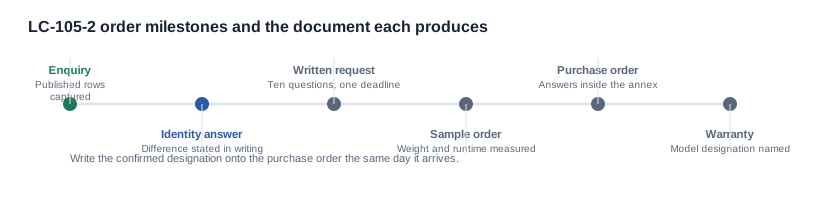
Send all ten as one written request during supplier evaluation, and put the answers into the purchase order rather than leaving them as correspondence. A term that exists only in an email is not a term, and a figure that exists only in an email will not survive the first inspection finding.
Evaluate the replies by shape as well as by content. A number with a stated method and an attached document is usable. A number without a method is a starting point for negotiation. A confident adjective is nothing at all, and it should be recorded as absent rather than as answered. The supplier who answers ten questions in one response has told you something about how they will handle a dispute in six months; the supplier who answers two and goes quiet has told you something too.
Ask the minimum order quantity per colourway rather than for the model, because the figure usually differs between them, and ask whether the lead time holds at your volume rather than at a reference quantity. Our internal documentation holds conflicting minimum order figures that have not been arbitrated, so treat any figure given verbally as provisional until it appears in a quotation.
Ask whether a charging case exists at your quantity and whether it is a separate line item. No model in the audio range publishes one, so if your retail format requires a case in the box, that is a question to ask now rather than after the packaging is designed.
Also close the commercial rows in the same exchange. Minimum order quantity, lead time and price are not published, and they belong in a quotation where they can be committed to. Ask which clock starts the lead time — deposit, artwork approval or a confirmed purchase order — because the three readings differ by weeks and the difference lands on your inventory plan.

Running one platform as two catalogue entries
There is a fourth part worth adding: whether the difference survives a change of supplier or a change of production run. A difference that depends on a component chosen at order time is a range risk rather than a range asset, because it can change without anybody deciding to change it.
If the answer comes back as a real difference, you now have a range decision rather than a documentation problem, and the decision has four parts. Can your channel carry two product pages on one platform without the pages competing for the same search terms? Does the second configuration split your production volume enough to change the price you can hold? Does the artwork differ, or only the copy? And is the difference one your customers will notice, or one only your catalogue will record?
Consolidating is easier than buyers expect, because the two entries usually have very little unique copy between them once the specifications turn out to match. The work is removing one product page, merging the colour and packaging references, and telling any channel partner who linked to the old page — which is the part that is genuinely worth doing carefully.
If the answer comes back as no difference, consolidate rather than maintain both. The cost is easy to underestimate because most of it lands at reorder rather than at launch: two inventory lines against one platform, two sets of product page copy to keep current, two purchase orders to track, and two opportunities for the pages to drift apart as somebody updates one of them. None of that is dramatic on its own, and all of it is avoidable.
Then use that exact form on the artwork, the listing, the certificate application and the shipping documents. Where a private-label version would carry your own name, ask separately whether the physical marking on the unit changes, because a moulded marking is a permanent commitment and a printed one is not.
Either way, write the confirmed model designation onto the purchase order the same day the answer arrives. A designation that exists in an email thread when the container sails is a designation you will have to reconstruct under time pressure.

What the ten checks cannot settle
Sizing, call quality in noise, and acoustic character. None of these can be settled by a specification row or a written answer, and all three are the rows your customers will judge the product on first. A full day of use, a call test in reproduced background noise and a side-by-side listening session against a model you already own are the only instruments that speak to them, and all three belong on a sample review rather than in a contract.
It also produces the only evidence you will have about a microphone pickup row that is not published for this model, which means the test result and the specification stay in step for the length of the order rather than diverging the first time somebody updates the listing.
The call test in particular is worth doing properly, because the microphone pickup row is the one most often assumed and least often tested in this category. Reproduce the environment you sell into rather than the one you happen to be standing in: fixed source, fixed distance, fixed position, and record the setup before you record the result.
It is also the test most often skipped, because it looks like a detail on a specification sheet. On a product with no published weight and no published temple description it is the only sizing evidence that will exist, and building the guidance from it costs five minutes.
The sizing test is equally cheap and equally decisive. Measure temple length, lens dimension and bridge on the sample, then build your sizing guidance from those measurements rather than from a range average. A buyer who has a sizing matrix can advise a customer; a buyer without one forwards the problem to your support desk.
Give each test a written pass condition before you start, not after. A pass condition is a sentence somebody else could repeat six weeks later on a different unit; an impression is not, and it cannot be used to argue that a production lot has departed from the sample.
Score the sample against the ten rows rather than against an impression. Where the sample contradicts a written answer, send it back as a dated question before you commit, and treat the reply as due diligence on the supplier rather than as a defect notice — the first framing produces a correction and the second produces a concession that changes the product you ordered.
The stance, and what we can confirm about identity
It is worth saying why we resolve identity before anything else even though it is not a specification. Because every other row on this list is either verifiable today or answerable in writing, identity is the only item where a wrong answer changes what you buy rather than what you write — which is a different class of problem and a different class of cost.
The identity question is the real blocker on this model and everything else here is manageable. We would rather resolve it early than build a purchase order, artwork and packaging around a designation that may not describe a distinct product.
We can give you the published rows for the LC-105-2 and we can tell you item by item which of the ten questions are open in our documentation. We will not estimate frame weight from a comparable model, we will not quote a market price, and we will not claim a certification status we cannot evidence with a certificate number. Where the answer is that a row does not exist for this configuration, we will say that rather than filling it with an industry-typical value.
If you want to move quickly, ask three questions first: which model this is, what condition produced the eight-hour figure, and what the frame weighs. Those three answers will settle whether the model belongs on your shortlist at all. The remaining seven rows are refinement rather than qualification, and asking for refinement before qualification is what turns a three-week evaluation into a two-month one.
Tell us your market, quantity and required configuration and we will tell you what we can confirm about model identity and which rows remain open.
Related reading
- This model against the range — which Bluetooth audio glasses model to pick
- The platform and its alternatives — YK12 specifications
- Reading competing runtime figures honestly — battery comparison for Bluetooth audio glasses
- The document set to request — Bluetooth SIG certification checklist
Pass the target market, the quantity and the required configuration to us, and we will come back with what is available and what is not.


