

Start with the honest part, because it shapes everything else. We do not publish prices, price tiers or unit costs for this or any other model, so a value comparison drawn from our catalogue is not available and we will not manufacture one. What this page does instead is set out the evidence you can actually evaluate, the components that drive the quotation you will receive, and the questions that determine whether a quoted price for this model is defensible.
The reason this model is worth a page about value is a single fact. It publishes the only mass figure anywhere in the catalogue: 158 grams for the glasses body, including the fitted battery and camera, and excluding the case. A unique, unambiguous, physically checkable number is rare in this category, and it carries real planning value — for freight, for replenishment and for setting an acceptance criterion that a supplier has committed to in print.
What it does not carry is a comparison. Nothing else in the range publishes a mass, so 158 grams cannot be weighed against a competing figure from the same catalogue. It is a useful number and not a ranking argument, and the two should not be confused when a quotation is being negotiated.
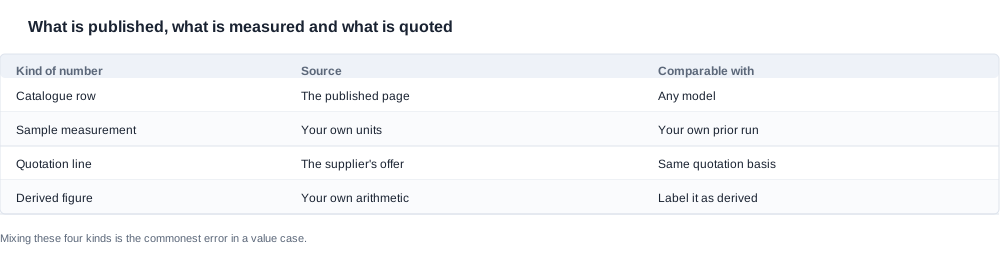
MT6 smart glasses value for money: four kinds of number, and only two of them comparable
Every figure in a sourcing exercise falls into one of four categories, and most bad purchasing decisions come from mixing them.
Published catalogue rows are comparable across models, because everyone is quoting the same source. For this model that means the cell capacity, the runtime, the charge-time ceiling, the camera resolution class, the case capacity and the body mass. Measured sample figures are comparable only with your own prior measurements, on the same conditions. Quotation figures are comparable only within the same quotation basis — same quantity, same configuration, same incoterms. And derived figures are yours alone, which is fine provided they are labelled as derived.
The 158 grams is in the first category. The case recharge count, if you measure it, is in the second. Any cost per delivered unit is in the third, and only becomes comparable once the quotation basis is fixed. And a cost-per-kilogram or cost-per-shift calculation is in the fourth, which is why two buyers can look at the same model and reach different conclusions without either being wrong.
Keeping these four apart before the quotation arrives is the single most useful thing a buyer can do here, because it prevents the most common error in the category: treating a catalogue figure as though it were a price, or a derived figure as though it were a supplier commitment.
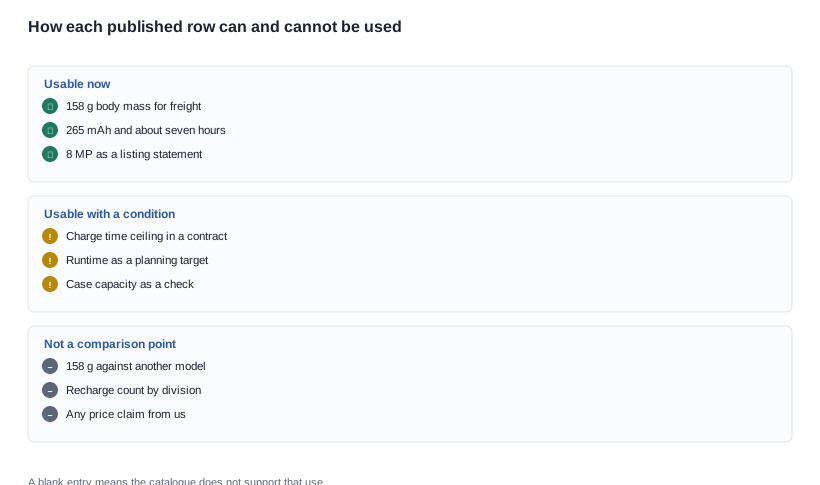
What the published rows are worth in practice
Each published row has a specific use, and a specific limit. Working through them tells you which parts of your plan are settled and which are provisional.
The body mass of 158 grams, excluding the case, is the row with the widest application. It gives you a freight planning input that no other model in the range offers, an acceptance criterion that can be checked on a scale in under a minute, and a configuration identifier when a shipment is questioned. Its limit is equally clear: it is a single model's figure, so it cannot be used to argue that this model is lighter than another, and the case mass is not published at all — which is the part that consumes volume in a carton.
The cell capacity of 265 mAh and the runtime of about seven hours together describe a power configuration. No other camera model publishes 265 mAh, so the capacity is unique within the group; the runtime is shared with four other models. Their limit is that neither figure carries a test condition, so they are citable but not comparable across suppliers without agreeing conditions first.
The charge time of two hours or less is a ceiling, published for every model in the range, which means it separates nothing in a comparison and should be treated as a standard term rather than a differentiator. The camera resolution class of eight megapixel is a legitimate listing statement and a poor quality proxy, because no sensor, field of view or frame rate is published behind it.

What drives the quotation you will receive
We do not publish prices, so we will not claim to know what a given order costs. What can be said is which specification choices tend to move a quotation in this category, and which of them apply here. A buyer who understands the structure of the quotation negotiates far better than one who only sees a unit price.
The case is the largest single variable on this model, and the reason is structural rather than commercial. This model ships with a folding case, and a fold mechanism is a moulded part with its own tooling, its own assembly step and its own packaging. The five camera models that publish a case capacity publish 1400 mAh, 900/1400 mAh and 1200 mAh in various combinations, and the presence of a case at all is what separates them from the models with no case row. Where you are comparing this model against one without a case, the quotation difference is real and structural, and it should be treated as such rather than as a supplier margin.
The camera is the second variable. The resolution class is published, but the sensor behind it is not, and the component that actually drives camera cost is exactly that unpublished row. Two configurations at the same published pixel class can sit at different costs, and nothing in the catalogue lets you predict which. That is not an obstacle; it is simply a line you negotiate against, and the right question to ask is what sensor is fitted and whether the configuration changes at reorder.
The third variable is the private label work. Whether logo application, packaging or a brand manual is included, and whether setup is charged once or per run, is a quotation question rather than a specification question. Buyers who ask it before the first quotation get it priced; buyers who ask afterwards negotiate against a figure already accepted.

Questions to ask before you commit
Five questions, in the order they are cheapest to answer. What is the quoted basis — quantity, configuration, incoterms and payment terms. Which of those lines recur on every order, and which are one-time. What sensor is fitted to this configuration, and does it change at reorder. What is included in the box, stated exhaustively rather than as a description. And what are the warranty terms, the claim procedure and whether they transfer if the goods are resold under a private label.
The fourth question is worth expanding, because "what's in the box" is where this category generates the most avoidable disputes. A case that ships for some units and not others, a cable omitted because the charge method was assumed rather than confirmed, an insert set that changes without notice — each is a small item individually and a recurring cost across a run. The way to prevent them is a line on the purchase order listing the contents exhaustively, which costs nothing to write and removes the ambiguity entirely.

Why the unpublished charge method matters commercially
The charge method is unpublished for this model, and it has a direct effect on what you are quoted and what you can claim. If the method is a contact arrangement, the case is effectively part of the charging architecture and any accessories or docks in your cost model are dictated by it. If it is a receptacle, the cable becomes a consumable and the case behaves more like an independent power source. Those two readings produce different accessory budgets, different replenishment ratios and different listing copy, and you cannot choose between them from the catalogue.
That means the quotation you receive contains an assumption you have not been able to verify. The professional response is not to refuse to order — it is to put the question in writing, ask for the bundled contents to be stated explicitly, and attach the answer to the order so that any later correction is a contractual matter rather than a misunderstanding. The charge method gap is treated in full in MT6 smart glasses charging options.
The same logic applies to the ingress position, the colour options and the approval scope. None is published, none is a reason to exclude the model, and all four are reasonable to attach to an order as disclosure obligations.
Evaluating what you get back
A sample order is the last cheap point at which a supplier can be asked to demonstrate rather than assert. It is worth spending it deliberately: state in advance what you will measure, and hold the measurements to the same conditions you intend to use in production.
The three figures worth taking from a sample are the body mass, the case mass and the case recharge count. The first is testable against a published figure and should agree with it. The second is not published anywhere and only your sample can supply it, and since the case is what consumes packing volume, it feeds directly into freight cost. The third determines how many devices one case serves, which is the basis of any replenishment or spare-unit policy you build afterwards.
Record all three with their conditions, because a measured figure without its condition is the same problem as a catalogue figure without one. And keep them separate from the catalogue rows in your file, so that later nobody mistakes your measurement for a published specification.
The sample-stage questions about what a sample proves are developed in MT6 smart glasses buyer review checklist, and the wider procurement process is in procurement samples. The specification rows themselves are set out in MT6 smart glasses specifications and features, and the battery position in battery life.
Where the value argument actually ends
The honest conclusion is narrow. This model gives you a complete power specification, a citable resolution class, a published folding case capacity and the only mass figure in the range, which together make it straightforward to plan and straightforward to check. It gives you no price, no certification record, no charge method, no ingress rating and no colour options, which together mean that parts of your commercial decision have to be made provisionally and confirmed in writing.
A buyer who can work that way will find this model straightforward to evaluate. A buyer who needs a published price will not find one here, and we would rather say so plainly than imply a comparison we cannot support. The value of any model in this category is decided in the quotation, and the specification tells you what to negotiate about once that quotation arrives.
What we can and cannot say about value
We can tell you exactly which figures are published for this model, which of your decisions each one supports, and where the boundaries of the record sit. We can tell you which specification choices a supplier is likely to price separately, and we can tell you what to ask so that the quotation you receive is comparable with another.
We cannot tell you what this model costs, at any quantity, in any market, or on any incoterm. We do not publish prices, price tiers, unit costs or margins, and we are not going to imply a positioning that a quotation would have to reverse. Our position is that a value argument built on an unpublished price is not an argument at all, and that a buyer who is shown one should ask for the basis before believing it.
That position costs us something in the short term and saves everyone time later. A supplier who quotes openly against a stated basis can be compared with a competitor quoting the same basis, and the comparison is worth doing. A supplier who will not state the basis is telling you something important about how a repeat order will be handled.
Evaluating quotations against a like-for-like basis
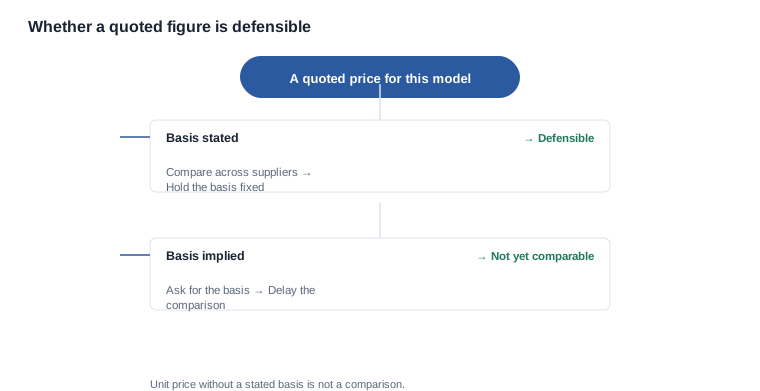
Two quotations for the same model are not comparable until six things match, and a buyer who checks only the quantity will draw a conclusion the numbers do not support. The six are: quantity, configuration, incoterms, payment terms and deposit structure, private label scope including any one-time setup, and box contents.
Configuration is the one most often left implicit. Two suppliers quoting the same model number may be quoting different sensor configurations, different case configurations, or different firmware states, and none of that appears in the model designation. Ask for the configuration to be described in words on the quotation, then hold both quotations to those words.
Incoterms and payment terms change the effective cost without changing anything physical. A quotation at one incoterm with a different deposit structure will not match another even at an identical unit price, which is why a comparison done before those two are fixed is usually wrong. Fix them first, then compare.
Box contents are the last and the most frequently overlooked. A cable or an insert omitted from one quotation changes the per-unit cost and the channel proposition without appearing anywhere on the specification. Asking for contents to be listed exhaustively costs one line and removes the most common source of a recurring discrepancy.
What to measure before you reorder
Three measurements earn their place on any sample, because each fills a gap that no document closes and each improves every future comparison.
The case mass is the first. It is unpublished for this model and it is the component that consumes packing volume, so it feeds directly into freight cost. Weigh it separately from the body, and keep the two figures apart in your file — the published 158 grams refers to the body alone, and merging them produces an error that is hard to detect later.
The case recharge count is the second. It determines how many devices one case serves, which is the basis of any spare-unit policy. Measure it by charging the case to its stated end state and cycling the frame from a fixed low threshold to a fixed end condition, on at least two identical units, and record the threshold you used. A count obtained by draining the frame to exhaustion is not comparable with one obtained by stopping at a usable reserve, and the difference between them is large enough to change a replenishment plan.
The runtime under your own workload is the third. The published figure of roughly seven hours carries no conditions, so your measurement and the supplier's are not the same number and never will be. What your measurement buys is a planning figure you own, one that will still be defensible when the next order is negotiated.
None of these three requires a supplier document, and all three produce figures that stay useful across orders. That combination is rare in this category and it is worth capturing at the sample stage rather than reconstructing later.
Where the value argument actually rests
Strip away the comparisons and what remains is a short, specific list. This model publishes a complete power specification that most models in the range match but none exceeds on documentation. It publishes a case capacity and a case construction that is unique in the range. It publishes the only mass figure in the catalogue, which is the single most useful number for freight planning that this catalogue offers. And it publishes nothing at all about price, which means every commercial conclusion about it is a conclusion you draw from a quotation rather than from a specification sheet.
A buyer who knows which category each number belongs to will handle this model well: measured figures for freight and replenishment, quoted figures for cost, and published figures only for what you may state to a customer. A buyer who mixes the four will overstate what they know in one direction or the other. The whole of this page is an attempt to keep them apart.
One closing practical note. Record the quotation basis at the moment the quotation arrives, not later: quantity, configuration in words, incoterms, payment terms, private label scope and box contents, on one line, attached to the purchase order number. It takes a minute, and it is the only way to know six months later whether a comparison you are about to make is against the same basis as the one you made last quarter. Buyers who skip this step end up negotiating against their own history without realising it, which is the quiet way that repeat orders drift.
It also settles an argument that otherwise recurs on every reorder: whether a change in the quoted figure represents a change in the product. With the basis recorded, that question has an answer you can check. Without it, every increase is unexplained and every decrease is suspect.
Two of those fields are the ones teams most often skip, and they are the two that decide whether a later comparison is possible at all: the configuration in words, and the box contents. Everything else on that line can be reconstructed from the purchase order paperwork. The configuration description and the contents list cannot, because neither appears on a quotation by default, and both change without notice when a supplier adjusts a build.
Related reading
- The camera range this model belongs to — AI camera glasses
- Every published row — MT6 smart glasses specifications and features
- The charge method question — MT6 smart glasses charging options
- What to check on receipt — MT6 smart glasses buyer review checklist


