
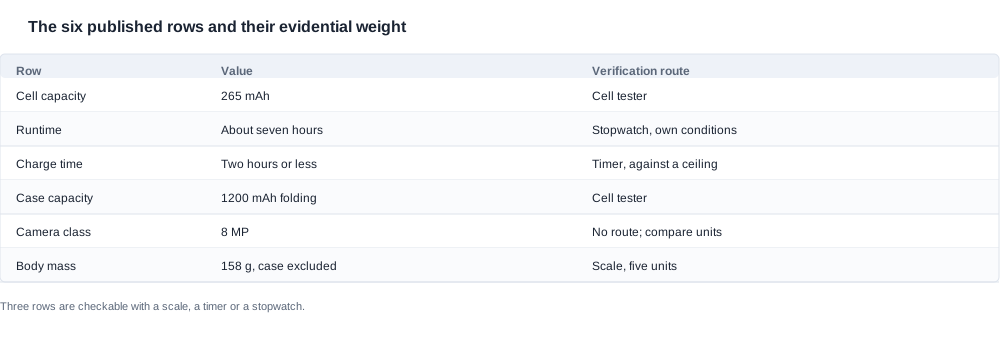
The MT6 smart glasses specifications and features set is small, and the useful way to work with it is row by row rather than as a list. Six figures are published for this model: a 265 mAh cell, a runtime of about seven hours, a charge time of two hours or less, an eight megapixel camera resolution class, a 1200 mAh folding case, and a body weight of 158 grams. Three short descriptors sit alongside them — portable, ultra-light, foldable case. That is the whole published surface, and each row supports a different set of conclusions and rules out a different set.
Read that way, the specification sheet stops being a marketing list and becomes an evidence map. A row tells you what you may state to a customer, what you may put in a contract, and what you may test on a sample. It also tells you, by omission, which of your own plans are currently unsupported. This note goes through all six, states what each does not establish, and ends with the rows this model does not publish — which are as much a part of the specification as the ones it does.
MT6 smart glasses specifications and features: how to weight each row
Rows are not equal. A mass figure can be checked on a scale in a minute; a runtime figure cannot be checked at all without agreeing conditions that the catalogue does not supply; a resolution class can be checked only by opening the device and inspecting what comes out. Ranking them by how easily they convert into evidence tells you where your due diligence effort belongs.
Three of the six rows are directly testable on ordinary equipment. The body mass is checked on a scale. The charge time is checked on a timer, against a ceiling. The runtime is checked on a stopwatch, against a figure whose conditions you must set yourself. The cell capacity and the case capacity need a cell tester. The camera resolution class cannot be verified from the device at all — there is no published sensor behind it, so the only check available is consistency across units.
That gives a clean division. One row is a citable fact with no verification route. One row is unique in the range and useful but incomplete. Three rows are power figures that describe different things from each other. And the features — portable, ultra-light, foldable case — are descriptors rather than specifications, valuable for positioning and useless as acceptance criteria unless they are converted into a test.
Power: three rows that describe three different things
The 265 mAh cell, the roughly seven-hour runtime and the two-hour-or-less charge time are frequently read as a single specification. They are not, and treating them as one is the most common misreading in this category.
The cell capacity is a quantity of charge. It tells you nothing on its own about runtime, because runtime depends on what the device is doing. Note that no other camera model in the range publishes 265 mAh, so this figure is unique within the group — which makes it useful for specifying a configuration and useless for comparing across models.
The runtime of about seven hours is a duration under conditions the catalogue does not state. It is a committed figure rather than a range, which is a stronger form of commitment: five camera models publish roughly the same row, while four publish a five-to-eight-hour range and two publish six-to-eight. A buyer planning replenishment should prefer the committed figure over the range, and should be careful not to read the top of a range as a target.
The charge time of two hours or less is a ceiling, and the distinction matters in contract language. It permits a unit that takes exactly two hours. It also carries no start state and no completion criterion, so without agreeing those two conditions in advance, the figure is not reproducible between a supplier's test and yours. It is published for every model in the range, which means it separates nothing at all in a comparison.
The relationships between these three rows are worth stating as questions rather than conclusions. Why is this cell paired with this runtime when a larger cell elsewhere in the range is paired with a range rather than a figure? What camera load sits behind seven hours? None of that is published, and the honest output is a question to put to the supplier along with a request to state the test condition. The broader battery discussion across the group is in AI camera glasses battery comparison, and the model-specific treatment is in MT6 smart glasses battery life.
The case, the fold, and what a capacity does not say
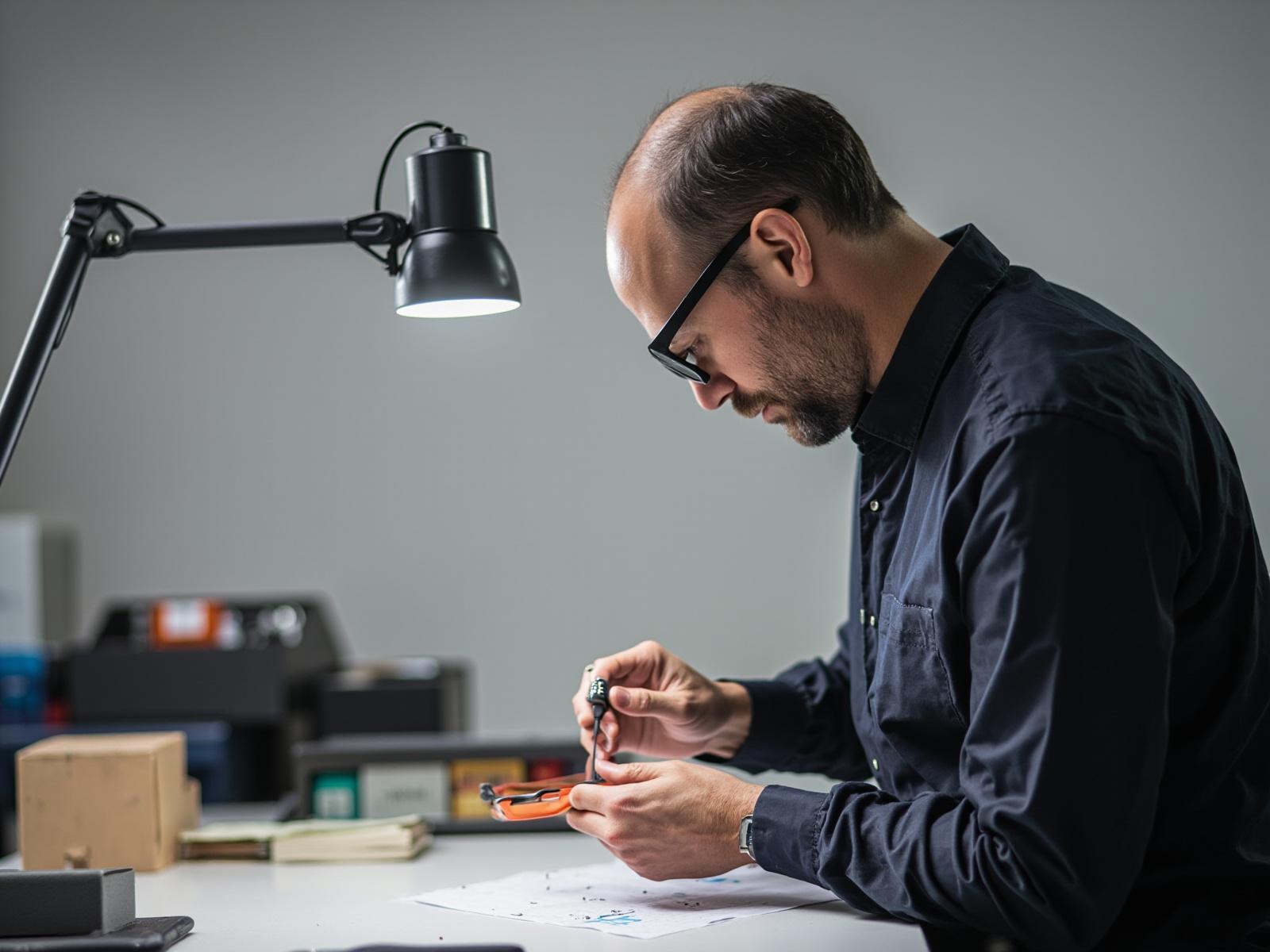
The case row is the reason this model is worth a separate note. It is a 1200 mAh folding case, and it is described on the page as portable, ultra-light and foldable. Two things follow from that description and one does not.
What follows first is that the fold is a mechanical feature, which makes it testable. A folding case will be folded and dropped in normal use, so a case cycle belongs in the sample order on the same footing as any other durability check. The same applies to the fold action generally, and the mechanism questions are covered in sport smart glasses durability testing.
What follows second is that case capacity comparison is possible. Five camera models publish a case figure: the CY05 and the L1 Pro, and the CY03 — each at 1400 mAh, the L2 Utral with a row reading 900/1400 mAh, and this model at 1200 mAh folding. That makes this one of the five models where a capacity comparison is legitimate rather than an inference.
What does not follow is a recharge count. The ratio between 1200 mAh and 265 mAh is visible to anyone reading both rows, but conversion losses, case overhead and the cut-off threshold are unpublished, so any cycle count derived from it is your arithmetic rather than the supplier's claim. Measure it on identical sample units to a stated end condition, and treat the result as the operating figure. Case options across the group are covered in AI camera glasses charging case options.
There is also a gap in the row itself. The charge method is not published for this model. The case capacity exists; how the device connects to it is simply absent from the page. That gap is the subject of MT6 smart glasses charging options, and it is the single most consequential missing row on this specification sheet, because it determines the cable, the dock and the replenishment procedure.
Camera and mass: the two rows buyers over-read
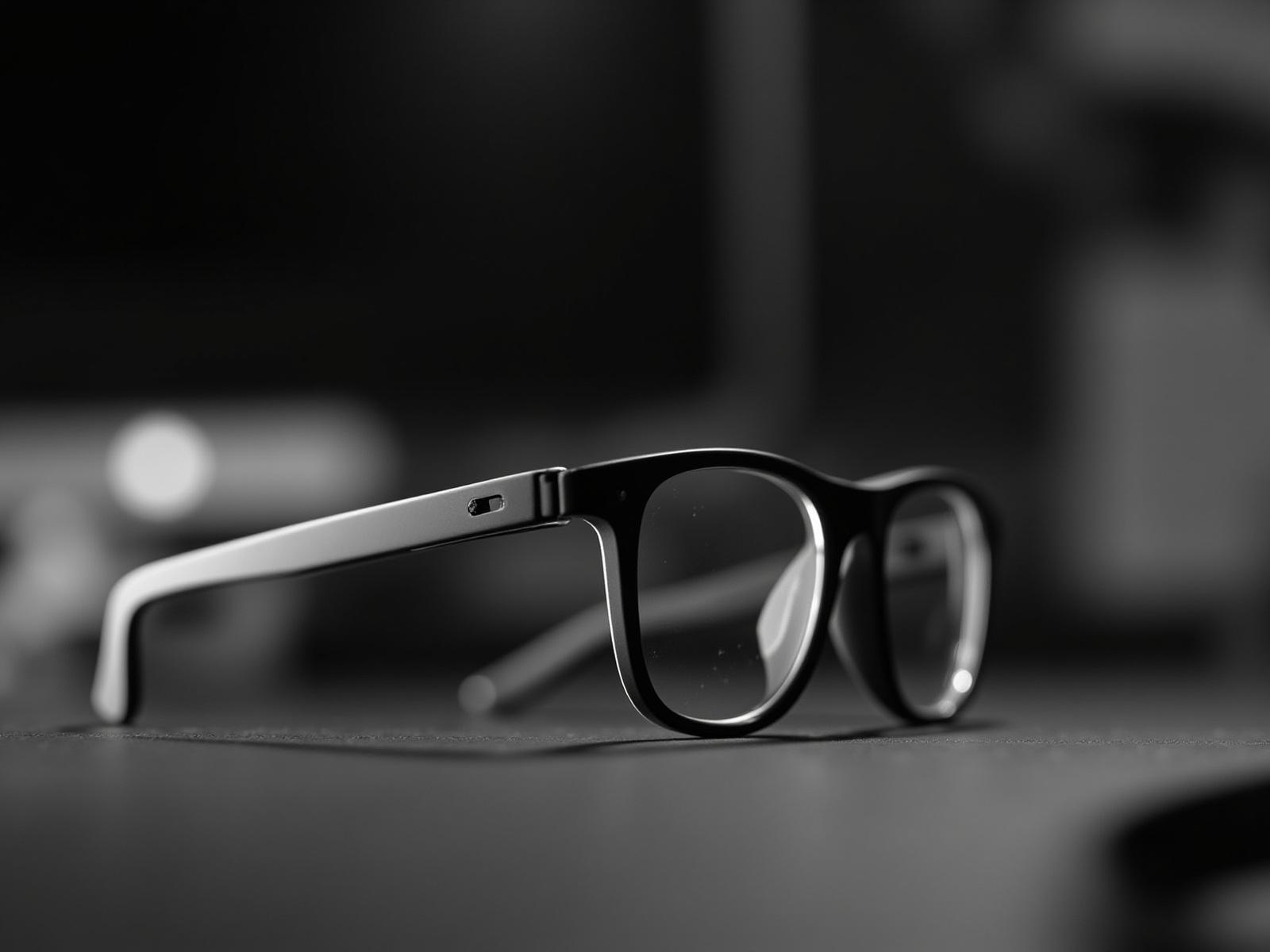
The camera row is an eight megapixel resolution class. It places this model in the eight-model group rather than the three-model group at thirteen megapixel. It is the entire published camera record: no sensor model, no field of view, no frame rate, no video format, no stabilisation, no low-light description, no storage capacity.
The over-reading happens in two directions. A buyer may assume the pixel class implies a quality advantage over the thirteen-megapixel models, which nothing supports. Or a buyer may assume no video row means no video, which is equally unsupported — an absent row is an absence of information, not a statement about the product. Both assumptions are avoidable, and both belong in the written request rather than in a specification. See AI camera glasses imaging for why an unpublished sensor limits what a camera evaluation can conclude, and AI camera glasses resolution options for how the class is used as a filter elsewhere in the range.
The mass row is over-read in a different way. The published 158 grams is the glasses body, including the fitted battery and camera, and it explicitly excludes the case. It is the only mass figure published anywhere in the catalogue, which makes it genuinely useful and genuinely awkward — useful for freight planning, awkward because there is nothing to compare it against.
Two cautions follow. It is not a frame weight; the catalogue has never published a bare frame mass for any model, and treating this figure as one introduces an error that propagates into every freight calculation downstream. And the case mass is not published, while the case is what consumes packing volume. The dimensional question is set out in AI camera glasses shipping weight, and it is one of the few figures on this page that only a sample can supply.
The rows this model does not publish
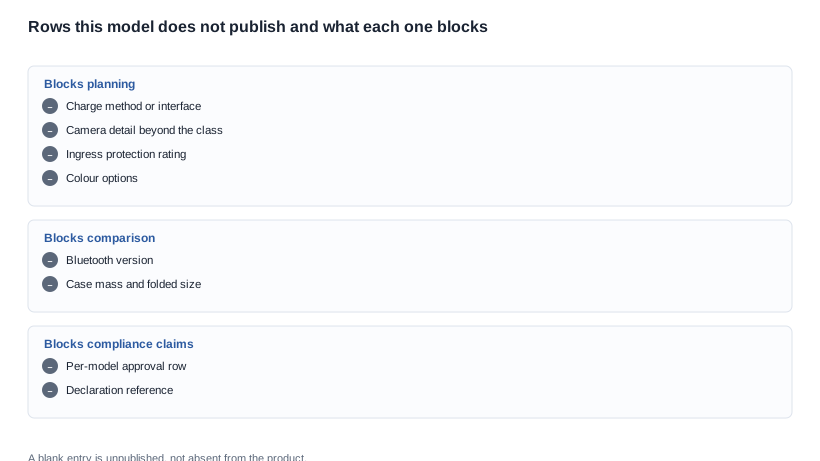
Listing the absences matters as much as listing the figures, because each one rules out a specific piece of planning.
Not published: the charge method or interface. Not published: any camera detail beyond the resolution class. Not published: an ingress protection rating — two models in the whole catalogue publish one, and this is not one of them. Not published: colour options — again published for two models, and not this one. Not published: Bluetooth version — no camera model in the range publishes it, though the audio models do. Not published: any per-model certification row, approval number or declaration reference. Not published: case mass, folded dimensions, warranty terms, MOQ or lead time.
Each of those is a specific decision that has to wait for a supplier answer. The certification position in particular is often described loosely, so it is worth stating precisely: the catalogue carries a company-level export certification page whose content is images, and those ten certificates are patent documents, eight appearance-design and two utility-model. The catalogue text contains no reference to CE, FCC or RoHS, and no per-model approval row exists. That is a gap in model-level evidence, not an absence of approvals, and the two are treated differently in every credible file. The full position is in MT6 smart glasses certification status.
The pattern across all of these is consistent, and it is the single most useful thing to take from this specification: this model publishes a complete power specification, a citable resolution class, a published case capacity and the only mass figure in the range. It publishes nothing about how it charges, what its camera sensor is, what it can record, whether it resists water, what colours it comes in, or what approvals it holds. A buyer can plan on the first group and must request the second.
What we can state, and what we will not
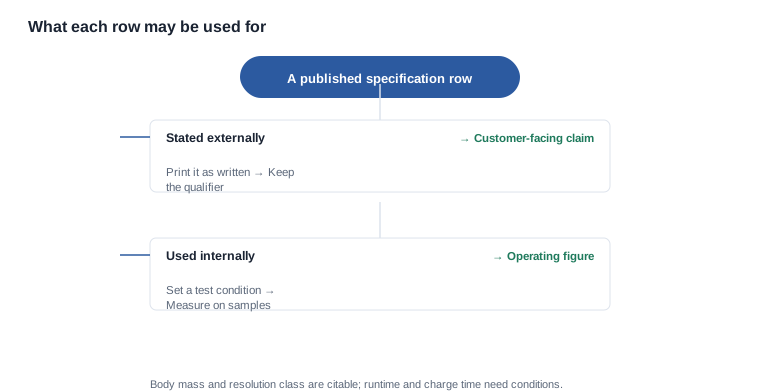
The position is narrow and we hold it deliberately. The six published rows on this page may be stated externally exactly as written — 265 mAh, about seven hours, two hours or less, an eight megapixel resolution class, a 1200 mAh folding case, and 158 grams for the body excluding the case. Those are citable claims, and a buyer who needs a defensible specification can build on them.
Everything else stays out. We will not describe a connector, because no charge method row exists. We will not describe video behaviour, because no video row exists — and equally, we will not say video is unsupported, because that would be an inference in the opposite direction. We will not state an ingress rating, a colour option, a sensor model or a field of view. And we will not describe this model as holding or claiming any certification, because a company-level page of ten patent images cannot establish a model-level approval.
The reason to hold the line is commercial rather than editorial. A claim that later turns out to be unsupported costs a buyer a listing correction, a channel conversation and sometimes a stock write-down, and it does so at a point when the money has already been spent. A specification built only from published rows is slower to write and considerably faster to defend.
Using each row in a contract
Rows and contracts are different instruments, and the useful exercise is deciding which rows belong in which. The mass figure is a good one to write into a purchase order as an acceptance criterion, because it is testable on a scale, because it is unambiguous about what it includes, and because it is the only such figure in the range. The charge time belongs in a contract as a ceiling with stated start and end conditions. The runtime belongs as a target with a stated workload, or not at all — a runtime in a contract without a workload is a dispute waiting to happen.
The case capacity is a configuration statement rather than a test: it tells the supplier what is in the box and tells the buyer what to check on arrival. The camera class is a listing statement, not an acceptance criterion, because there is no test route for a published pixel figure that sits behind an unpublished sensor.
The rows that are not published have exactly one correct use in a contract: as an obligation to disclose. Ask for the charge method, the sensor, the ingress position and the approval scope as written commitments against the purchase order. What you cannot do is write an acceptance criterion against a number the supplier never gave you, and a buyer who invents one has set a target the other party will meet by accident at best.
How to evaluate a supplier answer against this row set
The evaluation is a cross-check rather than a judgement. Take the supplier's answer and place it beside the published row it relates to, and ask whether the answer confirms, extends or contradicts. An answer that extends the record is useful but must be labelled as a supplier statement in your file, because it is not something the catalogue supports. An answer that contradicts a published row is a correction, and the published row wins until the supplier produces evidence.
Two questions to ask every time, because they are the ones suppliers most often skip. Is the figure you have given me for this configuration, and is it the configuration that will ship against this purchase order. The first distinguishes a model-level claim from a configuration-level one. The second distinguishes a current production run from an engineering sample or an earlier revision, and it is the single most common reason a good specification turns out to describe a product that no longer exists.
After that, apply consistency across the whole answer set. A supplier whose charge method answer implies one case configuration while its case answer implies another has given you two documents that cannot both be true, and that contradiction is more informative than either answer alone.
Common transcription errors to watch for
In a range of twenty-eight models sharing row labels, the most frequent failure is not a wrong number but a right number attached to the wrong model. Four are worth checking every time. A capacity figure transcribed from a neighbouring page — the 290 mAh shared by four other camera models is the one most often substituted for this model's 265 mAh. A runtime range pasted in place of a committed figure. A charge method carried over from a model that publishes one. And a mass figure treated as covering the case when it explicitly excludes it.
None of these is a serious matter individually, and all four are cheap to catch if you check the model designation on the document against the model designation on the purchase order. That single check, applied to every row on every quotation, removes the largest class of error that survives into a shipment.
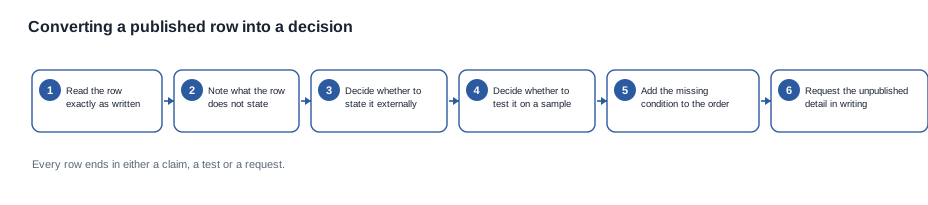
The wider habit is simple and worth stating once: treat this specification sheet as a checklist of what you may say, what you may test, and what you must ask. Six rows sit in the first two categories and the rest of the page sits in the third. Buyers who separate those three clearly before the first conversation tend to close the open items quickly, because the supplier receives specific questions instead of a request for the full specification.
Finally, a note on how this sheet ages. Published rows can be revised, and a revised figure is not automatically an error — it may reflect a configuration change or a genuine correction. What matters is that you know which figure you specified, on which date, against which purchase order, and which answer the supplier gave at the time. A specification file that records all four will survive a revision and a supplier change; one that records only the current figure will not.
That is the whole practical argument for treating a short specification page as a checklist rather than as marketing. Six rows, each with a defined use, each with a defined limit, and a named route for closing everything the page leaves open.
A closing observation for buyers comparing rows across this range: the number of published rows is itself a piece of information about how much you can plan. A model whose page carries a colour row, an interface row and an ingress row supports a channel decision without a supplier conversation. A model whose page carries five power-related rows and nothing else supports a power decision and leaves the channel decision provisional until someone answers a question. Both are legitimate positions. Neither is better in the abstract, and the right choice depends on how much open-ended due diligence your operation can absorb before a launch date.
Related reading
- The camera range this model belongs to — AI camera glasses
- Where the record stops — MT6 smart glasses limitations
- Position against the other camera models — MT6 smart glasses how it compares
- The charge method gap — MT6 smart glasses charging options
- What to check on another model in this range — L2 Utral before ordering


