

The MT6 smart glasses review checklist is short because this model publishes less than most. Its catalogue page carries five numbers — 265 mAh, about seven hours, a charge time of two hours or less, an eight megapixel resolution class, and a 1200 mAh folding case — plus a frame weight of 158 grams. That weight is the only mass figure anywhere in the range, and a folding case is the only case in the camera group described as folding. What the page does not publish matters just as much: no charge method row, no sensor model, no field of view, no frame rate, no ingress rating, no certification line. An acceptance plan built only around what is published will therefore pass a run that has real defects, so the eight steps below pair every published number with the question you must put to the supplier when the catalogue is silent.
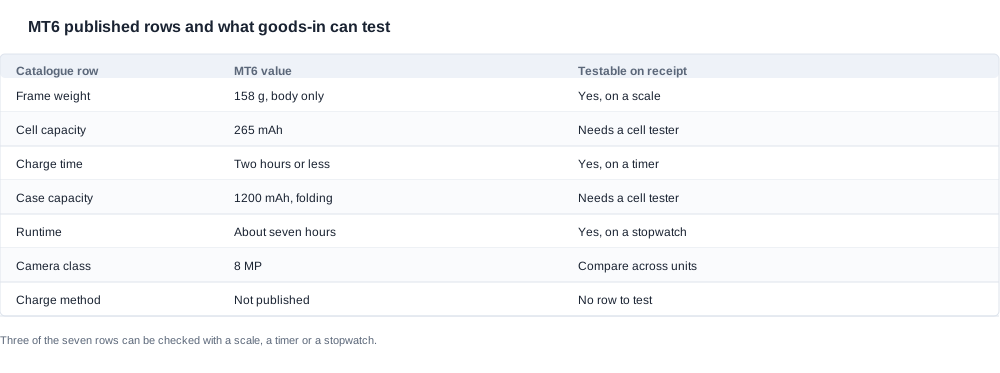
MT6 smart glasses review checklist: separating the three testable rows from the rest
Three of the five published numbers can be checked with equipment you already own: a scale, a timer and a stopwatch. The other two cannot be tested at all without disassembly, and saying so plainly is more useful to a procurement team than a long test protocol that quietly assumes access the supplier has not granted.
What the 158 grams covers, and what it does not
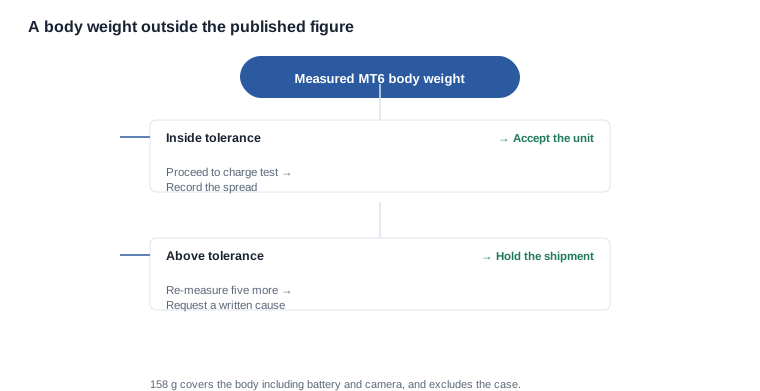
The published figure is 158 grams for the glasses body. It includes the fitted battery and the camera, and it excludes the folding case. That exclusion is not a rounding detail — it is the difference between a figure you can put on a platform scale and a figure that needs a freight scale. If a supplier quotes 158 grams as an all-in packed weight, that is a different claim from the catalogue row, and the two should not be reconciled by assumption.
Ask for the weighing protocol rather than the number alone: which units were weighed, how many, in what state, and with what tolerance. A single unit on a consumer scale tells you almost nothing about a production run. Five or ten bodies drawn from random cartons tell you whether the process is centred. Record the spread, not just the mean, because a run that averages 158 grams with a 20-gram spread is a different supply risk from one that averages 158 grams tightly.
Charge time is a ceiling, not a promise
Two hours or less is an upper bound. It permits a unit that takes exactly two hours, which under-two-hours language would not. Quote it as published and hold the supplier to the ceiling: if a measured charge takes longer than two hours from the stated start condition, that is a deviation from the row.
The published figure also carries no start state and no completion criterion. It does not say whether the cell starts empty, partly charged, or at a nominal level, and it does not say what charge level counts as finished. Without those two conditions, two hours or less is not reproducible. Put them in the purchase agreement as conditions of test, not as an assumption — this is the same class of problem as the charge time ceiling discussion on the battery comparison side of the range.
A 1200 mAh case is not a recharge count
The catalogue publishes the case capacity and the frame cell capacity as two separate numbers. It does not publish how many frame charges the case delivers. The arithmetic relationship between the two published figures is visible to anyone who reads both rows, but conversion losses, the case's own overhead draw, and the cut-off threshold are all unpublished, so any specific recharge count you derive is your arithmetic rather than the supplier's claim. Treat it as a hypothesis to test, never as a specification.
The measurable version is simple: charge the case, then cycle the frame from a fixed cut-off to a fixed end state and count how many cycles you get on identical units. Two or three sample units will give you a usable figure for planning; a single unit will give you a rumour.
Sampling: why the first carton proves nothing
Acceptance sampling is where most buyer checklists quietly fail, because the units that arrive first are frequently the units that were packed first and inspected last. Random selection is not a formality.
Draw units across the full carton count, not from the top. Use a published random method — a carton sequence and a unit position, both recorded — so that the selection can be defended later if a defect claim is contested. A sampling plan agreed before the shipment leaves is materially easier to enforce than one negotiated after a shortfall is discovered.
The inspection sequence that keeps the evidence usable
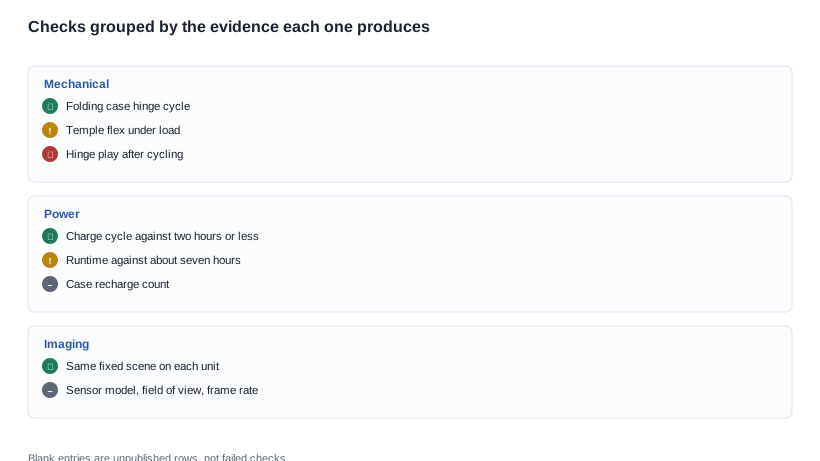
Order matters. Weigh before you power anything, because a powered unit may have a different thermal or charge state than one that has been resting. Time the charge cycle before any runtime test, since runtime tests drain the cell. Photograph markings before anything is opened or handled beyond normal operation. The sequence below is arranged so that each step does not contaminate the next.

What the imaging checks can and cannot settle
The MT6 publishes the eight megapixel resolution class, which places it in the eight-model group of camera glasses rather than the three-model thirteen megapixel group. That is a real, citable structural fact and it belongs in your specification file. It is also the full extent of what the catalogue says about the camera.
There is no sensor model, no field of view, no frame rate, no video format, no stabilisation row and no low-light description. So you cannot write an acceptance test that says the camera must perform to a published standard, because no such standard is published for this model. Any test you write that references one is testing against a number your supplier never committed to.
What you can do is test consistency, which is a different and often more valuable property. Photograph the same scene — same location, same subject, same lighting, same settings if settings are exposed — on every sampled unit, then compare across the batch. A run where five units produce materially different exposure or focus has a process problem regardless of what any spec sheet says. The reasoning behind why an unpublished sensor limits what a camera review can conclude is set out in the AI camera glasses imaging note, and the resolution classes across the camera group are compared in AI camera glasses resolution options.
Do not let an imaging test quietly become a comfort or subjective-quality review. Keep the frame, the subject and the light fixed, and score what you can observe.
The charge method gap and why it matters at goods-in
The MT6 page has no charge method row and no charge interface row. It is one of four camera models in that position — the MT6, the CY05 and the CY03, and the L1 Pro all publish a case capacity without publishing how the device charges. All four publish the case capacity, so the gap is specifically about method, not about whether a case exists.
Practically, this gap means your packaging, cable and dock decisions cannot be finalised from the catalogue. A magnetic contact and a Type-C receptacle impose different accessory requirements, different bundled-cable choices and different counter or warehouse procedures. Do not guess. Add the method to the document request list and make the answer a condition of the purchase order rather than a question you hope resolves itself during sample review. The certification checklist covers the document side of the same request set.
Turning a failed check into a written remedy
An acceptance test that produces a pass or fail without a pre-agreed consequence is a measurement exercise, not a control. The remedy has to exist in the purchase agreement before the run arrives, because after a shortfall is found, both sides are negotiating.
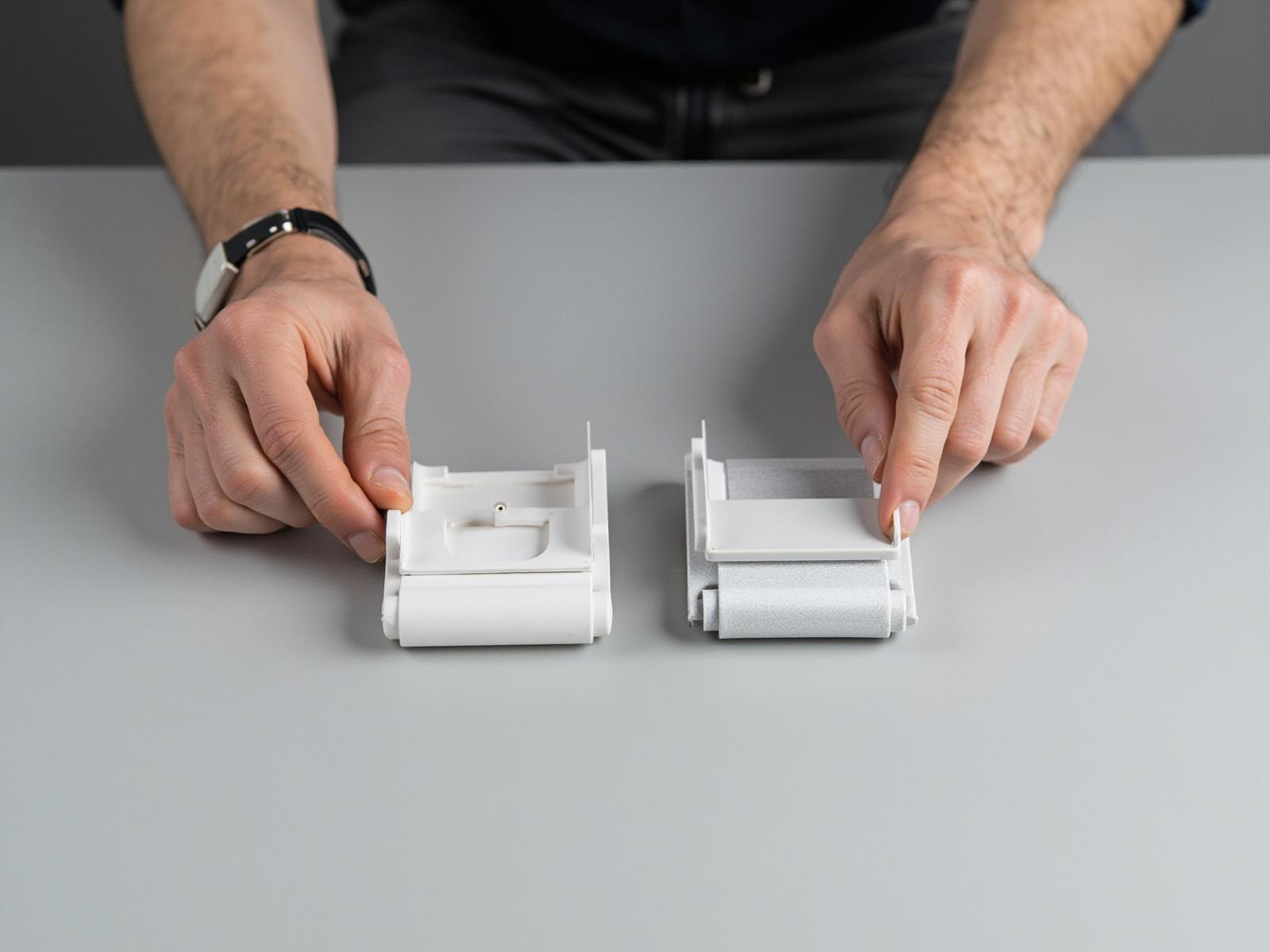
Classify defects by severity rather than by a single pass/fail. A deviation on the published frame weight is a specification deviation. A case hinge that develops play within a defined cycle count is a durability defect. A missing or incorrect marking is a documentation defect. Each class carries a different remedy: replacement of the affected units, a rework or credit against the balance, or a hold pending a written supplier explanation. Deciding which applies while the shipment is on the dock is the point at which leverage disappears.
Two contractual hooks carry most of the weight. The first is the acceptance clause itself — sample size, selection method, defects covered, and the window in which the buyer may reject. The second is the written-explanation requirement: when a measured value sits outside a published row, the supplier owes a written cause, not a verbal reassurance. A supplier who cannot explain a deviation has given you the strongest possible argument for a price concession, because the deviation is theirs and the cause is known to them.
Set the remedies at order stage, while the quantity is still being negotiated and the order is still conditional. Buyers who defer this conversation until the goods are on the dock routinely find that the only available remedy is return freight, which is rarely proportionate to the value at stake.
Writing the acceptance criteria before the sample ships
Most acceptance plans are drafted after the first shipment goes wrong, which is the worst possible moment to discover that nobody defined what "acceptable" means. The criteria are simple to write and impossible to reconstruct afterwards, so write them while the purchase order is still open.
Four criteria pay for themselves on this model specifically. First, the weighing protocol: how many bodies, drawn how, in what state, against what tolerance. Second, the charge cycle conditions: the starting state of the cell and the completion criterion, both stated, because the published row supplies neither. Third, the case recharge count, measured on a stated number of sample units to a stated end state, so that the spare-unit policy is built on data rather than on a division. Fourth, the imaging consistency rule: a fixed scene, a fixed frame, a fixed count of units, and a stated threshold for calling a unit inconsistent with the batch.
Each of those is a criterion you can defend and a threshold you can argue about. That is the difference between a quality control step and a dispute.
The commercial terms that attach to them matter as much as the wording. A percentage allowance for minor deviations, a defined remedy for major ones, and a window in which the buyer may reject are the three clauses that make the rest enforceable. Buyers who negotiate the remedy before the run is built get a better outcome than buyers who ask for it afterwards, because the supplier has already priced the risk differently by then. Where you have a private label arrangement, check that the acceptance criteria and the brand guidelines reference the same product configuration — a branding document that describes a slightly different unit is a common and entirely avoidable source of a rejected shipment.
If the supplier proposes their own inspection instead, read it against this list before agreeing. A supplier inspection that measures only what their process can pass is not an acceptance test; it is a self-assessment. Ask what proportion of the random sample they inspect, whether the selection method is recorded, and whether the report is per unit or per batch. Those three answers tell you whether the resulting document will mean anything in a warranty discussion six months later.
A worked sequence on a hypothetical shipment
Consider a constructed case rather than a client project. A distributor orders a first batch of MT6 units for a channel partner and builds the acceptance plan from the published rows alone. The first carton weighs within range on a platform scale. Sampling reveals, however, that every unit drawn from the middle cartons sits above the published body weight, while the units from the top cartons do not. The catalogue position, the charging method, the certification documents and the published 158 grams are four separate facts about this model, and they are exactly the set a written specification has to name.
The distributor's correct response is not to reject the shipment on the spot. It is to draw a further sample on the published random method, record the spread, and issue the written-explanation request with the shipment held. If the cause is a component substitution, the remedies range from a price concession to a re-run. If the cause is a supplier-side weighing error, the sample record still has evidentiary value. Either way the decision is made on a record rather than on an argument, which is the entire purpose of an acceptance plan.
The same reasoning explains why consistency checks outrank absolute checks on this model. Three of the five published numbers are testable; two are not; and the camera detail beyond the resolution class is not published at all. A plan that tests only what exists, and asks in writing for what does not, is the plan that survives contact with a real production run.
The failure modes this checklist will not catch
Two classes of problem survive every step above, and a buyer who knows which ones they are can spend their attention accordingly.
The first is the substitution problem: a component changed between the approved sample and the production run, with no catalogue row to detect it. The published figures would all still hold — the body would still weigh what it should, the charge time would still fit the ceiling, the runtime would still reach seven hours — while something that is not on any row has changed. The only defence is a technical file that names the configuration, and a supplier who will state in writing what changed and when. Ask that question at the sample stage, not after the run.
The second is the documentation drift: the paperwork matches an earlier production window rather than the units in the carton. Markings, declarations and packing lists are all places where this hides, and all three are checkable on a random unit in about a minute. Check the date on the paperwork against the shipment, and check the markings on units drawn from the middle cartons rather than from the first one.
Neither class is a defect in the product. Both are defects in the evidence, which is the harder kind to resolve later because nothing in the physical unit points at it.

What the supplier owes you in writing
The catalogue includes a company-level export certification page with image content instead of text content. Those ten certificates are patent documents — eight appearance-design patents and two utility-model patents. The catalogue text contains no reference to CE, FCC or RoHS, and there is no per-model certification row anywhere. Nothing in the catalogue links the MT6 to any particular approval, and nothing in it should be read as doing so.
That is exactly why this belongs in the acceptance plan. A buyer's certification due diligence is a document request, and it is the same request whether the model is the MT6 or anything else. Ask which approvals apply to this model in your destination market, ask for the test reports that support them rather than the certificate images alone, and ask who signs the declaration of conformity. Where the Radio Equipment Directive applies, the correct reference is (EU) 2014/53/EU; where electromagnetic compatibility is the concern, EN 301 489 is the harmonised standard family and should not be confused with a directive number. The wider pattern of how companies handle this is covered in OEM-ready certification coverage, and the export paperwork question in OEM-ready export documentation.
Record all of it against the purchase order number, not against a salesperson's name. When the next run ships under a different buyer or a different contact, the file is what carries forward.
Our boundary on what this checklist can prove
This checklist tests against published rows and asks written questions about unpublished ones. It does not certify anything, and it does not assert that any approval exists for this model. Where the catalogue is silent — charge method, sensor detail, ingress protection, certification scope — the honest output is a question, not an assumption. Buyers who understand where the evidence stops are the ones who can tell a supplier, with a straight face, exactly what they will accept and what they will not.
The record set that survives a dispute
Six months after a delivery, the only things that still carry weight are the ones you wrote down. Keep the random selection method and its record, the per-unit weight figures with their spread, the timed charge cycles with start and end conditions, the runtime stopwatch readings, the same-scene image set, the photographs of markings, and every written supplier response with its date.
That set is small enough to fit in one folder and specific enough to defend a claim. It also feeds the next order: the spread you measured becomes your tolerance proposal, and the explanation you received becomes the question you ask before the next run leaves the line. Sample-order discipline of that kind is worth setting up once — OEM-ready sampling before bulk covers how to structure the first sample round, and OEM-ready quality consistency covers what to do when a run drifts.
For MT6 specifically, the value of a written acceptance plan is higher than average, because the model publishes a unique mass figure, a unique folding case and no charge method row. Those three facts are the whole argument for verifying carefully rather than trusting a carton.
Two questions to ask before the sample order is placed
Both are cheap, both are often skipped, and both change what the sample is actually testing. Ask how many units the sample order contains and what that number is intended to prove. A two-unit sample can prove that a unit works; it cannot prove that the process does. If the purpose is to validate a specification before a bulk order, say so in the order and ask for a sample that can support it. Ask which configuration the sample will be, in the same words as the bulk order will be, because a sample that differs from the production configuration validates nothing you can later rely on.
Then ask what the supplier will do with your findings. A supplier who welcomes a defect report before the bulk run has told you something useful about how the next conversation will go. A supplier who regards the sample as a finished sale has told you something equally useful, and rather more cheaply than a rejected first shipment would.
Related reading
- The camera range this model belongs to — AI camera glasses
- What an unpublished sensor means for a review — AI camera glasses imaging
- The document set to request alongside this check — certification checklist
- Battery rows across the camera group — AI camera glasses battery comparison
- Setting the acceptance clause — OEM-ready sampling before bulk
Tell us the target market, the quantity and the configuration required, and we will answer with what is available and what is not.


