
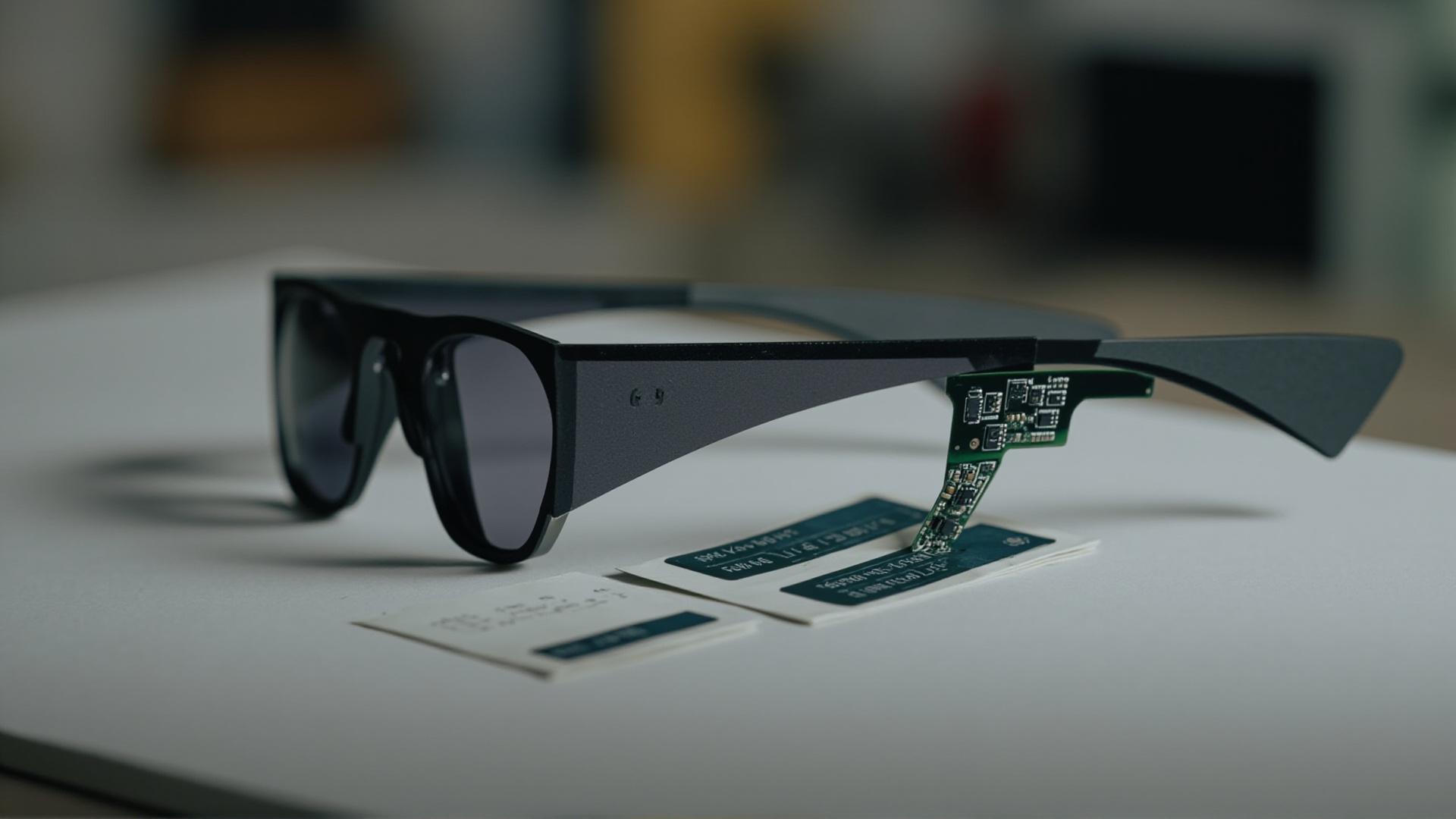
The MT6 smart glasses charging options are easier to plan than they are to read. The catalogue publishes a 265 mAh cell in the body, a runtime of about seven hours, a charge time of two hours or less, and a 1200 mAh folding case described on the page as portable, ultra-light and foldable. What it does not publish is the charge method itself. There is no charge method row and no charge interface row anywhere on this page. For a buyer deciding what to bundle, what to stock and what to write on a product listing, that single omission drives most of the practical work in this note.
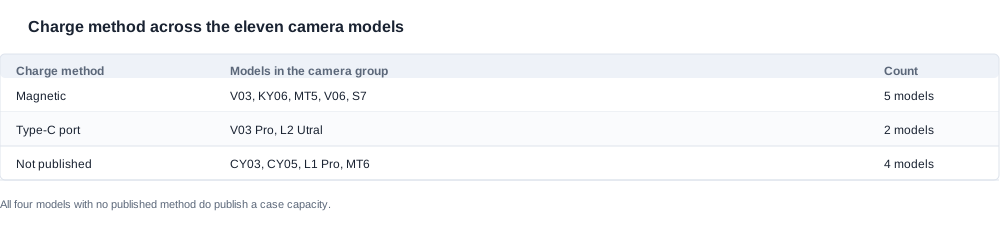
The gap is narrow and specific rather than general. The MT6 sits with three other camera models — the CY05 and the CY03, and the L1 Pro — in the position of publishing a case capacity without publishing how the device charges. All four of those models publish a case capacity, so the omission is about method, never about whether a case exists. Across the camera group the method splits three ways, and knowing which split the MT6 belongs to tells you precisely what to ask and what to plan around in the meantime.
MT6 smart glasses charging options: what the catalogue publishes, and the one row it omits
Read the MT6 page as a buyer would, and it is a dense page for this catalogue. Five rows carry the standard load: a 265 mAh cell, a runtime of about seven hours, a charge time of two hours or less, an eight megapixel resolution class, and a 1200 mAh folding case. Three further descriptors sit alongside them — portable, ultra-light, and a 158 gram body that excludes the case.
What is not there is the one row you would most expect on a model whose selling point is a case. No magnetic charging line, no Type-C interface line, no contact arrangement description. For the four camera models in that position, the catalogue publishes a case capacity and stops.
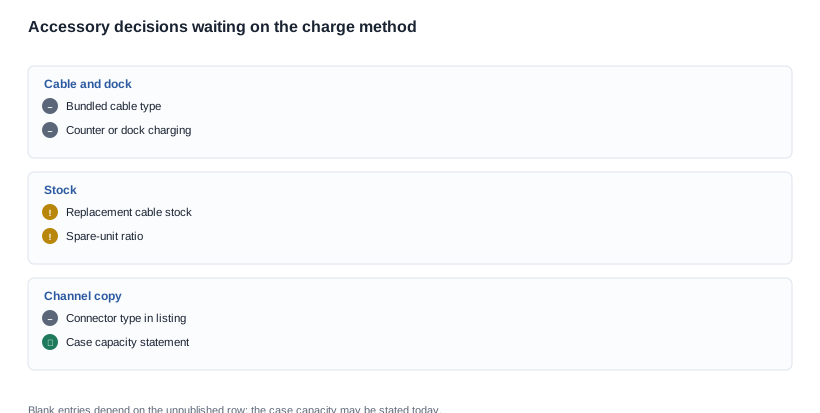
That is worth stating precisely, because the alternative reading — that the MT6 charges by a method the catalogue considers obvious — is exactly how accessory plans get built on an assumption. The method is not obvious. It determines the bundled cable, the counter procedure, the replacement stock, the docking solution for a fleet deployment and the copy on your own product page. All five are downstream of a row that is not published.
The four states of the case across the camera group
Eleven camera models, four different case situations. Separating them matters because a buyer who treats "no case" and "no published capacity" as the same statement will draw the wrong conclusion about what a supplier can offer, and will negotiate from a weaker position than the catalogue supports.
Five models publish a case capacity: the CY03 and the CY05, and the L1 Pro — each at 1400 mAh, the L2 Utral with a row reading 900/1400 mAh, and the MT6 with its 1200 mAh folding case. Two models have a case without a published capacity: the KY06 and the MT5. Four models carry no case row at all, which is not the same statement as having no case — the V03 Pro and the V03, and the V06 and the S7 simply have no such row on their page, and the case question for those four has to be closed in writing before a packing list is drawn up.
That last distinction is the one buyers get wrong most often. "The catalogue does not list a case" and "the catalogue states this model has no case" are different claims with different consequences. Collapsing them either loses you a case that may well exist, or lets you assume one that does not. The MT6 is in neither of those positions — it has a published capacity of 1200 mAh — so for this model the question is never whether a case exists. It is only how the charging works.
The wider case options are covered in AI camera glasses charging case options. What follows is how to read the MT6 rows specifically.
Why an unpublished charge method changes the accessory plan downstream
The method is not a detail when you are planning a channel. A magnetic contact arrangement and a Type-C receptacle produce different bundled cables, different warehouse procedures, different replacement stock, different charging-station decisions for a fleet deployment, and different listing copy. A buyer who finalises those decisions before the method is documented has made five decisions that may all need reversing, and reversing a bundled-cable decision after a channel partner has built inventory around it is expensive.
Ask the method as a specific question with a specific answer shape: the physical connector or contact arrangement, where it sits on the body, whether the case charges the body directly or charges independently, whether the case itself takes a separate input, and whether the same case charges any other model in the range. Those five answers are enough to build the accessory plan. A supplier who answers them precisely is also telling you something useful about the maturity of their documentation generally.
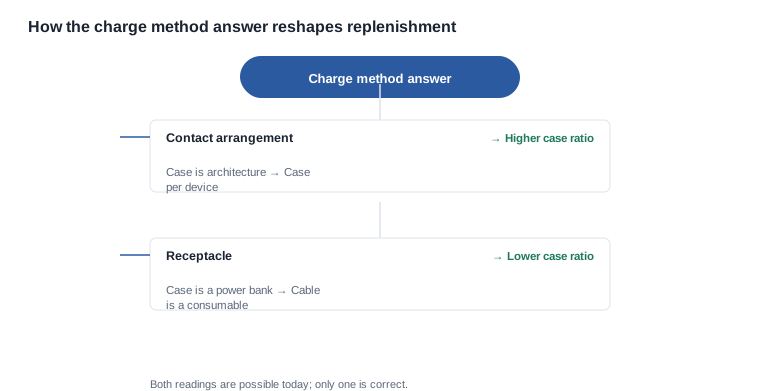
There is a second-order effect worth planning for. If the method turns out to be a magnetic contact arrangement, then the case is effectively part of the product's charging architecture rather than an accessory, which affects spare-unit ratios, transit packaging and the number of cases you must ship per device. If it turns out to be a Type-C receptacle, then the case is closer to a power bank and the cable becomes a consumable you replace. Both readings are plausible; only one is correct; and the difference changes your replenishment maths.
The same reasoning applies to what you may write on your own product page. You can state the case capacity because it is published. You cannot state a cable type, because the method is not published. Writing "magnetic charging" for this model because two neighbouring camera models use magnetic charging would be an inference the catalogue does not support, and it is the kind of inference that is difficult to retract once a channel has published it.


What 1200 mAh next to 265 mAh does and does not tell you
The two published capacities sit on the same page, so a buyer will naturally divide one by the other. That arithmetic is yours, not the supplier's. The catalogue publishes no recharge count, no conversion efficiency, no case self-discharge figure and no cut-off threshold. Any cycle count you derive is therefore a planning hypothesis rather than a specification, and the distinction matters the moment somebody writes it into a spare-unit policy.
The difference is not academic. If your operation issues one device per shift, a case delivering a single full recharge changes the spare-unit policy completely from a case delivering three. So measure it rather than assume it: charge the case to its stated end state, then cycle the frame from a defined low threshold to a defined end condition, and count what you actually get across two or three identical units. Record the threshold you used, because a count obtained by draining the frame to exhaustion is not comparable with a count obtained by stopping at a usable reserve.
Mass matters here too, and it is where this model is genuinely unusual. The published 158 grams is the glasses body — including the fitted battery and the camera — and explicitly excludes the case. Case mass is not published anywhere in the range. Since the case is the part that gets packed, stacked and shipped, the missing number belongs directly in your freight request, and it is one of the few figures on this page that only your sample can supply. That dimensional and packaging question is set out in AI camera glasses shipping weight.

Building a charging plan from the figures you can actually verify
Three of the MT6's power-related numbers are testable with ordinary equipment. A stopwatch confirms whether the runtime reaches about seven hours. A timer confirms whether the charge completes within the two-hour ceiling. A scale confirms the 158 gram body figure. The fourth, the case capacity, needs a cell tester. The recharge count needs the cycle procedure above.
Set the test conditions before you start, because the published rows carry none of them. A charge time of two hours or less has no stated start state and no stated completion criterion. A runtime of about seven hours has no stated workload, no stated camera load and no stated ambient condition. A runtime measured with the camera idle and a runtime measured with the camera recording are different numbers, and neither is wrong — but they are not comparable unless the condition travels with the figure.
This is where suppliers and buyers most often part company by accident. The supplier reports seven hours, the buyer measures five, and both leave the conversation believing the other is wrong, when the disagreement was about conditions rather than about the product. Write the conditions into the sample order before the units ship, not after the discrepancy appears.
Two further points on comparability. Charge time here is a ceiling: two hours or less permits a unit that takes exactly two hours, which "under two hours" would not. And the charge time is published for all twenty-eight models, but publication without a start state means it cannot be used to compare interruption length during a shift change, nor treated as the turnover time of a case that recharges several frames. The MT6 battery and runtime rows are set out in more detail in MT6 smart glasses battery life, and the full specification reference sits in MT6 smart glasses specifications and features.
Planning the channel before the answer arrives
Until the method is documented, plan on the conservative assumption: the case is the primary power source for the body, and the body needs a charging path of its own. That assumption holds whether the method turns out to be magnetic or Type-C, and it avoids the expensive failure mode of a channel that stocked one cable type and discovered the other was required.
Where the case matters mechanically to your use case — and a folding case will be dropped, folded and stacked — say so in the sample order and cycle it. The fold action is a distinguishing published feature of this model, which makes it a natural thing to test and a natural place for a quality control failure to appear late. The relationship between folding mechanisms and activity exposure is covered in sport smart glasses durability testing, and the general consistency question across repeated production runs in OEM-ready quality consistency.
Negotiating the packaging decision around an unknown
Accessory planning does not have to wait for the method answer. It can be narrowed to two options and priced against both, which is a stronger negotiating position than waiting for a document that may take weeks.
The two options are simple. Either the case is part of the charging architecture, in which case a case ships with every device and the case ratio in your replenishment model rises; or the case is closer to an independent power source, in which case the case ships in a smaller proportion of orders and the cable becomes a consumable you replace on a schedule. Ask the supplier to price both, and ask which one their current packing list assumes. A supplier who answers the second question is telling you what you will receive; a supplier who answers only the first is telling you they have not checked.
This is a useful question because it converts an open item into a bounded choice. Buyers who frame it that way get a decision inside a quotation cycle rather than a delay through a technical exchange, and the quotation itself becomes the place where the assumption is written down where both sides can see it.
Two further trade-offs belong on the same page of the negotiation. The first is bundled contents: a cable in every box is a cost per unit that a supplier will price one way and a channel partner will value another, and stating it explicitly on the order removes the argument. The second is spare-unit policy: until the recharge count is measured, plan conservatively and revisit once the sample data exists. Writing that revision point into the contract — who measures, on how many units, by when — costs nothing and prevents the policy from being argued twice.
The criteria for choosing between charging configurations
If you are comparing this model against others in the same sourcing exercise, the criteria that actually separate them are worth naming. On charge method, three of the camera models publish a magnetic row and two publish Type-C, so any comparison that needs a documented method should note which models actually carry one. On case capacity, five models publish a figure and the MT6's folding 1200 mAh case is one of them, so capacity comparison is possible for this model even though method comparison is not. On charge time, every model in the range publishes a figure, but all of them are ceilings without start conditions, so the published values rank nothing on their own.
The trade-off a buyer is really making is therefore between documentation maturity and specification depth, not between two better-documented alternatives. A model with a published method and no case row and a model with a published case and no method row both require a written question, just a different one. The checklist to run before you order is short: which rows does each candidate publish, which of your decisions depend on those rows, and which of your decisions therefore have to be made provisional until a supplier answers.
The checklist before you commit a channel decision
Four questions to ask before this model enters a channel plan, in this order. What do we actually need the charge method for — a bundled cable, a dock, a counter procedure, or listing copy? Which of those decisions can be made provisional and corrected later without cost? What is our fallback if the answer arrives after the launch date rather than before it? And what does the model cost us if the answer turns out to be the option we planned against?
Those four questions convert an open specification item into a managed risk, which is the only honest way to carry it. A buyer who has answered them can proceed with the order while the documentation catches up. A buyer who has not answered them will discover the same gap in a launch review, at which point the only remaining move is a delay.
The same discipline applies to the case. Two published numbers, 1200 mAh of case against a 265 mAh cell, describe a relationship without describing a behaviour. Measure the recharge count on your own units, with your own end conditions, and treat the result as the operating figure. Until then, plan the spare-unit ratio on the conservative reading, and write the revision point into the contract so that revising it later is a scheduled action rather than an argument.
Where the charging question becomes a negotiation point
The charge method is small in bytes and large in consequence, which makes it an unusually good lever in a quotation discussion. A supplier who has it documented confirms it in a line. A supplier who has to go and look has just revealed something about their documentation maturity, and a buyer who prices that risk is being paid for it.
Three requests carry the weight. First, the method as a written specification attached to the purchase order, so the accessory plan has a contractual basis rather than an email. Second, the bundled contents stated explicitly on the order, because what ships in the box is a per-order decision that is cheap to fix on the order form and expensive to fix after a partner has built a listing around it. Third, the case recharge count measured on your own sample units and reported with its conditions, so the spare-unit policy rests on your data rather than on a derivation.
None of this requires a price concession to ask for. It requires that the buyer treats the omission as a specification question rather than as a gap to be filled with a plausible guess. That framing also tends to produce a faster answer, because a supplier can respond to "which connector" far more readily than to a general request for certification paperwork.
The boundary of what we can state
We can tell you exactly what the published record contains: a 265 mAh cell, about seven hours of runtime, a charge time of two hours or less, an eight megapixel resolution class, a 158 gram body that excludes the case, and a 1200 mAh folding case. We do not publish a charge method for this model, and we will not infer one from the case capacity or from the methods used by neighbouring camera models. That row is absent, so it belongs in your written question to the supplier, where it belongs in your order as an agreed specification once answered.
What to negotiate once the answer arrives
Whatever the answer turns out to be, convert it into three lines on the order rather than a thread in an inbox. The connector or contact arrangement, named precisely. The bundled contents, listed exhaustively. And the case configuration, if the case is supplied separately from the device.
Those three lines are what stop the most common recurring dispute in this category, which is not usually a dispute about the product at all but about what was supposed to be in the box. A buyer who has them written down converts an ambiguous shipment into a checkable one, and converts a quality control problem into a contractual one that is far cheaper to resolve.
Add a fourth line for repeat orders: the review point at which a configuration change requires notification. Charging arrangements are exactly the kind of thing a factory will quietly standardise across models to simplify procurement, and the buyer who has not asked will discover it when a cable stops arriving in the box.
One further point for buyers running more than one model: do not assume the case is interchangeable between models until a supplier confirms it in writing. A case that charges one model and not another is a normal outcome, and the confusion costs more than the answer does.
Related reading
- The camera range this model belongs to — AI camera glasses
- Case options across the group — AI camera glasses charging case options
- Battery rows in detail — MT6 smart glasses battery life
- Specification reference — MT6 smart glasses specifications and features
- Physical testing of moving parts — sport smart glasses durability testing


