

OEM ready platforms are usually discussed on the buyer's side of the transaction, and customer support is where that focus becomes expensive. A support operation is the only part of a private-label programme that meets the customer directly, and it is the only part that cannot be deferred until the sales curve looks healthy. The decisions that make support workable — what the documentation says, what the triage path can answer, where spare units come from, who owns the escalation — are made either before launch or during the first bad month. This piece sets out how to set the support model up against published product structure, which questions your support team must never improvise an answer to, and how to build the reverse logistics and training decisions that make the model hold under volume.
OEM ready platforms and the support model that has to exist before launch
The range publishes twenty-eight models across several structurally different groups: eleven camera models, eight audio models, three sport models, children's models, an AR model, a bone-conduction model and a photochromic model. That breadth is the first fact a support model has to absorb, because a support operation organised around one product family will fail on the second.
The differences that matter for support are specific and published. The charging method divides into three states across the camera range, which means a support team cannot assume one cable or one dock covers the range. The case configuration divides into four states, which means "does it come with a case" has three different correct answers depending on the model. Two models publish an ingress protection rating and the rest publish none. Two camera models publish colour options and the rest publish nothing at all. No model in the range publishes a touch configuration row, and none of the eleven camera models publishes a radio version.
Each of those is a support exposure before it is a support answer. A customer who received a case with their unit and the catalogue page does not mention one is a documentation question. A customer asking why their unit will not charge is a triage question that becomes expensive if the interface is undocumented. A customer asking about a lens change is a question the published documentation cannot answer, because no activation data is published for the photochromic behaviour.
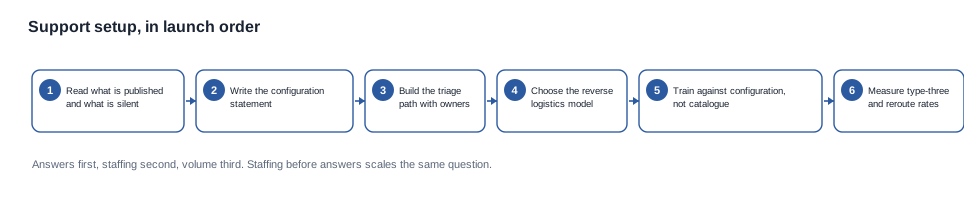
The structural conclusion is that support readiness is a documentation outcome, not a staffing outcome. Hiring people before the answers exist does not fix a question the organisation cannot answer; it produces a faster rate at which the same unanswerable question is asked. The right sequence is answers first, staffing second, volume third.
There is a commercial argument for doing this early that is usually missed. Support cost per unit is fixed by your handling model, but the number of tickets per unit is determined before launch by how well the product description and the documentation match reality. A description that overstates what is published generates a ticket for every unit sold, which means the cost is multiplied by the success of the programme rather than by the failure of it.

What the published documentation does and does not let a support team rely on
A support team should be told, in writing, which facts it may state as fact and which it must route elsewhere. That instruction is simple to produce and prevents most of the avoidable escalations.
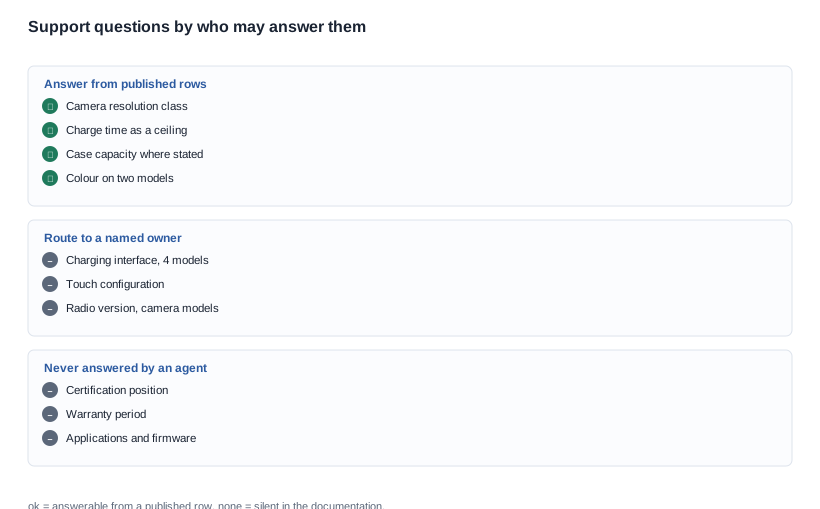
The team can state what is published. The camera resolution class for each camera model — eight models in the eight megapixel class, three in the thirteen megapixel class. The frame cell capacity, the stated endurance figure and the stated charge time for each model, always with the charge time expressed as an upper bound of two hours or less rather than as a measured duration. The case capacity where one is published, the colours where they are published, the ingress rating on the two models that publish it, and the one published weight — with its scope, because that figure covers the eyewear body and explicitly excludes the foldable case.
The team must route rather than answer wherever the catalogue is silent: sensor model, field of view, frame rate, video format, stabilisation, storage capacity, the charging interface on the four camera models whose pages carry no interface row, the radio version on camera models, the touch configuration on any model, the case presence on the three models with no case row, and the case capacity on the two models that have a case without a published capacity.
The team must not assert anything about certification, warranty terms, firmware, applications, or compatibility. None of that is published per model. In particular, a support agent who says the unit will work with an application is making a statement no product page supports, and on a range this structurally varied it is a statement that will be wrong for some configurations.
The distinction between the second and third groups matters more than it looks. Silence on a physical fact can be closed by asking a question. Silence on a platform fact cannot be closed by anyone inside the organisation if the supplier does not document it either, which is why those items belong in a pre-launch request rather than in a support script.
Designing the triage path
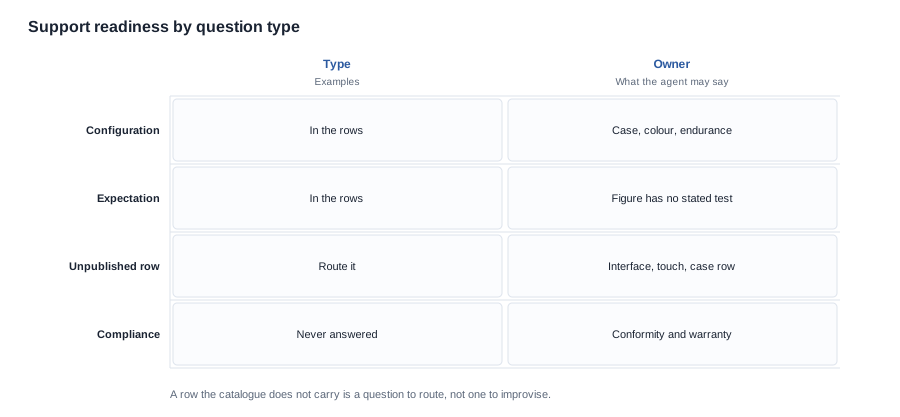
A triage path is a decision tree whose leaves are actions rather than answers. Build it around the question types that recur, and mark each leaf with what the agent is permitted to say.
Type one: configuration questions. Which models ship with a case, which colours exist, what the endurance figure means, what is in the box. These are answerable from the published rows provided the agent has the configuration statement for the specific model. The failure mode is an agent generalising from a neighbouring model, so the configuration statement needs to be per model and the agent needs to be told that group-level statements are not available.
Type two: expectation questions. Why does the stated endurance vary by use, why is the charge time an upper bound, why does the same product seem to behave differently. These are answerable, and the answer is that the published figure does not state its test condition. The reason this matters commercially is that an expectation question answered badly becomes a refund, and answered well becomes a short ticket.
Type three: fact questions with no published row. The interface on a model whose page does not carry one, the touch behaviour on any model, the case presence on a model with no case row. These must be routed to a single named owner with a response deadline, and the customer should be told when the answer will exist rather than given an estimate.
Type four: compliance and safety questions. Anything touching conformity, market availability or regulatory status. These must never be answered by a support agent, because the honest answer is that the position is documented per model and per market and lives in the compliance file.
The triage design decision worth making explicitly is who owns types three and four, and whether that owner is inside your organisation or the supplier. An internal owner gives you control and costs you time; an external owner gives you speed and costs you control over the message. Programmes that have not chosen deliberately tend to discover the answer through escalation.

Spare units, returns and the reverse logistics decision
The spare-unit and returns decision is the one most often deferred and most expensive to defer, because it determines the shape of the support operation rather than its cost.
Three models of handling are common. Replace from stock requires holding spare units, which is a working capital decision and a forecast decision, and it produces the fastest resolution for the customer. Repair and return requires a service path, which requires the interface and service documentation that this range does not publish per model. Refund without return is the cheapest to operate and the most exposed to abuse.
The published structure pushes in a specific direction here. A foldable case introduces a wear path and a transit failure mode that a rigid case does not, so a programme carrying the foldable configuration should expect returns to cluster on that component and should price the replacement rate accordingly. Across the range, the absence of a case on some configurations means a customer who expects one may raise a ticket rather than a return, which is a documentation problem rather than a logistics one.
Two structural facts are worth carrying into the reverse logistics design. The single published weight excludes the case, which means return shipping costs cannot be calculated from the catalogue. And no model in this range publishes a warranty period, so any statement about cover has to come from the agreement rather than from the product documentation — a point that support staff need to have in writing, because it is the question they will be asked most often.
Whatever model is chosen, the reverse logistics decision needs a documented path with named owners and turnaround expectations before launch, and the spare-parts and replacement questions are covered separately in after sales support and spare parts.
Training the people who answer the first question
Training is where published structure either becomes usable or becomes a trap, and the difference is entirely in how the material is presented.
The training material should be built from the configuration statement, not from the catalogue. The catalogue is organised by model; a support agent needs it organised by question. For each recurring question, the material should state the answer, the model scope it applies to, and what must not be said.
Three habits distinguish a support operation that works on this range from one that does not. The first is the habit of checking the model before answering — a range with four case states and three charging-interface states will produce wrong answers from memory faster than it produces right ones. The second is the habit of using the published wording for figures, particularly for charge time, which is an upper bound rather than a measured value, and for the weight, which has a scope. The third is the habit of recording what was asked, because the volume of type-three questions is the measurement that tells you which supplier answers to chase.
Training should also include the escalation boundary itself, stated plainly: which questions this team answers, which go to a named owner, and which go to the supplier. A support team that understands its own boundary escalates faster and answers more accurately than one that tries to resolve everything.
Deciding the support cost before you commit
A support model is a commercial commitment like any other, and it deserves the same treatment: criteria set in advance, trade-offs made explicitly, and a number attached before the order rather than discovered after it.
Four inputs determine what support will cost, and three of them are known before the first order. The configuration set determines how many distinct answers your agents need, because every model with a different case state or charging-interface state is a separate branch in the triage path. The channel determines who generates the tickets, and how quickly: a retail listing generates questions at the point of purchase, while a distribution arrangement generates them downstream where you have less control over the description that produced them. The documentation position determines the proportion of questions that can be answered at all, and on this range that proportion is set by what your supplier can supply in writing.
The fourth input, the handling model, is the only one you can change later without renegotiating, which is why it deserves the most attention in the commercial discussion. Replace-from-stock trades working capital for resolution speed. Repair-and-return trades a service dependency — which requires the interface and service documentation this range does not publish per model — for lower unit cost. Refund-without-return trades control risk for margin leakage.
What to ask before you order, in writing, and in this order because the answers have different lead times: what spare or replacement units can be supplied and on what timeline; what the agreed turnaround is for a warranty claim; what evidence the supplier requires from you to process a claim; whether a defective-unit rate is tracked per model or per range; and what the contractual position is on a configuration change between orders. None of these appears in product documentation, and the last one in particular determines whether a documentation change during your programme is a support problem or a contractual one.
The red flags in a support offer are worth naming before you see them. A support commitment with no turnaround attached is an aspiration. A warranty statement that covers the device but not its accessories is ambiguous exactly where returns cluster, and on this range the case is the component most likely to generate them. A spare-parts policy that assumes a shared accessory set across models is contradicted by the range's own structure, since the charging interface alone divides three ways and the case configuration divides four.
How to evaluate the answer is the same discipline used elsewhere in this programme. Specificity beats intent, and verifiability beats both. An answer that names a turnaround, a model scope and an evidence requirement can be held to; an answer that says the supplier will support the product cannot. Where an answer is vague, the correct next step is not to accept it and not to reject the supplier, but to convert it into a written question with a date.
Where to negotiate is also fairly predictable. Support cost is usually negotiated last, after unit price, which means the party with the least leverage on it is the one who ends up holding it. Moving support terms into the first commercial conversation, before the unit price is settled, costs nothing and changes the balance of that conversation materially.
The checklist before you commit is short: configuration statement written per model, triage path with named owners, handling model costed, warranty and returns agreed in the contract, type-three questions routed to a named supplier owner with a response date, and the published-wording training delivered. A programme that has all six has a support model. A programme that has two of them has a support cost that will be discovered in the first bad month.
Measuring support quality without inventing service metrics
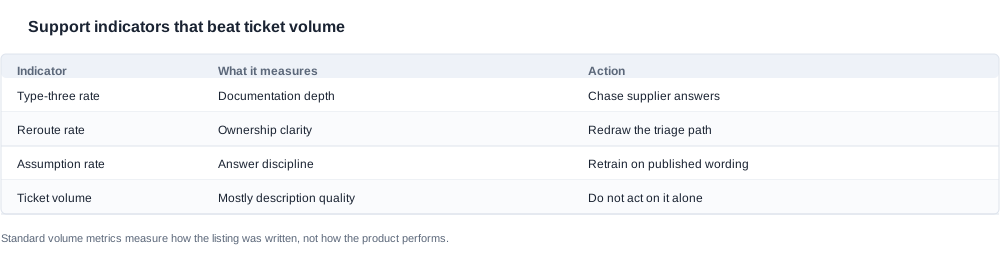
Support measurement is easy to get wrong in a launch-phase programme, because the easy metrics — ticket volume, response time, first-contact resolution — mostly measure how the description was written rather than how the product performs.
Three measures carry more information than the standard set. The type-three question rate measures documentation depth: questions the organisation cannot answer from published rows. A rising rate means the product description is ahead of the documentation, and it is the earliest warning that documentation work is needed. The reroute rate measures whether triage is working: the proportion of questions that move from one owner to another. A high reroute rate points at unclear ownership rather than at a difficult product. The assumption rate measures discipline: the proportion of tickets where the answer used information that is not published anywhere, which is a quality problem that no other metric surfaces and that eventually becomes a public claim you cannot support.
Each of these can be counted from ordinary ticket data without any service-level target, which matters because targets set during launch tend to be aspirational and then become a source of pressure rather than of information.
The sequencing that ties the sections together is straightforward, and it is the same sequence in every programme that gets this right. Establish what is published and what is silent. Write the configuration statement per model. Build the triage path with named owners. Decide the reverse logistics model and its costs. Train against the configuration statement rather than against the catalogue. Then measure with the three indicators above and use them to drive documentation requests.
The overall position is that support readiness for a range this structurally uneven is mostly a question of how honestly the published documentation has been read before launch. Where that has been done, the support operation inherits a large fraction of its answers for free. Where it has not, the same questions are asked by every customer instead of once by the buying team — and they are considerably more expensive that way.
The last practical point is about continuity. A support model is built against a specific configuration set, and a configuration set changes: a model is added, a case option changes, a market opens, a colour variant is introduced. Each of those events invalidates part of the triage path, and the cost of noticing the invalidation yourself is consistently higher than the cost of scheduling the review. Put a short recurring review against the configuration statement itself rather than against a calendar, so that the review happens when something has changed rather than when someone remembers. On a range with four case states and three charging-interface states, that recurring review is what keeps the answers correct, and it is far cheaper than the alternative of a support team answering from a document that was accurate at launch and is not now.
Related reading
- Spare parts and returns — after sales support spare parts
- Documentation discipline for the programme — OEM ready platforms brand guidelines
- Compliance positioning — OEM ready platforms certification coverage
Tell us the channel, the volume you expect and the configurations you will ship, and we will tell you which support questions your team can answer from published documentation on day one, and which ones have to be routed before launch.


