

Packaging design for an OEM-ready platform is a specification, not a finishing touch. The carton determines what gets weighed, what gets stored, what gets picked, what gets printed on, and what happens when a customer sends the unit back. Most private-label problems that surface three months after launch trace back to a packaging decision taken in week two, and the reason is visible in the documentation rather than in the process. For this range, the product record states for every one of the twenty-eight models that no product photographs, no video and no detection reports have been supplied, and the catalogue pages publish specification rows rather than dimensional drawings. So the packaging inputs a designer normally takes from a supplier are the ones this documentation does not carry, and the packaging job starts with a request list rather than with a template. This piece sets out which packaging inputs are actually published, which are not, and the order in which the decisions have to be made for the artwork not to come back.
What the packaging decision depends on, and where it comes from
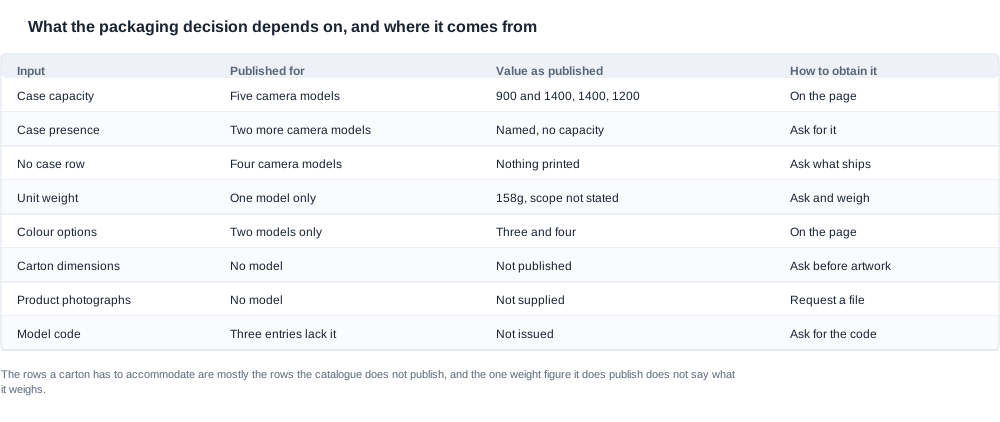
The table below lists the inputs a carton has to be designed against, and for each one, whether the catalogue publishes a value or whether it has to be requested.
| Input | Published for | Value as published | How to obtain it |
|---|---|---|---|
| Case capacity | Five camera models | 900 and 1400, 1400, 1200 | On the page |
| Case presence | Two more camera models | Named, no capacity | Ask for it |
| No case row | Four camera models | Nothing printed | Ask what ships |
| Unit weight | One model only | 158g, scope not stated | Ask and weigh |
| Colour options | Two models only | Three and four | On the page |
| Carton dimensions | No model | Not published | Ask before artwork |
| Product photographs | No model | Not supplied | Request a file |
| Model code | Three entries lack it | Not issued | Ask for the code |
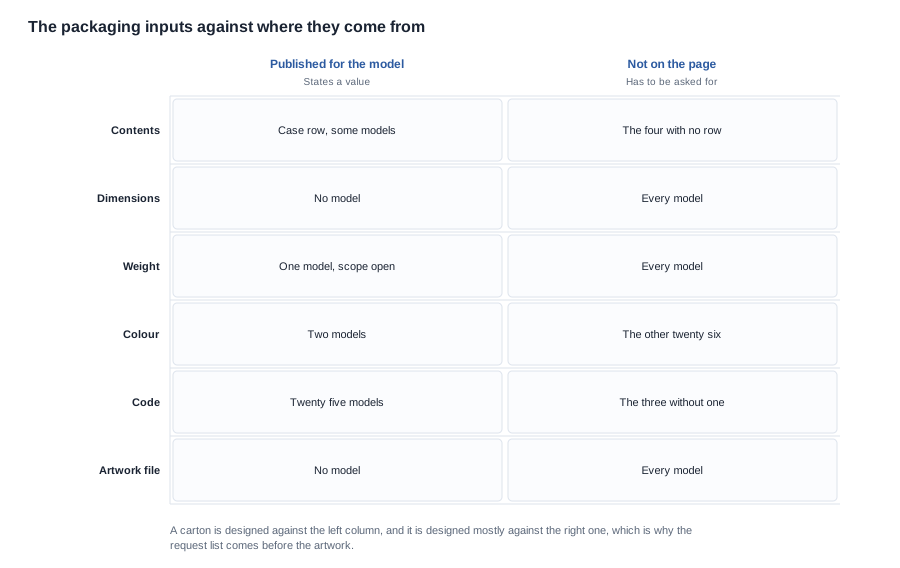
The first three rows are the one that determines the carton, and they are worth reading as a group because they show that the same question has four different answers across the camera range. Five camera models publish a charging case capacity, and among those, one publishes two values, three publish one value of one thousand four hundred milliamp hours, and one publishes one thousand two hundred alongside a note that the case folds. Two further camera models name a charging case in the charge method row without publishing a capacity, so the accessory is confirmed and its size is not. Four camera models carry no case row at all, so the catalogue does not say whether a case ships. A designer who has worked from one model's page and carried that assumption across a range will produce a carton for the wrong contents, and the error will surface at packing rather than at artwork review.
The weight row is the other one that catches people. The catalogue contains exactly one weight figure across all twenty-eight models, and it sits on the same image caption as a foldable charging case, which means the catalogue does not state whether that figure describes the glasses or the case. So a packaging sheet cannot be built against it as a reference value without first establishing its scope, and the same is true of the packaged weight, which appears nowhere at all. The colour row is narrower still: two models publish colour options, one with three and one with four, and the other twenty-six publish none, which means a colour-led brand cannot assume a colour option exists on a model it has not checked.
The last two rows are the ones that make the request list unavoidable. No model in the range has a published carton dimension, so every dimension on a packaging sheet is a figure the supplier provided rather than a figure the documentation carries, and a packaging sheet built on borrowed numbers from a different model will fail at the freight calculation rather than at the artwork stage. And three entries in the product record have no model code issued at all, which means no artwork can be finalised for them, because the code is the thing the artwork has to carry. The code is also what appears on the compliance paperwork, on the warranty record and on the purchase order, so a code issued late is a code used inconsistently for a period, and that inconsistency is expensive to unpick afterwards.

Which OEM ready platforms decision comes before which
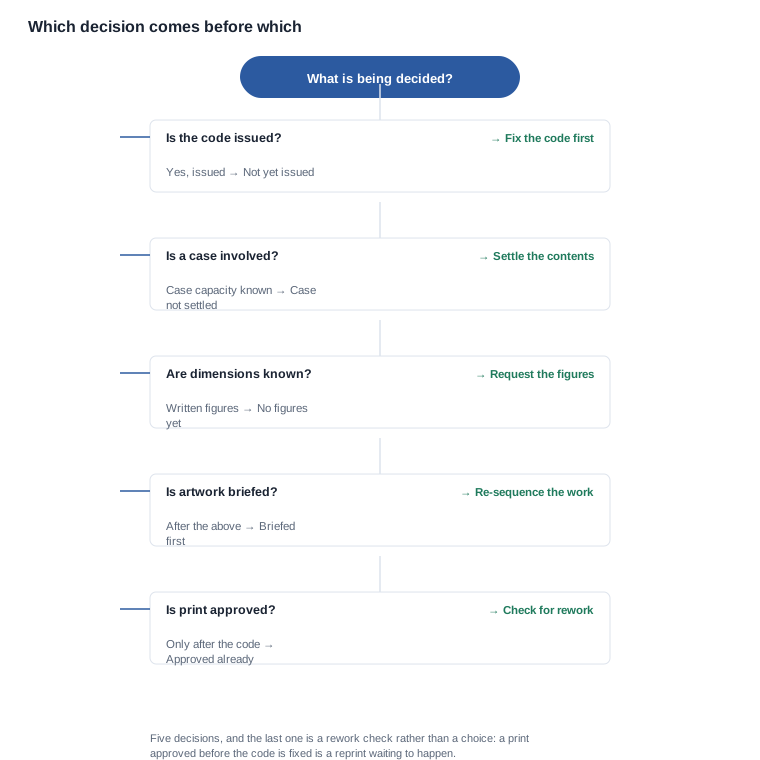
The packaging work has an order, and the order is the whole of the discipline. The criteria for sequencing OEM ready platforms packaging are these five, each of which constrains the one after it.
- The model code. It has to be settled before anything else, because the code appears on the artwork, on the documentation and on the barcode arrangement, and for three of the entries in the record it has not been issued.
- The contents. A carton has to be designed around what actually ships inside it, and the case question is not the same across the camera range, as the table above shows.
- The dimensions. This is the decision that has to be made in writing rather than estimated, because the dimensions a designer works from have to be the shipping dimensions rather than the shelf dimensions.
- The artwork brief. The brief is written against the first three, not against a preference.
- Print approval. The check before approving a print is short, and the order between it and the code is where the rework risk sits.
A packaging design that begins with a working name and resolves the code later is a design that will be redrawn, and the redraw is the expensive kind because the insert is usually cut to the carton. And a print approved before the code is fixed is a reprint waiting to happen, with the insert that was designed for the original carton as the piece that stops fitting.
There is one more sequencing point that a buyer with several models in a range will hit immediately, and it is that the sequence has to be run per model rather than once for the range. A range with five camera models does not have one packaging question, it has five, because the contents question alone resolves differently on each of them: one page publishes two case capacities, three publish one, two name a case without a capacity and four publish no case row. The efficient way to handle that is to run the record checks across the whole range first, because they cost nothing, and to sort the range into groups that share a packaging decision. Models whose pages agree on what ships can share a carton, with the differences handled in the insert. Models whose pages do not agree cannot share one, and finding that out before the artwork is briefed is worth more than any saving in the artwork itself. The criteria for deciding whether two models can share a carton are simple and checkable: the same case configuration, the same colour option state, the same documented contents, and a code that is issued for both. If all four hold, the two can be handled as one packaging job. If any one of them does not, they are two packaging jobs, and the second one costs what the first one did.

What to settle before the artwork is briefed
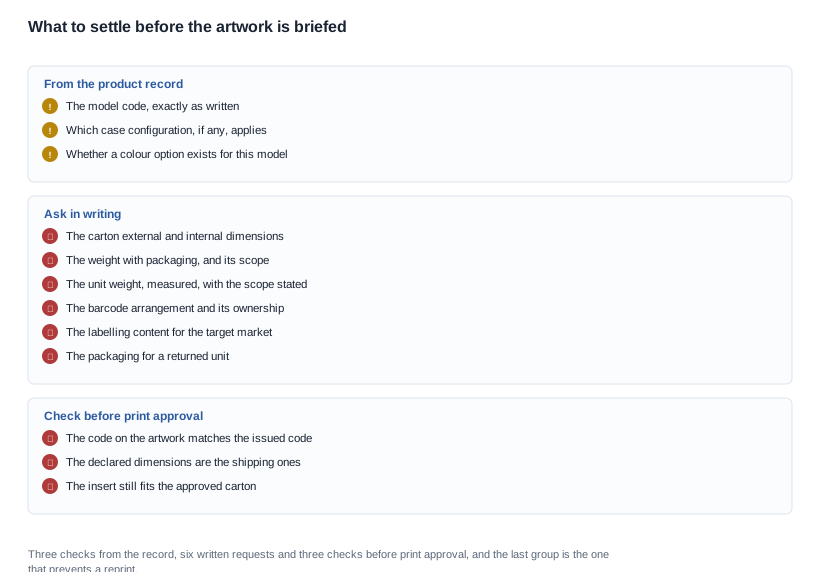
Three things come from the product record and cost nothing to establish, so they come first. The model code, exactly as it is written. Which case configuration, if any, applies to this model, including the mapping between the published capacities and the published variant names where both exist. And whether a colour option exists for this model at all, because on twenty-six of the twenty-eight entries it does not.
Then six requests, all of them in writing, and all of them before the artwork is briefed rather than after it is approved. The carton external and internal dimensions. The weight with packaging, and the scope of that weight stated. The unit weight, measured, with the scope stated, which is a different request from the packaged weight and is the one that lets a buyer build their own reference. The barcode arrangement and the question of who owns the code after delivery. The labelling content for the target market, which differs by market and is a regulatory matter rather than a graphic design one. And what happens to the packaging when a unit is returned, which is the question most often deferred and the one with the longest tail.
The returned-unit question deserves more attention than it usually gets, because it is a packaging design decision rather than a returns policy decision. A private-label unit that comes back in a branded carton and is restocked into a different channel is a problem that the packaging itself creates, and it is created at the point where the artwork is drawn rather than at the point where the returns terms are written. The available answers are not exotic. A carton that identifies the brand and the model clearly enough to be refused by a second channel. A serial or batch mark that ties a returned unit to its production run. A rule about which packaging may be restocked and which must be destroyed. Each of those is a design requirement, and each of them is cheaper to specify on the drawing than to solve after the first mis-restock.
There is a related point about what a packaging request can and cannot settle. The product record states that the configuration axes already defined for a model are recorded at category level, and that packaging is one of the recorded axes in five of the seven categories. That tells a buyer that packaging is a recognised axis rather than an improvised request, which is useful context, and it is not the same thing as a committed capability, a cost, a lead time or a minimum quantity, none of which the record carries and none of which this piece will estimate. What the record supports is the question: which of this model's packaging elements are already defined, and what has to be raised from scratch. The answer belongs in a quotation and in a written specification, not in a catalogue.
The labelling question deserves its own paragraph because it is the part of packaging that is decided by someone other than the designer and the buyer. The labels on a carton, the manual, the quick-start card and the declaration text are a set of content obligations whose content is set by the market the unit is sold into, and the set is not the same everywhere. The things a carton has to carry include a model designation, a variant, a handling instruction, an identification code and the declarations that apply in the destination market, and each of them has an owner, a language, a minimum size and a regulatory context. Two practical consequences follow. The first is that the language requirement has to enter the packaging design at the constraint stage rather than at the artwork stage, because a carton that is dimensionally correct for one market and carries text for another is a reprint, and a carton whose print area was never sized for the required content is a reprint of a different kind, because the carton itself has to change. The second is that the content has to be revisited whenever the configuration changes, which is why the content sheet has to be tied to a configuration rather than to a product family. A content sheet that is correct for the first order and wrong for the second is a packaging defect that no dimensional check will find.
This is also where the trade-off is most likely to be decided badly, because the two obvious directions are both expensive in different ways. A carton sized for the largest market wastes volume on every other market, and volume is what a device actually pays on air freight. A carton sized for the smallest market cannot carry the content the largest market requires, and that shows up as a compliance problem rather than a cost problem. The usual resolution is a carton that fits the physical product with the content in a separate printed layer, which is a design decision with a cost and a lead time attached, and it is a decision that belongs in the first conversation with the supplier rather than in the fourth revision of the artwork. What the criteria are is straightforward: the carton has to fit the contents, the content has to satisfy the market, and the dimension has to be the shipping one. Which of the three gets the compromise is a commercial decision, and it should be made by the person who owns the freight, not by the person who owns the drawing.
One more input to the packaging job is easy to overlook because it is not about the carton at all, and it is the product photograph. The product record states that no product photographs, no video and no detection reports have been supplied for any of the twenty-eight models, which means the imagery a carton and a listing both depend on does not exist yet in a usable form. That has a direct effect on the packaging sequence, because the pack shot and the carton are usually produced together, and the pack shot is the reference the carton artwork is drawn from. So the request for product imagery is not a marketing request that can run in parallel with the packaging work; it is a packaging prerequisite. A programme that briefs artwork against a supplied rendering and then receives the physical unit discovers a colour difference, a surface finish difference or a proportion difference at the point where print is already approved, and the correction is not a retouch but a reprint.
The practical sequence for that input is short. Establish the model code, so the imagery and the artwork carry the same identifier. Establish the contents, so the pack shot shows what actually ships. Establish the finish and the colour reference, which matters most on the two models that publish colour options and on the models whose pages publish no colour row at all, because a unit photographed without a stated colour reference cannot be matched to the artwork later. And then treat the pack shot as a measured artefact rather than a marketing one, because the file that comes out of that session is the one that will be compared against the unit that arrives in the carton, and any difference found at that comparison is a packaging defect too. The product photography piece covers that session in detail, and it is worth reading before the carton is designed rather than after, because a pack shot taken against a different configuration than the one being shipped is a rework of the same kind the artwork is trying to avoid.

How to read a packaging brief against the record
The narrow part of this is packaging, and it is worth saying so before a brief is written. We will not publish packaging dimensions, packaged weights or barcode allocation rules for a model where those figures are not on the record, and we will not substitute a figure from a different model to fill the gap, because a packaging sheet built on borrowed numbers fails at the freight calculator and not at the artwork stage, and by then it is too late to fix cheaply. We will not present the one weight figure in the catalogue as a reference for your units until its scope is confirmed, because the catalogue does not say what it measures. We will not treat a colour option as available on a model that publishes no colour row, and we will not brief artwork for the three entries whose model code has not been issued, because the artwork has to carry the code. And we will not quote a setup cost, a tooling charge, a minimum quantity or a lead time in place of the written specification, because those are commercial terms that have to be quoted for a specific configuration and a specific market.
What the record does support is a clear division of labour. The catalogue settles the contents question for five camera models and the colour question for two, and it settles them in a form that can be checked. The request list settles the dimensions, the weights, the barcode arrangement and the labelling content, and each of those is a short written request against a named model and a named market. The design sequence settles the order, and the order is what keeps the artwork from coming back. And the returned-unit decision settles the one part of packaging that a buyer controls entirely and that nobody else will think about.
A brand that works through those three layers in that order, and treats the model code as the first decision rather than the last, ends up with a carton that matches the box and a document set that matches the market. The freight and carton planning for the same range is set out in OEM ready platforms logistics planning, the returns terms that sit behind the returned-unit decision are in OEM ready platforms returns handling, and the sampling step that produces the weight figure the packaging sheet needs is in OEM ready platforms sample before bulk.
Tell us the target market, the sales channel and the model you are packaging, and we will tell you which packaging inputs are on the record for it and which ones have to be requested before the artwork is briefed.


