

Every request that quotes oem ready smart glasses platforms moq for new brands is really asking for a number, and the number is the one thing the catalogue is not able to supply. This article works on the other side of that gap. It sets out what the range publishes, what it leaves to the supplier, how many separate questions the phrase conceals, and the order in which a first enquiry should put them to a factory.
Nothing here answers a quantity question. Wherever a minimum order, a lead time, a unit price or a customisation charge would normally sit, what appears instead is the question a buyer should put in writing, together with a note about which party is the only one able to answer it. A figure published without a configuration behind it would be a figure a buyer could not act on, because the moment the model, the colour count, the packaging or the destination market changes, the figure that applied stops applying.
Three things follow from that. First, the oem ready range is structured tightly enough to narrow a programme before any supplier conversation happens, because the models divide into seven categories and every separating row is a published specification row. Second, the phrase "minimum order quantity" is not one question but three, and each of the three has a different owner and a different document. Third, the useful enquiry is not the one that asks for the number; it is the one that fixes the configuration and the destination market so that the number, once it is written, belongs to something.
Why a minimum order figure cannot be read off the catalogue
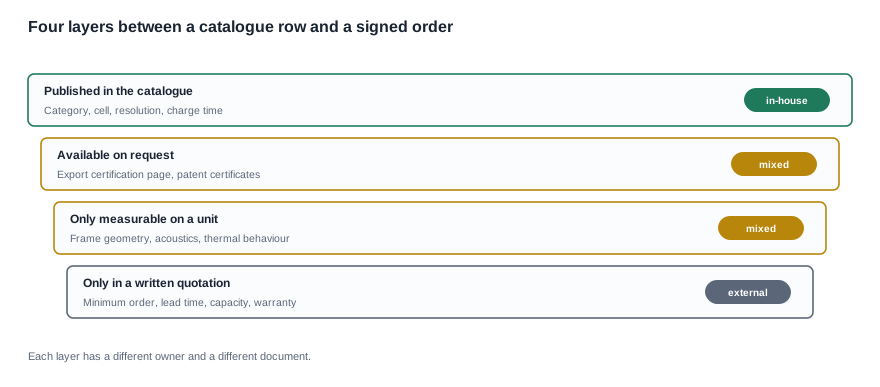
A catalogue row and a supply commitment answer different questions, and the distinction matters before anything else because it is the reason a figure cannot simply be lifted from a product list. A catalogue row is a statement about a product: the cell configuration, the rated runtime, the charge time, the charging method, the resolution class, the case capacity where one is published, the Bluetooth version where one is published, the colour where one is published, the structural features named on that model's own page. A supply commitment is a statement about a factory: how many units it will accept, at what point in its schedule, at what consistency, against which paperwork. The first kind of statement belongs to the product. The second belongs to the supplier. Only one of them can be printed in a specification, and only one of them is a number a reader can carry into a purchase order.
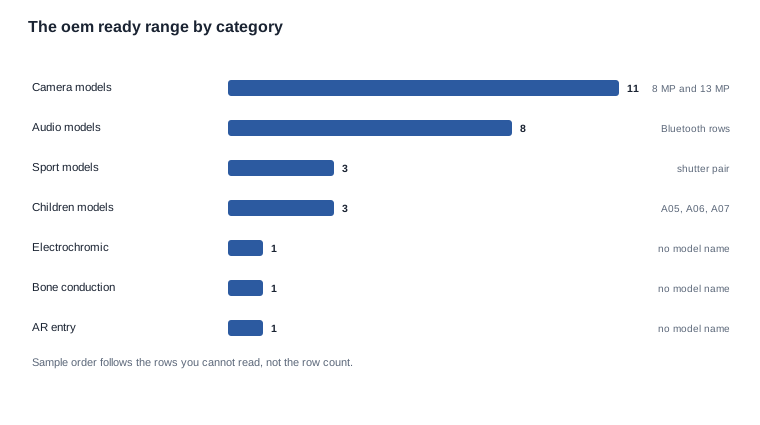
The oem ready range is twenty-eight models across seven categories: eleven camera models, eight audio models, three sport models, three children's protection models and three entries published without a model designation — electrochromic, bone conduction and AR. That structure is a map of where the products sit, not a schedule of how many can be made. The eleven camera models split by resolution into eight at 8 MP and three at 13 MP. The eight audio models split by Bluetooth version into two at V5.3 and six at V5.4. The three sport models sit alongside the three children's models and the three undesignated entries. Each division tells a buyer which configurations are structurally distinct, and each division raises a separate minimum somewhere downstream. A category holding eleven models and a category holding one are not the same commercial object, and nothing on these pages compares them commercially.
Set against that, some of the published rows are precise enough to be mistaken for a supply fact. The IP54 marking appears on the V06 and the S7 and on no other model. A weight appears on one model only: the MT6, at 158 grams for the glasses themselves, excluding its folding case. A remote shutter appears on the D17 and the ZH12 and nowhere else. Detachable parts are named in three places: a removable inner frame on the V06 and the S7, and a detachable temple on the G07. A colour is published for two models in the whole range, three on the V03 Pro and four on the V06. None of those rows carries a quantity attached to it, and each is exactly the kind of row a minimum would eventually be calculated against. The screening criteria for a shortlist are drawn from rows of that kind, and the trade-offs between two candidates are settled by the published values rather than by a negotiation.
The certification position is the sharpest illustration of the gap. The catalogue text contains no occurrence of CE, of FCC or of RoHS. There is no per-model certification row anywhere in the range, and no line recording a certificate number, a test report number or a pending status against an individual model. What the catalogue does carry is a company-level export certification page whose content is images rather than extractable text, and a set of ten patent certificates — eight appearance-design patents and two utility-model patents. The framework a European buyer would work from is RED, the Radio Equipment Directive (EU) 2014/53/EU, with EMC 2014/32/EU alongside it. The per-model position against that framework is not printed.
So the reason a minimum order figure cannot be read off these pages is not that the figure is withheld. It is that the figure belongs to a set of conditions the catalogue does not record: the state of the line, the tooling position behind a given colour or logo application, the cost of the documentation work for a given destination market, the packing configuration and the shipping arrangement. A catalogue that printed one number would have to print all of those conditions with it, or the number would be read as applying to a programme that does not exist. The published rows are what the catalogue is able to stand behind. The minimum is one of the terms that has to be agreed.
The practical consequence for a new brand is that the first conversation is not about quantity at all. It is about which rows of which model are going to be fixed on day one, because those rows are what a supplier will build a minimum against. A programme that leaves them open will receive a quotation that is generous in one line and silent in another, and neither line will explain why. The criteria for the first enquiry should therefore be written before the enquiry is sent, and how to evaluate the answer afterwards comes down to one test: does it name the configuration it applies to?

The three separate questions hiding behind the phrase
Asked as one sentence — what is the minimum order quantity? — the enquiry has three distinct answers, and they belong to three different documents. Splitting them apart before contacting a factory is the single most useful preparation a buyer can make, because each part has a different owner, a different trigger and a different failure mode when it is left vague. The question a buyer asks most often at this stage — how to evaluate a supplier from a catalogue alone — has a narrower answer than expected. The catalogue supports a shortlist, and only a shortlist. Anything that depends on a quantity, a schedule or a document stays out of reach until it is asked.
Question one: the platform quantity
The first is the smallest order a factory will accept for the standard configuration of a named model. This is the floor on the production order itself, and it is the number most often quoted as though it were the only one. It is set by the production slot: how many units make a run worth setting up, how many units have to be in the same run for the changeover to make sense, and how much material a supplier will commit before the goods are produced. It is the one of the three a supplier can usually answer from a stock and capacity position, and it is also the one that shifts least between two conversations inside the same quarter.
Question two: the configuration quantity
The second is the smallest order that applies to a specific configuration on top of the platform floor: a colour, a logo application method, a packaging print run, a lens option, a matched left-and-right bundle. This figure is often larger than the platform figure for the same model, and it is the one a new brand most often underestimates, because the brand has planned a single stock-keeping unit while the factory has priced a separate configuration for each colourway. The published rows show where configuration multiplicity is genuinely present. Two models in the whole range carry a published colour, and one of them carries four, so a colour programme on that model is a multi-way split rather than a single run. Detachable parts are named in only three places across the range, and a model whose inner frame or temple can be removed is a model with a configuration axis that has to be counted separately.
Question three: the documentation quantity
The third is the smallest order that carries the document set for the destination market — the point at which the compliance and documentation work for a given country is paid for and closed out. This is the least visible of the three and the most expensive to discover late. It sits next to a catalogue that publishes no per-model certification row and no certificate numbers, and next to a company-level export certification page whose text cannot be read. A buyer who asks only about the production quantity receives an answer that says nothing about whether the paperwork follows the goods into the market the goods are meant to reach, and that question has to be put separately and answered in writing.
Why the three get collapsed into one
The three are routinely treated as a single figure, usually the smallest of them, and the collapse is what produces the disappointment later. A number returned for the platform floor gets read as the answer to all three questions. It is not, and the quotation that follows will carry the other two as separate lines, at which point the programme has already committed money against an assumption nobody checked. A buyer who separates the three in the first message is not being pedantic; the separation is what makes the second and third answers reachable at all.
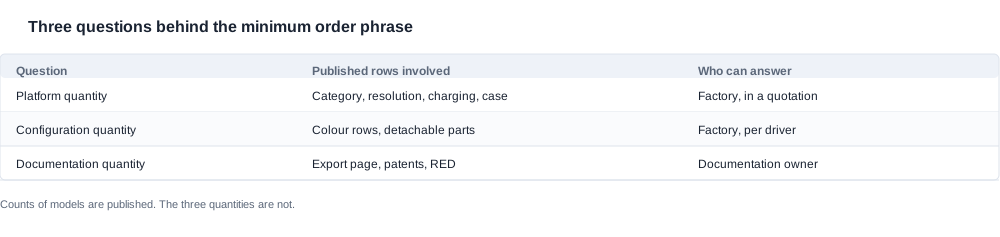
Read the table below as a routing instruction rather than a summary. The left column is the question to write down, the middle column is the part of the published range worth reading before the answer arrives, and the right column is the party who has to sign for it. A supplier who answers the platform quantity and leaves the documentation quantity open has answered half the enquiry, and the half left open is the one that decides whether the goods can be sold in the market the buyer had in mind. A due diligence checklist built on those three columns catches a missing answer before the order is placed, and the questions to ask come straight from the left column.
| Question to put in writing | Published rows that bear on it | Who can answer it |
|---|---|---|
| Platform quantity for a named model | Category split, camera resolution class, charging method, case state | The factory, against a quotation for a named configuration |
| Configuration quantity per colour, logo method and packaging | Published colour rows on the V03 Pro and the V06, detachable part rows | The factory, per configuration driver |
| Documentation quantity for the destination market | Company export certification page, ten patent certificates, RED (EU) 2014/53/EU | The supplier's documentation owner |

What the published rows do settle for a new brand
None of this makes the published rows useless. They settle a different layer of the decision, and for a brand with no supplier relationship yet, that layer is the one that decides which models are worth quoting at all. Because every separating row in the range is a specification row rather than a commercial one, the catalogue can narrow a programme precisely while remaining silent on the commercial terms — and for a shortlist built from published rows, that precision is the part a buyer can verify independently.
Resolution divides the camera range into two build groups
Eleven models in the range carry a camera, and they divide on resolution into two groups that are not marketing labels. Eight of them publish the 8 MP class — the V03 and the CY05, the MT6 and the MT5, and the CY03 and the V03 Pro, and the KY06 and the V06 — and three publish the 13 MP class, the L2 Utral and the S7, and the L1 Pro. The step between the two classes is a module change, and a module change is the point at which a supplier's internal configuration stops being interchangeable across the group. What the catalogue publishes for these eleven is the class itself. What it does not publish for any of them is the sensor model, the field of view, the frame rate, the video format, the stabilisation behaviour, the low-light performance, the storage capacity or the file format. It also publishes no Bluetooth version for any of the eleven, which is an unusual gap in a range where every audio model carries one. Two candidates can therefore be compared on published rows before either one is sampled, and the comparison is short because the separating rows are few and the rest stay silent in both directions.
The charging rows show where an interface commitment already exists
The charging rows are the most useful published rows for planning, because a charging interface is a component commitment the factory has already made. Across the eleven camera models the catalogue publishes five on magnetic charging — the V06 and the V03, the MT5 and the S7, and the KY06 — and two on Type-C, the V03 Pro and the L2 Utral. For the remaining four, the CY05 and the MT6, and the CY03 and the L1 Pro, no charging method row appears at all. That last group is the one to interrogate, and the question is precise: which interface does this model use, is the interface the same across the whole run, and is it fixed for the lifetime of the programme.
The charging-case row has three states, not two
The charging case needs the same attention, because the range publishes it in three different ways and a buyer who assumes two of them will misread the range. A case capacity is printed on five camera models, and on those rows the figures are unambiguous: 1400 mAh on the CY03, on the CY05 and on the L1 Pro, two capacities written into a single row on the L2 Utral at 900 and 1400 mAh, and a folding case rated at 1200 mAh on the MT6. Two more models carry a case with nothing attached to it — the KY06 and the MT5 — and the catalogue stops there rather than estimating. The remaining four camera models, the V03 and the V06, and the V03 Pro and the S7, print no charging-case row at all, which is a different statement from publishing that there is none. A row that is absent is an unpublished item rather than a design decision, and it belongs on the list of things to ask the supplier about; how many rows are missing is worth as much to a buyer as the number that are printed.
Colour is published on two models in the whole range
Two further rows bear on the configuration question rather than the platform one. A colour is published for the V03 Pro, at three, and for the V06, at four, and for no other model anywhere in the range. A colour programme on either of those is therefore a multi-way split of the production order rather than a single run, and the second question to put in writing is how that split is counted — per colour, per colour per model, or per colour across the programme. The second row is the set of detachable parts: a removable inner frame on the V06 and the S7, and a detachable temple on the G07, the only three places in the range where the physical configuration of a model is described as variable. Everything else is published as a fixed shape.
What all of this settles is the configuration, and the configuration is the currency a minimum order is denominated in. A buyer who has fixed the model, the resolution class, the charging method, the case state, the colour count and the packaging type has removed most of the reasons for a supplier to hedge a figure, and the quantity question then has a denominator against which the answer can be checked.

The order a first enquiry should take
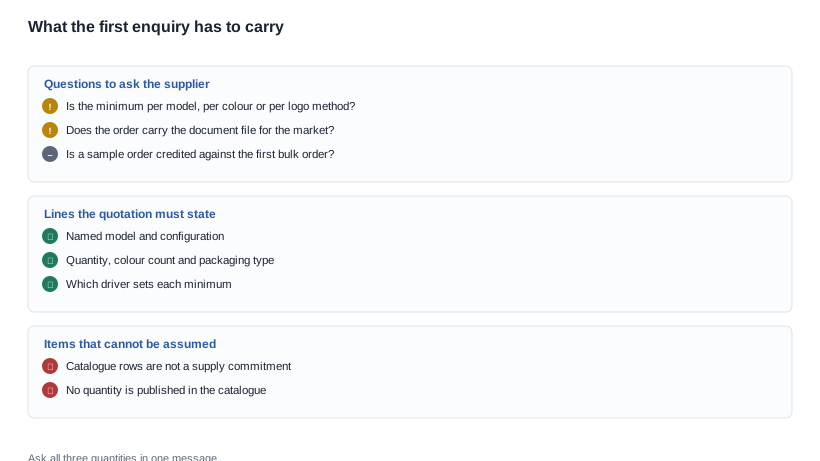
The order of the questions matters as much as their wording, because a supplier asked for a minimum before the configuration is fixed has to answer a different question from the one the buyer meant. The sequence below is the one that produces comparable answers across two suppliers and across two rounds of correspondence, and the questions to ask are written so that each answer arrives with the conditions attached to it.
- Name the model and the category, not the range. The eleven camera models, the eight audio models and the three sport models are built and quoted against different logic, and an enquiry naming a category instead of a model receives a category-level answer that cannot be carried into a purchase order.
- Fix the configuration, including the rows the catalogue leaves blank. Resolution class, charging method, case state, colour count and packaging type all go into the first message. Where the catalogue publishes nothing, the row is named as an open item rather than quietly dropped, because an open item named early is answered early.
- Ask the platform quantity in writing, against that configuration. The useful wording asks what sets the minimum as well as what it is, since a figure returned without its driver cannot be re-used when the configuration changes.
- Ask the configuration quantity as a separate question. Which minimum applies per colour, per logo application method and per packaging print run, and whether a split across configurations is possible in the first order at all.
- Ask the documentation quantity, and ask what the documentation carries. Which document set has to be closed for the destination market, who prepares it, whether it is charged per model or per programme, and what a change of configuration does to it.
- Ask what would move the answer. A different colour count, a different packaging type, a different destination market or a different scope of documentation. The reply to this question is what makes the quotation reusable rather than a one-off.
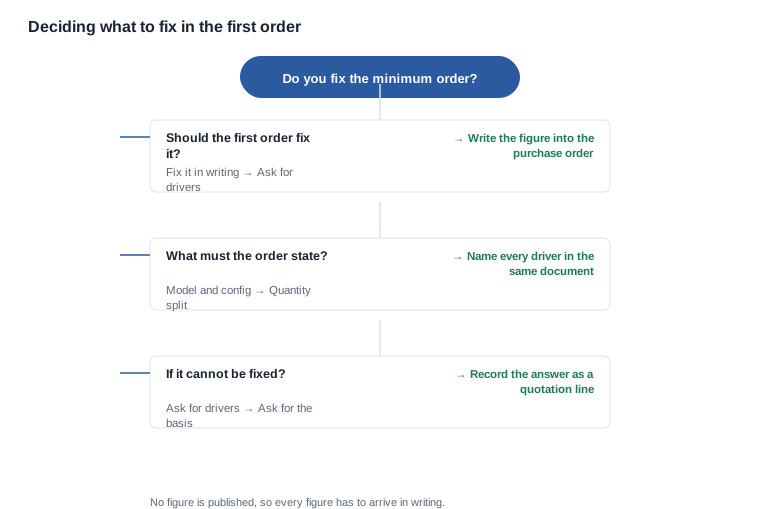
The way those questions are phrased decides the quality of the answers that come back. A question about the minimum quantity returns a number, and a number without the conditions attached to it is worth very little, because it will be quoted back later in a different context and applied as though it were general. A question about what sets the minimum returns the driver, and a driver survives a change of configuration: if the answer is that a minimum is driven by a per-colour packing run rather than by the production slot, the buyer knows exactly which lever to pull. Ask both in the same message, and require each answer to carry the same configuration identifiers the request used.
Two suppliers answering the same six questions in the same order are now comparable, and comparability is what a sourcing team actually needs. It is worth asking each supplier to state the terms sitting outside the quantity — the packing configuration, the destination, the document scope, the consistency the order is expected to hold — so that the figure each gives can be read against one shared set of conditions rather than against each supplier's own assumptions. A quotation that states its assumptions can be compared with another quotation line by line and verified before the order is placed. A bare number cannot, and neither can a number that arrives attached to a configuration nobody wrote down.
A new brand's first enquiry is not a commitment and should not be written as one. It is a request for the structure of the commercial terms, and the worth of the answer lies in how completely it is specified. A supplier who answers all three quantities and names the driver behind each has told a buyer precisely what the programme has to do to reach the lower figures. A supplier who answers only the production floor has described how many units sit on a shelf, which is a smaller and entirely different piece of information. Before you order, the assessment criteria should be written down in that form, because a comparison that cannot state what it is comparing on is an opinion. Treat the six questions as a checklist rather than as a conversation, and treat a missing answer as a red flag rather than as an omission.
The oem ready smart glasses platforms moq for new brands
Putting the pieces together, the oem ready smart glasses platforms moq for new brands is best treated as a question about which terms have to be written before a quantity can be quoted, rather than as a number to be found. The range is published in enough detail to fix a configuration precisely — twenty-eight models in seven categories, eleven camera models split at 8 MP and 13 MP, charging methods published on seven of those eleven, charging-case capacity published on five, colour published on two, an IP54 marking on two, a weight on one, a remote shutter on two, detachable parts in three places — and it publishes no unit price, no price tier, no minimum order quantity, no lead time, no production capacity, no warranty period, no certificate number, and no figure for a customisation programme, a non-recurring engineering cost, a tooling cost, a sample charge, a certification service or a packaging customisation minimum.
On the question of whether to publish a figure, our position is that the catalogue stays with the rows it can stand behind, and that a buyer is served better by the structure of the commercial terms than by a number that shifts with configuration, colour count and destination market. We will answer the quantities in writing against a named configuration, we will state which driver sets each one, and we will not publish a minimum order quantity on a page, because a figure without its conditions attached would be read as a general commitment and would eventually be held against us.
That produces a first message with three parts: the configuration that has been fixed, the three quantities to be answered, and the conditions under which each answer will hold. Written that way, the answer arrives as a document rather than as a courtesy, and the buyer's next move is a comparison across suppliers on one shared basis, which is the only basis on which an oem ready comparison is worth anything at all. The remaining risk sits in the criteria that were never written down, which is why what to ask is decided before the first message is sent and not while the answers are arriving.
There is one more case worth planning for. Some suppliers will answer the production quantity and treat the other two as terms that move in the moment, which is not unreasonable — they are commercial terms and they do move. The way to handle that is to keep the three questions separate in the correspondence, accept that the configuration quantity and the documentation quantity will be the ones that shift, and make sure any movement is recorded against the configuration identifier it applies to. A programme that lets the configuration change without changing the quoted terms is a programme whose terms are no longer accurate, and the discrepancy usually surfaces at a customs broker rather than at the factory. The common pitfalls in a first round all have the same shape: a figure that arrives without its conditions, and a configuration that changes after the figure was given.
The same discipline applies to the buyer's own records. A first enquiry that does not record which model, which colour count, which packaging type and which destination market the answer applied to will produce a second enquiry that cannot be compared with the first, and the buyer ends up holding two numbers that appear to answer the same question and do not. The range itself is on the oem ready products page, the volume mechanics behind these three questions are in standard oem moq, the commercial structure of the same subject is in smart glasses wholesale moq structure, the documentation side is in oem ready platforms certification coverage, and the ordering stage is in smart glasses wholesale stock availability.
Related reading
- The volume mechanics behind the three questions — standard oem moq
- How the commercial structure is built — smart glasses wholesale moq structure
- The documentation question in full — oem ready platforms certification coverage
- Choosing which models to sample — requesting smart glasses samples which models to sample
- Planning the stock behind the launch — smart glasses wholesale stock availability
Send the model, the configuration, the colour count, the packaging type and the destination market, and we will answer the three quantities in writing against that configuration.


