

A standard oem moq is not a number that can be quoted out of context, because there is no single context in the range to quote it against. What exists instead is a set of seven drivers, each of which multiplies the requirement differently, and a buyer who receives a figure without being told which driver produced it has received a number that cannot be checked against a second supplier's figure for the same configuration. That is the whole argument of this page. The minimum is an output, not an input, and the useful conversation is about the drivers rather than about the digit.
The seven drivers below are not an attempt to describe every possible way an order might be structured. They are the seven variables that our own product lines actually expose, and each one can be traced to something published: a cell configuration, a colour list, a removable part, a charging case in one of its three published states, a charging interface, or a market destination. Where a driver cannot be traced to a published row, the article says so and turns it into a question.
One thing this page will not do is give you a quantity. Not a starting quantity, not a typical quantity, not an indicative figure for a particular configuration. Our catalogue publishes no minimum order quantity for any entry, and a minimum published without the configuration it belongs to would be misleading even if it were accurate for somebody. The same applies to the commercial terms that usually travel with it: unit price, price tier, lead time, sample order cost, warranty period and production capacity are all absent from our published material, and none of them should be read into these pages.
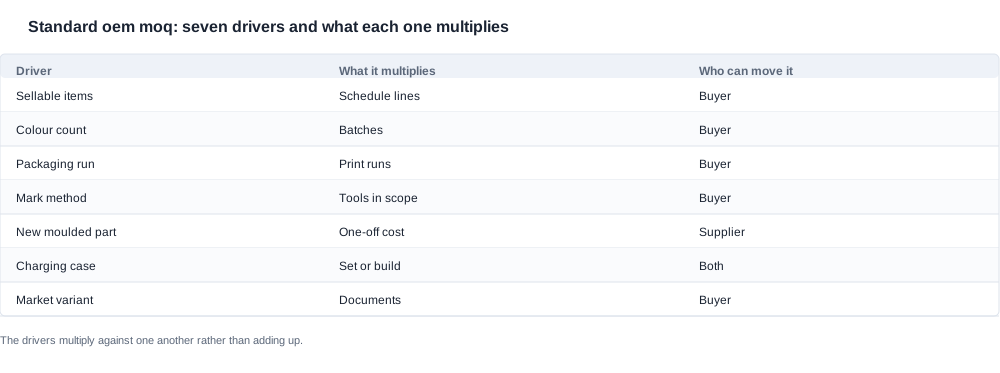
That table is the working structure for everything below. Read it as a multiplier set rather than as a checklist: each driver is a factor that pushes the minimum in a particular direction, and the drivers are not independent of one another. A programme that reduces three of them and leaves four untouched has not reduced its minimum by a third.
What actually sets a minimum order quantity
The first driver is the number of distinct sellable items in the order. A sellable item here is a configuration a customer could buy as one thing: a model, in a colour, with a lens configuration, in a language set. Each of those is a separate line on a production schedule, a separate quantity to be set, and a separate place for a shortfall to appear. An order for one model in one colour is a different production problem from an order for one model in three colours, and an order for two models in two colours is a third. The driver multiplies because each sellable item carries its own requirement, not because the products are complicated.
The second driver is the number of colours, and it is separated from the first because a colour can carry a requirement of its own. Colour is a batch, and a batch has a minimum quantity below which it cannot be mixed economically or reliably. Our published record is narrow here and a buyer should know exactly how narrow: two entries publish colour names, the V03 Pro with orange, off-white and black, and the V06 with orange, white ice blue, black and black ice blue. Twenty-six entries publish no colour at all. So the number of colours a buyer can order in is bounded by what a model publishes, and a brand planning a multi-colour launch has to work inside a published list that is much shorter than a typical launch plan assumes.
The third driver is the packaging print run. Printed material does not move one unit at a time; it moves in runs of print-ready material, and a run that is partly consumed cannot be recovered. Cartons, inserts, printed leaflets and labels all behave this way. A brand that splits its volume into three waves may trigger three print runs rather than one, and the second and third of those runs carry a different unit cost than the first. This is the driver most often left out of a buyer's own model of the order and the one most likely to change the total.
The fourth driver is how the brand mark is applied. A mark that is printed, screened or marked by laser onto a surface is a production setting with an artwork file and a fixture or plate; it does not change the geometry of the part. A mark that is carried by the moulded surface itself is a geometry question, and a geometry question brings a tool into the programme. Our catalogue publishes no mark row for any entry, which means the method cannot be read off the published record and has to be established in writing — and the method, not the mark, is what drives the requirement.
The fifth driver is whether the configuration needs a newly cut moulded part. If the geometry a buyer wants already exists in a tool, the programme joins an existing set and inherits its economics. If it does not, a new tool opens and carries its own commitment, its own amortisation and its own threshold. This is the only driver on the list that a supplier can settle unilaterally once the requirement is clear, and it is the one a buyer can most influence by choosing a configuration the range already publishes.
The sixth driver is the charging case. Across the eleven camera models the case is recorded three different ways — five entries carry a capacity, two carry a case with nothing measured against it, and four carry no case line at all — and each of those behaves differently for a production schedule. A capacity published on a row means the case is part of the described configuration and is set with it. A case shown without a figure is a set item whose own requirement is not something the catalogue speaks to. No case row at all means the question of whether a case belongs to the configuration is open, and it has to be closed before it can be scheduled at all. A case drawn from a set that other programmes also use can carry a requirement that belongs to the set rather than to the order.
The seventh driver is the market variant. The destination decides which documentation has to accompany the unit, which labelling has to appear on the carton, and which radio and safety scope the batch is built to. Because documentation and labelling sit in different places from the unit itself, a programme that changes destination between orders can carry a requirement that the unit itself does not explain.
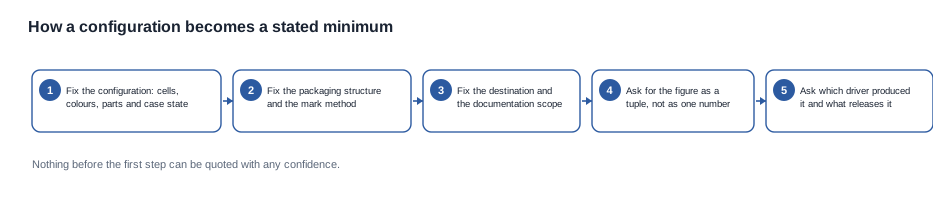
Read the flow above as the order of operations. The configuration comes first because every driver downstream of it depends on which cells, colours, parts and case state are actually in the build. The requirement comes second because the drivers multiply against each other rather than adding. Only after both does a minimum become a meaningful figure — and it becomes meaningful as a function of those two things, which is why it cannot be quoted before they are fixed.

The variables a buyer can influence and the ones they cannot
A useful minimum conversation separates the levers that belong to the buyer from the ones that do not, because the two groups are negotiated in completely different ways. The buyer's levers are design decisions and they can all be exercised before the order; the supplier's levers are the factory's economics and they cannot be moved by argument, only by changing what is being asked for.
The buyer's levers begin with the number of sellable items. Reducing the number of colours or the number of model variants is the single most effective action available, and it is available before anything is ordered. The published colour record helps here: because only two entries publish colour names, a brand that wants a wide colour range is choosing between models with a published list and models with none, and that choice is a requirement decision rather than a negotiation.
The buyer's levers continue with the packaging. Reusing an existing structure and an existing print run, rather than introducing a new carton geometry and a new artwork, changes the third driver without changing the product. The mark application method is a fourth lever, because a decision to move a mark off the moulded surface and onto a printed one removes a tool from the programme. Choosing a configuration that the range already publishes removes the fifth driver. Closing the case question early, rather than leaving it open, removes ambiguity from the sixth. Choosing one destination for the first programme, rather than several, removes the seventh.
The supplier's levers are the batch economics of the factory, the minimum quantity a component supplier will sell in, the structure of any shared set that a part is drawn from, and the policy by which a one-off tool is recovered. None of these can be negotiated down by a buyer directly, because none of them belongs to the buyer. They can only be influenced by changing the configuration, which is exactly why the configuration conversation and the minimum conversation are the same conversation.
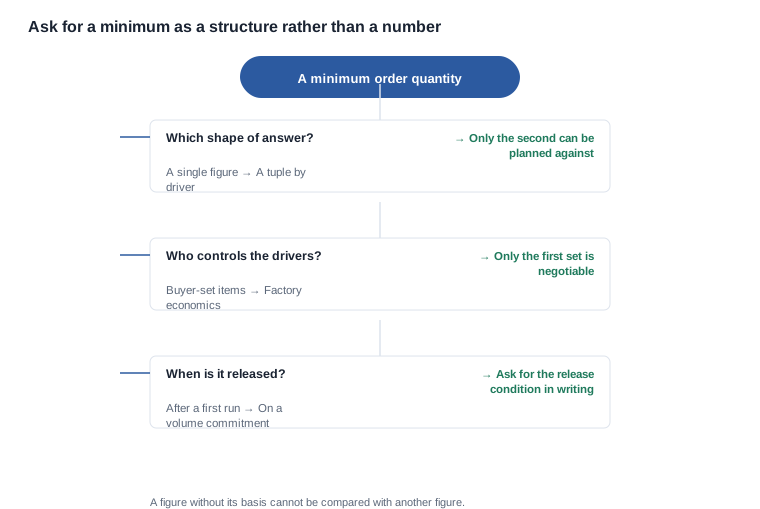
The decision diagram shows the practical consequence. A buyer who arrives with a fixed configuration and asks for a lower minimum is asking a factory to change something the buyer does not control. A buyer who arrives able to move the configuration is asking a question the factory can answer, and the answer is worth more than the number would have been.
There is a third category, and it is the one most often confused with the second. Some terms are not published by us and not negotiable by the buyer, but they are also not owned by the factory in the sense of being inviolable. A first order that establishes a configuration, a documentation set and a reference unit can relax conditions on a re-order of the identical configuration. That is a common commercial reality and it is worth asking about explicitly, because it changes the plan for the second wave rather than the plan for the first.

Why no minimum is quoted before the configuration is fixed
The reason no minimum appears in our published material is not caution for its own sake. It is that the number is not defined until the configuration is, and a configuration in this category has more components than a buyer usually expects on the first call.
Take a camera programme as the worked example. The base choice carries a cell configuration and a runtime, and the range publishes these from 40 mAh on the A05 and the A06 up to 290 mAh on four camera models. Every one of the eleven camera models publishes a resolution class, at eight megapixels on eight of them and thirteen megapixels on three. The charging method is published on twenty-four entries as magnetic or Type-C and is not printed for four camera models. A charging case is published in one of three states across the eleven camera models. Colour is published for two entries. A removable part is published for three. A marking method is published for none.
Now add to that a colour list, a packaging structure, a destination and a mark, and the configuration becomes a tuple with a substantial number of components, several of which are only partly determined by what the catalogue publishes. A minimum quoted against a fraction of that tuple is not a conservative estimate of the real one. It is a number about a different order.
There is a second reason, and it is about comparison rather than accuracy. Two quotations for the same product can carry different minimums for entirely legitimate reasons: one of them includes a packaging run inside the threshold, the other treats the packaging as a separate line; one of them builds a case into the configuration, the other treats the case as a set item. Both suppliers are being straight. The buyer simply has two numbers for two different orders. A minimum is therefore only comparable once both sides are comparing the same tuple, and the way to establish that is to ask each supplier to write down which of the seven drivers produced their figure.
This is also why a minimum should not be read as a quality signal. A supplier that will build from a very small quantity is describing its willingness to schedule a special run, not its confidence in the product. The question that carries the information is a different one: what changes about the build when the quantity is small, and which part of the programme carries that change.
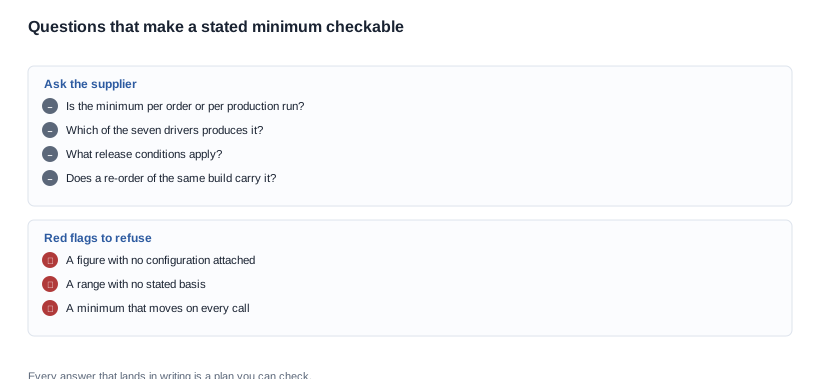
The questions in that panel are the ones worth carrying into a supplier call. Each of them converts a figure into a statement that can be evaluated, and each of them has an answer that can be written down. A supplier who answers all of them in writing has given you a position you can compare with another supplier's position, which is the only comparison that survives contact with a real quotation.

How to ask for a minimum that means something
There is a difference between asking a supplier for a minimum order quantity and asking for the minimum that applies to the order you intend to place. The first produces a digit; the second produces a structure, and the structure is what lets you plan.
The way to ask for the structure is to ask for the figure as a tuple rather than as a single number. A minimum quoted per sellable item, with a separate statement for the packaging run, a separate statement for any new tool, and a separate statement for the case if one is in scope, tells a planner how the requirement distributes. A single number does not, and it cannot be split later without going back to the supplier.
Alongside the tuple, ask for the basis. Which of the seven drivers is producing the requirement: is it the number of sellable items, the colour count, the packaging run, the mark method, a new tool, the case state, or the destination. A supplier who names the driver has told you something actionable, because you now know which lever, if any, would move it.
Then ask the release conditions. What has to be true for the threshold to change: a second order of the same configuration, a total volume commitment across waves, an artwork reuse, a deposit, a forecast, a signed documentation scope. These are ordinary commercial terms and they belong on the quotation, because a threshold with no stated release condition is a threshold the buyer has to renegotiate every time.
Then ask the re-order question, because it determines the shape of the launch plan rather than the first order. Does the same minimum apply to a later order of the identical configuration, and is there a reduced threshold after a first run has established the build? And ask what the supplier's own policy is for a combination of low quantity and a custom configuration, because that combination is where the two most expensive categories of cost meet.
Finally, ask what the supplier needs from the buyer in order to quote the minimum at all, and check that the list matches yours. If the supplier needs a colour list, a destination, a packaging structure and a mark method, then a minimum quoted before those four are fixed is a number about a different order, and the buyer who accepts it accepts the risk of a later revision.
The red flags are few and easy to spot. A minimum quoted with no configuration attached. A minimum that covers the whole order when the order actually contains several sellable items. A minimum that includes a packaging run without saying so. A figure presented as a range with no stated basis, which usually means it is a starting point rather than a requirement. A minimum that changes on every call. And a supplier who treats the minimum as a negotiating position rather than as a consequence of a build, because a figure that moves when pressed tells you nothing about what the build will require.
Where CYNRIN stands on standard oem order quantities
On order quantities, our position is that a minimum is quoted against a named configuration, in a form that shows which driver produces it, and that no such figure appears in our published material because our published material does not name a configuration. We are not withholding a number that would be useful to you; we are declining to publish a number that would be wrong for most of the configurations it would be applied to.
What we will do is take a configuration you have written down and tell you which of the seven drivers it exercises, which parts of it are already answered by published rows, and which parts have to be closed with the supplier before a requirement can be stated. We will do that in writing, because a driver analysis that lives in a call is not usable in a planning meeting.
The commercial terms that normally accompany a minimum — unit price, price tier, landed cost, bulk order rate, tooling recovery basis, sample order cost, warranty period and production capacity — are quoted on the same basis as the minimum itself: against a configuration, on the quotation. They are not published here, and nothing in this article should be read as a position on what they ought to be.
Where we are firm is on the boundary of what a published row can carry. If a printed claim on a carton, a label or a leaflet depends on something our catalogue does not publish, we will say that the claim needs evidence rather than supply the claim. That includes the certification position, where not one model in the range carries a certification line and the catalogue text names none of CE, FCC or RoHS, and the ingress marking, which on the V06 and the S7 appears as a catalogue annotation and is not backed by any third-party report number, and it cannot be restated externally without one. The same rule applies to the 35 dB figure the bone-conduction entry publishes: it is a catalogue row, and it supports no claim about hearing, medical use or suitability for any population.
For a procurement team, the practical method is short. Write the configuration down before you ask for the minimum, ask for the figure as a tuple with its driver named, ask what releases it, and put the release conditions on the quotation. Do that and the minimum stops being the thing you negotiate first and becomes the thing you can plan against, which is the only order in which it is worth discussing.
Related reading
- the configuration that has to be settled before a price can be carried
- what a carton has to carry and which printed claim needs evidence
- the catalogue rows a requirement can be built from
- what a sample round settles before a volume order
- the tool line and its ownership in one document
A minimum order quantity quoted without its configuration and its driver is a number about somebody else's order — the specification that fixes both is the part of the conversation worth having first.


