

Consistency is a property of a production programme, not a property of a product. A platform that produces an excellent first article and a poor second batch has not failed at manufacturing; it has failed at the handover between the two. For a brand, that handover is the moment the promise stops being yours and starts being your supplier's — and the second order is where a buyer finds out whether the platform was ever a platform.
The reason this deserves its own treatment in a category with a thin published specification is straightforward. When the specification is a resolution figure and a cell capacity, the properties that actually vary between units — the acoustic chamber, the camera alignment, the seal, the finish, the frame geometry — are exactly the properties a buyer cannot check from the catalogue. Consistency therefore has to be established by process, because the inspection criteria largely do not exist yet.
That is the honest framing, and it is more useful than a promise of uniformity. A buyer who knows which five places consistency breaks, which four controls stop the breaks, and which properties cannot be inspected at all can write acceptance criteria that will actually be met. A buyer who assumes a platform is consistent by definition is relying on a word.
OEM ready platforms: the five places consistency actually breaks
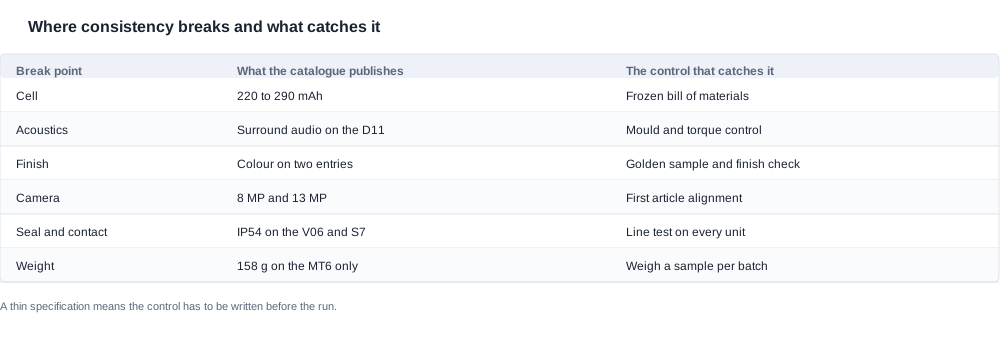
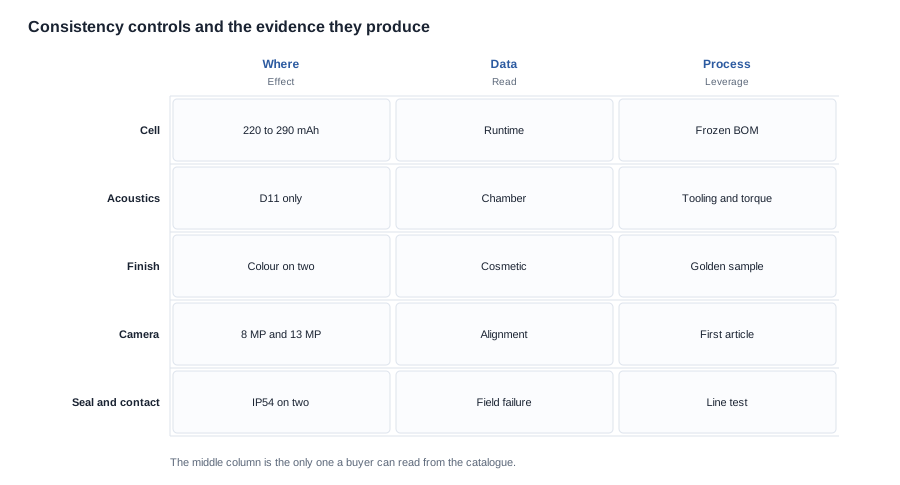
The cell. A cell substitution is invisible in the finished unit and visible only in runtime, in charge behaviour and in the transport documentation. It matters more here than in most categories because the catalogue leaves it partly open: camera batteries run from 220 mAh to 290 mAh and the charging method is not published at all for the CY05, the CY03 and the MT6, and the L1 Pro. A buyer looking at the catalogue cannot tell what is inside those four configurations, which means a substitution there cannot be detected from the specification — it can only be prevented by the bill of materials.
The acoustic configuration. Temple geometry, the internal chamber and the seal determine the sound result, and none of them is published for any entry in the range. The catalogue publishes surround audio for exactly one model, the D11. The G07 publishes ultra-thin and detachable temple options and the YK12 publishes a slim temple variant, which tells you the geometry is treated as a specification choice rather than a fixed detail — and therefore that it has to be frozen. A variation in the mould or in the assembly torque changes the chamber, and no line check will catch it unless the criterion was written down.
The finish. Matte, gloss and soft-touch are different processes with different inspection standards, and a gloss inspection is a stricter inspection than a matte one. Cosmetic variation is the most common first-article rejection in this kind of programme, which means it is the variation a production run is most likely to reproduce. The catalogue publishes colour options on only two camera entries — the V03 Pro with three options, which is also the only camera model with photochromic lenses, and the V06 with four options — so for most of the range the colour plan is still an open decision when the bill of materials is frozen.
The camera module. A mount, an alignment and a calibration decide the image result. The camera group divides cleanly on resolution, with eight entries at 8 MP and three at 13 MP, and every one of the eleven publishes a rated runtime of about five to eight hours with no test condition published. Because the sensor model, the field of view and the video specification are not published, this is the component where a variation is least likely to be detected by inspection at all.
The seal and the charging interface. A misaligned contact produces intermittent charging that a customer experiences rather than a line operator. A seal that is not as specified produces a product that fails in the field rather than in the factory. This is where the published evidence is thinnest of all: only the V06 and the S7 carry an IP54 marking anywhere in the catalogue, and the export certification page carries no per-model certification row and no published UN38.3 test summary, so there is no published document against which an ingress claim can be checked.
Two more break points sit underneath those five and are worth naming because they are driven by the catalogue rather than by the engineering. The first is charge behaviour. The catalogue publishes two hours or less for 26 of the 28 entries, with only the D17 and the ZH12 publishing approximately one hour. Two different charge behaviours in one range mean two different line tests, two different charger fixtures and two different thermal conditions, and a programme that carries both has to specify which test applies to which unit — otherwise a batch of the faster configuration is judged against the slower limit and rejected for something it is not. The second is cell size. The children's entries sit at 40 mAh for the A05 and the A06 and 70 mAh for the A07, with a rated runtime of about twenty hours, while the camera entries sit between 220 mAh and 290 mAh with about five to eight hours. Cells four to seven times apart in capacity behave differently under the same charge test, and the acceptance limit has to travel with the configuration rather than with the product family.

OEM ready platforms: the four controls that establish consistency
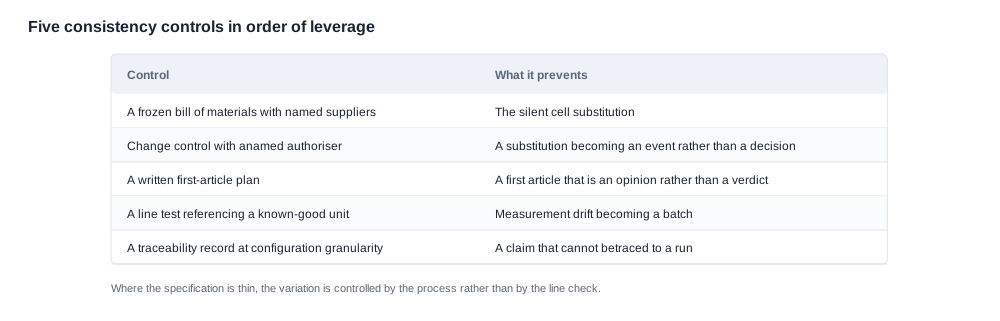
Consistency work is cheap to specify and expensive to retrofit. In order of leverage, four controls do most of the work, and they are worth asking for in writing before the first purchase order rather than discovering the absence of them during a quality dispute.
1. A frozen bill of materials with part numbers and named suppliers. Not a family, not a type, not "an equivalent camera module". The moment the bill of materials names a specific part from a specific supplier, a substitution becomes a visible event rather than an invisible one. This is the single most effective consistency control in the category, and it works for a simple reason: a substitution is only possible if somebody permits it. On an OEM ready platform the bill of materials will also cover the cell, the charging contacts, the case cell and the accessory items, and it is the document that ties the published configuration facts to the physical product.
2. A change control procedure with a named authoriser. The requirement is that any change requires written notice, and that the buyer has a stated right to reject or to require a re-verification. Written notice alone is not enough — a change the buyer cannot reject is a notification, not a control. The authoriser should be a named role rather than a department, and the procedure should say what happens to units already in production when a change lands.
3. A first-article verification plan with a written criterion. Sample size, the characteristics to be measured, and the acceptance limits for each. This is the control most often reduced to an opinion, and it is the one that decides whether the first production run matches the sample. The plan should reference the specification rows the catalogue does publish — the resolution, the cell capacity, the charging method, the case capacity, the charge time — and add criteria for the properties the catalogue does not, because those are the ones that will move.
4. A traceability record at configuration granularity. A unit in the field has to be tieable to a batch, and a batch has to be examinable. That means the production date, the configuration, the cell lot and the line test result must travel with the product or be recoverable from its identifiers. Without it, a field failure cannot be diagnosed, a batch cannot be isolated, and a recall becomes a guess.
These four controls interact, and the interaction is where the cost of getting it wrong sits. A frozen bill of materials without change control is a document; change control without a frozen bill of materials is a notice with nothing to compare the change against. A first-article plan without traceability cannot tell you whether a later failure belongs to the same population as the approved unit. Traceability without a first-article reference leaves you with a perfect record of a production run nobody has defined. The four are a set, and a buyer who negotiates for one of them in isolation will usually find the others already exist, because a supplier that maintains one of them properly almost always maintains all four.
The sequence also tells you where the leverage is in a negotiation. A buyer asking for all four controls gets a supplier to describe its own quality system, which is the cheapest and most informative request in the whole process. A buyer asking for a written tolerance on one dimension gets a number, which is much easier for a supplier to offer and much less useful. The trade-off is real — a full control set has a cost that appears as engineering time and as a slightly slower line — but the cost lands once per programme, while the absence of it lands on every unit that reaches a customer.

OEM ready platforms: the questions to put to a supplier
These are the questions that reveal whether a consistency programme exists. A supplier with a real programme answers all of them in writing without hesitation, because the answers are already in its own quality system.
- What does the bill of materials look like for this configuration, and what is the substitution policy? Ask to see the part number and the named supplier for the cell, the camera module, the charging contacts and the case cell.
- What is the change control procedure, and who authorises a change? Ask what notice period applies and whether the buyer can reject.
- What is the first-article inspection plan? Ask for the sample size, the characteristics and the acceptance criteria, not for a summary of them.
- How is the line test referenced to a known good unit, and is there a golden sample retained for the programme?
- What does the traceability record contain, and at what granularity? Ask to see one record for a completed run.
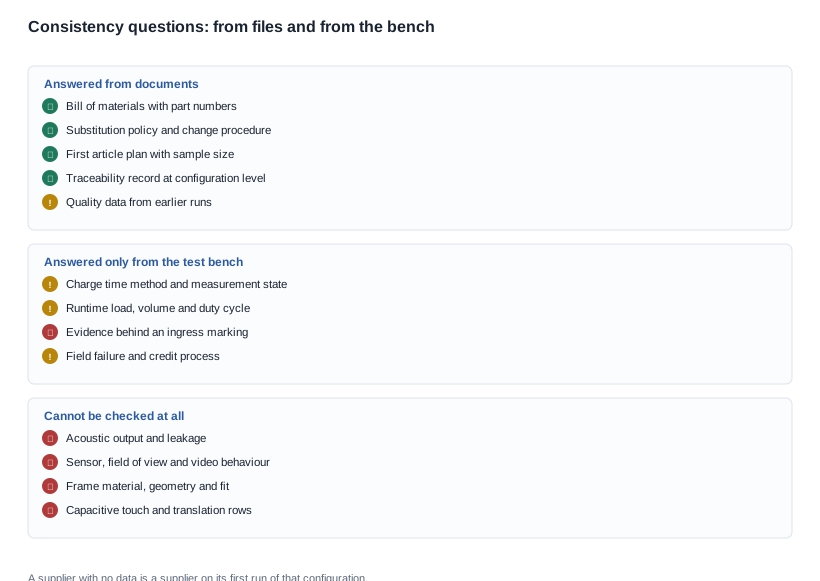
- What quality data exists from previous production runs of this configuration? A supplier with no data is a supplier on its first run of that configuration, and that is worth knowing before you order rather than after.
- What is the charge time test method, and what does it include? The catalogue publishes two hours or less for 26 of 28 entries, with only the D17 and the ZH12 publishing approximately one hour. The ceiling is a specification, not a measurement, and the test method determines whether a unit conforms.
- How is the runtime figure determined, given that no test condition is published for the camera group? Ask what load, what volume and what duty cycle the supplier uses when it states a figure internally.
- What is the process for a field failure, and what does the buyer get as a credit or a replacement? A supplier with a defined process will describe it without being asked to write it.
- What evidence supports the ingress marking on the configurations that carry one? Only the V06 and the S7 publish IP54, and the catalogue holds no per-model certification row.
The last three are where the due diligence goes from documentary to physical. A supplier who answers questions one to six from files has a management system. One who answers seven to ten from a test bench has a process.

OEM ready platforms: what a buyer verifies, and what cannot be inspected
Some of the variation in this category is detectable and some of it is not, and a buyer who writes acceptance criteria across the whole range without separating the two will end up with criteria nobody can meet.
What can be verified at receipt. The cell marking and the stated cell capacity against the specification. The charging method actually fitted, which matters because the catalogue does not publish it for four camera entries. The case capacity on the five configurations that publish one — the L1 Pro and the CY05, and the CY03 — each at 1400 mAh, the L2 Utral at either 900 mAh or 1400 mAh, and the MT6 in a 1200 mAh foldable form. The colour against the golden sample. The weight, on the one configuration where it is published at all: 158 g for the MT6 glasses, excluding the case. The identifiers against the traceability record, and the presence of the accessories on the packing list.
What cannot be inspected, because there is no published criterion. The acoustic output and leakage, because surround audio is published for the D11 alone and no acoustic measurement supports any entry. The camera sensor, the field of view and the video behaviour. The frame material, the frame geometry and the fit, since the catalogue carries no frame dimension and no frame material for any entry. The ingress performance beyond the IP54 marking on the V06 and the S7. The capacitive touch behaviour and the translation behaviour, because the catalogue has no capacitive-touch row and no translation row anywhere at all.
What needs a criterion written before production, not after. The charge time, the rated runtime and the microphone behaviour under real conditions are all published as ranges or as ceilings, so a unit can comply and still disappoint. The catalogue publishes about five to eight hours of rated runtime across the camera group with no test condition, publishes two hours or less as the charge ceiling for 26 entries, and publishes a rated runtime of about twenty hours for the children’s entries. Each of those is a configuration statement. Acceptance criteria have to specify the condition, and that condition is the buyer’s decision, not the catalogue’s.
The discipline in all three lists is the same: write the criterion against the physical property, not against the published figure. "Charge time under 2 hours or less at a stated ambient temperature, measured from empty to full, averaged over three units" is a criterion. "Charges in 2 hours or less" is a copy line, and copy lines do not protect a buyer from a variation they can measure but cannot complain about.
Batch discipline is the part that is most often skipped and the part that does the most work. A unit from the same batch as the one you approved tells you about that batch, and consistency is a claim about batches rather than about units. The minimum that makes the claim meaningful is to take units from at least two batches and to run the same protocol on each, because a single batch can be uniformly good and uniformly bad and will teach you nothing about the process. Where the volume allows, the stronger version is to take units at the start, the middle and the end of a batch, which is where a drift in a fixture or in a cell lot shows up first. Keep the raw data, not a summary of it, because the summary is where a drift disappears.
There is also a version of this that belongs to the buyer rather than to the factory. If you run your own protocol on a fixed sample of units from each delivery and keep the results, you have built a consistency history of your own that survives a change of supplier, because the protocol is yours and the reference unit is yours. That history is what lets a buyer negotiate with evidence rather than with an assertion, and it is the only defence available when the published specification is as thin as it is in this category.

OEM ready platforms: acceptance criteria you can actually write
The test of a good acceptance criterion is that it can be written by an inspector who was not in the conversation, measured with equipment on the line, and judged without interpretation. That standard is harder in this category than it looks, because so much of the published specification is a range or a ceiling.
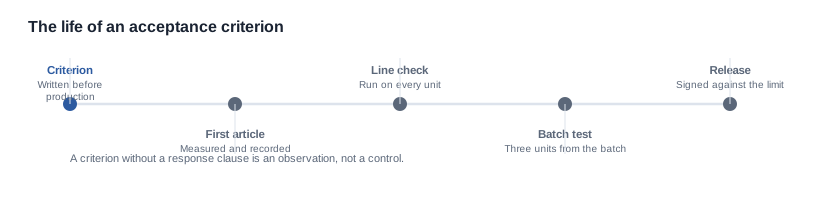
A workable structure has four parts. First, the characteristic and its source: name the property, the measurement method and the equipment, so that two runs of the same test give comparable numbers. Second, the limit and the statistic: the acceptance value, whether it is a mean or a maximum, and how many units are measured. Third, the reference: the golden sample or the first-article unit that the number is compared against, because a limit without a reference describes a population rather than a standard. Fourth, the response: what happens when a unit falls outside the limit — rework, downgrade, quarantine, or ship under concession — and who signs that decision.
Worked example. For the charge time on a camera configuration, the criterion is: measured from the empty state, on the supplied charger, with the ambient temperature recorded, on three units from the batch, with the longest of the three recorded; the acceptance limit is the published ceiling of two hours or less; the reference is the first article; the response on a failure is quarantine and a line investigation. That is a criterion a factory can run, an auditor can check and a buyer can enforce, and it is built from a row the catalogue actually publishes.
The same structure applied to a field that is not published is where the buyer adds value. An acoustic criterion on a platform with no published acoustic figure needs a reference unit rather than a numeric limit, because there is nothing to compare against; the test becomes whether a unit from a new batch matches the golden sample within a defined tolerance. That is a weaker criterion than a number, and it is honest about being weaker. It is still enormously better than no criterion, because without one the first unit from a new batch is the standard.
Two trade-offs deserve naming. The first is between inspection depth and line speed: every criterion added to the line costs time on every unit, and a buyer who adds ten checks for a low-volume programme may be buying quality at a price that exceeds the risk. The second is between a numeric criterion and a reference criterion — a number protects you more, but it requires either a published value or the measurement history to derive one, and this category rarely has both.
OEM ready platforms: how we scope the work on our side
Consistency is scoped and quoted per programme, against a specific configuration, an annual volume, the documentation scope the customer’s own customers will audit, and the schedule in force at the time. It is not a line item on a catalogue page, and we hold no published list price, no published minimum order quantity and no published lead time for a consistency programme, because a number printed here would describe a configuration nobody in this conversation has named yet.
What we do commit to is supplying the four controls in writing for a named configuration: the frozen bill of materials, the change control procedure with a named authoriser, the first-article verification plan with its sample size and criteria, and the traceability record at configuration granularity. What we will also do is tell you plainly where the specification is thin enough that inspection cannot help, so that your criteria are written against the properties that can actually be controlled.
The platforms these controls apply to are on the OEM ready products page, the branding layer that sits on top of a controlled platform is covered in OEM ready platforms and branding options, the wider quality framework for eyewear brands is in quality assurance for eyewear brands, and what happens at the point where a programme turns into volume is in mass production stage.
Related reading
- The platform range — OEM ready products
- The branding layer — OEM ready platforms and branding options
- The wider framework — quality assurance for eyewear brands
- The production stage — mass production stage
Tell us the configuration and the volume and we will tell you what the consistency controls look like for that programme.


