

"Compatible" in an audio range is four different questions, and they are ranked here by how often each one actually decides the commercial outcome. Open ear audio glasses smart glasses compatibility is a read that separates the practical ones — the app, the cable, the case, the platform — from the acoustic one, which is the question every buyer asks and almost none can answer from documentation. Three of the four are checkable on a sample in an afternoon with a written protocol. The fourth, whether two models sound consistent with each other across a range, cannot be checked from documentation at all, because the acoustic configuration that determines the result is not published for any model in the range and has to be established on samples, in one session, on one script.
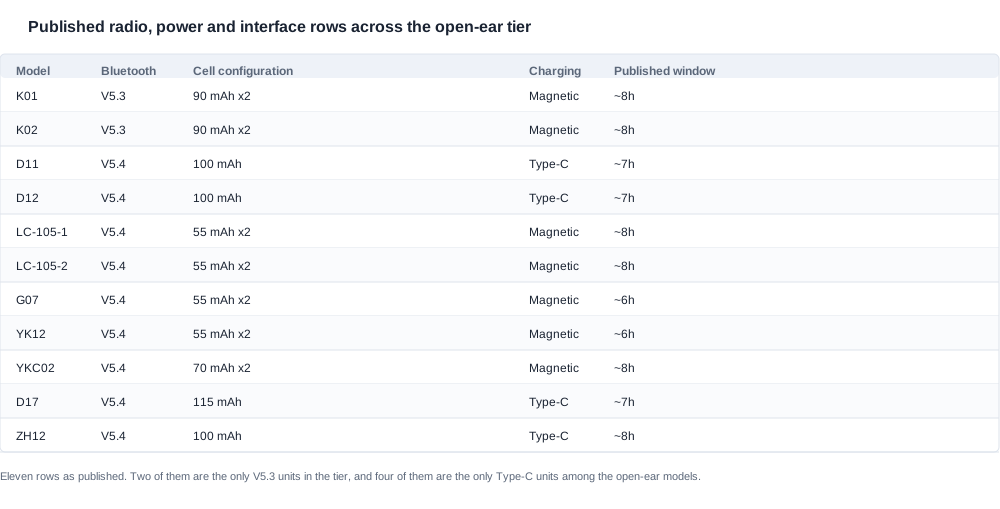
The published data across the open-ear rows is the starting point. Bluetooth 5.3 on the K01 and the K02, and 5.4 on the other nine open-ear models — six of those nine on the audio pages, and the YKC02, the D17 and the ZH12 on the sport pages; cell configurations at 55 mAh times two, 70 mAh times two, 90 mAh times two, a single 100 mAh cell and a single 115 mAh cell; charge windows of one hour on the D17 and the ZH12 and two hours on the rest; operating windows of roughly six, seven or eight hours; magnetic charging on seven models and Type-C on four; no touch control row published for any model in the tier; and feature rows naming surround sound on the D17 and the D11, and the YK12 and the YKC02, stereo surround on the ZH12, ultra-slim detachable temples on the G07, a slim temple on the YK12 and remote control photography on the D17 and the ZH12.
Open ear audio glasses: four questions, one published
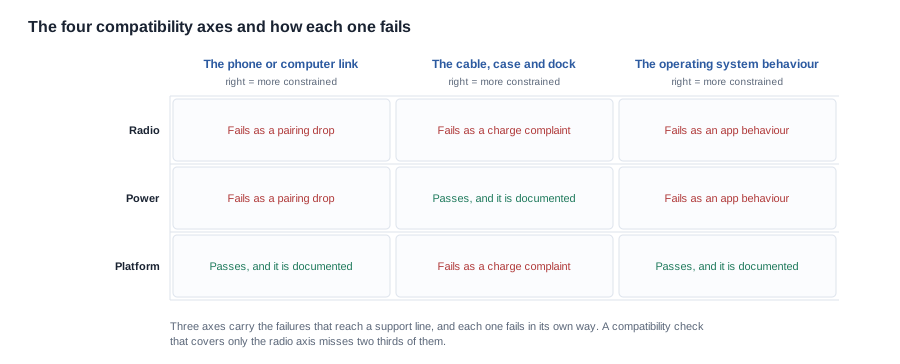
The four compatibility axes. A range is compatible or incompatible with something in four distinct ways, and each one fails in its own way and reaches a different part of the business.
- Radio. Whether the unit will hold a link to the target phone or computer, and whether it will hold it after a reconnection.
- Power. Whether the charging interface, the cable, the case and the dock all belong to one accessory programme.
- Platform. Whether the operating system on the customer's device behaves the way the listing assumes.
- Acoustic. Whether two models in the range sound consistent enough to sit on the same shelf.
The first three are verifiable. The fourth is not verifiable from any published row we hold, and a buyer who has budgeted for the first three and forgotten the fourth discovers the acoustic inconsistency at the point where a customer compares two products from the same brand, which is a review page rather than a returns counter.
Which axis costs what. The radio axis costs support time. The power axis costs accessory inventory, because each charging interface in a channel is a separate line, a separate packaging variant and a separate accessory minimum. The platform axis costs listing corrections, because a listing written for one operating system may describe a behaviour the other one does not have. The acoustic axis costs brand consistency, and it is the one that cannot be bought down with a documentation request.
The decision this article supports. How to choose a compatible set of models for a channel is a four-step filter, and it should be applied before any price comparison: keep the models whose radio and platform behaviour has been established on samples, keep the models that share one charging interface with the channel's existing accessory line, then keep the models whose operating window covers the session, and then — separately — test the acoustic consistency of whatever survives. The filter removes models for stated reasons, and the acoustic test is applied last because it is the most expensive and least decisive of the four.
The radio link: version, profile and codec
The version number is a generation statement, not a behaviour statement. Our published radio rows are V5.3 on the K01 and the K02 and V5.4 on the other nine open-ear models. That row has three uses and one limitation. Its first use is the regulatory one: the radio generation determines the compliance class, and therefore the documentation a model carries. Its second use is the platform one: a device that is more than two generations behind the current radio cannot necessarily negotiate with the latest phone operating systems, which is the mechanism behind the observed obsolescence of otherwise capable products. Its third use is the accessory one: the radio generation correlates with the charging interface in this range, since the two V5.3 models are magnetic and four of the V5.4 models are Type-C. Its limitation is that it says nothing about behaviour, and behaviour is what a customer experiences.
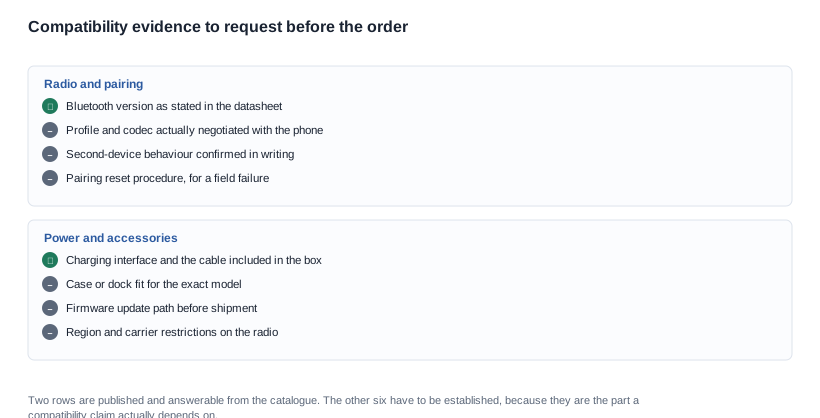
Profile, codec and the two that are not published. Three things are needed to describe an audio link properly, and we publish one of them. The version is published. The profile — the set of rules that defines how the audio function behaves, including how output is selected when several devices are connected — is not published for any model. The codec — the compression format actually negotiated — is not published for any model either. Both are single-line answers from a supplier and both are absent from every datasheet we have seen in this category, which is why a buyer asking "is this compatible" gets a version number back and has to insist on the other two.
The second device question, which almost nobody asks. A unit that holds one connection is a different product from a unit that holds two, and the difference shows up in the customer's second week rather than in the first. A customer who pairs a phone and then a laptop and finds that the unit silently drops the first connection will not read the specification; they will return the product. The question to ask is narrow and specific: how many simultaneous connections does the unit hold, and what happens to the existing connection when a second one is established. Both parts matter, and the second part is the part that generates a support call.
Region, carrier and the approvals that follow the radio. The radio generation is not the same thing as the radio approval. A unit sold into a market requires the approvals that market recognises, and the approval set is a separate question from the version. A buyer building a range across several markets should ask which approvals each model carries and for which destinations, and should treat the answer as a per-model row rather than as a range-level claim. Our catalogue carries a company-level export-certification page, and the text of that page names no CE, FCC or RoHS marking at all; there is no per-model certification row for any model in the range. The approval scope for one model and one destination is therefore written material that has to be requested, and it cannot be read off any row we hold.
The phone and its operating system as the moving variable
Why the phone matters more than the radio version. The customer's handset is the half of the link that a factory does not control, and it is the half that changes on a schedule the factory does not set. A unit that pairs reliably with one handset in a test and with a different handset in the field is not defective; it is undefined, and the definition has to be established by asking about operating system behaviour rather than about radio generation. The three behaviours that decide whether a device link works in practice are the initial link, the automatic reconnection after a restart, and the selection of the audio output when more than one output is available.
The three operating system behaviours to write down. The first is the reconnection behaviour after the phone restarts, which in practice decides whether a customer experiences the product as reliable. The second is the behaviour when an incoming call arrives while the unit is connected to another device, which decides whether calls and media can coexist. The third is the update path: whether the unit can receive a firmware update over the air, whether the update is signed, and what happens to the unit if an update is interrupted. The third is the one that catches procurement teams, because a unit that has been sold with a feature and later cannot be updated is a unit whose feature claim has quietly expired.
The reset procedure, which is a field-failure tool. Every compatibility conversation eventually reaches the reset procedure, and its absence is a supply-chain problem rather than a technical one. A unit that has been paired to a customer's phone and is returned under warranty cannot be resold or redeployed until somebody knows how to clear the saved device list, and if that procedure exists only inside the factory it becomes a shipping bottleneck. The procedure should be in writing, in the supplier's own document, and it should be in the delivery documentation as well as the packaging.

Accessory and channel dependencies that carry a cost
Cable, case and dock interoperability. The compatibility question that a buyer forgets is the accessory question, and it is the one with a straightforward commercial answer. Seven models in our open-ear tier charge magnetically and four charge over Type-C, and each interface in a channel is a separate accessory line, a separate packaging variant, a separate accessory minimum and a separate instruction set. A channel that already ships Type-C with everything else should say so at the quotation stage rather than discover it at the packaging stage, because the instruction insert and the box artwork are the last things to change and the first things to hold up a shipment.
The published interface rows as a compatibility screen. Before any sample arrives, the published rows already answer a large part of the power question: the magnetic group is the G07 and the LC-105-1, the LC-105-2 and the K01, the YKC02 and the K02, and the YK12, and the Type-C group is the D11, the D12, the D17 and the ZH12. What the published rows cannot answer is whether a specific case or dock from the channel's accessory programme fits a specific model, because the published rows carry no mechanical interface at all. That is a request, not a gap in the data.
The accessory cost that a unit price comparison hides. A magnetic model obliges the channel to stock a magnetic cable or a magnetic cradle, and a Type-C model obliges it to stock a Type-C cable. Where the channel already has one of those in volume, the marginal cost of the other is the entire accessory line rather than a cable. That is a line in the accessory budget and not in the product budget, and it is the line that most often reverses a ranking of two otherwise comparable models.
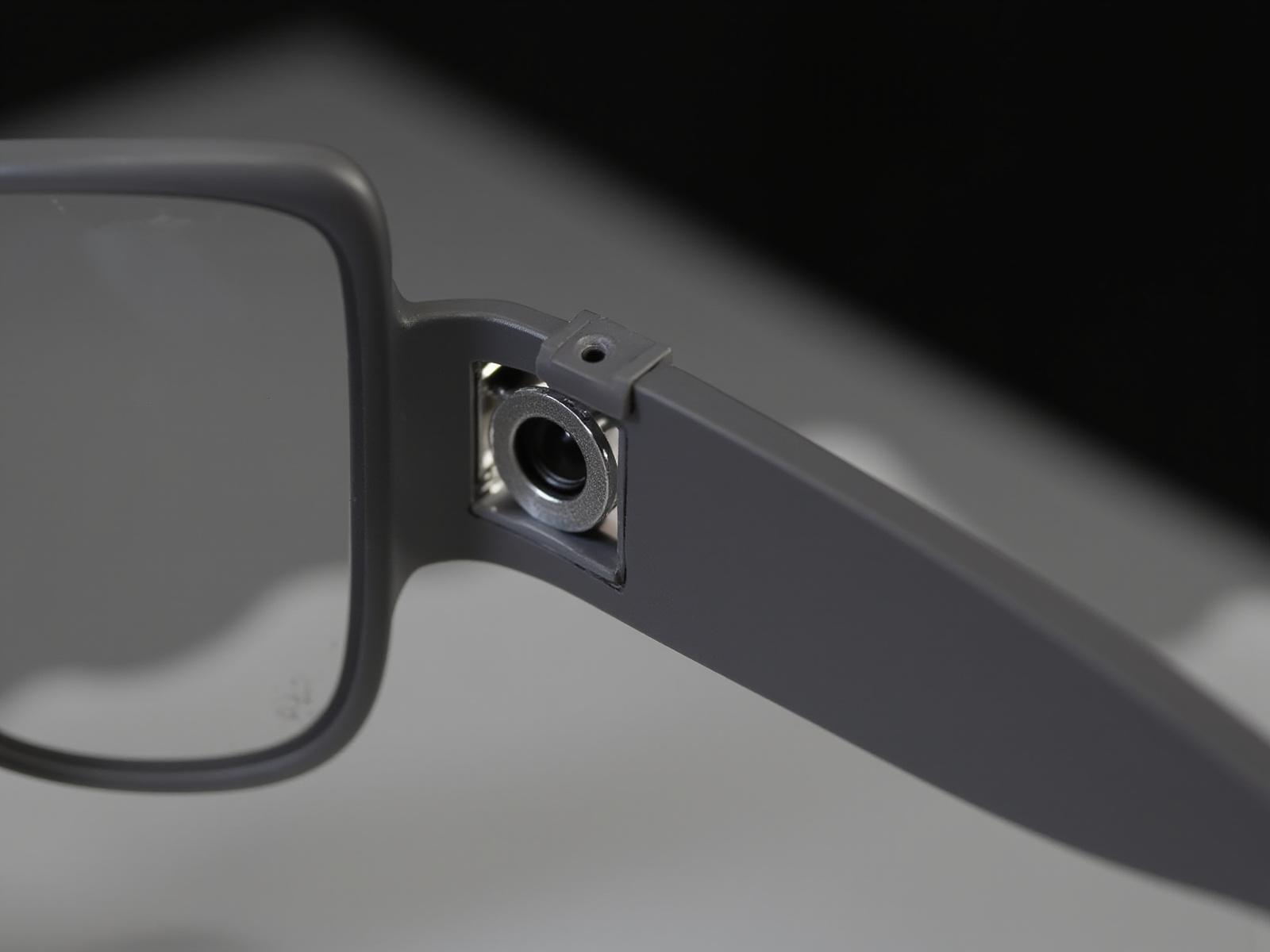
What the feature rows commit a channel to. The G07 publishes ultra-slim detachable temples and the YK12 publishes a slim temple, which means a channel carrying either of them carries a spare-parts and a replacement commitment that a fixed-temple model does not create. The D17 and the ZH12 publish a remote control for photography, which is a separate accessory with its own device link, its own battery and its own regulatory scope — and neither of the two publishes a camera specification of its own, so what the control actuates is a question for the supplier rather than a row in our documentation. A buyer who treats the feature row as a line on a product page rather than as a line in the accessory programme will find the cost in the accessory programme.

The fourth axis: acoustic consistency across a range
The three axes above are settled by procedure. The fourth is settled by judgement, and a buyer who has a range rather than a single model has to deal with it deliberately.
The script, the position and the comparison. Consistency across a range is measured by playing the same material on each model and comparing the results, and the method has to be fixed before the comparison is made. The script should be a fixed set of passages covering speech at two levels and a piece of music with a known dynamic range, because speech and music expose different faults. The position should be a defined distance in a defined room with a defined background level, because the same unit produces a different result in a corridor and in a treated room. The comparison should be by a panel, with the models presented in a random order, because a panel that knows which model is which will find differences that are not there. Two models can pass this test and still sound different, because the test measures consistency rather than quality; it is the right instrument for the question a brand manager is actually asking, which is whether a customer who buys two models will be disappointed.
What consistency is worth paying for. It is worth a great deal in a retail channel, where the customer can compare two products from the same shelf on the same afternoon, and very little in a channel where each unit is sold once into a use case that never repeats. That makes consistency a channel decision rather than a product decision, and it should be made before the range is assembled rather than after the first customer complaint. The practical consequence for a buyer is that the range should be assembled from models that share an acoustic configuration, and since the acoustic configuration is not published for any model in our range, that grouping has to be established by the supplier in writing or by the sample script.
The cost of getting it wrong. An inconsistent range produces a specific and expensive outcome: the better-sounding model becomes the reference point, and the other models read as worse versions of it. That is a return-rate problem and a listing problem at once, because the listing for the weaker model is hard to write when a customer can hear the difference. The preventive measure is the same as it is for every other failure mode in this category: the requirement goes into the purchase order, and the requirement names the models, the script, the position and the pass condition, because a requirement that names only "consistent" cannot be used to refuse a lot.
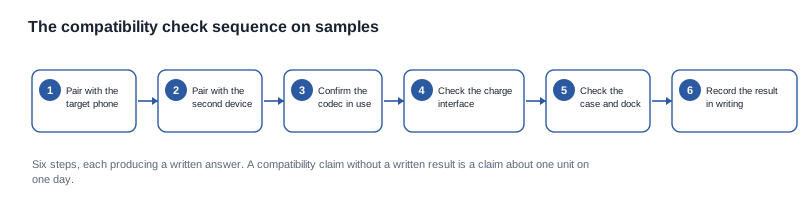
Running the check on samples, step by step
Six steps, and what each one produces. The protocol below is deliberately narrow and it is written before the first sample is powered, because a compatibility check conducted after the fact tends to record whatever happened rather than what was required.
- Pair with the target handset and record the model of the handset, the operating system version and the outcome, with the unit's firmware state noted.
- Pair with a second device and record whether the first connection survives, whether the second is established automatically or by an action, and how the unit behaves when a call arrives on the first device.
- Confirm the codec and the profile actually negotiated with the handset, and record the values rather than the fact of a successful connection.
- Disconnect and reconnect the unit through a handset restart and through a unit restart, and record whether the reconnection is automatic in both directions.
- Check the charging path with the supplied cable, with the channel's existing cable and with the channel's existing dock or cradle, and record which combination works.
- Record the result in writing, per model, on a single sheet, with the date and the unit identifiers, so that a later claim can be traced to an observation rather than to a memory.
The four red flags in a compatibility claim. The first is a claim phrased as "works with all phones", which is a statement about the supplier's confidence rather than about the product. The second is a compatibility statement with no handset model and no operating system version attached, which means it cannot be tested. The third is a promise of multi-device behaviour with no stated limit on the number of connections. The fourth, and the most expensive to discover late, is a claim of cross-model acoustic consistency with no method behind it, because nothing in our published documentation supports such a claim for any model.
What to do when a step fails. Record the failure as it happened, with the handset, the version and the step. Then ask the supplier the same question in writing and attach their answer to the record. A compatibility problem that is fixed by a firmware update is a different commercial situation from one that is a hardware difference, and only the written answer distinguishes them. If the answer is a firmware update, ask for the update path to be part of the delivery documentation; if it is a hardware difference, it becomes a model exclusion rather than a defect.
The questions to send with the sample order. Ask how many simultaneous connections the unit holds and what happens to the existing one. Ask which profile and codec are used with the target platform and whether a firmware update is available before shipment. Ask for the device-link reset procedure in writing. Ask which approvals each model carries and for which destinations. Ask whether the unit can be supplied with the charging interface the channel already stocks, and at what minimum order quantity. Five questions, one sheet, and the answers can be filed with the quotation rather than reconstructed later.
Where the detail sits. The configuration rows behind this procedure are collected at the open-ear audio key specifications, the selection comparison is at how to compare open-ear audio glasses, the range itself is at bluetooth audio glasses, and the technical background is at open-ear audio technology.
What we will publish and what we will not. We publish the radio version, the cell configuration, the charge window, the operating window and the charging method for every open-ear model, and we publish the feature rows that describe what a model carries. We publish no Bluetooth profile, no codec, no multi-device behaviour, no device-link procedure and no acoustic consistency claim for any model, and we would rather say so than print a compatibility table that a customer's phone can contradict. We also publish no unit weight for any model in the audio tier. If your compatibility decision depends on one of the empty rows above, tell us which one and we will tell you what has to be established on samples before the order is placed.


