

Open-ear audio solves four specific problems, and a programme that treats it as a general-purpose audio solution will not ship well. The honest version of the question is therefore not whether open-ear audio is good, but whether your programme contains one of the four problems it actually solves. If it does not, the answer is no, and the correct action is to decline the brief rather than to source it and negotiate the price. Open ear audio glasses smart glasses do you need it is answered below as an exclusion procedure: four stop conditions that end the conversation before a factory is contacted, what the programme becomes once the audio is removed, and what each wrong choice costs over the first year.
The published position of our range makes the exclusion concrete rather than theoretical. The open-ear rows publish Bluetooth 5.3 on the K01 and the K02 and 5.4 on the other nine open-ear models — six of those nine on the audio pages and the YKC02, the D17 and the ZH12 on the sport pages — cell configurations at 55 mAh times two, 70 mAh times two, 90 mAh times two, a single 100 mAh cell and a single 115 mAh cell, charge windows of one hour on two models and two hours on the rest, operating windows of roughly six, seven or eight hours, magnetic or Type-C charging, and feature rows for surround sound, slim and detachable temples, and remote control photography. On acoustic performance the published position is that the range publishes the technique — open-ear acoustic structure, directional audio and intelligent noise reduction — and publishes almost none of the measurements that would let a buyer compare one model against another.
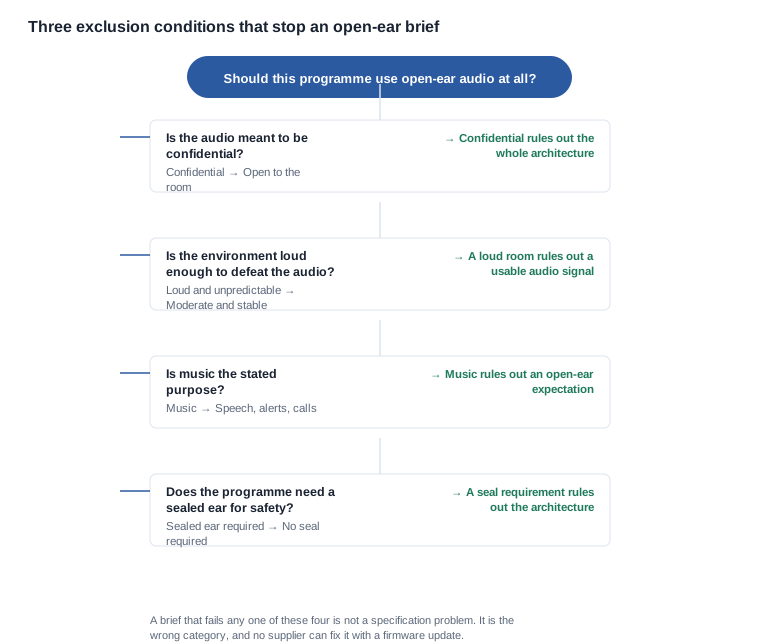
Open ear audio glasses: four jobs, four limits
Start with what the architecture is for, because the four things it does well and the four things it cannot do are the same list read from two directions.
Job one: hands-free awareness. The ear canal stays clear, so the person's surroundings remain available to them. In a warehouse, on a site, behind a counter, in a vehicle, this is the point of the product rather than a compromise. A buyer who specifies open-ear audio for an awareness job has specified the right architecture, and the acceptance test is written around intelligibility over a stated noise floor rather than around sound quality.
Job two: a public audio channel. The unit produces sound in a space where other people can hear it. That is what makes it work for a retail floor, a showroom, a training room, or a family environment where a speaker is the desired behaviour. It is also the reason it fails as a confidential channel, and the same property that makes a product work in a showroom makes it unusable in a boardroom.
Job three: calls where the person's hands are occupied. The microphone and the speaker sit on the frame, so a call can be taken without freeing the hands. This is a genuine category benefit and it is the one that converts most reliably into a channel sale, because the buyer of the product is a person who has been trying to solve a specific task.
Job four: alerts and notifications without a second device. Navigation prompts, alerts, a timer spoken into the room — the open-ear channel is a way to deliver short information without adding another object to the person's hands. This job is bounded by a rule that buyers routinely miss: the message must be short, because the product competes with the ambient noise rather than with a sealed earbud.
Against those four jobs, the architecture has four hard limits.
Listening to audio versus hearing a conversation. A listener and a participant are not the same use case, and the category separates them without overlap. A participant needs speech to arrive intelligibly over whatever is already in the room. A listener needs a signal that reaches the ear with detail intact and with the environment excluded, and no open-ear architecture delivers that. Any brief whose purchase justification is written in the language of listening is a brief for a different product, and a factory that quotes it is telling you the brief is not being read.
Confidential calls are not an open-ear job. If a person has to take a conversation that must not be overheard, an open-ear unit emits the conversation into the room by construction. There is no firmware setting that fixes this, no connection configuration that fixes this, and no price level at which it becomes acceptable. This is the exclusion that most often gets discovered after launch rather than before it, because the failure surfaces in a customer review rather than in a returned unit.
Where the environment turns sound into noise. Open-ear output is added to whatever the room is already producing. In a quiet room the added signal dominates. In a room with a sustained high noise floor it can be drowned, and the person's only remedy is to turn the level up, which increases what everyone else hears. The condition that makes the architecture work in one channel makes it unusable in another, and the two channels are usually adjacent in a catalogue.
A sealed ear is sometimes a requirement. Where an employer, a safety regime or a customer specification requires the ear canal to be blocked, an open-ear product cannot be supplied into that environment, and the reason is not acoustic preference but the requirement itself. This is a rare exclusion in consumer channels and a routine one in industrial ones.
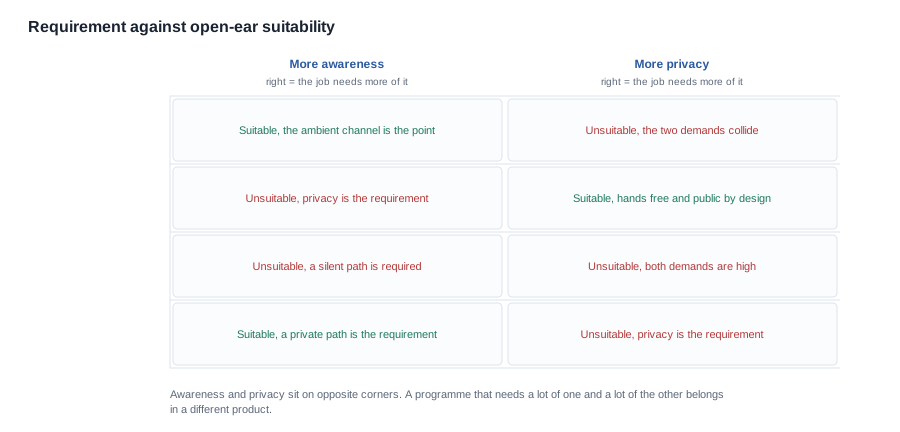
The matrix above shows why the decision is binary in practice. Awareness and privacy are the two axes the buyer is really trading, and they sit in opposite corners. A programme that needs a lot of both is asking for a product that does not exist, and the correct response is to change the requirement rather than to shop harder.
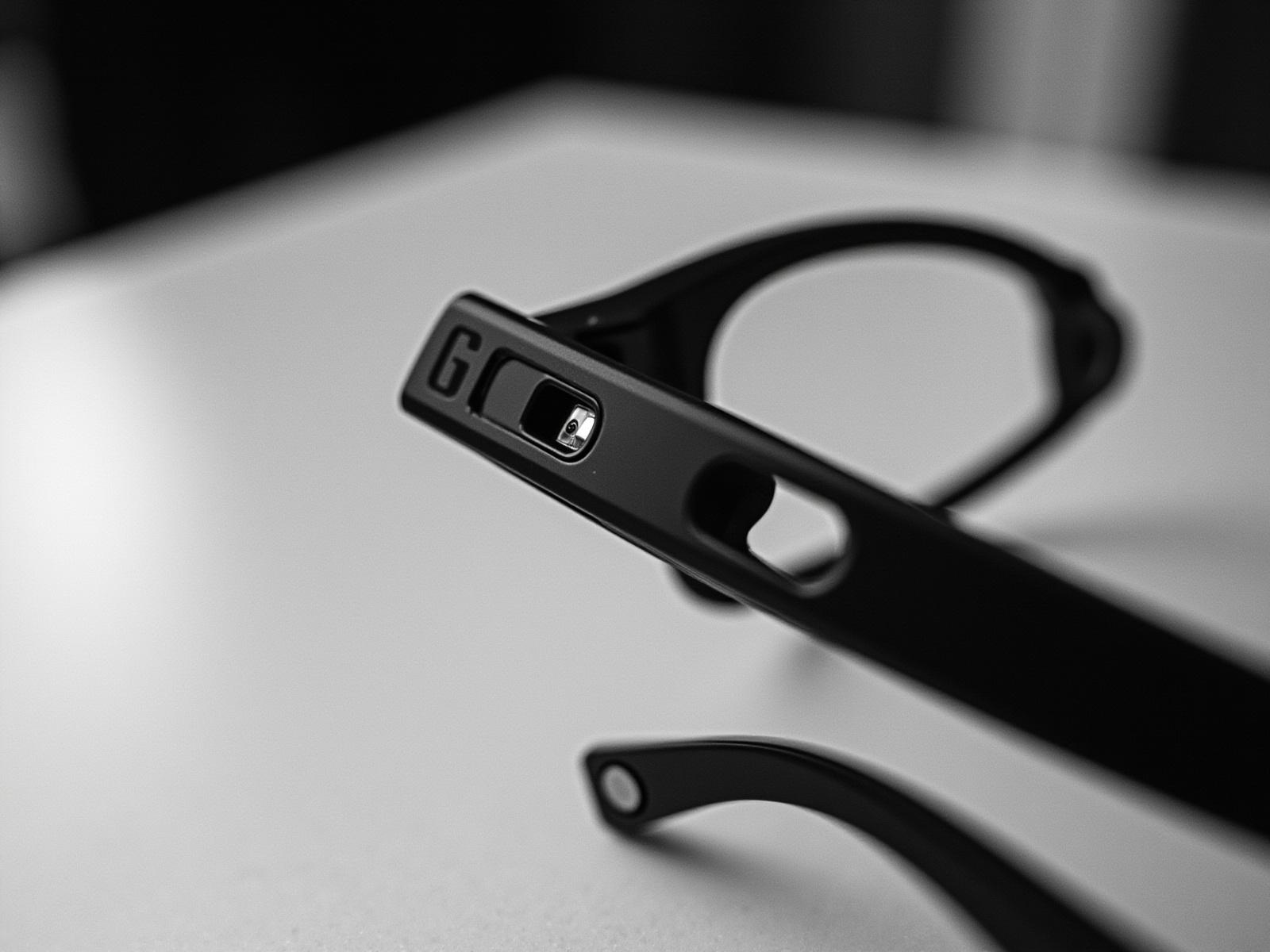
The exclusion conditions that should stop a brief before it reaches a factory
A stop condition is different from a preference. A preference is something you would like to have if it is free; a stop condition is something that makes the whole approach wrong. The four below are stop conditions, and each of them can be tested in a single meeting with the channel that owns the requirement.
The four exclusions that are stop conditions rather than preferences. First, the audio carries a confidential conversation. Second, the purchase justification is written in the language of listening rather than of awareness or of calls. Third, the environment is loud and variable enough that the added signal cannot be made intelligible at a reasonable level. Fourth, the person has to hold a sealed ear for a reason that an employer or a regulator imposes. If any one of these is true, the programme is not an open-ear programme, and the useful question becomes which of the alternatives in the next section you should be considering instead.
How to run the exclusion without a factory. Put the four conditions in writing as four yes-or-no questions, and get the answers from the channel that owns the customer relationship rather than from the engineering team, because the channel knows what the customers are actually buying. Record the answers in the same document that will later hold the shortlist, so the reason for excluding a model is traceable at review. If any answer is uncertain rather than clear, treat it as a stop condition and write the programme for the certain case. A brief that turns out to be the uncertain case can be re-opened; a programme built on the uncertain case cannot be undone at a sensible price.
What to do when a condition is borderline. Three borderline cases recur and all three have a defensible answer. A confidential conversation in a room where the participants are far apart is a stop condition, because the distance does not change the emission, only how much of it reaches a bystander. A loud environment is a stop condition only if the audio is the primary channel; if it is a secondary alert channel, a loud environment is acceptable because the alert only has to be distinguished from the noise, not from silence. And an employer requirement for a sealed ear is a stop condition with no exception, because a supplier offering a workaround is offering a product that does not meet the requirement.
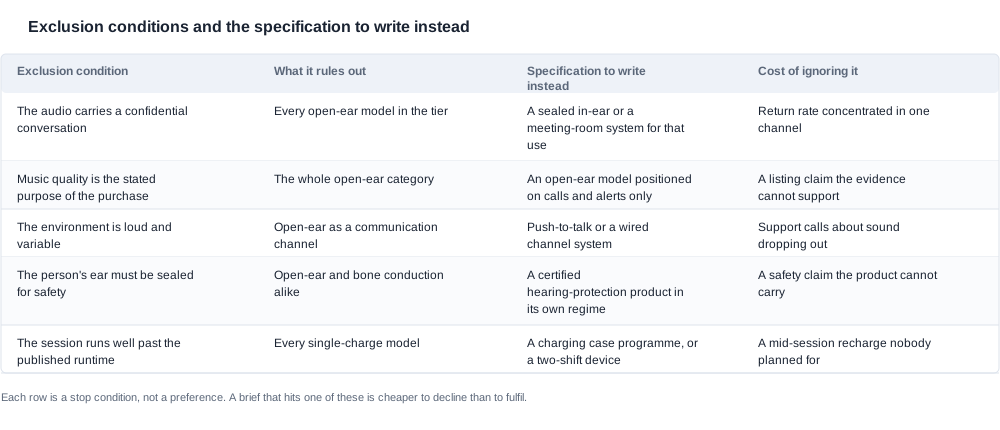
The right-hand column of that table is the part that makes this article useful to a procurement team. For each excluded brief there is a specification you can write instead, and in three of the four cases the alternative is not an open-ear product at all. That is worth saying plainly, because the pressure inside a category is always toward sourcing something from within it.

What the programme becomes after the audio is removed
When the exclusion applies, the programme does not disappear. It changes shape, and the change is usually commercially better than the original.
The substitution table for a brief that fails. If the audio was carrying a confidential conversation, the specification that serves the same job is a sealed in-ear system or a room-level conferencing product, and the channel position changes with it — a sealed product competes with the earphone shelf rather than with the frame shelf. If the justification was listening, the specification is a sealed earphone, and this is an entirely different sourcing task with different tooling, different compliance and different logistics. If the environment defeats the audio, the specification moves to a wired or push-to-talk arrangement, which removes the battery question and the charging interface question at a stroke. If a sealed ear is required, the specification is a certified hearing-protection product in its own regulatory regime, and it must be sourced as such.
When a camera-led model is the right answer instead. A third substitution is specific to this factory and worth naming, because it is often the correct one. Several of our models carry a camera as well as audio — the AI camera range, the sport camera models and the photochromic model — and a programme whose real requirement is capture rather than sound may be better served by a camera-led unit. Our camera-led tier publishes 8 MP and 13 MP configurations, charging cases at 1400 mAh on three models, 900 and 1400 mAh on one, and a 1200 mAh foldable case on the MT6, and it publishes an ingress marking on two sport models only. The audio tier publishes no ingress marking on any model. If a brief's real requirement involves exposure to weather or dust, the audio tier cannot satisfy it and the camera tier is where the check happens.
The cost consequence of the substitution. Swapping architectures is not free, and a buyer who discovers the cost after committing has mis-sequenced the decision. The costs that move are the tooling, the accessory line, the certification file and the channel position on the shelf. A program that begins as a frame with a feature and ends as a different product line should be re-costed from the start rather than adjusted at the end. The comparison procedure is set out at how to compare open-ear audio glasses, and the range comparison is at the open-ear audio glasses specification overview.
How the cost of choosing wrongly is priced
A wrong architecture choice does not usually show up as a manufacturing defect. It shows up as returns, as support contacts, and as a compliance problem, and all three are priced by somebody. A buyer should be able to name who pays.
What a wrong choice costs across the first year. The direct cost is concentrated in the return rate, because a mismatch between the product and the expectation produces returns that are not defects. Those returns carry the freight, the inspection time, the restocking and the write-off, and they land on the channel rather than on the factory unless the acceptance criteria said otherwise. The second cost is the support load, which is not visible in the unit price and is proportional to the number of customers whose expectation was never met. The third cost is the compliance cost, which is the one that is hardest to reverse: a listing claim that the evidence does not support is a market access issue, not a returns issue, and it is discovered by a platform or a regulator rather than by the customer.
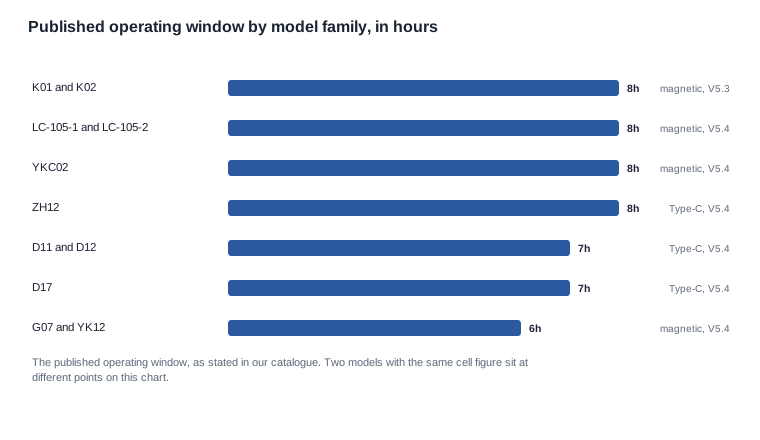
The published operating window is the row most likely to be misread as a performance claim. The chart above shows the operating windows across the open-ear tier. A buyer who treats these as a performance comparison will conclude that the eight-hour models are better than the six-hour models. They are not better; they are different products with different cell configurations and different session assumptions, and the two 55 mAh twin-cell groups at approximately eight hours and approximately six hours are the clearest evidence that capacity alone does not determine the window.
The three questions that settle the cost. Ask what the acceptance criteria will say, because a programme without written acceptance criteria converts every mismatch into a dispute. Ask who carries the cost of a lot that fails them, because the answer is almost always negotiable at the contract stage and never afterwards. And ask what the return rate was on the last comparable programme in this channel, because the answer is usually available and is usually more informative than any of the published rows.
The commercial terms that move when the architecture moves
A brief that fails the exclusion is often worth more as a written commercial position than as a product, because the channel usually still wants something for the same shelf position. The terms that are genuinely open at this stage are worth naming so that a procurement team can negotiate them rather than accept them.
-
The specification scope. The number of configurations the supplier is asked to carry is the largest single lever on both the price tier and the certification workload. A brief that reduces to one model in one colour with one charging interface is a materially better commercial proposition than one that asks for three models in four colours with two interfaces, and the reduction usually costs the channel nothing.
-
The acceptance criteria and who carries a failed lot. With an architecture substitution in play, the risk that the shipped product does not meet the channel's expectation is real, so a written acceptance condition and a named cost bearer are worth negotiating here rather than at the point of dispute.
-
The delivery structure. A programme that changes architecture late is a programme where a second delivery is likely. Splitting a delivery, holding a smaller first run against a named configuration, or agreeing a price break at a stated volume are all negotiable, and all of them reduce the amount of tooling spend committed to a product whose specification is still moving.
-
The documentation scope. Who assembles the technical file, who owns the model list, and who carries the cost of a model being added to the range later are all contract terms rather than technical ones. On a brief still at the substitution stage, these terms are far easier to settle than they are after a first shipment.
-
The warranty boundary. A warranty written against a measured failure criterion is worth more than one written against a calendar assumption, and on a substituted architecture the measured criterion has to be agreed before the first lot is accepted. It is a negotiable term precisely because both parties can live with it.
The terms that do not move are the cost and the elapsed time of a certification exercise, and the nature of a tooling charge once tooling has been cut. Those are quoted per configuration and per laboratory queue, and a larger order does not shorten either of them. What a larger order does do is spread the tooling, which is why the configuration count is the number to argue about rather than the unit count.
Where our own catalogue makes the exclusion easy to run
We think the exclusion procedure is worth more than a model recommendation, and our range is set up so that a buyer can run it without contacting anybody. The rows that let you run the exclusion yourself. The mechanism rows split the range into eight open-ear models on the audio pages, three more open-ear models on the sport pages and one bone conduction entry, and the bone conduction entry is the only row in the range with a published amplification gain, at 35 dB. The feature rows name surround sound on the D11 and the YK12, and the D17 and the YKC02, stereo surround on the ZH12, remote control photography on the D17 and the ZH12, a slim temple on the YK12 and ultra-slim detachable temples on the G07, which is what lets a buyer tell a call-oriented model from an alert-oriented one. The charging rows split seven magnetic models from four Type-C models, which is what lets a buyer check the accessory commitment without a factory. The camera rows, published separately on the camera tier, are what let a buyer confirm whether a camera-led substitution exists at all.
What we will not do to make the exclusion easier. We will not publish an acoustic figure we do not have, we will not describe an open-ear unit as suitable for confidential listening, and we will not suggest that a published operating window is an acceptance value. We also will not present the absence of an ingress marking on the audio tier as a safety statement in either direction — it is the absence of a published marking, and the full range is at bluetooth audio glasses with the technical background at open-ear audio technology.
What we would say if you asked us to decline a brief. We would decline it in writing, name the condition that failed, and tell you what the alternative specification would be. That is a more useful outcome than a quotation for a product that will be returned, and it is faster than discovering the problem after a tooling deposit. If you send us the use case, the market and the session length, we will tell you whether the requirement is one this category can serve, and we will say so before you spend anything.
The next step, in one page. Write the four exclusion questions down, answer them with the channel, and only then decide whether to continue. If the answer is yes on all four, the shortlist procedure at how to compare open-ear audio glasses is the next document. If the answer is no on any one of them, the useful output of this step is the alternative specification, and it is cheaper to write today than to renegotiate after the tooling bill arrives.


