

An open-ear product is not competing with the other open-ear products on the shelf. It is competing with the customer's existing earphones, with their phone's speaker, with the room's own audio system, and with doing nothing — and the comparison that decides the commercial outcome is usually the last one. Open ear audio glasses smart glasses how it compares to alternatives is a read of four alternatives, the axis on which each one is genuinely better, the axis on which each one is genuinely worse, and what it costs a procurement team to switch between them. The conclusion is not that open-ear wins. It is that open-ear wins on exactly one axis — the amount of the surroundings the person can still perceive — and that a range built on any other premise will lose in the market.
Our published position across the open-ear rows is what the comparison has to work with. Bluetooth 5.3 on the K01 and the K02 and 5.4 on the other nine open-ear models — six of those nine on the audio pages and the YKC02, the D17 and the ZH12 on the sport pages; cell configurations at 55 mAh times two, 70 mAh times two, 90 mAh times two, a single 100 mAh cell and a single 115 mAh cell; charge windows of one hour on the D17 and the ZH12 and two hours on the rest; operating windows of roughly six, seven or eight hours; magnetic charging on seven models and Type-C on four; no touch control row published for any model in the tier; and features including surround sound, ultra-slim detachable temples, a slim temple and remote control photography.
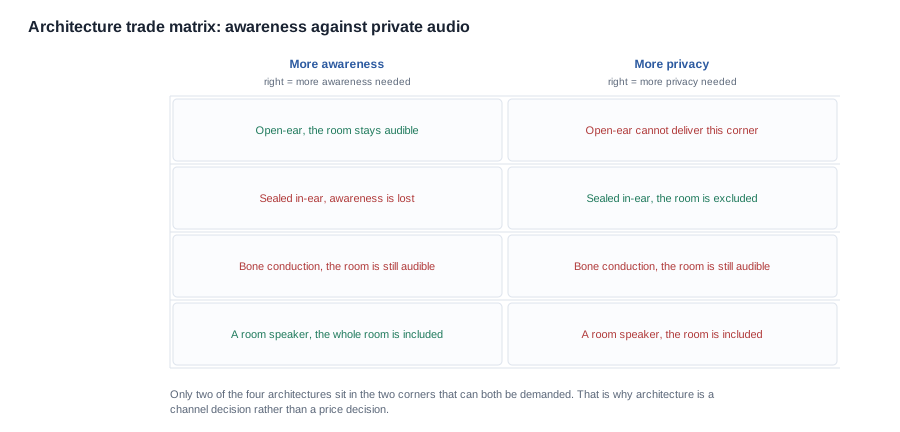
Open ear audio glasses: four alternatives, measured side by side
Bone conduction moves the problem rather than solving it. A bone conduction transducer transmits through the skull to the inner ear, and it leaves the ear canal unobstructed in the way an open-ear speaker does — but by a different route, and the difference matters commercially. Sound conducted through bone reaches the ear through the tissue of the head, so less of it arrives in the room and more of it arrives at the person. That is the trade: better privacy at the cost of the usable low end, because the tissue path attenuates and distorts the lower frequencies far more than the air path does. In our catalogue the bone conduction mechanism appears as a single entry with no model designation, publishing a 35 dB amplification gain, a 200 mAh cell, a two hour charge window, an approximately seven hour operating window and Type-C charging. A buyer comparing architectures is comparing a range of eleven open-ear models against a single product, which is a sourcing consequence before it is an acoustic one.
Sealed in-ear: the comparison the customer is actually making. A sealed in-ear earphone is better on almost every axis that a shopper can evaluate in a shop: it is quieter, it has a lower floor, it does not leak into the room, and it costs less because it has no frame. It loses on exactly one: the person's surroundings disappear. That single loss is decisive in an environment where surroundings are information and worthless in an environment where the customer is listening to music. The commercial consequence is that an open-ear product sold into a music-listening brief is competing against a better product on the wrong axis, and that the comparison the customer will make in the shop is the one the open-ear product loses.
The phone speaker and the room speaker. A phone held to the ear is free, needs no accessory, needs no battery and needs no certification. It is also unusable when both hands are occupied, it is unusable where a phone on the ear is unsafe or unprofessional, and it is unusable at any distance. A room speaker is the right answer for a training room and a retail floor, where the audio is public by design and the listeners are stationary. Both alternatives win decisively on cost and lose decisively on the axes where a frame wins: hands-free operation, continuous availability and the person's ability to move.
Doing nothing, the alternative that wins on total cost. The most common competitor in a channel is the customer's existing phone and their existing earphones, or simply the absence of any audio device at all. Doing nothing has a total cost of zero and a compliance burden of zero, and it wins every comparison except one: the job that requires the audio to be present at all. A buyer who cannot name the job loses to it by default, and a listing that describes a general audio benefit rather than a specific job is a listing that loses to it by default.
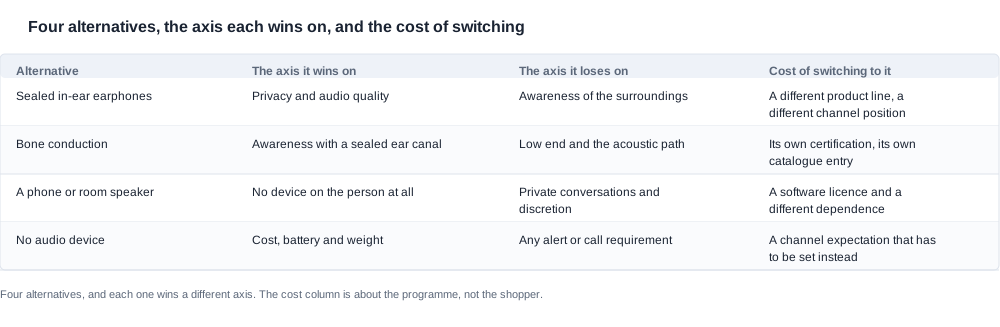
The axis on which each alternative wins, and the axis it loses
The comparison table is organised the same way for all four alternatives, because a comparison organised inconsistently is a comparison that produces a preference rather than a decision.
The leakage test that settles the comparison. The one measurement that separates the four architectures more clearly than any other is how much of the output leaves the device and reaches the room. A sealed in-ear earphone emits very little into the room, an open-ear temple speaker emits a great deal, and a bone conduction unit emits considerably less than an open-ear speaker for the same perceived level. A room speaker emits the most of all, and the phone held to the ear emits the least. We publish no leakage figure for any model in our range, which means a buyer running this comparison has to establish it on samples, and that measurement is worth more in this category than almost any other because it is the one number that changes the architecture ranking.
The certification scope of each architecture. Switching architectures changes the compliance file, and the file is where the elapsed time sits. A radio-equipped product of any architecture needs the radio framework, a lithium cell in any architecture needs the transport file, and a product that reaches the consumer market needs the substance and labelling documentation. The differences between architectures are smaller than a buyer might expect on the radio and substance side, and larger on the descriptive side: a product that amplifies sound toward the ear has to be described carefully, because a hearing-related description moves it into a different framework. Our catalogue publishes a 35 dB amplification gain on the bone conduction entry as a technical figure, and that figure must not become a description of what the product does for a person's hearing.
The accessory programme each architecture creates. The in-ear alternative creates an accessory programme of tips and a charging case. The open-ear alternative creates a charging interface, a cable and optionally a case. The bone conduction alternative creates a cable and a different regulatory scope. The phone and the room speaker create none of these, and that is their largest commercial advantage in a channel where the accessory line is a real cost. The decision is therefore not about which product is better; it is about which cost structure the channel can carry and which shelf position the brand is competing for.
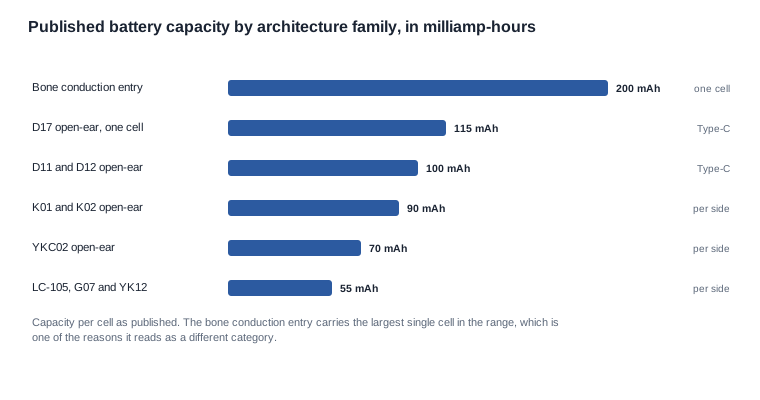
Published battery capacity as the clearest structural tell. The chart below sets out the published cell capacity for each architecture family. The bone conduction entry carries the largest single cell in our range at 200 mAh, while the open-ear models range from a single 115 mAh cell down to 55 mAh per side in the twin-cell group. This is not an acoustic finding, and it is not presented as one. It is the clearest published evidence that the bone conduction mechanism is not a variant of the open-ear product but a different category with a different power budget, and a buyer comparing them should compare them as different products with different cost structures.
What switching architectures costs in tooling and certification
Once the architecture question is settled, the procurement question is what the decision costs, and the cost falls in three places that are easy to underestimate.
The tooling is a new programme, not a variation. Moving from an open-ear model to a sealed in-ear product moves the supplier out of the frame business entirely: different jigs, different assembly lines, different test cycles, different packaging, and in most cases a different supplier. The frame moulds, the acoustic chambers and the temple electronics cannot be re-used, so the tooling that was paid for on one architecture cannot be amortised on the other. A buyer who has already paid a tooling charge on an open-ear programme and then switches is buying two programmes.
The certification file does not transfer either. A radio approval covers a model and the configuration that was tested. A new architecture is a new configuration, a new model designation and a new document, and a family-level document cannot be stretched across it. The elapsed time sits in the laboratory queue and in the artwork round, and neither of those is shortened by a larger order. What a larger order does is spread the tooling, which is the reason to make the architecture decision before the tooling order rather than after it.
The channel position is the cost that does not appear on any invoice. This is the one that decides whether the commercial outcome is good, and it is the reason the alternative comparison has to start from the channel rather than from the product. A channel that sells audio accessories is a different channel from one that sells frames, and a frame with audio is a different shelf position from a sealed earphone. The decision to sell an open-ear audio frame commits the brand to a shelf position, a return policy, a support script and a replacement strategy, and none of those appear on the supplier's quotation.
A channel-level selection matrix a buyer can apply
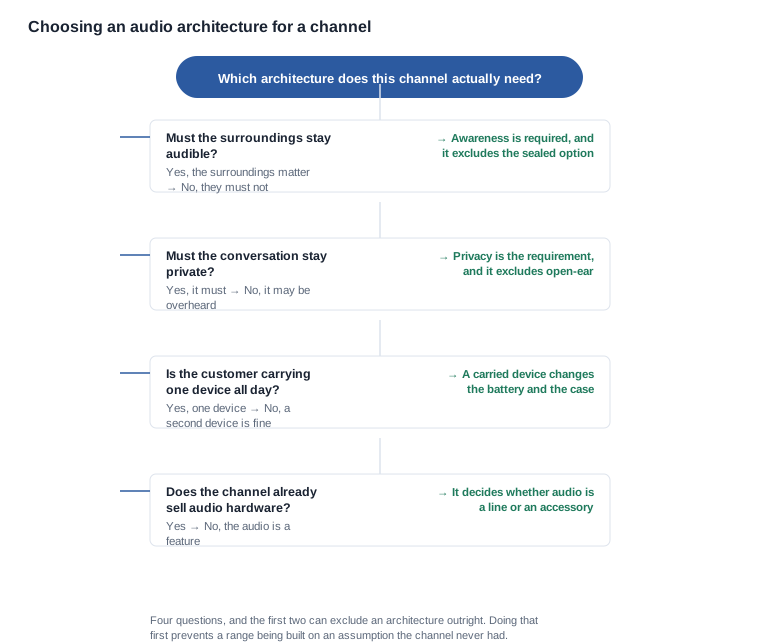
The five-row matrix a buyer can fill in an afternoon. The comparison is short enough to be done before any sample order, and it is short enough that the answer is usually obvious once the rows are in front of each other.
- Awareness required. Does the job need the person to keep hearing their surroundings? If yes, an open-ear unit or a room speaker is the only candidate and the sealed option is out.
- Privacy required. Does the job need the audio to stay with the person? If yes, the open-ear unit is out and the comparison moves to sealed, bone conduction or a room system with a private output.
- Hands free required. Does the person have to keep both hands available? If yes, a phone held to the ear is out.
- Device carried. Is the person already carrying something on their head? If not, the open-ear unit competes with adding a device, which raises the value of the frame form factor and lowers the value of the audio quality relative to it.
- Channel fit. Does the channel already sell frames, or already sell earphones? The answer decides which position the product occupies and which set of expectations the listing has to meet.
How to read a completed matrix. The first two rows are the ones that exclude, and they should be answered first because they are the only two that can end the comparison. The third row excludes a single alternative. The fourth and fifth rows do not exclude anything; they decide which of the surviving options is the better commercial position, and they are the rows that use the channel's data rather than the product's.
What a buyer should send to a supplier. Send the surviving architecture, not the open-ear specification, and ask for the quotation against it. If the surviving architecture is open-ear, the request should carry the session length, the charging interface the channel stocks, and the number of configurations, in the same form as any other request. If the surviving architecture is bone conduction, the request should additionally ask which regulatory framework the description on the listing falls under, because that is a question about wording and it determines the compliance scope. If the surviving architecture is a room system, the supplier relationship changes completely and the quotation framework changes with it.
The five criteria a procurement team should score an alternative against
How to choose between architectures is not a matter of taste, and it is not settled by a supplier's demonstration. It is settled by five criteria, each of which can be written down and answered before money moves.
-
The awareness criterion. Does the job require the person to keep hearing their surroundings? If it does, a sealed in-ear product is eliminated before any other criterion is applied, and the comparison narrows to open-ear, bone conduction or a room system. If it does not, the open-ear architecture has no advantage over the alternatives and should be compared on the other four criteria as an ordinary audio product.
-
The privacy criterion. Does the job require the audio to stay with the person? If it does, the open-ear architecture is eliminated, and the shortlist moves to sealed or bone conduction. A buyer who scores this criterion late will have already spent the sample budget on the wrong architecture.
-
The total cost criterion. What does the alternative cost across the whole programme, including the accessory line, the certification scope, the packaging and the returns exposure? A sealed earphone is cheaper to buy and more expensive to return. The total cost question is the one that usually reverses a first impression, and it is the one a unit price comparison cannot answer.
-
The channel fit criterion. Where does the product sit on the shelf, and which set of customer expectations does that position create? A frame with audio is compared with frames; a sealed earphone is compared with earphones. Red flags here are a product whose listing borrows the vocabulary of a different position, because the customer will compare it against that category and it will lose on the criteria that category is judged by.
-
The evidence criterion. Which of the rows that decide the comparison can actually be evidenced? For the open-ear architecture in our range, the rows that can be evidenced are the radio version, the cell configuration, the charge window, the operating window and the charging method; the rows that cannot are leakage, frequency response, driver size, pickup distance and every third-party acoustic measurement. A buyer should score a supplier on how many of the decisive rows they will commit to in writing, not on how many rows they will print.
The three questions that test a shortlist before you order. Ask which architecture the quotation assumes, and whether the price changes if the architecture changes. Ask what happens to the tooling and the certification file if the architecture changes after the tooling is cut. And ask which of the five criteria above the supplier's own product was designed against, because a supplier that answers the awareness criterion for an open-ear product is a supplier who understands the category. Questions to ask in this form produce comparable answers across suppliers, and the answers should be recorded in the file rather than in a notebook.
The checklist to carry into the meeting. Six lines, and they are the whole of the decision:
- The job the audio is for, written as one sentence without the word "audio".
- The awareness requirement, answered yes or no.
- The privacy requirement, answered yes or no.
- The accessory line the channel already carries.
- The number of configurations at launch.
- The architecture the price is quoted against.
A hypothetical comparison, worked through. The following is a hypothetical case rather than a client project, and it is included to show the decision sequence rather than to report an outcome. Assume a distributor of safety equipment serves a construction and logistics channel, and the brief is a hands-free alert and call channel for site supervisors, with a shift of eight hours and no charging point on site. Scoring the criteria: the awareness requirement is yes, because a supervisor on a marshalling yard needs to hear a vehicle and a colleague at the same time, so the sealed option is eliminated and bone conduction is eliminated as well on the low-end argument for speech in noise. The privacy requirement is no, because the channel is public by design, so nothing else changes. The total cost criterion then becomes decisive, because the sealed alternative is cheaper to buy but has a different accessory line and a different certification scope, neither of which the distributor wants to carry. The channel fit criterion is yes, because the distributor already sells frames and the product sits naturally on that shelf. The evidence criterion leaves four open-ear models, narrowed by the eight-hour session to the group publishing approximately eight hours and by the accessory line to the magnetic subgroup. The shortlist that survives is three models, and the two rows that remain open are leakage and usable low end, both of which have to be closed on samples with a written protocol rather than on a catalogue.
Where the comparison stops and the samples begin
Everything above is decidable from published rows and channel data. Two things are not, and both have to be settled on samples with a written protocol.
The two things that need a sample. The first is leakage, because we publish no leakage figure for any model in our range and the number changes the architecture ranking. The second is the usable low end, because the coupling between the frame and the head is not published and it is the variable that explains why two units at the same published configuration do not sound alike. Both are measurable, both need a defined position and a defined protocol, and both should be written into the acceptance condition rather than observed and reported.
The failure modes this comparison prevents. A range positioned on audio quality rather than on awareness loses to a sealed earphone in the shop. A range positioned on general convenience loses to the customer's existing phone. A range whose listing promises more privacy than the architecture can deliver produces a return rate concentrated in one channel and a complaint that cannot be settled, because the product is doing what it was designed to do. And a range that mixes architectures without a written reason produces a shelf in which the better-sounding product makes the other look wrong.
Where the detail sits. The entry point for a buyer who has not worked in the category is the beginner's guide to open-ear audio glasses, the observed behaviour of the products is at open-ear audio glasses in real-world performance, the range is at bluetooth audio glasses, and the technical background is at open-ear audio technology.
What we will say plainly about our own position. We publish our open-ear models and one bone conduction entry, and we do not publish a sealed in-ear product, so we are not a neutral party in this comparison and we do not pretend to be. We publish no leakage figure, no frequency response, no driver size and no third-party acoustic measurement for any model, and we will not quote a typical value from another product to fill one of those rows. We publish no unit weight for any model in the audio tier. And we will say directly which axis our products win on, which is awareness, and which they do not, which is audio quality in a listening environment. If your channel's requirement is the second one, the honest answer from us is that this is the wrong category, and the table above is the tool for deciding that before a sample order is placed.


