

If you are new to open-ear audio glasses and you are buying for a brand, a channel or a shelf, the useful skill in this category is not choosing a model. It is asking the questions that make the choice possible. Our catalogue publishes eleven open-ear models and one bone conduction entry, and almost every row on the published sheet is a configuration fact rather than a performance fact — the mechanism, the radio generation, the cell configuration, the charging interface, the operating window. What is missing is the acoustic evidence, so a buyer who compares the published rows is comparing the cheap part of the decision and skipping the expensive one.
This guide is written in the order a first-time buyer actually needs it. It starts with the two mechanisms, because that choice carries a compliance boundary with it. It then teaches the five terms that decide a shortlist, how to reduce eleven published models to two or three candidates without spending anything, and the supplier questions that are worth more than a specification sheet. The last section states plainly which rows we publish and which we do not, so you can tell the difference between a decision you can make from documentation and one you have to make on samples.
Open ear audio glasses: two mechanisms, and the first question
The category divides into two technologies, and confusing them is the most expensive mistake a first-time buyer can make. An open-ear temple speaker sits in the arm of the frame and pushes sound out through a grille, leaving the ear canal entirely unobstructed. A bone conduction transducer presses against the skull and carries the signal through bone tissue to the inner ear, leaving the ear canal clear by a different route. Both keep the canal open. They do not behave the same way, and they do not carry the same paperwork.
The mechanism decision that also moves your compliance file. In our catalogue the open-ear mechanism covers eight models on the first two pages of the audio tier and three more on the sport pages, and the bone conduction mechanism appears as a single entry with no model designation at all. That asymmetry is itself informative. A bone conduction programme is a one-model programme, which means every variant, every colour and every market decision lands on a single unit with no second candidate to fall back on. Before you compare anything else, decide whether a one-model programme is acceptable to you.
The two approaches are set out side by side at the open-ear and bone conduction comparison, and the mechanism is described at open-ear audio technology. The practical difference that a first buyer should hold on to is not sound quality — it is where the acoustic energy goes. An open-ear speaker radiates into the room, and what reaches the ear is whatever the room does not absorb. Bone conduction radiates into the head, and what reaches the ear is what the tissue passes. That is why an open-ear unit can be usable in a street and unusable in a confidential conversation, and why bone conduction carries a published amplification gain figure that an open-ear unit does not.
Why the first question is not about price. A first-time buyer typically opens the range, sees eleven rows, and starts comparing unit price per thousand units. That comparison is legitimate, and it is also premature, because the unit price rows in this category are decided by a mechanism choice and a configuration choice that are both more expensive to change later than the price itself. If you pick the mechanism first and the price second, you will spend your negotiating effort where it can move. If you pick the price first, you will discover the mechanism was never open to negotiation.
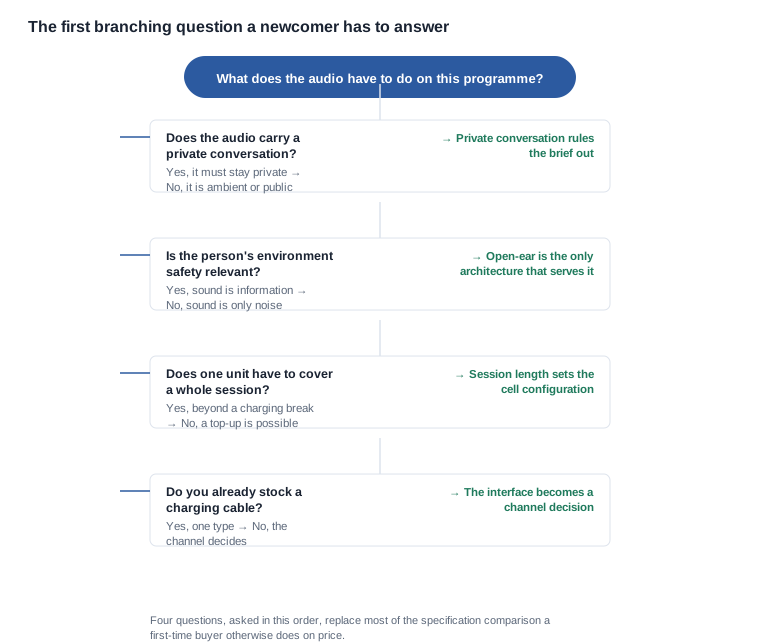
Three questions decide the mechanism, and they come out in this order because each one eliminates more of the range than the next. The first is whether the audio carries a conversation that has to stay confidential. If it does, open-ear is out, regardless of price, because the requirement is architectural rather than a specification preference. The second is whether the person's surroundings are information rather than noise — a warehouse, a site, a counter, a vehicle. If they are, open-ear is not a preference but the only architecture that serves it. The third is whether one charge has to cover a whole working period, which is where the cell configuration enters and where the published operating window starts to matter.
The vocabulary that decides the shortlist, in the order a buyer meets it
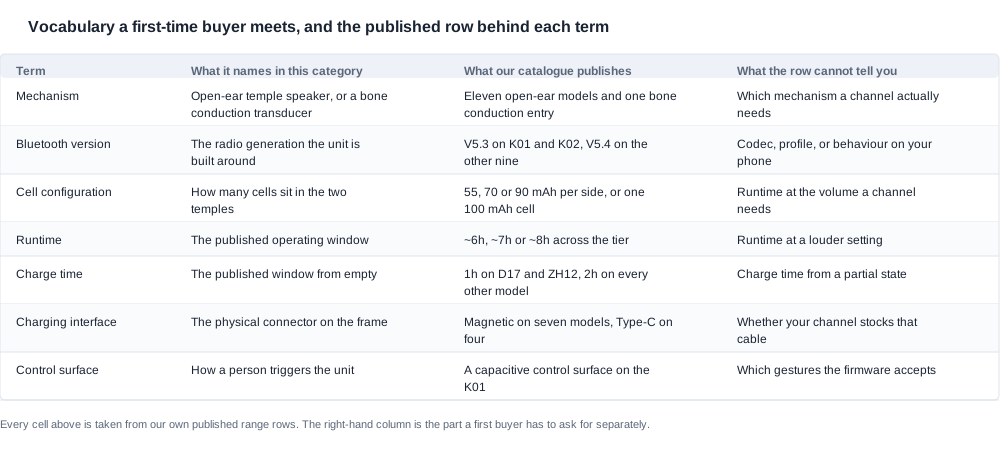
Every row on a published configuration sheet belongs to one of five terms, and a buyer who knows the five can read the whole sheet without being misled by it. The first term is the mechanism, which you have now settled. The second is the radio generation. The third is the cell configuration. The fourth is the charging interface. The fifth is the operating window.
Bluetooth version, and the two things it does not certify. Our catalogue publishes V5.3 on the K01 and the K02, and V5.4 on the other nine open-ear models. That row is useful and narrow. It tells you the radio generation and, by implication, the regulatory class of the radio, which is the part that matters for a compliance file. It does not tell you which codec is negotiated with a phone, whether the unit will hold two connections at once, or how the unit behaves on the particular operating system your channel's customers actually own. A buyer who treats a version number as a compatibility statement has substituted a factory's marketing convenience for a test result.
Cell configuration, and why a single cell and twin cells are different products. The published rows state capacity in two ways. The K01 and the K02 state 90 mAh times two. The LC-105-1 and the YK12, and the G07 and the LC-105-2 state 55 mAh times two. The YKC02 states 70 mAh times two. The D11, the D12 and the ZH12 state a single 100 mAh cell, and the D17 states a single 115 mAh cell. Those are not two ways of writing the same number. A twin-cell unit divides its budget across two temples and pays for two electronics boards, two charging contacts and two flex assemblies; a single-cell unit concentrates it. The consequence for a buyer is that the single-cell models are mechanically a different product family, and the tooling, the assembly steps and the failure modes are different with them. The battery side of the range is compared at the battery comparison, and the call-oriented models are covered at bluetooth audio glasses for calls.
Charging interface as a channel decision rather than an engineering one. Seven of the open-ear models state magnetic charging and four state Type-C. The D17 and the ZH12 are the two that state a full charge in one hour, and both are Type-C. A first-time buyer should read this row as an accessory commitment rather than an engineering detail, because the number of cable types in a channel's inventory and the number of cable types in a customer's bag are both directly proportional to it. A channel that already ships Type-C with everything else gains nothing by adding a magnetic model and loses a accessory line. A channel whose customers already own magnetic docks gains the same way. The range at bluetooth audio glasses carries the row, and the open-ear options are compared at bluetooth audio glasses open-ear options.
The operating window is a screen, not a commitment. Our published windows in the open-ear tier are approximately eight hours on the ZH12 and the K01, the LC-105-1 and the LC-105-2, and the K02 and the YKC02; approximately seven hours on the D11, the D12 and the D17; and approximately six hours on the G07 and the YK12. These figures are the screen you use to eliminate models, and they should not appear in a purchase order as an acceptance value. A published operating window does not state the volume level, the duty cycle, the ambient temperature or whether the cell was new at the start of the test. Two models with an identical cell figure can sit an hour or two apart on this row, which is exactly what happens with the 55 mAh twin-cell group: the LC-105 pair publishes roughly eight hours and the G07 and the YK12 publish roughly six hours.
The table above collects the five terms against the rows we publish. The right-hand column is the part a first buyer has to ask for separately, and it is not a small part — it is most of the decision.

Turning a catalogue into a shortlist without spending anything yet
Shortlisting in this category does not require a sample. It requires a written environment brief, a written session length and a written accessory commitment, and it should produce two or three candidates with a reason attached to each. A shortlist of eleven is not a shortlist; it is the catalogue with extra steps.
The five-step reduction from eleven published models to three candidates. Start with the mechanism. If the brief requires confidential audio, stop here and take it to a sealed product instead, because no open-ear row will satisfy it. If it does not, take the eleven open-ear models. Second, group them by radio generation. The two V5.3 units are a group on their own, and if your channel has no radio, carrier or platform reason to exclude V5.4, that group has already lost. Third, sort by cell configuration, because single-cell and twin-cell units are mechanically different families and a buyer should not compare a single-cell unit against a twin-cell unit on any row that is not the operating window. Fourth, apply the session length. If the working period is longer than the published window, the model drops out unless a case is in the plan, and a case changes the accessory line, the packaging and the price. Fifth, apply the accessory commitment, and keep only the models whose charging interface the channel already stocks.
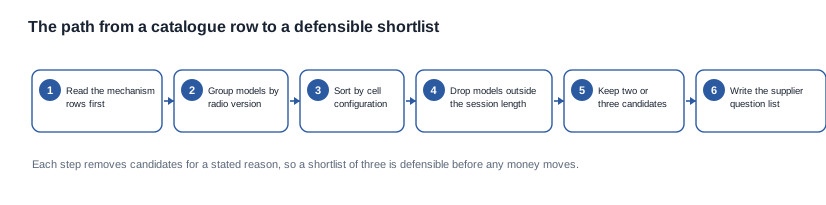
That sequence leaves two or three candidates in a typical case, and it leaves them with reasons attached. The reasons matter more than the names, because a reason is portable to the next supplier. "We are considering the K01 because it publishes a twin-cell 90 mAh configuration, a magnetic interface that matches the channel's existing accessory line and an approximately eight hour operating window" travels to a different factory and still means something. "We like the K01" travels nowhere.
The three sentences that make a brief checkable. Write down the environment in one sentence, the session length in hours in a second, and the accessory commitment in the third. If the environment sentence does not name a noise floor or a working context, it is not yet a brief. If the session length is a phrase such as "all day", convert it to the longest continuous interval the unit will be asked to cover without a charging opportunity. If the accessory commitment is missing, the charging interface decision will be made by whichever quotation arrives first, which is the worst possible way to make it.
What to do with the result. A shortlist of two or three candidates with written reasons is the document you send to each factory. It tells a supplier what you are comparing, which cuts the quotation round from a general request into a defined comparison. It also gives you the ability to ask the same four questions of every supplier and compare the answers side by side, which is where the real difference between quotations appears. A full selection procedure is set out at how to choose open-ear audio glasses, and the practical checklist form is at the buying checklist.
The supplier questions that are worth more than a specification sheet
A specification sheet tells you what a factory wants you to buy. A good question list tells the factory what it has to prove. The difference is worth more than any single published row, and it is also the part that a first-time buyer most often omits because the catalogue already feels like an answer.
The document request, written as a list and not as a question. The request below is deliberately specific. Each line is a document or a defined answer, and each one can be checked. Asking a supplier to "send the certification details" produces a paragraph; asking for the certificate numbers, the issuing bodies and the model designations each document names produces something a procurement team can file.
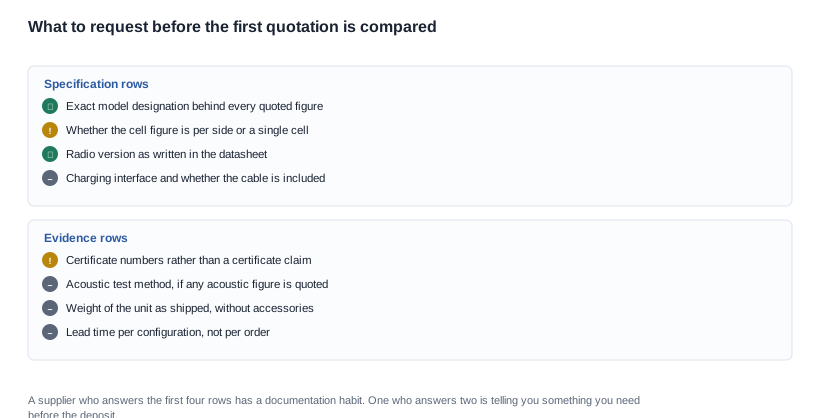
The list is short enough to send in one email and specific enough to be checked. It divides into two halves, and the halves behave differently. The specification rows — model designation, whether a capacity figure is per side or for the whole frame, radio version, charging interface — are answerable today from published material, and a supplier who answers them accurately has a documentation habit worth noticing. The evidence rows — certificate numbers, any acoustic test method, the weight of the unit as shipped, the lead time per configuration — are the ones that cost a supplier something to answer, and the ones a first-time buyer should read most carefully.
What a supplier answers first, and what that answer is worth. Quotation responses follow a predictable order. The unit price arrives first, then the cell configuration, then the charging interface, then the operating window, and then the evidence questions, if they are answered at all. A supplier who answers the first four and declines the fifth has told you something precise: that the evidence package is the part they would rather you did not have. That does not disqualify them for every programme, but it does mean the compliance work moves onto your desk, and it means you should price that work into the comparison.
The four questions worth asking before a sample order. These are written so that each one has an answer which is a fact, a number or a document, and a non-answer is itself an answer.
- Which cell did the published operating window come from, and at what volume level was the unit running when it was measured?
- Is the acoustic claim on the range sheet a method name or a measured figure, and if it is a figure, what were the measurement conditions and the standard they were taken against?
- Which certificate numbers do you hold, which model designations does each one name, and which of them covers the configuration we are quoting?
- What happens to the unit price if the order is delivered in two shipments rather than one, and what is the cut-off date for adding the second model to the same production run?
The first question is the one a first-time buyer is most likely to skip and the one a factory is most likely to answer with a number it does not have. Ask it anyway; the answer determines whether the published window can be used as an acceptance value or only as a screen.
Where our own catalogue stops, and what that means for a first order
We would rather tell you where the published rows end than let a first-time buyer build a decision on a row that was never there.
The rows our catalogue publishes for the open-ear tier. Eleven open-ear models across the audio and sport pages, each with a radio version, a cell configuration, a charge time, an operating window and a charging method. Feature rows are published for specific models: surround sound on the D17 and the YK12, and the YKC02 and the D11; stereo surround on the ZH12; remote control photography on the D17 and the ZH12; ultra-slim detachable temples on the G07; a slim temple on the YK12; a long battery life note on the D11 and the YKC02. One bone conduction entry publishes a 35 dB amplification gain, a 200 mAh cell, a two hour charge window, an approximately seven hour operating window and Type-C charging, with no model designation attached to it.
The rows it does not publish, and how to ask for them. We publish no driver size, no acoustic chamber dimension, no leakage figure, no frequency response, no microphone pickup distance, no signal-to-noise ratio and no third-party acoustic measurement for any model in the range. We publish no weight for any model in the audio tier — the only published unit weight anywhere in our catalogue is 158 g for the MT6 glasses unit, which includes its battery and camera and excludes the foldable 1200 mAh charging case, and no bare frame weight is published for any model in the range. We publish no certificate numbers: the export-certification page in our catalogue carries ten patent certificates, eight appearance-design patents and two utility-model patents, and names no CE, FCC or RoHS marking, so the conformity document for a model is something you request — and it is worth asking for it early, because a document produced after the order is placed delays the shipment instead of the quote. We publish no acoustic figure because no third-party measurement supports any model in this tier.
Why this matters more to a first-time buyer than to anyone else. A buyer who knows what is missing asks better questions. A buyer who assumes the sheet is complete will treat the published operating window as an acceptance value, treat the charging interface as an engineering detail and treat "open-ear acoustic structure" as a performance claim. All three are errors, and all three surface after the tooling is committed. The published rows are enough to build a shortlist and to write a compliant request list. They are not enough to write an acceptance test, and a first order should be structured on the assumption that the acceptance test has to be written with the factory, not read from a sheet.
Three requests to make this week. Write the three brief sentences — environment, session length, accessory commitment — and put them in front of the channel that owns the product. Send the document list above to two factories at the same time, with the shortlist attached. Then ask each of them the four questions that only appear on samples, and compare the answers in a single table. The range is at bluetooth audio glasses, the technical background is at open-ear audio technology, and the supporting pages for this stage are the sample order guide, the pricing guide, the contract terms reference, the certification checklist and the battery transport compliance page.


