

Four things change between the bench and the street, and none of them is captured by a published figure. The published position across this range is that no third-party acoustic measurement supports any model in the audio tier. What is published is the electrical and interface data — the cell configuration, the radio generation, the charging interface, the rated runtime and the charge time. Open ear audio glasses smart glasses real world performance is therefore about the transfer: which of those rows survives the move into a customer's environment, which of them decides the experience, and what you have to measure on your own units to close the rest.
The commercially important point for a buyer is that a runtime comparison which ignores the workload is the most common error in this category, and the published figures make it easy to commit. The published runtimes describe a device under a load the supplier chose. The day your customer creates is a different load again, and the gap between the two is where the return comes from.
Open ear audio glasses: bench and street differ
The four variables the specification does not capture
The seal. What the listener receives is set by how the frame sits on the head at that moment, and the same unit produces a different level on a different head. This is the variable that makes a single-unit sample evaluation misleading, and it is the reason a fixture with a defined head position exists in a factory inspection regime.
The environment. A quiet office, a vehicle, a street and a worksite are four different signal-to-noise conditions, and the audio experience is set by the environment rather than by the device. A test in a quiet room makes almost any microphone acceptable, which is exactly why a quiet result is a sanity check and not a decision.
The workload. Continuous playback, a day of intermittent calls and a day with the camera running are three different loads, and the published runtime describes none of them specifically.
The session. The first hours are comfortable for almost any frame, and the pressure only establishes itself once the person has stopped thinking about the device. The end of a working day is where a frame is either accepted or returned.
None of these four is a flaw in the specification, and none of them is a flaw in the product. They are the reason a specification sheet cannot complete a comparison for this category, and the reason the field work has to happen on units you can reach.
A day on the published runtime tiers
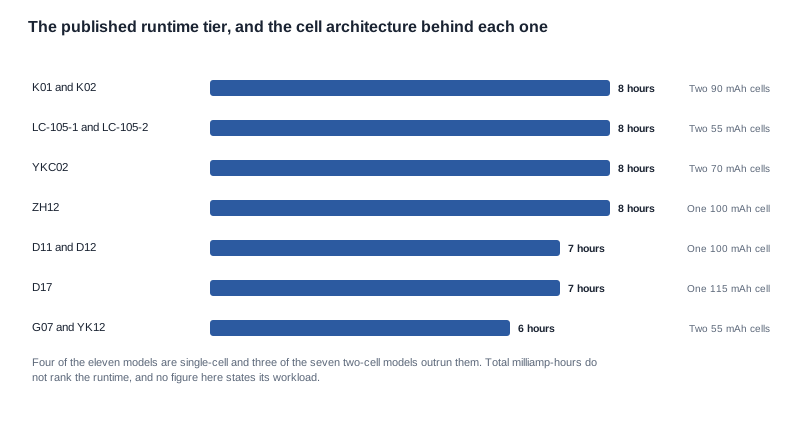
Read that chart carefully, because it contains the argument against the most natural buying instinct in this category. The chart covers eleven published models, the eight audio models (the LC-105-1 and the K01, the K02 and the D11, the D12 and the LC-105-2, and the G07 and the YK12) plus the three sport models (the YKC02, the D17 and the ZH12), so the four single-cell models in it are not four audio models. Two of the eight audio models are single-cell and six of them are two-cell, and the two-cell group is not uniformly the longer-running one: the D11 and the D12 publish one 100 mAh cell at about seven hours; the K01 and the K02 publish about eight hours across two 90 mAh cells, the LC-105-1 and the LC-105-2 about eight hours across two 55 mAh cells, and both groups outrun the single-cell pair; the G07 and the YK12 publish about six hours across two smaller cells. The sport models sharpen the point rather than soften it. The D17, a sport model rather than an audio one, publishes the largest single cell in the chart at 115 mAh and about seven hours, and that single cell carries more capacity than the two 55 mAh cells of the LC-105 pair without outrunning them. The ZH12, also a sport model, publishes 100 mAh in one cell and about eight hours — the same cell as the D11 and the D12, and a longer published runtime.
So total capacity does not rank runtime, and no figure in that chart states its workload. What it does give you is the power architecture and the ceiling, which is enough to ask a supplier the right question and not enough to answer it.
A working day, against the published tiers
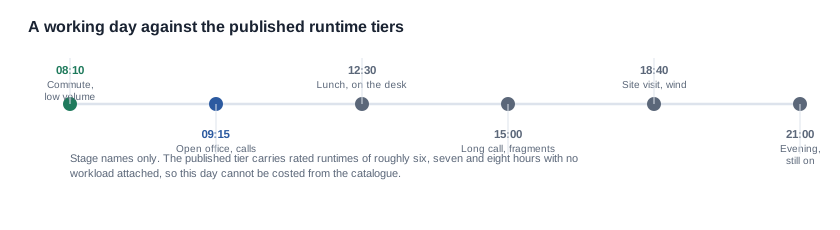
The timeline above shows the shape of a working day against those tiers, and the shape is the point. The unit is on in fragments, and the fragments are not the workload the rating was measured on. A day of intermittent calls with the phone also carrying other traffic draws differently from continuous playback, and the published figure does not tell you which of the two it resembles.
There is one published row that does transfer to a field day more reliably than the runtime, and it is the charge time. Nine of the eleven models publish a charge time at or under two hours, and the D17 and the ZH12 publish at or under one hour. That is a figure a customer can act on, because a customer can put the unit on the desk at lunchtime and know when it will be ready — which is the difference between a product that survives a working day and one that does not.
The second published row that transfers is the charging interface, for the same reason. Seven models charge magnetically and four over Type-C, and a customer with two of them in a bag has to carry the right cable. That is a field behaviour rather than a laboratory one, and it is decided by a specification row.
The published rows against a working day
The commute: low volume, short sessions
The commute is the easiest environment for an open-ear frame and the one most likely to produce a positive first impression, which makes it the most useful part of the day for a buyer testing a sample.
The conditions are favourable in three ways at once. The noise floor is high enough that an open path is not obviously audible to a stranger. The session is short, so the pressure profile has not established itself. And the volume needed is low, because a vehicle cabin is loud and the listener has to work slightly harder to hear the audio — which is the opposite of the condition under which the product is criticised.
What the commute does expose is the seal. A frame that has been adjusted in the morning and then placed in a pocket or a bag will not sit the same way at 5pm, and the level a listener receives at the end of the commute is not necessarily the level they had at the start. It is also where the connection behaviour shows up, because a phone in a pocket or a bag is a different radio environment from a phone on a desk.
The measurement a buyer should take from a commute is therefore not an acoustic one. It is whether the unit is still at the same level after two hours of intermittent movement, and whether it reconnects when the phone has been switched between a call and playback.
The open office: calls, ambient level and distance
The open office is the environment where this category is either fine or a problem, and the deciding variable is not the device.
Two things matter here and they are frequently confused. The first is the ambient level at the microphone, which sets how intelligible the call is for the person at the far end. The second is the distance to the nearest listener, which sets how audible the audio is to the people around you.
They pull in opposite directions in an open office, and the tension between them is the actual design problem. Turning the volume up helps the second problem and worsens the first, because a louder playback raises the level at the microphone as well as at the ear. That is a genuine trade-off rather than a setting, and a listing that promises clarity in an open office without acknowledging it is promising something the format cannot deliver.
The published rows are silent on both variables, which is the honest position: there is no microphone figure and no leakage figure for any model in this tier. What a buyer can do is measure the combination, at a desk distance and an ambient level that matches the environment being sold into, and write the result into the acceptance criteria. That measurement is the one that decides whether the product belongs in that environment at all.
The long meeting: charge, proximity and continuity
A long meeting is the easiest situation to test and the most revealing, because everything happens at once. The unit is on continuously. The audience is close. The interruption that matters is not the acoustics but the handover between a call and playback, because a phone on a conference call will take the audio stream away from the unit and give it back when the call ends.
That handover is a documented behaviour rather than a fault, and the reason it generates tickets is that nobody has written it down. A buyer who finds it during the sample phase can put it in the manual and the support script. A buyer who finds it in the field will find it in a return.
The published charge time matters here in a way it does not elsewhere, because a meeting is exactly long enough to exhaust a unit that is used continuously. Nine models publish at or under two hours and two publish at or under one, and a meeting that begins after a full morning of use will find the unit at a state you cannot predict without the workload figure.
The site visit: wind, distance and the end of the battery
An outdoor site is where the limits of the format are most visible and where the scoping decision has to be made rather than deferred.
Wind raises the ambient level at the microphone and degrades intelligibility in a way that no product work fixes, because the capture path is being asked to separate the wearer's voice from a noise source that is both loud and moving. Distance does the same thing more gently. Together they are the reason an open-ear frame is a poor choice for a site where the call has to work reliably and the noise is loud.
The second thing the site visit exposes is the end of the battery. On the models publishing about six hours — the G07 and the YK12 — a full day of intermittent use will find the unit flat before the day ends, and the published figures do not say what happens at that moment.
That last question is worth asking the supplier directly, because a unit that warns and a unit that dies silently are very different support experiences. A warning is a documentation matter and possibly a firmware setting. A silent death in the middle of a call is a ticket, and it is a ticket that arrives at the wrong end of the supply chain.
The evening question, and the case that does not exist in this tier
The last question of the day is the one a customer asks most often and buyers ask least often: what happens when the unit needs charging, and is there anything to charge it into.
In the audio tier the answer is that no charging case is listed for any of the eleven models. The case line belongs to camera models in a different part of the range. So the customer in this tier is looking at a magnetic interface on seven models and a Type-C port on four, and the end-of-day routine is the same as for any other device in that category.
This is worth settling before the programme launches, because it determines the packaging, the accessory line, the unboxing experience and the copy. A channel that planned a case in the box is planning a product that does not exist in this tier, and a channel that assumed one would have promised a feature that no unit in the range delivers.

The environments where the product stops working
Which published rows survive each environment
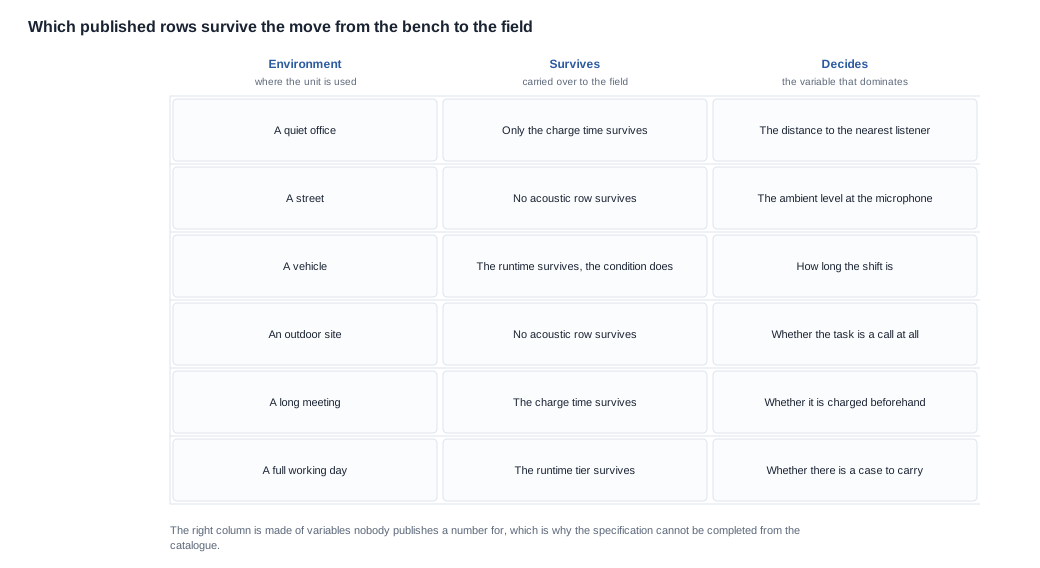
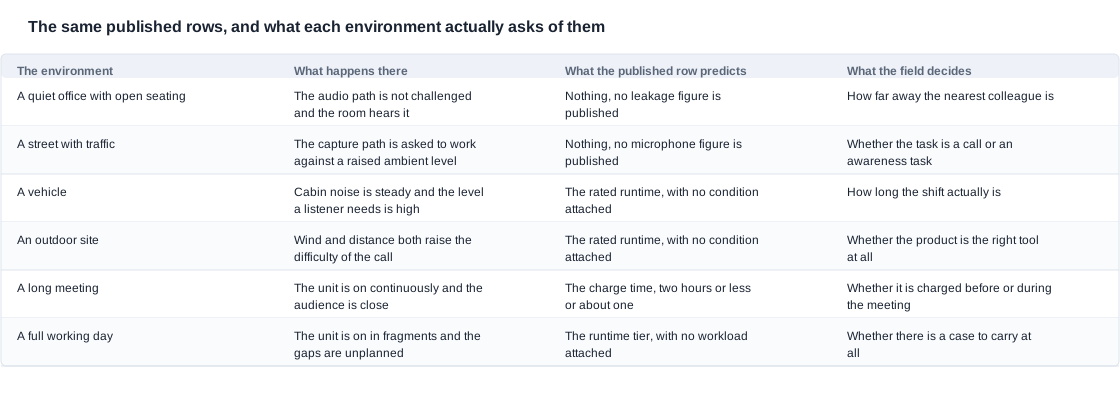
The right-hand column is made of variables nobody publishes a number for, which is the reason the specification cannot be completed from the catalogue. In a quiet office the deciding variable is the distance to the nearest listener. On a street it is the ambient level at the microphone. In a vehicle it is the length of the shift. At an outdoor site it is whether the task is a call at all.
That last one is the difference between a performance question and a scoping question, and a buyer who treats it as a performance question will keep testing a product that was never going to work there.
The scoping decision, and why it belongs before the model
The environments in this category divide into three groups, and the division should be made before a model is selected rather than after a sample has disappointed.
Where the product works well. Open-ear audio in a moderately noisy environment where the task is awareness plus short communication: a site visit, a shop floor, a delivery run, a walk-and-talk. The environment supplies the noise floor the open path needs, and the task does not require a call to be intelligible against a loud background.
Where the product works with a condition. An open office at a stated distance, a vehicle on a short shift, a meeting room. The product works, and the condition — the distance, the shift length, the charging routine — has to be written into the copy and into the acceptance criteria.
Where the product does not work. A loud worksite where a call has to be intelligible, a recording task, a scenario where the customer must hear something they cannot afford to miss. These are not product failures. They are scoping errors, and the cost of making one is high because the failure appears after the listing is written.
Turning field results into an acceptance criterion
The output of a field test is worth nothing unless it becomes a number somebody can hold a supplier to. That conversion is the difference between a field test and an anecdote, and it has four parts.
The environment, described precisely. Not "outdoors" but a stated ambient level, a stated distance and a stated wind condition. The ambient level matters most for the microphone, and it is the one variable a field test can produce and a laboratory test cannot.
The workload, stated. What the unit was doing for how long, and at what volume. Without this, a runtime result cannot be compared with the rated figure, and the comparison is the most useful thing the test produces.
The pass criterion, agreed before the test. Write it down first, because a criterion designed afterwards is a description of what happened. The useful form is a statement that would make you reject the unit, and if you cannot write one, the test is not a test.
The sample size and the unit identifier. How many units, from which lot, with the model designation recorded for each. A field result from one unit of one lot is a data point; the same result from four units of one lot is a finding.
The limits of what a field test can establish
A field test establishes the customer experience and it does not establish the conformance of a lot. Those are different documents and they do different jobs. A field test is what tells you whether the product belongs in the environment; a factory inspection regime with written criteria is what tells you whether a specific lot is acceptable. The procedures for the two are separate, and mixing them produces a result that serves neither.
The other limit is the sample. A field test on a unit from the first approved lot tells you about that lot and about the configuration in that lot. If the programme later changes the cell, the temple or the firmware build, the field result has to be re-established, because the configuration it described no longer exists.
Designing the field test so the result survives contact with a contract
Choosing the units, the lot and the number of them
A field result is only as transferable as the configuration it was taken on, and the configuration is decided by the lot. The units should come from a single lot, because a lot difference introduces a variable the test was not designed to control. The model designation should be recorded for every unit, because a field result without it cannot be attached to anything in the purchase order.
The number of units is a procurement decision rather than a technical one, and the way to make it is to write down what each additional unit would settle. One unit establishes whether the product works in the environment at all. Two units from the same lot, run on different people, begin to separate a product characteristic from a head characteristic. Four units from the same lot begin to tell you something about the process. Beyond that, the marginal value of another unit falls away and the budget is better spent on a second environment.
Where the supplier has a sample order process, this is the place to use it: a field test on production-configuration units is worth more than a field test on demonstration units, and the difference between the two is usually the difference between a result you can quote and a result you can only mention.
Writing the protocol before the first session
The protocol is the document that makes a field result reproducible by somebody else, and it is short if it is written before the first session rather than reconstructed after the third.
Five things have to be on it. The environment, described precisely enough that someone else could stand in it. The workload, stated in the units the unit consumes. The measurement procedure, written as steps rather than as intentions. The pass criterion, written before the result is known. And the sample size, with the unit identifiers.
The pass criterion is the part teams get wrong, because it is the part that requires someone to say in advance what would make them reject the unit. If no one can write one, the test is not a test — it is a demonstration, and its result cannot be used as an acceptance criterion however badly everyone wants it to be.
The cost of getting this wrong is specific and expensive. A field test that produces a number nobody can contract against will be repeated before the launch, because the first one did not settle the question. That is a sample order and a factory's time, twice.
Who runs the test, and what they have to record
The test is run by people who are not the buyer, which creates a recording problem rather than a measurement problem. The record has to be good enough for somebody who was not there to reach the same conclusion, and that means recording the conditions as well as the outcome: the ambient level, the distance, the volume setting, the phone volume, the unit identifier, the firmware build, the date, the time of day and the elapsed session time.
Two of those are routinely omitted and both of them matter. The elapsed session time matters because the pressure profile and the power state change across a day, and a result taken at minute twenty is not a result about the end of a shift. The phone volume matters because it is a variable in the audio path that nobody controls, and a result recorded without it cannot be compared with a result recorded later.
There is a commercial dimension to the recording requirement as well. If the field test is going to support a purchase decision, the record is part of the acceptance file, and the supplier has to be able to read it. A record your own team cannot share with the supplier because it does not identify the configuration is a record that will be disputed.
Turning a field result into a line in the purchase order
The last step is the one that converts a project activity into a protection. A field result becomes a line in the purchase order by carrying four things into the document: the value, the conditions, the sample size and the model designation. Those four are the same four that appear in the acoustic acceptance criteria elsewhere in this category, and for the same reason.
The negotiation around it is worth having explicitly rather than by implication. Most suppliers will accept an acceptance criterion that is defined by a protocol they have seen, and the discussion that follows is about the protocol rather than about the obligation. That is the right way round, because a criterion the supplier has read end to end is a criterion they will not be surprised by when a lot fails it.
The cost allocation for a lot that fails the field criterion should be settled at the same time as the criterion, and the clause should say which lot is judged by which protocol. A field criterion applied to a production lot with no protocol attached is unenforceable, and the buyer's fallback is to ship the lot and argue later, which is a much worse position than declining to ship it.
What we can and cannot promise about field behaviour
Our position, and the sample report we will read
The boundary we hold: we publish the electrical and interface rows exactly as the catalogue states them, and we publish the absence of third-party acoustic measurement, of any leakage figure, of any microphone specification, of any runtime test condition and of any unit weight with the same prominence. We will not convert a rated runtime into a usable one by applying an assumed efficiency, and we will not rank two of our own models on an acoustic characteristic nobody has measured.
What we will do is read a sample report. Give us the field results and we will tell you which of them are comparable with the published rows, which conditions are missing from the record, and which have to be written into a purchase order as acceptance criteria before you commit to a volume. That is a narrower offer than a specification, and it is the honest one, because the field behaviour in this category is decided by the environment rather than by the product.
What we need in order to read a field result
-
Send us the environment, the session length, the channel and the price point. We will tell you which of the four variables decides the project for that combination, which published rows apply, and which results have to be confirmed on a production unit before you commit to a volume.
-
Send us your field protocol. We will tell you which parts of it are reproducible and which parts are anecdotal, and we will point at the places where a criterion is missing.
-
Send us the comparison you are trying to settle. The comparison procedure for two candidates is set out at how to compare open-ear audio platforms, and the published rows behind it are at open-ear audio key specifications.
-
Ask us for the documents before you commit. The battery transport documentation is at battery transport, the certificate register procedure is at certification checklist, the clause language is at contract terms and the commercial structure of a first order is at pricing.
The technology background is at open-ear audio technology, and the range is at Bluetooth audio glasses.
Related reading
- The technology and the published rows — open-ear audio technology
- Comparing two candidates — how to compare open-ear audio platforms
- The specification rows — open-ear audio key specifications
- The range covered — Bluetooth audio glasses
Tell us the environment and the session length, and we will say which of the four field tests decides the project.


